Quick Overview
- Cutting swath width is the strip of grass a mower cuts in one pass. It is set by blade tip-to-tip length, not the mower’s outer body width (Tractor Supply, 2024).
- Effective swath width is smaller than the deck’s rated width. A 10% overlap on each pass is normal, so a 42-inch deck cuts closer to 38 inches of new grass per pass (Inch Calculator, 2025).
- Push mowers run 18 to 22 inches. Riding mowers run 42 to 72 inches or more (ThePoolAndLawn, 2025; A-1 Power, 2026).
- A wider deck cuts mowing time. Going from 42 to 54 inches cuts pass count by about 22% (A-1 Power, 2026).
- A wider deck is not always better. Gates, storage sheds, and tight yards can make a wide mower a poor fit (Main Street Mower, 2024).
Cutting swath width tells you how much grass a mower clears in one pass. It is the single number that decides how long you push, ride, or steer around your yard. This guide breaks down real swath width, not just the number on the box. You will learn how to match swath width to your yard, your gates, and your budget. Siddik Kazi pulls in what he sees on the repair bench too, since deck width changes what breaks and when.
What Is Cutting Swath Width?
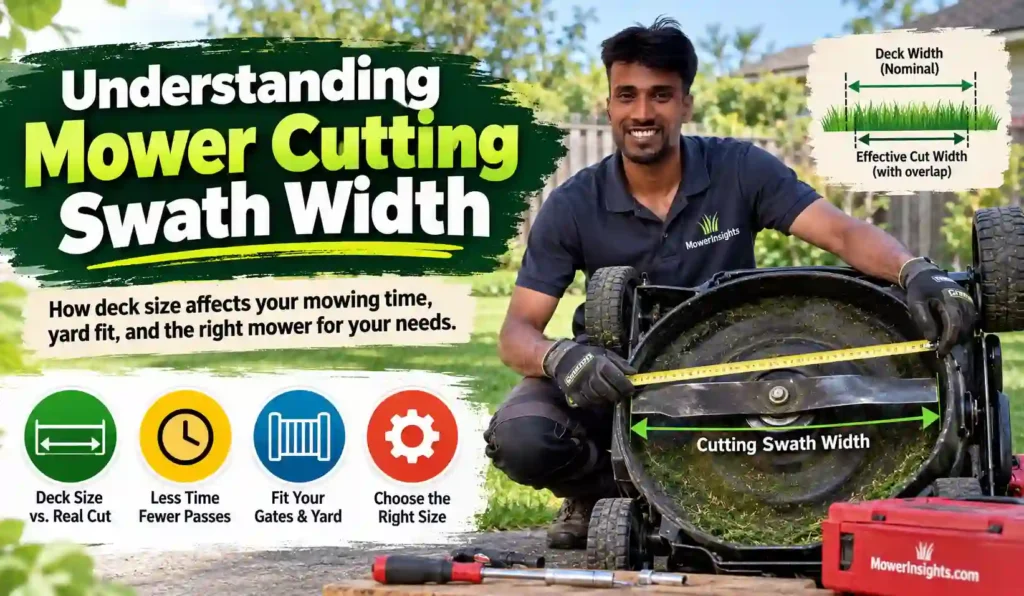
Cutting swath width is the strip of grass a mower cuts in a single pass. It is measured tip to tip across the spinning blade or blades (Tractor Supply, 2024). A “42-inch mower” cuts a 42-inch strip of grass. It does not mean the mower itself is 42 inches wide.
Most brands call this number the deck size or cut width. All three terms mean the same thing. This guide uses “cutting width” as the main term, and “swath width” as its plain-English twin.
The blade housing, or deck, sits above the blades. It shields you from debris. It also directs cut grass to the bag, side chute, or mulch channel. The deck is almost always a little wider than the blades inside it.
Swath width decides your pass count. A bigger number means fewer trips across the lawn. A smaller number means better control near flower beds, trees, and fences.
Nominal Cut Width vs. Effective Cut Width (The Gap Nobody Explains)
The number on the mower’s spec sheet is not the number you actually get in the yard. Every pass needs some overlap with the last one. Skip the overlap and you leave thin strips of uncut grass behind, often called “Mohawk stripes” in the repair shop.
Most estimating guides use a 10% overlap allowance, which gives an efficiency factor of about 0.9 (Inch Calculator, 2025). That means a 42-inch deck delivers close to 37.8 inches of new-grass coverage per pass. Round it down and plan for 38 inches.
This gap matters for two reasons.
First, it changes your mowing time math. If you plan your mowing schedule using the full 42 inches, you will run short on time almost every week.
Second, it changes your buying decision. A shopper comparing a 42-inch deck to a 46-inch deck is really comparing about 38 effective inches to about 41 effective inches. That is a smaller real gap than the sticker numbers suggest.
Nominal vs. Effective Cutting Width
| Nominal Deck Size | Overlap Allowance | Effective Cutting Width |
|---|---|---|
| 21 in | 10% | ~18.9 in |
| 30 in | 10% | ~27 in |
| 42 in | 10% | ~37.8 in |
| 48 in | 10% | ~43.2 in |
| 54 in | 10% | ~48.6 in |
| 60 in | 10% | ~54 in |
Keep this table in mind for every deck-size comparison in this guide. The nominal number sells the mower. The effective number does the work.
How Swath Width Changes Your Mowing Time
A wider swath cuts more grass per pass. That means fewer passes for the same yard. Fewer passes means less time behind the mower.
The standard formula looks like this (Mowers Web, 2025):
Mowing time (minutes) = Lawn area (sq ft) ÷ (Deck width in feet × Speed in feet per minute × 0.9) × 60
Here is that formula in action. A 1-acre lawn is about 43,560 square feet. A 42-inch deck is 3.5 feet wide. A typical push-mower speed is 3 mph, or 264 feet per minute.
Run the numbers and a 1-acre yard takes close to 79 minutes with a 42-inch push mower at that pace. Swap to a 54-inch riding deck at 5 mph, and the same yard drops to roughly 37 minutes.
Estimated Mowing Time Per Acre by Deck Size
| Deck Width | Typical Speed | Est. Time per Acre |
|---|---|---|
| 21 in (push) | 2.5 mph | ~2 hr 15 min |
| 30 in (self-propelled) | 3 mph | ~1 hr 30 min |
| 42 in (riding) | 4 mph | ~50 min |
| 54 in (zero-turn) | 6 mph | ~26 min |
| 60 in (zero-turn) | 7 mph | ~20 min |
These are estimates for open, flat ground. Add time for trimming, edging, obstacles, and slopes (Bobby Ford Tractor, 2025).
Going from a 42-inch deck to a 54-inch deck cuts pass count by about 22%. Going from 54 inches to 72 inches cuts it another 25% (A-1 Power, 2026). Those gains shrink fast on a yard full of trees, beds, and tight corners, since trim work does not scale down with deck size.
Common Cutting Widths by Mower Type
Not every mower type competes on the same swath-width scale. Matching the type to your yard matters more than chasing the biggest number.
Push and Self-Propelled Mowers
Standard push mowers run 18 to 22 inches wide (ThePoolAndLawn, 2025). Self-propelled models cluster around 21 to 22 inches, with some wide-deck models reaching 30 inches. These mowers suit yards under a half acre with beds, trees, or narrow side yards.
Lawn Tractors
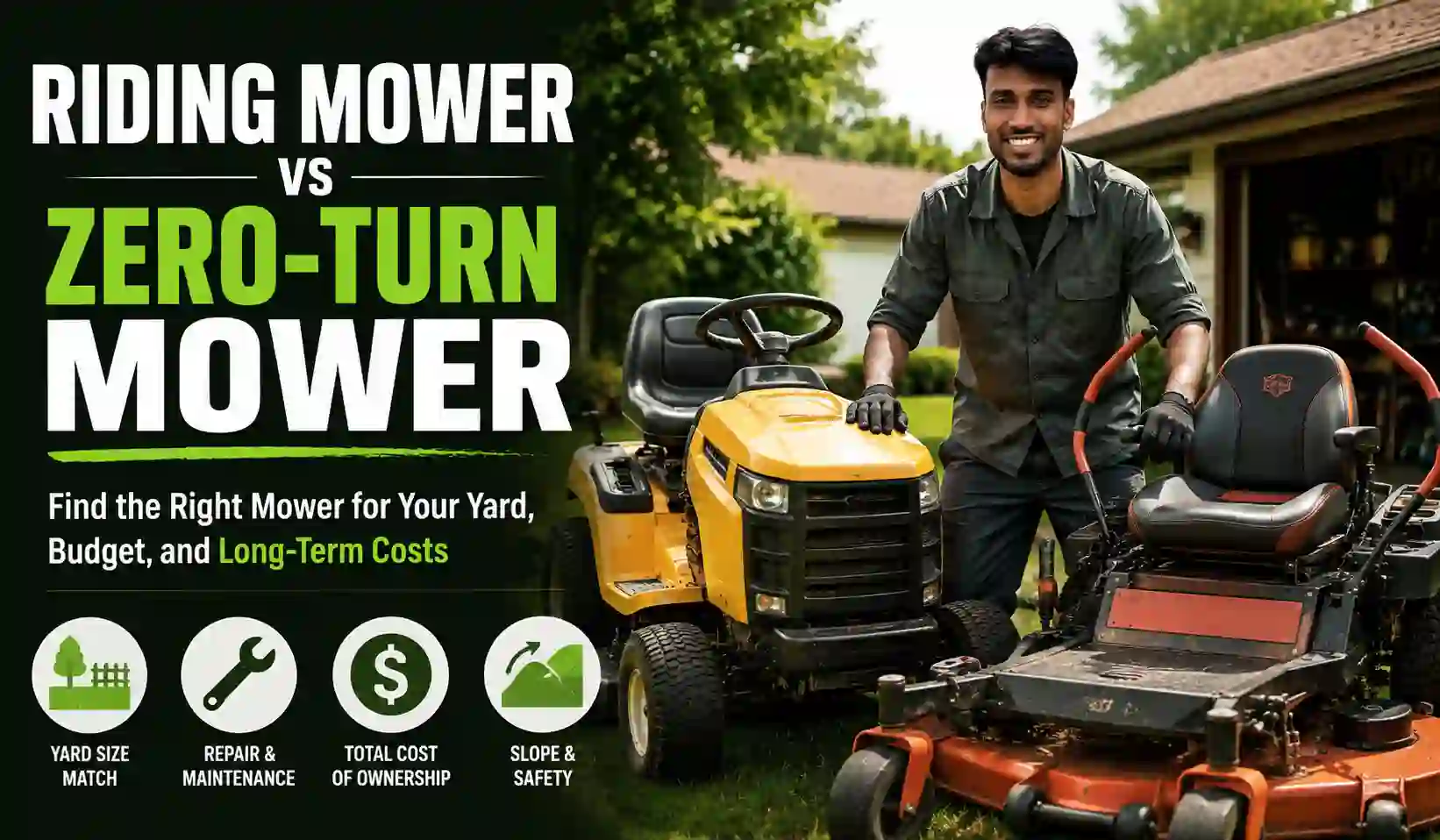
Entry lawn tractors typically run 42-inch decks. A 42-inch deck needs about 18 horsepower to spin its blades at a working speed (A-1 Power, 2026). This size fits yards from about 1 to 1.5 acres well (Exmark, 2024).
Zero-Turn Mowers
Zero-turns span the widest range, from 42 inches on entry models up to 72 inches or more on commercial units. A residential 54-inch zero-turn typically needs 22 to 24 horsepower (A-1 Power, 2026). Zero-turns trade a tight turning radius for speed on open ground.
Riding Mowers Overall
Tractor Supply groups most residential riding mowers into a 21 to 52-inch cutting-width range for properties up to 2 acres (Tractor Supply, 2024).
Robot Mowers
Robot mowers cut with a narrow blade disc, often 7 to 9 inches wide, but they run many short passes over days instead of one long pass. Swath width matters less here than mapped coverage and mow frequency.
Swath Width and Yard Size: What to Actually Choose
Yard size is the first real filter for swath width. Terrain and obstacles come second, and both matter together.

Quarter Acre or Less
A push or self-propelled mower with an 18 to 22-inch deck is the standard pick. Most buying guides use a quarter acre of actual mowing area as the walk-behind cutoff (Exmark, 2024).
Half Acre to 1 Acre
A wider self-propelled mower, or an entry riding mower with a 30 to 42-inch deck, saves real time without adding much bulk.
1 to 1.5 Acres
A 42-inch riding mower or lawn tractor is the common starting point for this range (Exmark, 2024).
1.5 to 3 Acres
A 42 to 48-inch deck balances speed with maneuvering room around beds and trees (Exmark, 2024).
3 Acres and Up
A 48 to 72-inch zero-turn deck saves the most time, but only on open, flat ground. Wide decks scalp grass on uneven terrain and struggle around dense obstacles (Exmark, 2024; A-1 Power, 2026).
Decision Framework
If your yard is under half an acre, mostly open, and has narrow side-yard access, choose an 18 to 22-inch push or self-propelled mower. If your yard is 1 to 3 acres and mostly flat, choose a 42 to 54-inch riding mower or zero-turn. If your yard has heavy obstacle density regardless of size, favor a smaller deck in the 42 to 48-inch range over a wider one, since trim time will not shrink with deck size (A-1 Power, 2026).
Cutting Width vs. Total Mower Width: The Gate Problem
Cutting width and total mower width are not the same number, and this trips up a lot of buyers. Cutting width is the blade span. Total mower width includes the deck housing, wheels, and discharge chute (Main Street Mower, 2024).
A “36-inch” mower can be several inches wider than 36 inches once you measure the actual body. Most homeowners only find this out after buying, when the mower will not fit through the backyard gate.
Standard fence gates run about 36 or 48 inches wide, though older or custom gates vary (Main Street Mower, 2024). Before buying, measure the clear space between the inside edges of your gate, not the gate panel itself.
In the shop, this is one of the most common return complaints Siddik hears from new mower owners. A shopper picks a mower based on the cutting-width number on the box, skips the tape measure, and finds out at home that the mower will not clear the side gate.
What to Measure Before You Buy
- Clear width between the inside edges of your narrowest gate
- Width of your storage shed or garage doorway
- Turning clearance needed to angle the mower through a bend in the path
Swath Width, Horsepower, and What Breaks First
A wider deck does not just mean a bigger mower. It means a bigger engine, more belt length, and more spinning mass under stress. This is where deck-size choice starts to affect your repair bills.
A 21-inch walk-behind runs on roughly 5.5 to 7 horsepower. A 42-inch lawn tractor needs around 18 horsepower. A 54-inch residential zero-turn typically needs 22 to 24 horsepower (A-1 Power, 2026). Bigger blades need more power to spin at a safe cutting speed.

In the repair shop, wider decks bring their own failure patterns. The most common repair on a 50-plus-inch deck is spindle bearing failure, since longer belts and heavier blades put more side load on each spindle. On uneven yards, anti-scalp wheels on wide decks wear out faster too, because the deck has more surface area riding the ground contour.
Narrower decks are not repair-free. Push mowers most often come in for cable and drive-belt issues, plus blade balance problems after hitting a hidden root or rock.
Expert Tip
Before buying a wider deck to save mowing time, check your yard’s spindle-stress reality: count the low spots, dips, and slope transitions. Every dip means the deck rocks, and rocking wears spindle bearings faster than flat, steady ground ever will.
How to Measure Your Mower’s Actual Cutting Width
Do not trust the box. Measure the deck yourself in under five minutes.
- Park the mower on a flat, level surface and shut off the engine.
- Wait for the blade to stop spinning completely before touching anything near the deck.
- Measure from the outer tip of the blade on one side to the outer tip on the other side.
- For multi-blade decks, measure the full swept path, not one blade alone.
- Write this number down and compare it to the box or listing claim.
This step matters most for used mowers, where paint, wear, or a swapped blade can throw off the stated spec.
Common Mistakes When Choosing Swath Width
Buying the widest deck available. Bigger decks cost more, need more storage space, and struggle in tight, obstacle-heavy yards. Match the deck to your yard, not your budget ceiling.
Ignoring gate and shed width. A wide mower that will not fit through your gate is a wide mower that lives outside, exposed to weather.
Skipping the overlap math. Planning mow time around the nominal deck size, instead of the effective width, leads to rushed, thin passes and missed strips.
Forgetting terrain. A wide deck on a bumpy, sloped yard scalps grass and wears anti-scalp wheels fast. A narrower deck often finishes a rough yard cleaner, even if it takes a few more minutes.
Overlooking horsepower needs. A wider deck needs a stronger engine to keep blade tip speed safe and effective. A mismatched engine bogs down in thick grass.
Trust & Testing Methodology
This guide draws on published spec ranges from major mower and outdoor power equipment retailers, plus Siddik Kazi’s repair-shop experience with deck failures across push, riding, and zero-turn mowers. Cutting-width figures are cross-checked against manufacturer and retailer spec pages where possible. Model-specific claims carry a VERIFY marker for reconfirmation before publishing.
Frequently Asked Questions
What is cutting swath width on a lawn mower?
Cutting swath width is the strip of grass a mower cuts in one pass. It is measured across the blade tips, not the mower’s outer body (Tractor Supply, 2024).
Is cutting width the same as deck size?
Yes. Cutting width, deck size, and swath width all describe the same measurement in most lawn-care contexts (Tractor Supply, 2024).
How much overlap should I plan for between How to Create Mowing Patterns?
Plan for about 10% overlap on each pass. That gives an effective cutting width close to 90% of the nominal deck size (Inch Calculator, 2025).
What cutting width do I need for a half-acre yard?
A self-propelled mower with a 21 to 30-inch deck, or an entry riding mower with a 30 to 42-inch deck, usually fits a half-acre yard well.
Does a wider cutting width always mean faster mowing?
Not always. Wide decks save time on open, flat ground, but obstacle-heavy or sloped yards erase much of that time advantage (A-1 Power, 2026).
Why does my mower’s cutting width not match the number on the box?
Some listings round the number, and paint or attachment guards can make a hand measurement come out slightly different. Always measure blade tip to blade tip for the true figure.
Can a wider deck damage my lawn?
On uneven ground, yes. A wide deck can scalp high spots and leave the low spots too long, since it cannot flex to the contour as well as a narrower deck (Exmark, 2024; A-1 Power, 2026).
What to Do Next
Measure your actual mowing area and your narrowest gate before you shop for cutting width. Match the deck size to your yard size and terrain first, then confirm it will fit through every access point you have. If your yard mixes open stretches with tight, obstacle-heavy corners, lean toward the smaller end of the size range that fits your acreage.