Quick Overview
- Cool-season grasses like tall fescue and Kentucky bluegrass do best at 2.5 to 4 inches (6.4 to 10 cm).
- Warm-season grasses like Bermuda and Zoysia do best low, often 1 to 2 inches (2.5 to 5 cm).
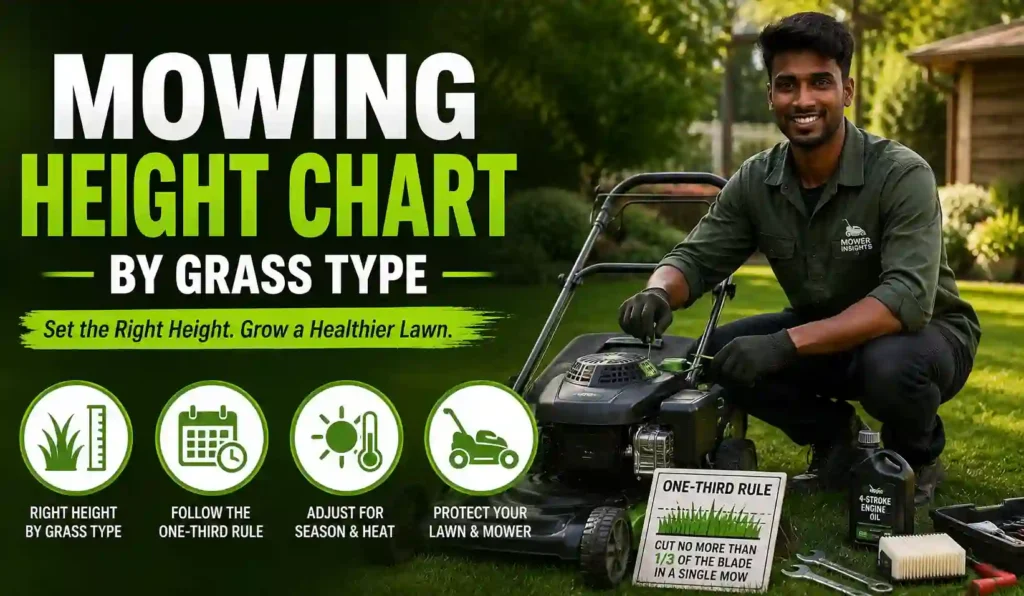
- Never cut more than one-third of the blade height in a single pass. This is the one-third rule.
- Raise your mowing height by about half an inch in peak summer heat and in shaded areas.
- Cutting too low, called scalping, stresses the lawn and can damage your mower deck and blade.
Why Mowing Height Actually Matters
The right mowing height keeps grass roots deep and strong. It also keeps weeds out and helps grass survive heat and drought.
Cut too short, and the grass cannot make enough food from sunlight. The roots shrink. Weeds move in fast.
Cut too tall, and some grass types get thin at the base. Air stops moving well. Fungus can grow.
In Siddik’s repair shop, height problems show up on the mower too, not just the lawn. A deck set too low scrapes dirt and rocks. That dulls blades fast and can bend a spindle.
Mowing Height Chart by Grass Type
Here is the direct answer: use this chart to set your mower deck for your grass type. Heights are for the cut, not for how tall grass gets before you mow.
| Grass Type | Best Height (inches) | Best Height (cm) | Grass Category |
|---|---|---|---|
| Kentucky Bluegrass | 2.5 – 3.5 | 6.4 – 8.9 | Cool-season |
| Tall Fescue | 3 – 4 | 7.6 – 10.2 | Cool-season |
| Fine Fescue | 2.5 – 4 | 6.4 – 10.2 | Cool-season |
| Perennial Ryegrass | 2 – 3 | 5.1 – 7.6 | Cool-season |
| Bermuda Grass | 1 – 2 | 2.5 – 5.1 | Warm-season |
| Zoysia Grass | 1 – 2.5 | 2.5 – 6.4 | Warm-season |
| St. Augustine Grass | 2.5 – 4 | 6.4 – 10.2 | Warm-season |
| Centipede Grass | 1.5 – 2 | 3.8 – 5.1 | Warm-season |
| Bahia Grass | 3 – 4 | 7.6 – 10.2 | Warm-season |
If you do not know your grass type, look at the leaf blade width and how it spreads. A local extension office can identify it fast and for free in most regions.
Cool-Season vs. Warm-Season Grass, Explained Simply
Cool-season grass grows best when air stays between 60 and 75°F, or 15 to 24°C. It grows fastest in spring and fall.
Warm-season grass grows best when air stays between 80 and 95°F, or 27 to 35°C. It grows fastest in summer.
This matters for height because cool-season grass needs more leaf area to survive heat stress. That is why it gets cut taller.
Warm-season grass spreads sideways with runners. It can handle a lower cut and still stay thick and healthy.
If you live in the northern U.S. or most of Europe, you likely have a cool-season lawn. If you live in the southern U.S., you likely have a warm-season lawn. The transition zone in the middle of the U.S. can have either, or a mix.
The One-Third Rule: How Often to Mow at Each Height
Never remove more than one-third of the grass blade in one mow. This one rule prevents most lawn stress problems.
Here is what that means in practice. If your target height is 3 inches, mow again once the grass reaches 4.5 inches. Do not wait until it hits 6 inches.
The table below shows how often each grass type usually needs a cut during its main growing season.
| Grass Type | Target Height | Mow When Grass Reaches | Typical Frequency (Growing Season) |
|---|---|---|---|
| Kentucky Bluegrass | 3 in / 7.6 cm | 4.5 in / 11.4 cm | Every 5-7 days |
| Tall Fescue | 3.5 in / 8.9 cm | 5.25 in / 13.3 cm | Every 6-8 days |
| Bermuda Grass | 1.5 in / 3.8 cm | 2.25 in / 5.7 cm | Every 4-6 days |
| Zoysia Grass | 2 in / 5.1 cm | 3 in / 7.6 cm | Every 7-10 days |
| St. Augustine Grass | 3 in / 7.6 cm | 4.5 in / 11.4 cm | Every 6-8 days |
Breaking the one-third rule stresses the plant. It also throws more clippings at once, which clogs the mower deck faster and strains the drive belt on self-propelled models.
Seasonal Height Adjustments
Raise your mowing height by about 0.5 inch, or 1.3 cm, once daytime temperatures pass 85°F, or 29°C. Taller grass shades its own roots and holds soil moisture better.
In early spring, cut at your normal height once growth starts. Do not scalp in spring to “clean up” the lawn. This removes healthy tissue the plant needs to recover from winter.
In fall, for cool-season lawns, lower the height slightly for the final one or two cuts before winter. A height near 2 to 2.5 inches, or 5 to 6.4 cm, helps prevent snow mold and matting.
For warm-season lawns, keep the regular height through fall until the grass goes dormant and stops growing.
Mowing Height for Shade, Drought, and New Lawns
Shaded lawns need extra height. Add 0.5 to 1 inch, or 1.3 to 2.5 cm, above the standard range so leaves can catch more of the limited light.
Drought-stressed lawns also need extra height. Taller grass shades the soil and slows water loss. Mow at the top of your grass type’s range during dry spells, and mow less often.
New lawns, whether seeded or sodded, need their first cut once grass reaches about 3.5 to 4 inches, or 8.9 to 10.2 cm. Cut only the top third on that first pass, even if it feels short of the “final” height.
What Wrong Mowing Height Does to Your Mower
This is the part most lawn care guides skip. Height settings do not just affect the grass. They affect the machine.
Cutting too low, called scalping, forces the blade closer to dirt, rocks, and roots. In the shop, Siddik sees this cause three problems most often: chipped or bent blades, worn skid plates, and deck scrapes that expose bare metal to rust.
Cutting too high or too infrequently means thick, wet clumps of clippings. These clumps pack under the deck. On gas mowers, this can stall the engine mid-cut and strain the drive belt on self-propelled models.
Expert Tip: After scalping damage, check the blade for a slight bend before you re-sharpen it. A bent blade that gets sharpened anyway will still vibrate and can wear out the spindle bearing early.
| Wrong Height Habit | Effect on Lawn | Effect on Mower |
|---|---|---|
| Cutting too low | Roots shrink, weeds move in | Blade chips, deck scrapes, skid wear |
| Skipping mows, cutting too much at once | Grass yellows and thins | Deck clogs, belt strain, possible stall |
| Same height all year | Poor heat and cold tolerance | Uneven blade wear from constant deck rubbing at low settings |
Common Mistakes to Avoid
- Cutting the same height in July as in April. Grass needs more height in summer heat. A fixed setting all year ignores this.
- Waiting too long between mows in a growing spurt. This breaks the one-third rule and stresses both the lawn and the mower deck.
- Guessing the deck height instead of measuring it. Deck number wheels are not always accurate. Measure actual cut height with a ruler on flat ground.
- Mowing wet grass. Wet clippings clump, clog the deck, and can leave uneven cut height across the lawn.
- Using a dull blade at any height. A dull blade tears grass instead of cutting it, which stresses the lawn regardless of the height setting.
How to Set Your Mower to the Right Height
- Park the mower on a flat, hard surface. A driveway works better than grass for an accurate measurement.
- Measure from the ground to the blade tip. Use a ruler or tape measure at the front and back of the deck.
- Adjust the height levers evenly on all wheels. Uneven settings cause a slanted, uneven cut.
- Re-check after adjusting. Height wheels can shift slightly during adjustment, so measure again before mowing.
- Test on a small patch first. Walk a short strip and check the result before mowing the full lawn.
When to Call a Lawn Care Pro Instead of DIY
Most height adjustments are simple enough to do yourself in under ten minutes. Call a professional when the lawn has large bare or scalped patches that do not recover after two to three normal-height mows.
Also call a pro if the deck will not adjust evenly, since this usually points to a bent deck or worn height adjustment linkage rather than a settings problem. In Milan, MowerInsights offers mower repair and deck service for exactly this kind of mechanical issue.
Frequently Asked Questions
What is the best mowing height for grass?
It depends on the grass type. Cool-season grasses like tall fescue do best at 3 to 4 inches, or 7.6 to 10.2 cm. Warm-season grasses like Bermuda do best at 1 to 2 inches, or 2.5 to 5.1 cm.
How do I know if I am cutting my grass too short?
Look for a yellow or brown tint right after mowing, thin patches, and visible dirt between blades of grass. This is called scalping and it stresses the lawn’s roots.
Should I cut my grass shorter before winter?
For cool-season lawns, yes. Lower the height slightly for the last one or two fall cuts, down to about 2 to 2.5 inches, or 5 to 6.4 cm. This helps prevent snow mold.
How often should I mow if I follow the one-third rule?
Most lawns need a cut every 5 to 7 days during peak growing season. Slower-growing warm-season grasses like Zoysia can often go 7 to 10 days between cuts.
Does mowing height affect how often I need to sharpen my blade?
Yes. Lower height settings bring the blade closer to dirt, rocks, and debris. This dulls and chips the edge faster than mowing at a taller setting.
Key Takeaways
- Match your mowing height to your grass type using the chart above, and measure the actual cut height rather than trusting the deck number wheel.
- Follow the one-third rule to protect both the lawn and the mower deck from stress.
- Raise the height in summer heat, shade, and drought, and lower it slightly for the last fall cuts on cool-season lawns.
- Wrong height settings show up on the mower as chipped blades, deck scrapes, and belt strain, not just on the lawn.