Push mower throttle cable replacement takes about 30 to 60 minutes and needs only basic hand tools. You unhook the old cable at the engine, remove it at the handle, and fit a matching cable along the same path. Then you set the tension so the lever controls engine speed the way it should.
This guide is for US homeowners with a walk-behind gas mower. It walks through push mower throttle cable replacement in 11 steps, with the tools you need, safety rules, how to trim a universal cable, and what to do if the new cable still acts up.
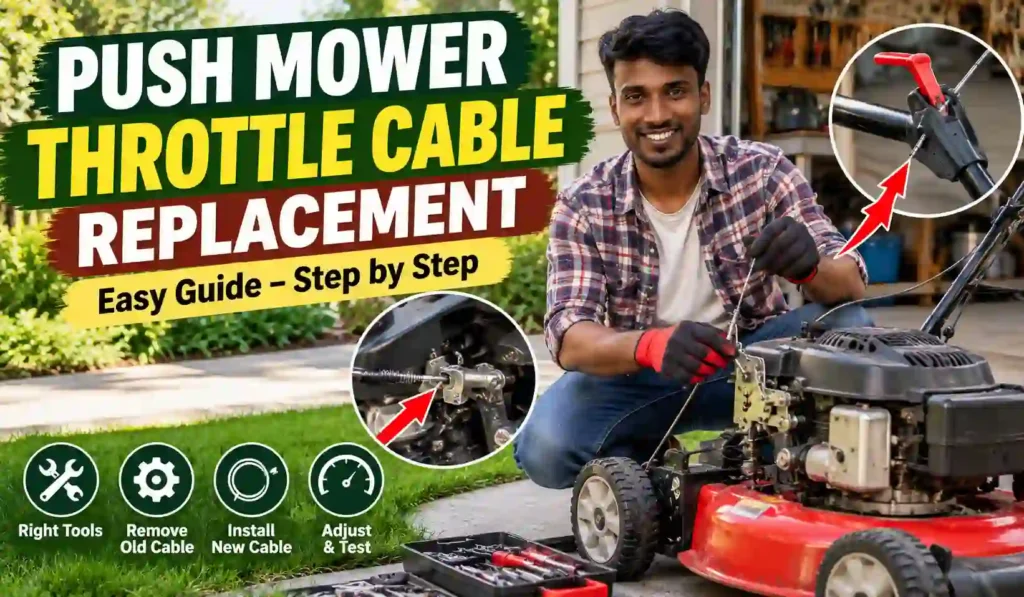
Quick Answer: How Do You Replace a Push Mower Throttle Cable?
To finish push mower throttle cable replacement, disconnect the spark plug wire, photograph the old cable path, and unhook the cable at the engine and at the handle lever. Fit a new cable with the same length and end style, route it the same way, and clamp it with the lever set to FAST. Test every lever position before you start the engine.
The whole job costs little. Most cables run $9 to $30, depending on whether you buy aftermarket or genuine manufacturer parts.
What You Need for Push Mower Throttle Cable Replacement
You need a matching cable, a few hand tools, and a lubricant. Gather everything before you start, because the old cable comes off in minutes and a missing tool can leave the mower in pieces for a day.
Tools
- Needle-nose pliers to hold small wire ends and shape the Z-bend.
- Wire cutters or cable cutters to trim a universal cable.
- Phillips and flat screwdrivers for the handle control box and engine cover.
- A small socket or wrench set, since some handle bolts use a 7/16-inch head.
- Work gloves and safety glasses.
- A phone for photos of the old setup.
Parts
- A replacement throttle cable matched to your mower model or part number.
- A spare cable clip or a few zip ties, in case an old clip cracks.
- A Z-bending tool, which is optional because pliers can do the same job.
Materials
- Silicone-based lubricant for the housing and moving ends.
- Penetrating oil, only if you plan to free a stiff cable instead of replacing it.
- A rag, masking tape, a marker, and a small cup for screws.
Safety First
Push mower throttle cable replacement is a low-risk job, but the engine sits right next to the work. Treat the mower as live until the spark plug wire is off. A pull on the starter rope or a bump on the blade can start the engine.
Follow these rules for this specific task:
- Disconnect the spark plug wire before you touch any cable, lever, or clamp. Tuck the boot away from the plug so it cannot touch it.
- Let the engine cool until the muffler and cylinder feel cool to the touch. A hot muffler sits close to the carburetor end of the cable.
- Keep the mower on flat, firm ground. Do not tip it unless the manual says so, and never tip it with the carburetor side down.
- Close the fuel shutoff if your mower has one. This cuts the chance of a leak if you bump the carburetor.
- Wear safety glasses when you cut or bend cable wire. Cut ends fly and fray.
- Keep hands away from the blade area. The blade can still turn if you pull the starter rope by accident.
Before You Start
Before you order a part for push mower throttle cable replacement, confirm you have a throttle cable problem and the right replacement in hand. A stuck lever does not always mean a bad cable. Dirt, rust, and dried grease can lock a good cable, and a quick cleaning may fix it.
Should You Replace the Cable or Just Free It Up?
Replace the cable if you see frayed strands, a kink, a cracked housing, or a broken end. Try freeing it first if the lever is only stiff.
To free a stiff cable, unhook both ends. Pour penetrating oil into the housing and work the inner wire up and down with pliers until it moves smoothly. Once the oil drains out, add silicone lubricant so the wire keeps sliding. If the cable still binds, replace it.
How Do You Know It Is a Throttle Cable?
A throttle cable links the handle lever to the carburetor or governor arm, so moving the lever changes engine speed. Many push mowers also have an engine zone control cable. That one stops the engine when you let go of the handle bar.
The two cables can look alike, so check before you buy. Single-speed mowers often have no throttle lever and no throttle cable at all. Throttle, choke, and zone control cables are not interchangeable.
How Do You Find the Right Replacement Cable?
Use your mower’s model number first. It sits on a label on the deck, and the owner’s manual lists the cable part number. Search that number and compare the photo and listed length to your old cable.
If the model number is gone, measure the old cable. Record the outer housing length from end to end. Then record how much inner wire sticks out of each end. Compare the end fittings too. Common styles are the Z-bend, the barrel end, and the clamp end.
Step 1: Park the Mower and Disconnect the Spark Plug
Every push mower throttle cable replacement starts the same way. Park on level ground, turn the lever to STOP, and pull the spark plug boot off the plug. This single move makes every later step safe. The engine cannot fire without the boot attached.
- Wait until the engine and muffler are cool.
- Pull the boot straight off. Do not yank the wire.
- Fold the boot back so it cannot touch the plug.
- Wipe loose grass and dirt from the engine top and the handle control box.
Pro tip: Stick a bright piece of tape on the handle as a reminder that the boot is off. It stops you from pulling the starter rope with the wire disconnected, and from forgetting to reconnect it later.
Step 2: Photograph the Old Setup
Take photos before you remove anything. Cable replacement fails most often because the new cable ends up on a different path than the old one. Three or four clear photos prevent that.
Shoot these views:
- The handle control box with the lever in each position.
- The cable path along the handle and down to the deck.
- Each clip, tie, or guide that holds the cable.
- The engine end, showing the clamp, the bracket, and the arm the wire hooks into.
Mark the Lever Positions
Write down the labels on the lever, such as STOP, SLOW, FAST, and CHOKE. Note which way the lever moves toward FAST. You will use this to check the cable at the end.
Common mistake: Relying on memory. A cable that looks simple on the bench can have two or three clips hidden under the handle.
Step 3: Loosen the Cable Clamp at the Engine
Start at the engine end. Loosen the clamp screw, slide the housing out of its bracket, and unhook the inner wire from the throttle or governor arm. This frees the cable from the engine side.
- Remove the air filter cover if it blocks your view of the carburetor.
- Loosen the clamp screw a few turns. Do not take it all the way out.
- Slide the outer housing out of the bracket.
- Lift the end of the inner wire out of the hole in the arm.
- Note which hole in the arm the wire used. Some arms have more than one.
Common mistake: Removing the clamp screw completely. It drops into the engine shroud, and you lose time fishing it out. A loose screw is enough.
Step 4: Detach the Cable at the Handle Lever
Next, open the handle control box and free the other end of the cable. Most boxes split in two halves held by one or two screws or a single bolt. Take your time here, because small springs and plastic pieces can pop out.
- Remove the screw or bolt holding the lever assembly together.
- Lift the top half away and note how the lever sits.
- Slide the end of the inner wire out of the lever slot.
- Lift the outer housing out of its bracket in the handle.
- Pull the cable free from every clip along the handle.
Work over a tray or a cup so loose parts do not roll away. Take one more photo of the opened lever box.
Pro tip: If the lever box has a small spring, note which way it faces before it falls out. That spring often sets how the lever feels, so a backward spring makes the new cable seem faulty.
Step 5: Match the New Cable to the Old One
A good match is the most important part of push mower throttle cable replacement. Lay the old and new cables side by side on a bench. They should match in three ways: housing length, exposed wire length, and end fitting. A mismatch here causes most problems later.
Check these points:
- Housing length: the outer sleeve should be the same length as the old one, within a small margin.
- Exposed wire: the bare wire at each end should be close to the old cable.
- End style: a Z-bend, barrel, or clamp end must fit the lever and engine arm.
- Cable type: throttle, choke, or zone control. Confirm it is a throttle cable.
Aftermarket throttle cables for walk-behind mowers usually cost about $9 to $15. Genuine manufacturer cables often cost $15 to $30 (MowerInsights estimate). Prices may vary by retailer and change over time.
Plan for Trimming If the Cable Is Universal
A universal cable comes longer than you need and has a plain wire end. You cut it to length and bend the Z yourself, which is covered in Step 8. Check the product notes first, because some two-stroke mowers use special cables that a universal part does not fit.
Common mistake: Buying a zone control cable because the photo looks the same. If your mower has a throttle lever, match the part number to the throttle cable.
Step 6: Install the New Cable at the Handle Lever
Install the handle end first. Seat the cable end in the lever, set the housing in its bracket, and close the control box. Then move the lever through every position before you route anything.
- Slide the barrel end or Z-bend into the lever slot, matching the old position.
- Press the housing into the handle bracket until it sits flat.
- Refit the spring if the lever had one.
- Close the control box and tighten the screw or bolt snugly.
- Move the lever from STOP to FAST and back.
The lever should glide with light resistance. If it feels stiff now, the housing is probably pinched or the cable is wrong.
Pro tip: Test the lever movement while the other end of the cable is still loose. A stiff lever is easier to diagnose when nothing else is connected.
Step 7: Route the New Cable Along the Old Path
Follow your photos and run the cable along the original path through every clip. The cable needs gentle curves, free space, and slack where the handle folds. Wrong routing causes sticking, snapping, and a lever that slowly drifts.
- Use the original clips and guides in the same order.
- Keep the cable away from the muffler, blade area, and wheels.
- Avoid tight bends. A tight bend makes the inner wire drag.
- Do not pull any zip tie so tight that it squeezes the housing.
Check the Handle Fold Slack
Fold the handle down the way you do for storage. Watch the cable. It should loosen or curve, never pull tight. If the wire tugs at the lever or the engine arm, the cable is too short or routed too directly.
Common mistake: Tying the cable to the handle with no slack. It works until you fold the handle, and then the cable pulls off the arm or the housing bends.
Step 8: Trim and Z-Bend a Universal Cable
Skip this step if your new cable is a direct fit with finished ends. Trimming only comes up in push mower throttle cable replacement when you buy a universal part. For a universal cable, measure the path, cut the housing to length, expose a short piece of wire, and bend a Z. This gives the cable a hook that sits in the throttle arm.
Cut the Housing
Measure from the handle bracket along the routed path to the engine bracket. Add a few extra inches, because it is easy to trim more and impossible to add back.
Under the plastic cover, the housing is a tight coil of steel wire. Cut it in one clean spot with cable cutters or side cutters. Wear safety glasses.
Expose the Inner Wire
Strip back a short length of cover and coil at the engine end, about 1 to 2 inches. You need enough bare wire to reach the throttle arm with a little extra for lever travel. Compare it to the exposed wire on the old cable.
Make the Z-Bend
Hold the wire with needle-nose pliers. Make two small bends in opposite directions to form a Z. Each leg should be about as long as the hole in the arm is wide.
- Test the Z in the arm hole before you tighten anything.
- If it slips out, bend it slightly tighter.
- File or tape any sharp frayed ends.
Pro tip: Leave the housing a little long on the first cut. You can shorten it after you test fit at the engine, and you will not waste a cable.
Step 9: Connect the Cable at the Engine
Now connect the engine end. Hook the Z-bend in the arm, seat the housing in the bracket, and set the clamp with the lever at FAST. The lever position at this moment decides how much throttle you get later.
- Set the handle lever to FAST.
- Hook the Z-bend or end fitting into the same arm hole as before.
- Slide the housing into the bracket.
- Pull the housing until the arm sits against its FAST stop. Take out the slack, but do not stretch the cable.
- Tighten the clamp screw firmly.
- Refit the air filter cover.
Common mistake: Tightening the clamp with the lever in the SLOW position. The arm then never reaches full throttle, and the mower seems underpowered.
Step 10: Adjust and Test Each Lever Position
With the spark plug boot still off, move the lever through every position and watch the arm at the engine. At FAST, the arm should rest against its stop. At SLOW, it should move back freely. If your lever has a CHOKE position, the choke plate should close fully.
Check each position in this order:
- FAST: the arm touches the stop.
- SLOW: the arm returns without sticking.
- STOP (if present): the arm reaches the stop position.
- CHOKE (if present): the choke plate closes all the way.
To adjust, loosen the clamp, slide the housing a small amount, and tighten again. Retest all positions after each change. Many mowers need two or three small tweaks.
Pro tip: Mark the clamp position with a dab of marker or tape after a good setting. If the clamp shifts later, you can see it.
Step 11: Reconnect the Spark Plug and Run the Mower
The last part of push mower throttle cable replacement is a live test. Reconnect the spark plug boot, start the mower on flat ground, and test the lever with the engine running. The engine speed should rise smoothly as you move the lever toward FAST. It should drop smoothly toward SLOW.
- Push the boot firmly onto the spark plug.
- Start the mower and let it warm up for a minute.
- Move the lever slowly through all positions.
- Listen for surging, stalling, or a lever that drifts.
- Fold and unfold the handle to check the cable moves freely.
Keep your hands and feet clear of the deck during the test. If everything works, you are done.
Common mistake: Skipping the handle fold test. A cable that works with the handle up can bind the moment you fold it.
Common Problems and Mistakes
Most problems after push mower throttle cable replacement come from the clamp setting, the routing, or a wrong part. This table covers the six most common ones.
| Problem | Likely Cause | Solution |
|---|---|---|
| Lever moves but engine speed does not change | Z-bend slipped off the arm, or the clamp is loose | Rehook the wire and tighten the clamp |
| Engine stays at high speed | Cable too tight, or housing pinched | Loosen the clamp, check the routing |
| Engine will not reach full speed | Clamp set with the lever below FAST | Reset with the lever at FAST |
| Lever feels stiff or snaps back | Sharp bend or kink in the cable | Reroute with a wider curve, or replace |
| Cable pulls tight when the handle folds | Cable too short or tied down too firmly | Add slack, or buy a longer cable |
| New cable will not fit the lever | Wrong end style, or a zone control cable | Match the part number and end fitting |
Push Mower Throttle Cable Replacement Troubleshooting
If the mower still misbehaves after push mower throttle cable replacement, the cause is usually one of three things. Work through them in order, because the first is the most common.
The Lever Moves but the Engine Does Not Change Speed
First, check the engine end. Pull the spark plug boot, then look at the arm while you move the lever. If the arm does not move, the Z-bend has slipped out or the clamp has slid.
Rehook the wire and tighten the clamp with the lever at FAST. If the arm moves but the engine speed does not change, the governor spring may be loose or unhooked. That is a separate repair.
The Engine Stays at High Speed
The engine may be stuck at full throttle if the cable is too tight or the housing is pinched. Loosen the clamp and slide the housing back a small amount. Then move the lever to SLOW and check that the arm returns.
Also look for a kink or a tie that squeezes the housing. A pinched housing can keep the inner wire from sliding home. If a kink is visible, replace the cable.
The Lever Is Stiff or Sticks
A stiff lever usually points to a sharp bend, a dirty housing, or a pinch point under the handle. Reroute the cable with a wider curve and check every clip.
If the cable is still stiff, apply silicone lubricant inside the housing. If it is stiff right out of the package, return it. A new cable should slide freely.
Expert Tips
These tips for push mower throttle cable replacement come from general small-engine repair practice and match what most walk-behind mowers need.
- Photograph the old cable path before you remove anything. It is the single best way to avoid routing errors.
- Order the exact part number when you can. A universal cable works, but it costs extra time to trim and bend.
- Use silicone lubricant, not thick grease. Grease collects grass and dirt and can make a cable sticky again.
- Set the clamp with the lever at FAST. Most throttle cable mistakes come from setting it at a lower position.
- Keep the old cable until the new one works. You can compare lengths and end styles if something does not fit.
When to Call a Professional
Stop and get help if the problem is not the cable. Push mower throttle cable replacement fixes cable faults only. A professional can check the carburetor and the governor linkage safely.

Call a repair shop if:
- The engine surges or hunts for speed even after the cable works smoothly.
- The throttle arm or governor linkage is bent, broken, or missing parts.
- You cannot find the right cable by model number or measurement.
- The cable runs through an enclosed housing you cannot open without breaking plastic.
- The engine runs at only one speed no matter where the lever sits.
FAQs
How long does push mower throttle cable replacement take?
Most people finish in 30 to 60 minutes (MowerInsights estimate). Trimming a universal cable adds about 10 to 15 minutes. If the handle control box is hard to open, plan a little more time.
How do I know if my push mower throttle cable is bad?
A bad cable can cause a lever that sticks, a lever that moves with no change in engine speed, or an engine that stays at one speed. Look for frayed wire, a kink, or a cracked housing. If the cable is only stiff and not damaged, cleaning and lubricating may fix it.
Can I skip photographing the old cable?
You can, but it raises the risk of wrong routing. A cable on a different path can bind, drift, or pull tight when the handle folds. Photos take a minute and save much more time later.

Can I use a universal throttle cable on my push mower?
Yes, on many mowers. You need to match the length, trim the housing, and make a Z-bend or fit a matching end. Check the product notes, because some two-stroke mowers use special cables. A direct-fit cable matched to your part number is simpler.
What is the difference between a throttle cable and a zone control cable?
A throttle cable changes engine speed through the lever. A zone control cable, also called an engine stop cable, shuts the engine off when you release the handle bar. They may look similar, but they connect to different parts and are not interchangeable.
What if the engine still runs wrong after push mower throttle cable replacement?
First, recheck the clamp setting with the lever at FAST and confirm the arm moves through its full range. Then check the routing for kinks. If the cable is fine and the engine still surges or runs rough, the carburetor or governor may need service.
Final Takeaway
Push mower throttle cable replacement is a job most homeowners can finish in under an hour. Match the cable to your model, photograph the old path, and set the clamp with the lever at FAST. Then test every lever position and fold the handle before a full test run.
If the new cable works and the engine still runs wrong, the cable was not the only problem. Check the carburetor and governor linkage, or take the mower to a repair shop.
Why Trust This Guide
This guide comes from a lawn mower repair shop, not a content farm. Siddik Kazi runs a repair and maintenance service in Milan, Italy, and the steps for push mower throttle cable replacement reflect the kind of work that comes through a workshop.
Sources and methodology: This guide draws on manufacturer parts listings, general small-engine repair practice, and patterns in owner feedback. Cable length, end style, and clamp position vary by model, so use your owner’s manual as the final reference for your mower.