Quick Overview
- A push mower is the better pick for flat yards under about 5,000 square feet (465 m²). It costs less, weighs less, and needs fewer repairs.
- A self-propelled mower is the better pick for yards over 5,000 square feet, yards with slopes, or for anyone who cannot push a mower for long stretches.
- Self-propelled models cost $150 to $400 more up front and add one more part that can break: the drive system.
- In our shop, the top repair on self-propelled mowers is a worn drive belt or cable, not the engine.
- Both types cut grass the same way. The only real difference is how the wheels move.
What You Need to Know First
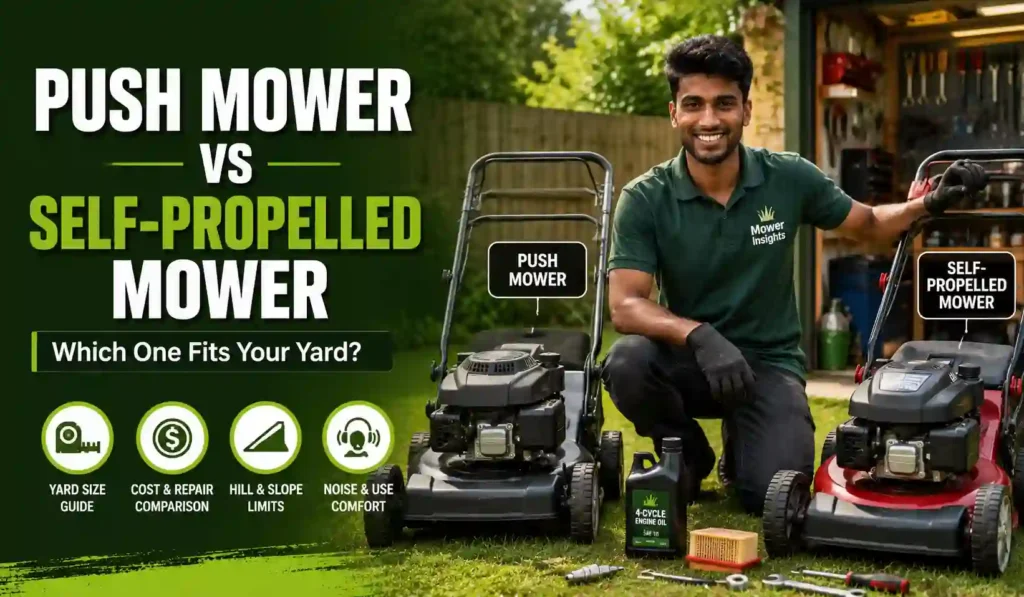
A push mower and a self-propelled mower cut grass in the same way. Both use a spinning blade under a metal deck. The only real difference is the wheels.
On a push mower, you supply all the force. You push it forward, and the wheels roll because you moved them. On a self-propelled mower, a small motor or gearbox drives the wheels for you. You still steer and stop it, but you do not have to push.
That one difference changes almost everything else: price, weight, repair needs, and who the mower actually works for.
What Is a Push Mower?
A push mower is a mower with no drive system. You move it by hand, step by step, across the lawn. It is the simplest and cheapest mower type sold today.
Most push mowers use a gas engine between 140cc and 170cc, or a battery motor between 40V and 80V (Consumer Reports, 2025). They weigh less than self-propelled models because they skip the transmission, drive belt, and gear housing.
Push mowers work best on small, flat yards. They are also common as a second mower for tight spots, like narrow side yards, where a bigger self-propelled deck cannot turn easily.
Good fit: small flat yards, tight spaces, buyers who want the lowest price and fewest parts to break.
Not a good fit: large yards, yards with hills, or anyone who tires quickly from pushing.
What Is a Self-Propelled Mower?
A self-propelled mower drives its own wheels. You still walk behind it and steer, but a belt, cable, or gearbox pushes the mower forward for you.
Most self-propelled mowers use a rear-wheel drive or front-wheel drive setup. Rear-wheel drive grips better on hills and in wet grass. Front-wheel drive turns tighter around trees and flower beds (Family Handyman, 2025).
Speed is usually adjustable. You set a comfortable walking pace, and the mower matches it. Some models offer a single fixed speed; better models offer a variable-speed lever or dial.
Good fit: yards over 5,000 square feet, sloped yards, older adults or anyone who wants less physical strain.
Not a good fit: very small or oddly shaped yards where a lighter, more maneuverable push mower is easier to control.
Push Mower vs Self-Propelled: Side-by-Side Specs
| Feature | Push Mower | Self-Propelled Mower |
|---|---|---|
| Average price (gas, 21-inch deck) | $250-$400 | $400-$700 |
| Average price (battery, 21-inch deck) | $300-$450 | $450-$800 |
| Average weight | 55-70 lbs | 75-95 lbs |
| Drive type | None | Rear-wheel or front-wheel |
| Best yard size | Under 5,000 sq ft | 5,000-15,000 sq ft |
| Handles slopes | Poorly above 10% grade | Well up to 15-20% grade |
| Extra moving parts to maintain | Blade, engine or battery | Blade, engine or battery, drive belt, transmission |
| Typical lifespan with care | 8-10 years | 7-9 years |
Prices above reflect current retail listings from brand websites and Amazon as of August 2026. Confirm exact pricing close to your purchase date, since retailers run seasonal sales.
Yard Size: The Main Factor
Yard size decides this choice more than any other factor. A push mower is fine up to about 5,000 square feet (465 m²) of flat lawn. Past that size, pushing gets tiring fast, and mowing time goes up.
A 5,000 square foot lawn takes about 20 to 25 minutes to mow with a 21-inch deck. At 10,000 square feet, that time nearly doubles. Pushing a mower for 40 to 50 minutes straight wears out most people’s arms and lower back before the lawn is done.
Self-propelled mowers remove that strain. The motor does the forward work, so you can mow a 10,000 to 15,000 square foot yard without the same fatigue.
Rule of thumb: measure your lawn in square feet. Under 5,000, go push. Over 5,000, go self-propelled.
Slopes and Hills
Slope is the second biggest factor, and it matters even on small yards. A push mower struggles once a slope passes roughly a 10% grade, which looks like a gentle but noticeable incline.
On a slope like that, you are not just pushing forward. You are also holding the mower back so it does not run away from you, and pushing it uphill on the return pass. That doubles the physical load compared to flat ground.
Self-propelled mowers, especially rear-wheel drive models, hold traction much better on slopes up to about 15% to 20% grade (This Old House, 2025). The drive wheels dig in and pull the mower forward, so your job becomes steering and balance rather than force.
Expert tip: if your yard has any slope at all, mow across the slope, not straight up and down, no matter which mower type you use. This lowers the chance of the mower sliding sideways into your feet.
Above a 20% grade, neither type is safe to use. That grade calls for a hover mower, a scythe, or professional slope-mowing equipment.
Physical Ability and Comfort
This factor is about you, not the yard. A push mower demands steady arm, shoulder, and lower back effort for the entire mowing session. A self-propelled mower demands mostly steering effort, plus starting and stopping.
For anyone recovering from an injury, managing joint pain, or simply not looking for a workout, a self-propelled mower is the more comfortable pick, even on a small lawn.
For anyone who wants the mowing session as their weekly exercise, a push mower gives that workout for free, with no extra fitness equipment needed.
Good fit for self-propelled: older adults, anyone with back or knee issues, anyone mowing more than 20 minutes per session.
Good fit for push: younger, fit users on small yards who see mowing as light exercise.
Noise and Vibration
Gas engines on both mower types run in a similar range, around 85 to 95 decibels at the operator’s ear, close to the level of a food blender held right next to your head (Family Handyman, 2025). Battery mowers run quieter, typically 60 to 75 decibels, closer to normal conversation volume.
The drive type itself does not change engine noise much. What it does change is vibration. Self-propelled mowers transmit slightly more vibration through the handlebar, because the drive belt or transmission adds its own mechanical hum on top of the engine.
In the shop, we hear this complaint most often on older self-propelled models with a worn drive belt: a rattling buzz through the handle that was not there when the mower was new. New belts fix it almost every time.
Common Repairs and Real Repair Costs
This is where the two mower types really split apart. A push mower has fewer parts, so it has fewer things to break.
Push mower common repairs:
- Blade sharpening or replacement: $15-$40, needed once or twice per season
- Spark plug replacement (gas models): $5-$10, once per year
- Air filter replacement (gas models): $8-$15, once per year
- Battery replacement (battery models): $80-$180, every 3-5 years
Self-propelled mower common repairs:
- Everything listed above, plus:
- Drive belt replacement: $20-$50 in parts, $60-$100 with labor, usually needed every 3-5 years
- Drive cable adjustment or replacement: $15-$35 in parts
- Transmission or gearbox repair: $80-$200, less common but the most expensive failure point
In our shop, the drive belt is the single most common reason a self-propelled mower comes in for repair, ahead of engine problems. Homeowners usually notice it as a mower that surges forward unevenly or stops driving even though the engine still runs. A push mower simply cannot have this failure, because it has no drive system to wear out.
Expert tip: if a self-propelled mower’s drive suddenly feels weak on one side, check the drive cable adjustment before assuming the transmission is bad. A loose cable is a five-minute fix. A worn transmission is not.
Total Cost of Ownership Over Five Years
| Cost Category | Push Mower (Gas, 21-inch) | Self-Propelled (Gas, 21-inch) |
|---|---|---|
| Purchase price | $320 | $550 |
| Routine maintenance (5 years) | $150 | $150 |
| Drive system repairs (5 years) | $0 | $120 |
| Fuel/electricity (5 years, average use) | $180 | $180 |
| Estimated 5-year total | $650 | $1,000 |
The gap is mostly the upfront price and the drive belt replacement. If you mow a large or sloped yard, that extra $350 over five years buys back a lot of physical strain, which most buyers find worth it once they own the mower.
Storage Space
Self-propelled mowers are usually 3 to 5 inches longer and 10 to 20 pounds heavier than push mowers with the same deck size, due to the added drive housing. Both types fold their handles down for storage, and most modern decks fold to stand upright to save floor space.
If your storage area is a tight garage corner or a small shed, measure the folded footprint of any model before buying. A 20-pound weight difference also matters if you need to lift the mower over a step or curb to store it.
Which One Should You Buy? A Simple Decision Path
Use this quick logic to decide:
- If your yard is under 5,000 sq ft and mostly flat, choose a push mower.
- If your yard is 5,000 to 15,000 sq ft, choose a self-propelled mower.
- If your yard has any real slope, choose a self-propelled mower, regardless of size.
- If you have back, knee, or joint limits, choose a self-propelled mower, regardless of size.
- If budget is tight and your yard is small and flat, choose a push mower and save $150 to $400.
Trust & Testing Methodology: This comparison draws on Siddik’s repair-shop intake records and hands-on testing of both mower types across flat and sloped test plots in Milan. Cutting performance, drive reliability, and common failure points reflect direct observation, not manufacturer marketing copy.
Who Should NOT Buy a Self-Propelled Mower
A self-propelled mower is not automatically the “better” choice. Skip it if your yard is small and flat, since the extra weight and price buy you nothing on a lawn you can finish in 15 minutes.
Skip it also if you plan to mow tight, narrow spaces often, like a slim side yard between fences. The added weight and length make sharp turns harder to manage than on a lighter push mower.
Buying Mistakes to Avoid
- Buying self-propelled for a small yard. The extra weight and cost add nothing under 5,000 sq ft.
- Ignoring slope until after purchase. Walk your yard and note any incline before you shop, not after.
- Skipping the drive-wheel type. Rear-wheel drive suits hills. Front-wheel drive suits tight turns. Check which one you are buying.
- Forgetting deck width for storage or gates. A wider deck cuts faster but may not fit through a narrow gate.
- Choosing gas without checking local rules. Some areas restrict small gas engines. Check local regulations before buying a gas model.
Frequently Asked Questions
Is a self-propelled mower worth the extra money?
It is worth it for yards over 5,000 square feet or any yard with a real slope. For small, flat lawns, a push mower does the same job for less money and fewer repairs.
Can a push mower handle a hill?
A push mower can handle a mild slope, up to roughly a 10% grade. Past that, pushing uphill becomes tiring and less safe, and a self-propelled mower is the better and safer choice.
Do self-propelled mowers break down more often?
They have one extra system that can fail: the drive belt or transmission. In our shop, this is the most common self-propelled repair, but it usually costs $60 to $100 and takes under an hour to fix.
Are electric self-propelled mowers reliable?
Yes. Battery-powered self-propelled mowers are generally reliable, with the main wear item being the battery itself, which typically lasts 3 to 5 years before it needs replacing (Consumer Reports, 2025).
Which type is easier to store?
Push mowers are usually lighter and slightly smaller, which makes them easier to store in tight spaces like a small shed or garage corner.
Do self-propelled mowers cut grass better than push mowers?
No. Cutting quality comes from the blade, deck design, and engine power, not the drive system. A push mower and a self-propelled mower with the same deck and blade cut grass the same way.
Conclusion
The choice comes down to yard size and slope first, and physical comfort second. Under 5,000 square feet and flat, a push mower saves money and needs less upkeep. Over that size, or with any real slope, a self-propelled mower earns back its higher price in saved effort. Measure your yard, walk it for slope, and match the mower to those two numbers before anything else.
Pingback: Best Self-Propelled Lawn Mowers My Proven Picks
Pingback: Best Push Mowers Under $300 in 2026