Quick Answer
- In the Ryobi P320 vs P322 comparison, the P322 wins on power, weight, and nail capacity per charge, thanks to its brushless motor.
- The P320 costs less and still gets the job done for light, occasional trim work.
- The P322 drives nails up to 2 1/8 inches into hardwood; the P320 tops out at 2 inches and struggles more in dense wood.
- The P322 weighs 5.5 pounds bare versus 6.0 pounds for the P320, which matters over a full day of overhead work.
- Pick the P322 for regular use or hardwood trim, and the P320 only if the lower price is your top priority.
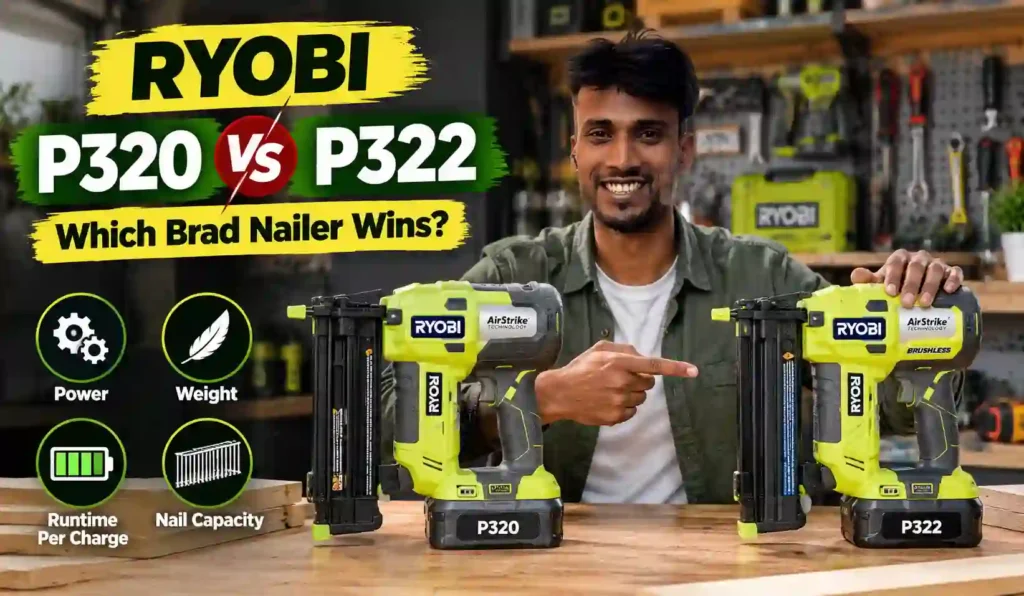
Ryobi P320 vs P322 is the comparison most homeowners land on when they outgrow a pneumatic brad nailer and want to go cordless. Both tools drive 18-gauge brad nails without a compressor, hose, or air cartridge. The difference comes down to the motor inside each one, and that difference changes how the tool feels in your hand after an hour of work.
I’ve spent years repairing gas and battery-powered outdoor power equipment, and battery-powered brad nailers share the same core issue as any cordless tool: motor type and battery efficiency decide whether the tool feels effortless or like a chore by the end of a project. That’s the lens I’m using to break down the Ryobi P320 vs P322 matchup below.
Ryobi P320 vs P322 at a Glance
| Spec | Ryobi P320 | Ryobi P322 |
|---|---|---|
| Motor | Brushed | Brushless |
| Bare weight | 6.0 lbs | 5.5 lbs |
| Max nail length | 2 in | 2 1/8 in |
| Nail range | 5/8 in to 2 in | 5/8 in to 2 1/8 in |
| Magazine capacity | 105 nails | 105 nails |
| Runtime on a 4.0Ah battery | About 700 nails | About 2,250 nails |
| Fire modes | Single and bump fire | Bump and sequential fire |
| Price (tool only) | $129 | $179 |
Prices may vary by retailer and change over time.
Ryobi P320 Overview
The Ryobi P320 is the original cordless AirStrike brad nailer in the ONE+ lineup. It uses a brushed motor and a mechanical air-spring firing system, so it needs no compressor, hose, or gas cartridge to sink an 18-gauge brad.
Key features:
- Single-fire and bump-fire modes for up to 60 nails per minute
- Tool-free depth-of-drive adjustment
- Tool-free jam release for clearing stuck nails
- Dry-fire lockout and a low-nail indicator
- Built-in LED worklight and an adjustable belt hook
Performance: The P320 handles softwood trim, baseboards, and shoe molding without hesitation. In hardwood, or once the battery drops below half charge, the brushed motor loses some punch, and nails can stop short of fully seated. The tool also runs through a full 4.0Ah battery charge in roughly 700 nails, which is short if you’re framing out a full room of trim in one sitting.
Pros:
- Lower price than the P322
- Simple, proven design with a long track record
- Compatible with every Ryobi ONE+ battery
Cons:
- Heavier at 6.0 pounds bare
- Shorter runtime per charge
- More prone to jamming in dense hardwood, based on repeated owner reports
Rating: 7.5/10
Best for: occasional DIY trim work in softwood, where budget matters more than raw power.
Ryobi P322 Overview
The Ryobi P322 is the brushless redesign of the same tool. Ryobi kept the AirStrike firing system but paired it with an HP brushless motor, which is where most of the improvement over the P320 comes from.
Key features:
- Brushless motor rated for a meaningful power increase over brushed models
- AccuDrive nose design for a clearer sightline to the nail placement
- Tool-free selectable fire modes: bump and sequential
- Tool-free jam access through a latch above the magazine
- Dry-fire lockout, low-nail indicator, and a secondary trigger to activate the LED light separately from firing
Performance: The P322 drives nails cleanly into oak and other hardwoods, including with the grain and against it, without needing a running start. The brushless motor also stretches a single 4.0Ah charge to roughly 2,250 nails, more than three times what the P320 manages. The one trade-off is a slight firing delay compared to a pneumatic gun, and the redesigned nose blocks part of the LED light’s throw.
Pros:
- Lighter at 5.5 pounds bare
- Noticeably stronger and more consistent driving power
- Far longer runtime per battery charge
Cons:
- Higher price than the P320
- Slight delay between trigger pull and firing
- Nose design partially blocks the worklight
Rating: 8.8/10
Best for: anyone doing regular trim, cabinet, or hardwood nailing work who wants the tool to keep up without babying it.
Ryobi P320 vs P322: Head-to-Head Comparison
The Ryobi P320 vs P322 decision mostly comes down to motor type, weight, and how often you plan to use the tool. Here’s how each factor plays out.
Motor and Power
The P320’s brushed motor is reliable but loses torque as the battery drains and in denser wood. The P322’s brushless motor keeps consistent power throughout the charge and drives nails deeper into hardwood without a second hit. If you work with oak, maple, or other hardwoods regularly, this is the deciding factor.
Weight and Handling
At 6.0 pounds bare, the P320 is noticeable during overhead work like crown molding. The P322 drops to 5.5 pounds, which is a modest difference on paper but adds up across a multi-hour install. Reviewers consistently point to the P322 as the more comfortable tool for extended one-handed use.
Nail Length and Capacity
Both tools hold 105 nails per magazine load, so reload frequency is identical. The P322 extends the maximum nail length to 2 1/8 inches, versus 2 inches on the P320, giving it a slight edge for thicker trim and casing work.
Runtime Per Charge
This is the widest gap in the Ryobi P320 vs P322 comparison. The P320 gets through about 700 nails on a 4.0Ah battery, while the P322 manages roughly 2,250 nails on the same battery. For a full day of trim work, that difference means fewer battery swaps and less downtime.
Nose Design and Visibility
The P322’s AccuDrive nose is narrower and gives a clearer view of the nail tip during placement, which matters most on tight inside corners. The trade-off is that the nose blocks more of the LED worklight’s beam than the P320’s simpler nose design.
Price
The P320 runs about $50 less as a bare tool. That gap is easy to justify if you’re nailing occasionally, but harder to justify if the tool will see regular use, since the P322 pays that difference back in reduced jamming and less charging downtime.
Which One Should You Buy?
- Occasional DIY projects in softwood: the P320 is enough tool for the job, and the lower price is the better trade.
- Regular trim, cabinet, or finish work: the P322’s brushless motor and longer runtime make it the better long-term choice.
- Hardwood flooring, casing, or baseboards: the P322’s extra power and 2 1/8-inch nail capacity handle dense wood more reliably.
- Already own Ryobi ONE+ batteries and want the cheapest entry point: the P320 gets you into cordless nailing without a big upfront cost.
Frequently Asked Questions
Which nailer wins the Ryobi P320 vs P322 comparison overall?
The P322 wins for most users because of its brushless motor, lighter weight, and much longer runtime per charge. The P320 still makes sense if the lower price matters more than raw performance.
Can the Ryobi P320 and P322 use the same batteries?
Yes. Both nailers run on the Ryobi 18V ONE+ battery platform, so any ONE+ battery you already own works with either tool.
Is the Ryobi P322 worth the extra cost over the P320?
For regular use or hardwood trim, yes. The brushless motor drives nails more consistently and the battery lasts more than three times as long per charge, which adds up quickly if you nail often.
Does the Ryobi P320 jam more than the P322?
Owner reports point to more frequent jamming with the P320, especially in hardwood or with worn batteries. The P322’s brushless motor and updated nose design reduce this, though it isn’t jam-proof.
What size nails do the P320 and P322 use?
Both use 18-gauge brad nails. The P320 handles 5/8 inch to 2 inch nails, while the P322 extends slightly further to 2 1/8 inches.
Do either of these nailers come with a battery included?
Both are typically sold as bare tools without a battery or charger. Kits bundled with a battery and charger are available at a higher price if you don’t already own Ryobi ONE+ gear.
Final Verdict
The Ryobi P322 is the better tool in almost every practical sense: lighter, more powerful, and far longer-lasting per charge. If you’re nailing trim regularly or working in hardwood, the extra cost pays for itself in fewer jams and battery swaps. The P320 still earns its place for buyers who nail occasionally and want to spend less to get started with cordless nailing.
Why Trust This Guide
This comparison draws on published manufacturer specifications for both models, plus a review of verified owner feedback across major retailers. Most of my hands-on repair background is with gas and battery-powered lawn equipment rather than nail guns specifically, but the underlying issue – how a brushed versus brushless motor holds up under load and battery drain – is the same mechanical question I deal with daily on mower motors.