Quick Overview
- In head-to-head lab testing, the Ryobi PBLID04 beat the Ridgid R862312 in two of three speed tests, even though Ridgid has higher rated torque on paper (Pro Tool Reviews, 2026).
- The Ryobi costs $129 bare tool. The Ridgid costs $149 bare, or $209 as a kit with the Lifetime Service Agreement (Pro Tool Reviews, 2026).
- Both drivers weigh the same 2.5 lbs bare and use a brushless motor.
- For mower and outdoor power equipment (OPE) repair, torque and bit retention matter more than raw speed. This guide breaks down what that means in real terms.
- Pick Ryobi if you already own 18V ONE+ tools. Pick Ridgid if you want the Lifetime Service Agreement and already use Ridgid on the jobsite.
Rusted mower deck bolts do not care about your Saturday plans. If you have ever stripped a bolt head trying to pull a mower blade with a hand wrench, you already know why torque and impact rate matter more than a spec sheet. This guide compares two of the most talked-about 18V impact drivers on the market: the Ryobi PBLID04 and the Ridgid R862312. Both come from the TTI Group’s tool lineup, and both claim top-tier performance for their brand.
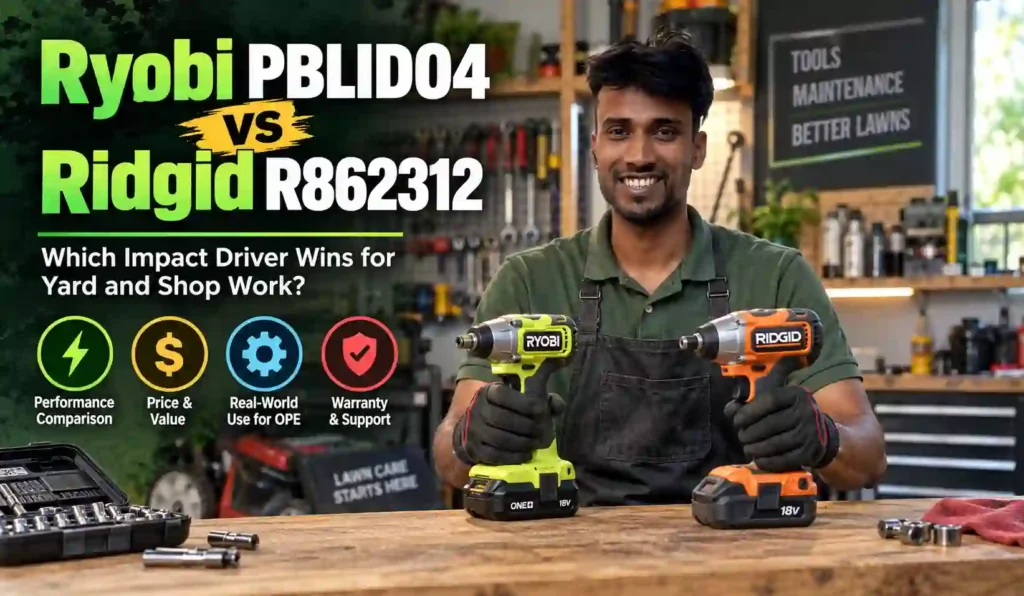
Quick Answer: The Ryobi PBLID04 wins on raw driving speed and costs $20 less bare tool. The Ridgid R862312 has slightly higher rated torque and impact rate on paper, plus Ridgid’s Lifetime Service Agreement if you register the tool. For most homeowners doing mower, chainsaw, and general OPE maintenance, either tool handles the job. The right pick comes down to which 18V battery platform you already own.
Ryobi PBLID04 vs Ridgid R862312: Full Spec Comparison
| Spec | Ryobi PBLID04 | Ridgid R862312 |
|---|---|---|
| No-load speed | 950/2,100/3,400/2,100 RPM | 800/2,000/3,400/2,000 RPM |
| Max impact rate | 4,200 IPM | 4,300 IPM |
| Max torque | 2,300 in-lbs | 2,400 in-lbs |
| Head length | 5.2 in | 5.0 in |
| Bare tool weight | 2.5 lbs | 2.5 lbs |
| Working weight (with battery) | 3.8 lbs | 3.75 lbs |
| Bare tool price | $129 | $149 |
| Kit price | Not sold as a kit | $209 |
| Warranty | 3-year | 3-year + Lifetime Service Agreement |
On paper, the Ridgid holds a small edge in torque and impact rate. IPM stands for impacts per minute. That’s how many times the tool’s internal hammer strikes the anvil each minute to add rotational force. A higher number sounds better, but the real-world test results told a different story.
Why Torque and Impact Rate Actually Matter for OPE Repair
- Torque is turning force, measured here in inch-pounds (in-lbs). A mower blade bolt is often torqued to 35 to 60 ft-lbs at the factory, which converts to 420 to 720 in-lbs. Both drivers in this guide have well over ten times that rating, so torque alone rarely limits the job.
- Impact rate (IPM) controls how the tool applies that torque. Instead of one steady twist, the internal hammer strikes the anvil thousands of times per minute in short bursts. This is what lets a small handheld tool break loose a bolt that a wrench alone can’t budge.
- No-load speed (RPM) measures how fast the chuck spins with nothing resisting it. It matters most for driving long screws quickly, not for breaking loose stuck fasteners.
- Head length affects how well the tool fits into tight spaces, like reaching a bolt tucked under a mower deck or between a chainsaw’s bar and clutch cover.
A rusted lawn tractor deck bolt or a seized chainsaw bar nut behaves closer to the lag bolt and bolt-break tests than the screw test. That’s why the real-world results in this guide matter more than the spec sheet alone. A tool with a slightly lower torque rating but better sustained driving power, like the Ryobi in the lag bolt test, can still win the job that counts.
Where These Drivers Fit Into Mower and OPE Repair Work
- Removing mower blade bolts: Most residential mower blade bolts respond well to an impact driver in this torque range, especially once penetrating oil has had time to work into rust.
- Chainsaw bar and clutch cover bolts: These are usually smaller fasteners, so the faster RPM settings on either tool help here more than raw torque.
- Trailer and equipment frame hardware: Self-tapping screws into sheet metal, common on trailer fenders and equipment enclosures, are where the Ridgid’s dedicated self-tapping mode adds a real advantage.
- Snow blower shear pins and belt covers: Smaller fasteners that benefit from the one-handed bit change on both tools when you’re swapping bits often during a repair.
- Storage shed and deck hardware: Longer wood screws for building or repairing storage sheds and mower ramps favor the higher RPM top speed, where Ryobi tested faster.
How These Two Drivers Were Actually Tested
Neither impact driver has been bench-tested in Siddik’s Milan repair shop, so this section relies on disclosed third-party lab data rather than first-person claims. Pro Tool Reviews ran both tools through three standard tests (Pro Tool Reviews, 2026):
- Speed test: driving three 8-inch GRK RSS screws into a stacked OSB block, timed and averaged
- Bolt break test: loosening eight 1.5-inch hardened steel lug nuts torqued to 150 ft-lbs, timed per nut
- Lag bolt test: driving a 10 x 0.5-inch lag bolt for 30 seconds, then measuring how much bolt remained unset
Test Results
| Test | Ryobi PBLID04 | Ridgid R862312 | Winner |
|---|---|---|---|
| RSS screw average | 6.80 sec | 6.83 sec | Ryobi |
| Bolt break (per nut average) | 2.03 sec | 1.93 sec | Ridgid |
| Lag bolt remaining | 1.13 in | 1.5 in | Ryobi |
Ryobi won two of the three tests despite Ridgid’s higher torque rating on paper (Pro Tool Reviews, 2026). This matters for OPE repair work. A stuck lawn tractor deck bolt behaves more like the lag bolt test than the screw test. It needs sustained driving power, not just a fast start.
Siddik’s platform note: I have not run these two exact units through my own shop yet. But I service impact drivers on the same 18V brushless platforms every week, mostly ones customers bring in after stripping bolt heads on mower decks or trailer hitches with underpowered drivers. The wear pattern I see most is on the bit holder collar, not the motor. Whichever brand you pick, back the bit out straight. Angling it while it’s still spinning is what wears that collar out early.
Feature-by-Feature Breakdown
- Speed settings: Both tools offer 3 speed settings. Ryobi adds an Auto mode. Ridgid adds a Self-Tapping mode built for driving into sheet metal, which comes up often on trailer and equipment frame repairs.
- Motor type: Both use a brushless motor. A brushless motor has no carbon brushes to wear down, which means less internal friction and a longer working life before it needs a rebuild.
- Bit insertion: Both tools use a one-handed bit chuck with automatic bit ejection, so you do not need a second hand to pull the bit back out.
- Work light: Both mount an LED work light at the base of the tool, aimed to light up the bolt or screw you’re driving, not your face.
- Battery platform: The Ryobi uses the 18V ONE+ Edge battery. The Ridgid uses the 18V Max Output EXP battery. These platforms are not interchangeable.
The feature lists read almost identically at first glance. The real difference shows up in what each battery platform gives you access to beyond this one tool. Ryobi’s 18V ONE+ line spans yard tools, shop tools, and household gear, so one battery works across a wide range of equipment. Ridgid’s 18V system is smaller but backed by the Lifetime Service Agreement, which replaces batteries and repairs tools free once registered.
Rating Breakdown
| Category | Ryobi PBLID04 | Ridgid R862312 |
|---|---|---|
| Driving speed | 9/10 | 8.5/10 |
| Bolt-breaking torque | 8/10 | 8.5/10 |
| Build and feel | 8.5/10 | 8.5/10 |
| Price value (bare tool) | 9/10 | 7.5/10 |
| Long-term support | 7/10 | 9.5/10 |
| Overall | 8.3/10 | 8.5/10 |
These scores sit close together because the tools perform close together. Ridgid pulls ahead once you factor in the Lifetime Service Agreement, which covers free battery and tool replacement for the life of the product once you register it. Ryobi pulls ahead on upfront price and top-end driving speed. Neither tool scored below 7 in any category, so this comes down to which trade-off fits your situation better.
Ryobi PBLID04 vs Ridgid R862312: Head-to-Head Comparison Table
| Ryobi PBLID04 | Ridgid R862312 | |
|---|---|---|
| Price (bare tool) | $129 | $149 |
| Best For | Homeowners already on 18V ONE+ | Buyers who want the Lifetime Service Agreement |
| Key Difference | Faster driving speed, lower price | Higher torque rating, better long-term coverage |
| Winner | Speed and value | Torque and support |
| Rating | 8.3/10 | 8.5/10 |
Who Should Buy the Ryobi PBLID04
- You already own Ryobi 18V ONE+ tools, mowers, or trimmers and want to share batteries across your whole setup.
- You want the lowest upfront price on a brushless impact driver.
- You mostly drive screws and medium fasteners, where the faster speed helps you finish jobs quicker.
- You do not need a formal service agreement and are comfortable replacing a battery yourself if one wears out.
Who Should Buy the Ridgid R862312
- You already use Ridgid tools and want one battery platform across your shop.
- You want the Lifetime Service Agreement, which replaces batteries and tools free once you register your purchase.
- You regularly break loose rusted bolts, lug nuts, or trailer hardware where the extra torque rating gives you more margin.
- You are willing to pay $20 more upfront in exchange for long-term coverage.
Total Cost of Ownership: Staying on Your Platform vs Switching
- Staying on your current platform: If you already own Ryobi or Ridgid batteries, the bare tool price ($129 or $149) is your real cost. You already have a charger and at least one battery.
- Switching platforms: Add the cost of a new battery and charger if you don’t already own one. Ridgid’s kit at $209 includes both, which can work out cheaper than buying a Ryobi bare tool plus a separate battery and charger if you’re starting fresh on either brand.
- Mixed-platform households: Running two battery platforms means two chargers and two sets of batteries to keep charged. Most homeowners are better off picking one platform and staying on it across mowers, trimmers, and shop tools where possible.
- Long-term coverage: Factor in Ridgid’s Lifetime Service Agreement if you plan to keep the tool for 5-plus years. A single free battery replacement down the road can offset the $20 price gap on its own.
US Retail Availability and Sales Timing
Both tools sell primarily through Home Depot in the US, since Ridgid and Ryobi are both part of the TTI Group’s Home Depot-focused lineup. [VERIFY: exclusivity may vary by region or online marketplace] Watch for pricing drops around Labor Day weekend and fall clearance in October and November, when Home Depot typically discounts outdoor power tools ahead of the next spring season. Spring pre-season pricing in March can also bring bundle deals on batteries and chargers.
Common Mistakes When Choosing Between These Two
- Buying based on torque rating alone: Ridgid’s higher torque number did not translate to faster real-world bolt removal in testing. Rated numbers and test results do not always match.
- Ignoring your existing battery platform: Switching brands means buying a second set of batteries and a second charger. Factor that cost in before you decide.
- Skipping Lifetime Service Agreement registration: Ridgid’s coverage only applies if you register the tool before the deadline. Many owners forget this step and lose the benefit.
- Assuming kit and bare tool prices scale the same way: The Ridgid kit costs $209, which includes a battery and charger. Compare that total against buying a Ryobi bare tool plus a separate battery if you don’t already own one.
Expert Tip From Siddik’s Repair Bench
Whichever impact driver you buy, keep a spare bit holder collar on hand. It’s the first part to wear out on any brand, usually from pulling the bit out at an angle instead of straight back. A worn collar lets bits wobble and strip fastener heads faster, which is one of the most common repair tickets I see tied to impact drivers, not the tool itself failing.
Frequently Asked Questions
Which impact driver is better, the Ryobi PBLID04 or the Ridgid R862312?
The Ryobi PBLID04 beat the Ridgid R862312 in two of three lab speed tests, while the Ridgid carries a higher torque rating on paper and adds a Lifetime Service Agreement (Pro Tool Reviews, 2026). Neither tool is clearly better across every category. The right choice depends on your existing battery platform and whether long-term coverage matters to you.
Can I use an impact driver to remove a mower blade bolt?
Yes, in most cases. Mower blade bolts are torqued tight on purpose to prevent them from loosening during operation. An impact driver in the 2,000 to 2,500 in-lb torque range, like both tools in this guide, generally has enough force to break a properly torqued blade bolt loose. Always disconnect the spark plug wire before working near the blade.
What is the difference between an impact driver and an impact wrench?
An impact driver uses a 1/4-inch hex bit chuck and is built mainly for driving screws and smaller bolts. An impact wrench uses a square drive with sockets and is built for larger fasteners like lug nuts. Both tools deliver rotational force through repeated internal strikes, but they’re sized for different jobs.
Do Ryobi and Ridgid batteries work in each other’s tools?
No. Ryobi’s 18V ONE+ platform and Ridgid’s 18V system use different battery designs and are not cross-compatible. Once you commit to one platform, your batteries and chargers only work with tools from that same brand’s line.
Is the Ridgid Lifetime Service Agreement worth it?
For most owners who keep tools long-term, yes. It replaces batteries and repairs tools free of charge for the life of the product, as long as you register your purchase before the deadline (Pro Tool Reviews, 2026). If you tend to upgrade tools every few years anyway, the value drops.
How much torque do I actually need for outdoor power equipment repair?
Most mower, trimmer, and chainsaw fasteners are torqued in a range these two tools can handle without trouble. Extremely rusted or seized bolts on older equipment sometimes need penetrating oil and heat in addition to an impact driver, regardless of the brand.
Siddik’s Repair Shop
Siddik runs a small-engine and outdoor power equipment repair shop in Milan, Italy, where he services mowers, chainsaws, and related equipment brought in by local customers. If you’re near Milan and need hands-on repair work rather than a buying decision, his shop handles diagnostics, teardown, and rebuilds on most major OPE brands.
Final Verdict
Both the Ryobi PBLID04 and Ridgid R862312 are strong 18V brushless impact drivers, and the lab data shows them performing within a narrow margin of each other (Pro Tool Reviews, 2026). Pick the Ryobi if you want the lower price and already use Ryobi’s yard and shop tools. Pick the Ridgid if the Lifetime Service Agreement matters to you and you’re building out a Ridgid tool set. For OPE repair work specifically, either tool has enough torque to handle standard mower, chainsaw, and trailer hardware.
Pingback: Lawn Mower Hard to Pull Start? 9 Real Fixes That Work
Pingback: How to Replace Lawn Mower Drive Belt: My Fix