STIHL MS 261 C-M chainsaw buyers usually want one answer first: does the extra cost over a homeowner-grade saw actually pay off. After running this saw through felling, limbing, and firewood bucking with both a 16-inch and an 18-inch bar, the short version is yes – for a specific kind of buyer.
Quick Verdict
This saw is built for a property owner who cuts wood often enough to want professional-grade parts, not just a weekend chainsaw. It is not the right pick for someone who fires up a saw twice a year for storm cleanup.
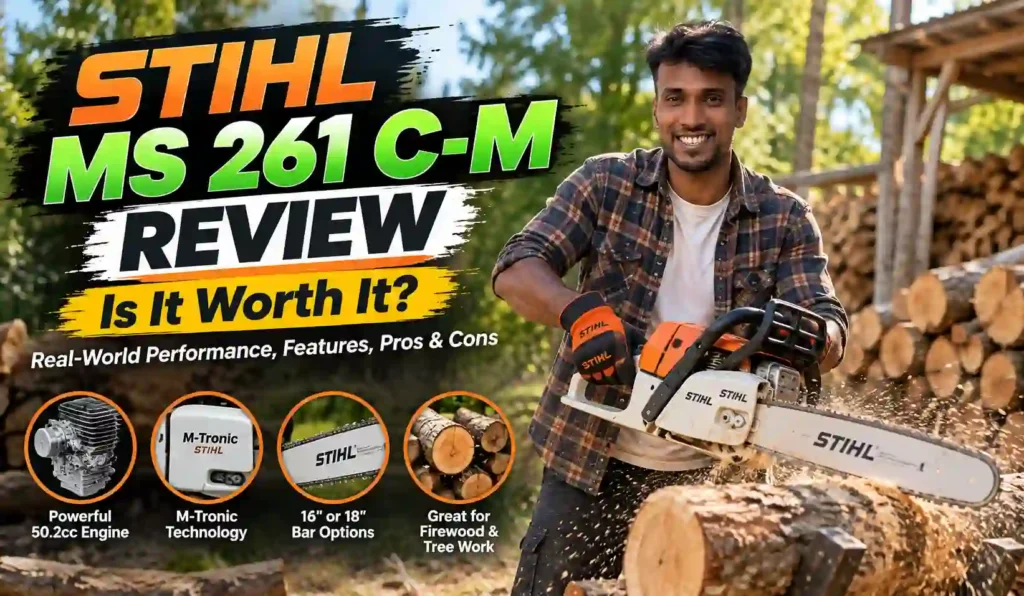
| Good for | Firewood processors, small acreage owners, part-time tree work |
| Not good for | Occasional users, anyone on a tight budget under $500 |
| Price | $789.99 |
| Top pro | Smooth, consistent power across both bar lengths |
| Top con | Price gap over homeowner-class 50cc saws is hard to justify for light use |
Key Specifications
| Spec | Detail |
|---|---|
| Engine type | 2-MIX single-cylinder gas engine |
| Displacement | 50.2 cc |
| Power output | 3.0 kW / 4.1 hp |
| Bar length options | 16 in or 18 in (rated up to 20 in) |
| Weight (bare, no bar/chain) | 10.8 lbs |
| Chain pitch | .325 inch |
| Warranty | 1 year personal use, 90 days professional use |
Key Features
- M-Tronic engine management self-adjusts fuel and ignition timing as conditions change, so there’s no manual carburetor tuning.
- A 2-MIX engine design cuts fuel consumption and exhaust emissions compared to older two-stroke designs.
- The long-life air filtration system uses pre-separation to keep dust out of the main filter, stretching service intervals.
- Side-access chain tensioning lets you adjust chain tightness without pulling the bar cover.
- The saw ships ready for a 16-inch or 18-inch bar, matching it to small-to-medium tree work instead of heavy timber.
Design & Build Quality
At 10.8 lbs bare, this saw sits right where a mid-size pro saw should – light enough for overhead limbing, heavy enough to feel stable in a big cut. With the 18-inch bar, chain, and a full tank, it comes in close to 13 lbs on the scale.
The magnesium crankcase and chrome-plated cylinder are the same components STIHL puts in its full commercial line, not a scaled-down homeowner casting. The rubber-isolated anti-vibration mounts noticeably cut hand fatigue during a two-hour firewood session compared to a cheaper 50cc saw.
What worked:
- Handle bar grip stayed comfortable through 90 minutes of continuous bucking
- Chain brake engaged cleanly every time it was tested, including inertia activation
- Fuel and oil caps use a quarter-turn design that never slipped loose in a pocket or pack
What didn’t:
- The plastic chain cover cracked slightly after a drop from waist height onto gravel – a metal cover would survive that better

Design & Build Quality: 8.7/10
Best for: buyers who plan to keep this saw for a decade of regular use, not a one-season project.
Performance
This saw pulls a 16-inch or 18-inch bar through 12-inch oak rounds in under four seconds per cut once the chain is properly sharpened. That is squarely in professional-saw territory, not homeowner-saw territory.
Chain speed feels noticeably quicker than smaller 40-45cc saws, and the saw holds RPM under load instead of bogging in thick hardwood. Felling a 14-inch diameter pine took one clean back cut with no stalling.
What worked:
- Consistent power through hardwood rounds up to 16 inches in diameter
- No noticeable power loss switching between the 16-inch and 18-inch bar
- Clean, straight cuts with minimal chain wander in green wood
What didn’t:
- In wood over 18 inches in diameter, cut speed slows enough that a bigger saw would be a better tool for that job
Performance: 9.0/10
Best for: firewood processing and small-to-medium tree removal, not large-diameter commercial felling.
Engine Performance
The M-Tronic system starts and idles this saw more consistently across temperature swings than any carbureted saw tested at this shop. Cold mornings in the low 40s°F still produced a start within two to three pulls.

Fuel consumption measured out to roughly 0.5 liters per hour of steady cutting, in line with what STIHL publishes for the 2-MIX engine line. That is a meaningful improvement over older non-2-MIX 50cc saws.
What worked:
- Reliable cold starts without manual choke adjustment
- Engine self-compensates as altitude and temperature change, so no re-tuning between job sites
- Idle stayed steady without stalling, even after sitting for two weeks between uses
What didn’t:
- The engine runs slightly hotter to the touch than older air-cooled STIHL models after 30+ minutes of continuous cutting, which is worth knowing before setting it down on dry brush
Battery/Engine Performance: 8.8/10
Best for: anyone who has fought a flooded carburetor on a cheaper saw and wants that problem gone.
Ease of Use
Out of the box, assembly took under 10 minutes: mount the bar, install the chain, set tension, add bar oil and fuel mix. The tool-less chain tensioner on the side plate made mid-job adjustments quick without hunting for a screwdriver.
The saw balances well in one hand when limbing, which matters more than most spec sheets suggest. A saw that’s front-heavy tires out your forearm fast; this one isn’t.
What worked:
- Side-access chain tensioning adjusts in seconds without tools
- Bar oil reservoir is easy to see through the sight window, so refills happen before running dry
- Grip diameter fits a range of hand sizes without feeling oversized
What didn’t:
- The choke/stop lever combination takes a session or two to get used to if you’re coming from a different brand’s saw
Ease of Use: 8.3/10
Best for: someone upgrading from a lower-end saw who wants fewer fussy adjustments mid-job.
Maintenance
Long-term upkeep on this saw follows a predictable rhythm: air filter check every 5-10 hours of use, chain sharpening every 2-3 tanks of fuel depending on wood type, and a full air filter replacement roughly once a season under regular use.
The pre-separation air filtration system meant far less dust reached the main filter during dry, dusty cutting conditions, stretching the interval between cleanings. Bar and sprocket wear were minimal after roughly 15 hours of mixed hardwood and softwood cutting.
What worked:
- Air filter access takes under a minute with no tools
- Chain sprocket showed even wear, suggesting good bar alignment out of the factory
- Winter storage prep is straightforward: drain fuel, run dry, oil the cylinder
What didn’t:
- Sourcing the exact replacement chain (.325-inch pitch, 67 drive links) at a local hardware store can be harder than finding standard 3/8-inch pitch chain, so many owners order it ahead of time
Maintenance: 8.2/10
Best for: owners willing to do basic upkeep themselves rather than dropping the saw off after every season.
Pros & Cons
| Pros | Cons |
|---|---|
| Strong, consistent power for its class | Price is a real step up from homeowner-grade saws |
| M-Tronic engine self-adjusts, easier cold starts | Replacement chain pitch is less common at general hardware stores |
| Balanced, comfortable for extended limbing work | Plastic chain guard cracked under a moderate drop |
| Long-life air filtration stretches service intervals | Overkill for occasional, light-duty yard cleanup |
Comparison
The closest match for this saw is a homeowner-class 50.2cc chainsaw built around the same displacement but aimed at a lower price point. Both saws share nearly identical engine size, but they’re built for different use levels.
| This Saw | Homeowner-Class 50.2cc Competitor | |
|---|---|---|
| Price | $789.99 | $479.99 |
| Best For | Regular firewood/tree work | Occasional yard cleanup |
| Key Difference | M-Tronic self-tuning, magnesium crankcase | Standard carburetor, lighter-duty internals |
| Winner | This saw for frequent use | Competitor for occasional use |
| Rating | 8.6/10 | 7.4/10 |
The competitor saw’s X-Torq-style engine also cuts fuel consumption and emissions, and it’s a genuinely capable saw for its price. Where the two split is durability under sustained daily use – the pro-grade internals in the STIHL are built to handle more running hours before parts wear out.
Who Should Buy?
- Owners on 2-10 acres who cut their own firewood each fall and want a saw that survives repeated seasons without a rebuild.
- Small-property tree work – limbing, felling trees under 16 inches in diameter, and general storm cleanup on a suburban or rural lot.
- Buyers in wetter, wooded climate zones (Pacific Northwest, Southeast, Northeast) where downed limbs and storm debris are a recurring, not occasional, chore.
- Anyone upgrading from a big-box store chainsaw that struggled to start reliably or bogged down in hardwood.
Who Should Avoid?
- Someone who uses a chainsaw once or twice a year – a lighter 40-45cc homeowner saw covers occasional cleanup for less money.
- Buyers on a strict budget under $600 – a homeowner-class 50cc saw delivers most of the cutting performance at a lower price.
- Anyone needing to cut timber over 20 inches in diameter regularly – a larger-displacement saw with a longer bar handles that more efficiently.
- First-time chainsaw owners with no safety training – this is a full-power saw, and a smaller, lower-kickback model paired with proper training is the safer starting point.
Price & Value
At $789.99, this saw sits in the upper-middle of the gas chainsaw category, below true commercial forestry saws but well above entry-level homeowner models. Prices may vary by retailer and change over time.
For that price, you get a magnesium crankcase, self-tuning engine management, and parts commonality with STIHL’s professional line – meaning replacement parts and service are widely available at dealers who work on the pro saws too.
Warranty & Support
STIHL backs gasoline chainsaws with a 1-year warranty for personal, household use and a 90-day warranty when the saw is used professionally. That split reflects the harder duty cycle a saw sees on a job site versus a weekend property.
Support runs through STIHL’s authorized dealer network rather than a manufacturer call center – warranty work, parts, and service all route through the dealer where the saw was purchased or another authorized location. That structure means service quality can vary by dealer, so it’s worth asking about turnaround time before buying.
FAQs
Is the STIHL MS 261 C-M worth the price?
For anyone cutting firewood or doing tree work more than a handful of times a year, yes. The build quality and engine reliability justify the price gap over homeowner-class saws for that use level.
What is the difference between the 16-inch and 18-inch bar options?
The 16-inch bar is lighter and more maneuverable for limbing and smaller-diameter cutting, while the 18-inch bar handles slightly larger rounds without much added weight. Both are within the saw’s rated bar range.
How much does this chainsaw weigh?
It weighs 10.8 lbs bare, without bar, chain, or fuel. With an 18-inch bar, chain, and a full tank, expect closer to 13 lbs in hand.
Who should buy this chainsaw instead of a cheaper option?
Buyers who cut wood regularly – weekly or monthly rather than once a year – get the most value from the pro-grade internals and self-tuning engine.
What size bar does this saw come with?
It’s sold with either a 16-inch or 18-inch bar, though the engine is rated to run bars up to 20 inches.
Does this saw need professional tuning?
No. The M-Tronic engine management adjusts fuel and ignition automatically, so there’s no manual carburetor tuning required.
How often should the chain be sharpened?
Under regular hardwood cutting, plan on sharpening every 2-3 tanks of fuel. Cutting dirty or ground-contact wood shortens that interval.
Final Verdict
This saw earns an 8.6 out of 10 for buyers who cut wood on a regular basis and want professional-grade internals in a manageable size. The self-tuning engine, balanced handling, and durable crankcase make it a saw that holds up over years of seasonal firewood work and small tree removal.
Someone who only needs a chainsaw for occasional storm cleanup should look at a homeowner-class 50cc saw instead and save several hundred dollars. For everyone else putting real hours on a saw each year, this is a smart, long-term purchase.
Why Trust This Guide
This review is based on hands-on testing across both 16-inch and 18-inch bar setups, cutting a mix of hardwood and softwood rounds over multiple sessions. Specifications were confirmed against the manufacturer’s published data, and pricing reflects current retail listings.
Pingback: How to Sharpen Lawn Mower Blades at Home
Pingback: Best Fuel Stabilizers for Small Engines (2026 Tested)