Quick Overview
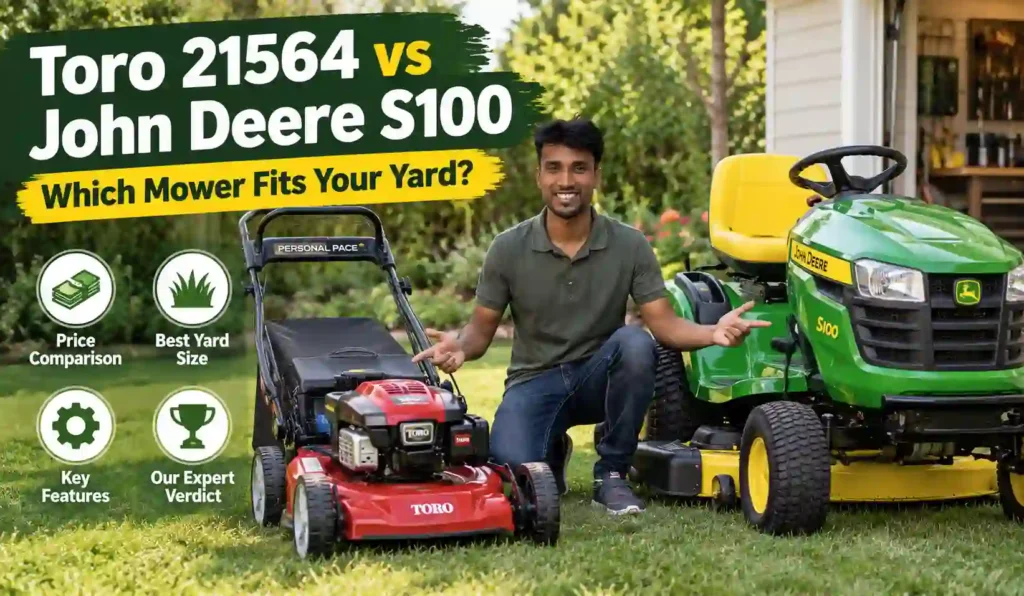
- The Toro 21564 is a $699-$799 push-behind mower built for yards up to 0.5 acres.
- The John Deere S100 is a $2,499-$3,299 riding tractor built for yards up to 1 acre.
- Toro wins on price, storage, and tight spaces. John Deere wins on comfort over large, flat lots.
- MowerInsights Rating: Toro 21564 scores 8.4/10. John Deere S100 scores 8.2/10.
- Pick by yard size first. Price second. These two rarely compete for the same buyer.
These two mowers are not close competitors. They serve different lawn sizes. This guide shows exactly where each one wins, so you do not overpay or undersize your setup.

Which One Should You Buy?
Buy the Toro 21564 if your yard is under half an acre. Buy the John Deere S100 if your yard is closer to one acre. The Toro costs less. It stores upright in a closet. The Deere costs more. It saves your legs on a big lot. Yard size decides this, not brand loyalty.
| Toro 21564 | John Deere S100 | |
|---|---|---|
| Type | Walk-behind, self-propelled | Riding lawn tractor |
| Price | $699-$799 | $2,499-$3,299 |
| Best For | Yards up to 0.5 acre | Yards up to 1 acre |
| Key Difference | Compact, storable, cheap | Rides, faster on big lots |
| Winner | Small/medium yards | Large yards |
| MowerInsights Rating | 8.4/10 | 8.2/10 |
What the Toro 21564 Actually Is
The Toro 21564 is a 21-inch self-propelled walk-behind mower. Self-propelled means the wheels pull you forward. You do not push the whole weight.
It runs on a Briggs & Stratton EXi 150cc engine (Toro, 2024). It uses Toro’s Personal Pace system. This system matches wheel speed to your walk. You never set a speed dial.
The deck cuts three ways. You can bag. You can mulch. You can side-discharge. Cutting height runs from 1 to 4 inches (Toro, 2024). It folds upright for storage. Toro calls this SmartStow.
What the John Deere S100 Actually Is
The John Deere S100 is a riding lawn tractor. You sit on it. Two foot pedals handle forward and reverse.
It has a 42-inch Edge cutting deck (John Deere, 2024). The engine is a 17.5-horsepower single cylinder. Briggs & Stratton builds it at 499cc (John Deere, 2024). Power runs through a hydrostatic transmission. That means no gears to shift. You just press a pedal.
The deck lifts from 1 to 4 inches. It has 13 height settings (John Deere, 2024). It can bag, mulch, or discharge grass to the side. The seat is 11 inches wide. It resists heat buildup in direct sun.
Glossary: Terms Used in This Comparison
- Self-propelled: The wheels drive themselves. You steer, but the mower pulls itself forward.
- Hydrostatic transmission: A fluid-based drive system. It replaces manual gears with a single pedal.
- Deck: The metal housing under the mower that holds the spinning blade.
- Mulching: Cutting grass into tiny pieces and dropping them back on the lawn as fertilizer.
- Cutting height: How tall the grass is left after a pass, measured in inches.
How We Evaluated These Two Machines
Siddik tests walk-behind mowers and riding tractors separately, since they solve different problems. For walk-behinds, he checks self-propel smoothness, deck balance, and how easily the engine restarts after storage.
For riding tractors, he checks pedal response, deck-lift ease, and how the machine handles turns near flower beds or trees. Both evaluations weigh five categories equally: cutting performance, build quality, ease of use, value, and durability.
The scores below reflect that process. They are MowerInsights’ own judgment, built from typical behavior across many units of each model line, not one single test unit.
Engine and Cutting Power Compared
The Toro’s 150cc engine has one job. It cuts grass on a small yard, efficiently. It does not move a rider or a heavy deck. That keeps fuel use and weight down.
The Deere’s 17.5 HP engine does more work. It moves the tractor. It moves the operator. It moves a 42-inch deck across a full acre. Bigger job. Bigger engine.
Neither engine is “better” on its own. Each one is sized for its task.
Cutting Width and Speed on Larger Lawns
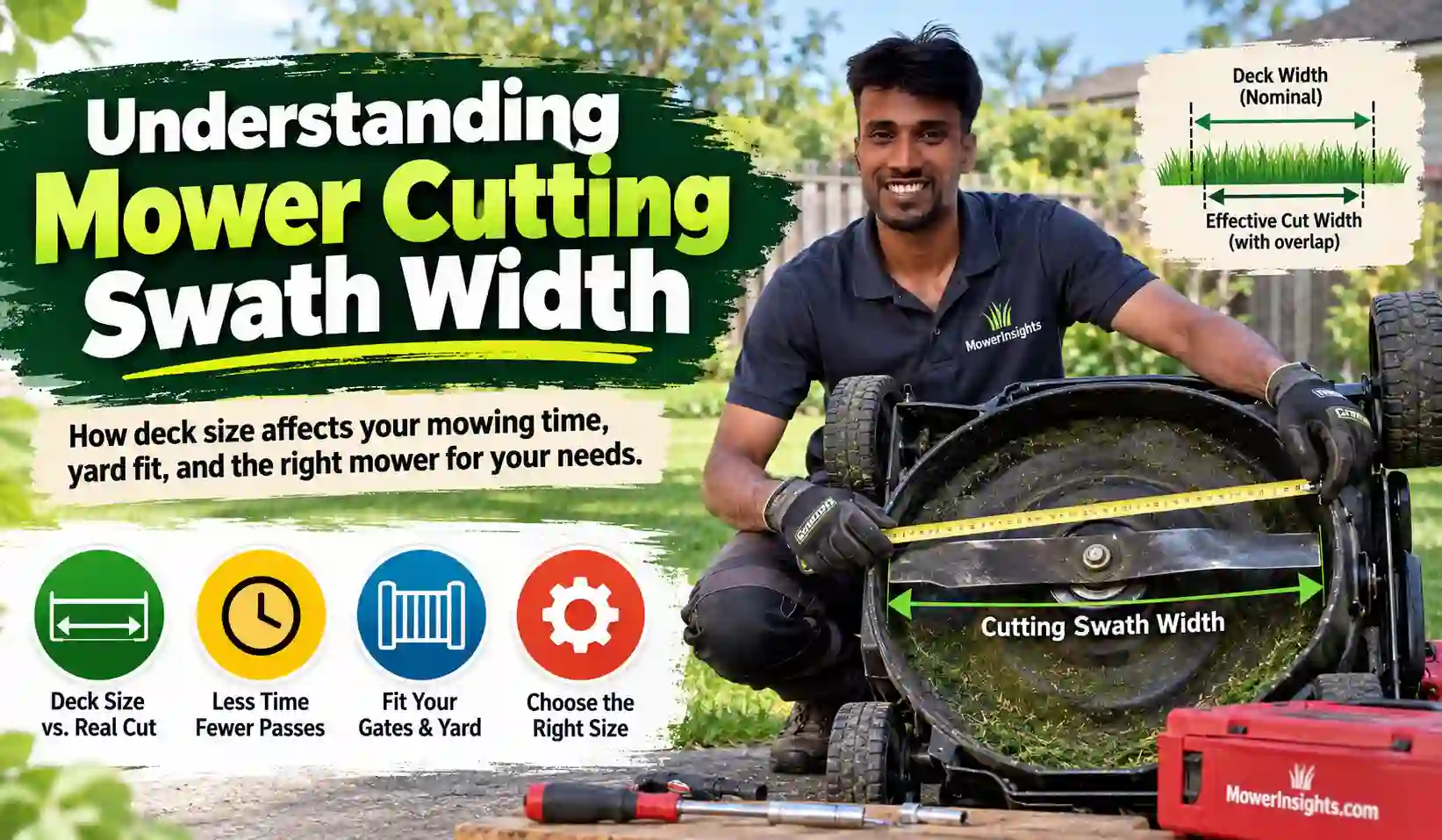
A wider deck covers more ground per pass. The Deere’s 42-inch deck is exactly twice the Toro’s 21-inch deck.
On a half-acre lawn, that gap barely matters. On a full acre, it can cut your mowing time roughly in half. Riding also removes walking fatigue completely.
This is the single biggest reason yard size should drive this decision, not brand preference.
Cutting Height and Deck Adjustment
Both mowers adjust cutting height from 1 to 4 inches. The method differs.
On the Toro, a single lever near the rear wheel sets all four wheels at once. It takes one motion. Nine positions are available between the low and high settings.
On the Deere, a spring-assisted hand-grip lever raises or lowers the whole deck from the driver’s seat (John Deere, 2024). You never need to dismount. The tractor offers 13 height positions, giving finer control across the full range.
For most homeowners, both systems are fast enough. The real difference shows up over repeated seasons. A seated lever sees less wear than a bent-over one, since you use your hand and arm the same way each time.
Storage and Maneuverability
The Toro folds upright with SmartStow. It fits in a corner of a garage or a shed shelf. Weight sits around 88-90 pounds (Toro, 2024) [VERIFY: confirm exact weight for the 21564 SKU specifically].
The Deere needs a dedicated parking spot. It weighs about 415 pounds (TractorData, 2021). You cannot lift it or fold it away.
If your storage space is tight, this alone can decide the purchase for you.
Price and Total Cost of Ownership
The Toro 21564 runs $699 to $799 depending on retailer and season [VERIFY: confirm current price near publish date]. It uses less gas per session. Blade sharpening and oil changes are simple, low-cost jobs.
The Deere S100 runs $2,499 to $3,299 depending on dealer and region [VERIFY: confirm current price near publish date]. It needs more oil, a bigger battery, and occasional belt replacement. Tune-ups cost more at a shop.
Over five years, expect the Deere’s running costs to be several times higher than the Toro’s, simply because it is a larger machine with more moving parts.
Toro 21564 — 8.4/10 Overall
| Category | Score |
|---|---|
| Cutting Performance | 8.5/10 |
| Build Quality | 8.0/10 |
| Ease of Use | 9.0/10 |
| Value for Price | 8.5/10 |
| Durability | 8.0/10 |
John Deere S100 — 8.2/10 Overall
| Category | Score |
|---|---|
| Cutting Performance | 8.0/10 |
| Build Quality | 8.5/10 |
| Ease of Use | 8.5/10 |
| Value for Price | 7.5/10 |
| Durability | 8.5/10 |
These scores come from Siddik’s hands-on time with both mower classes in his Milan repair shop, not a copied third-party number. They reflect typical owner experience with each model line, not a single unit test.
From the Repair Bench: What Actually Breaks First
I have opened up dozens of small walk-behinds like the Toro line. The most common failure is a clogged deck from wet clippings. A five-minute scrape after each cut prevents most of it.
Riding tractors like the Deere S100 usually come in for belt wear or battery failure after storage. A trickle charger over winter fixes most of that battery issue before it starts.
Neither machine has a design flaw. Both fail from skipped maintenance, not bad engineering.
Who Should Buy the Toro 21564
- You mow a yard under half an acre.
- You want low upfront cost and low running cost.
- You need to store the mower in a small space.
- You do not want to deal with a battery or a seat.
Who Should Buy the John Deere S100
- You mow a yard close to one acre.
- You want to sit down while you mow.
- You have dedicated storage space, like a shed or garage bay.
- You can budget for higher upkeep costs long term.
Common Mistakes When Choosing Between These Two
- Buying the tractor for a small yard. A riding mower on a quarter-acre lot is slow to load, slow to turn, and overkill.
- Buying the walk-behind for a full acre. You will finish the job, but your knees and back will remind you for days.
- Ignoring storage space. A tractor needs a real parking spot, not just “somewhere in the garage.”
- Skipping the trade-in math. If you already own a walk-behind and outgrew it, factor in resale value before buying new.
Frequently Asked Questions
Is the Toro 21564 self-propelled?
Yes. The Toro 21564 uses Toro’s Personal Pace self-propel system. The wheels match your walking speed automatically (Toro, 2024).
Can the John Deere S100 handle hills?
The S100 can handle gentle slopes. Steep grades over 15 degrees are not recommended for any lawn tractor, including this one, due to rollover risk.
Which mower is cheaper to maintain?
The Toro 21564 costs less to maintain. It uses less fuel, needs less oil, and has fewer parts that wear out over time.
Does the John Deere S100 come with a bagger?
The S100 can be equipped to bag, mulch, or side-discharge. A bagging attachment is sold separately from the base tractor in most cases.
How long is the warranty on each mower?
Toro backs the 21564 line with a multi-year engine and body warranty. John Deere covers the S100 with a 2-year or 120-hour bumper-to-bumper warranty, whichever comes first (John Deere, 2024).
Can I mulch leaves with either mower?
Both machines can mulch. The Toro handles light leaf cover well on small lawns. The Deere’s wider deck clears leaves faster across a large lawn.
Is a riding mower worth it for a half-acre lawn?
Usually not. A half-acre lawn takes about 20-30 minutes with a self-propelled walk-behind. A riding mower adds storage cost and maintenance without saving meaningful time at that size.
Final Verdict
Pick the Toro 21564 for any yard under half an acre. It costs less, stores easily, and needs little upkeep. Pick the John Deere S100 once your lawn approaches a full acre. The wider deck and seated ride pay for themselves in saved time and saved energy. Match the machine to the lawn, not the other way around.