Worx Landroid review searches usually come from homeowners who want one answer: can a robot mow my yard without constant babysitting? The short version is yes, on the right lawn. The Landroid line covers two very different machines, a wire-guided Landroid L and the newer wire-free Landroid Vision Cloud. This guide scores both, explains where each one struggles, and tells you which yard size and budget fit each model.

Quick Verdict
In this Worx Landroid review, the Landroid comes out as a good robot mower for flat or gently sloped yards up to about one acre, as long as you accept some light upkeep. The wire-free Vision Cloud is the better pick for most buyers in 2WD form. The older wire-guided Landroid L is cheaper but needs more patience. Each score below comes from the five scored sections that follow, and they average to the overall number.
| Item | Verdict |
|---|---|
| Overall score | 7.8 out of 10 |
| Good for | Tidy, mostly open lawns from 1/4 acre to 1 acre where you want daily mowing handled quietly |
| Not good for | Steep, bumpy, wooded, or overgrown yards, and anyone who wants zero supervision in week one |
| Price | About $1,000 to $1,750 for the Vision Cloud, depending on lawn rating. About $900 to $1,500 for the Landroid L |
| Top pro | Quiet, steady cutting that keeps grass short and clippings tiny |
| Top con | Gets stuck on roots, raised edges, and debris, so it needs an occasional rescue |
Prices may vary by retailer and change over time.
Key Specifications
Every Worx Landroid review starts with the numbers, so the table below compares the two Landroid families most US buyers see on shelves today. The Vision Cloud column lists the one-acre 2WD version (WR340). The Landroid L column lists the half-acre WR155.
| Spec | Landroid Vision Cloud (WR340) | Landroid L (WR155) |
|---|---|---|
| Navigation | Camera, AI, and cloud RTK, no boundary wire | Boundary wire you lay around the lawn |
| Rated lawn size | Up to 1 acre | Up to 1/2 acre |
| Cutting height | 1.57 to 3.54 in | 1.6 to 3.9 in |
| Battery | Worx PowerShare 20V, 5Ah | Worx PowerShare 20V, 6Ah |
| Charge time | About 60 minutes | About 90 minutes |
| Noise level | 59 dB | 63 dB |
| Weight | 30.9 lbs with battery | 22.9 lbs |
| Maximum slope | 30% (17 degrees) | About 35% (20 degrees) |
| Connectivity | Wi-Fi, Bluetooth, 4G | Wi-Fi, Bluetooth |
| Water resistance | IPX5, hose washable | Hose-friendly undercarriage |
| Warranty | 3-year limited | 3-year limited |
Worx also sells the Vision Cloud in 4WD versions and in smaller lawn ratings. Check the lawn-size rating on the box before you buy, because the mower will not cover more than its firmware allows.
Key Features
The Landroid line stands out for a handful of features, listed here before the detailed scoring.
- Wire-free mapping on the Vision Cloud: a 140-degree HDR camera, AI object detection, and cloud RTK positioning map your lawn without a perimeter wire.
- Cut-to-Zero edge blade: a second, smaller blade near the wheel reaches closer to borders than a single center blade.
- Shared battery system: both families use the Worx 20V PowerShare battery that also fits Worx cordless tools.
- App control and voice assistants: you set schedules, zones, and rain delays in the app, and the Landroid L also works with Alexa and Google Assistant.
- Built-in rain sensor: the mower stays home when the grass is wet.
Design & Build Quality
The Landroid has a compact orange body that is easy to spot in grass and sheds water well. The Vision Cloud is IPX5 rated, which means you can rinse the underside with a hose. The Landroid L WR155 added a hose-friendly undercarriage over the older WR150. Weight is 30.9 pounds for the Vision Cloud and 22.9 pounds for the Landroid L. Owner reports on older wire models are harsher than reviews of the newer Vision Cloud, so this Worx Landroid review keeps the two families apart in the notes below.
Vision Cloud body and deck
The Vision Cloud uses a self-leveling cutting deck to cut down on scalping over small bumps. Its main blade is a spinning disc with three small metal blades, closer to a trimmer head than a full mower blade. A second small blade handles the edge.
- The deck follows uneven ground better than a fixed deck.
- The body has no front bumper, so the camera and AI do the work of avoiding objects.
- There is no carrying handle, which makes moving it by hand awkward.
Landroid L body and wheels
The Landroid L uses razor-style blades and a 9-inch cutting width. It bumps into objects and turns away, which is how most wire models work.
- The default wheels can lose grip after about a year, and some owners buy spike rings or upgraded wheels.
- On soft or muddy ground, repeated turns can dig small ruts.
What worked
- IPX5 rating on the Vision Cloud makes cleaning easy.
- The orange color makes it easy to find in tall grass or at dusk.
- Blades are cheap and reversible on both families.
- The shared battery means you can swap in a spare from another Worx tool.
What didn’t
- No handle or front bumper on the Vision Cloud.
- Wheel traction on the Landroid L is its weakest design point on slopes and wet soil.
Design & Build Quality: 8.0/10
Best for: buyers who want a washable, easy-to-service body and already own Worx 20V tools.
Performance
The Landroid keeps grass short by mowing a little every day, not by tackling a jungle once a week. Reviewers who tested the Vision Cloud on a quarter-acre lawn reported neat results, tiny clippings that disappear into the turf, and clean lines at borders. Cutting power is enough for thick weeds and grass that grew a few inches too tall, but it is a maintenance mower, not a cleanup mower. This Worx Landroid review scores performance on cut quality, edge work, and how often the mower needs help.
Schedule settings that help
Short, frequent runs beat long, rare ones. Most owners set the mower to run most days, with a rain delay on, and let it make up missed time on dry days. In spring growth, add a run. In summer heat, skip the hottest afternoon hours to protect the turf from wheel marks. Raise the cutting height a notch in dry weather so the grass keeps more leaf.
Cut quality and edges
Frequent light cuts leave very small clippings that act like mulch. The Cut-to-Zero blade on the Vision Cloud trims close to walls and concrete borders. It still cannot cut where the wheel cannot go, so fences, posts, and tree bases need a string trimmer.
Debris and obstacles
Sticks, pinecones, and acorns get flicked or rolled over instead of mulched. In wooded yards, expect to clear debris by hand now and then. The camera system sees toys, pets, and furniture and steers around them. Wire models rely on an optional ultrasonic add-on for the same job, and owners report it misses objects at times.
Real-world coverage speed
A large-yard owner who ran two wire-guided Landroid mowers on about 4,000 square meters (roughly one acre) reported that each mower covers 100 to 250 square meters per hour. Adding a fresh 1,000 square meters took about a week of heavy mowing before the grass was under control. Plan on a similar warm-up period.
What worked
- Daily mowing keeps lawns looking freshly cut.
- The Vision Cloud avoids toys, a soccer goal, rocks, and a tree trunk in reviewer tests.
- Narrow corridors work on both families once zones are set.
- Slopes up to about 30% to 35% are within published limits.
What didn’t
- Sticks, leaves, and pinecones slow the mower down.
- A one-acre lawn can need three to four mow-and-charge trips, which stretches the finish time.
Performance: 8.0/10
Best for: open lawns that are already in decent shape and get mowed on a daily schedule.
Battery/Engine Performance
For battery life, this Worx Landroid review finds that the mower runs on a removable 20V battery and brushless drive motors, so there is no gas, oil, or spark plug to manage. Runtime is about two hours per charge on the Landroid L with a 4Ah pack, and charging takes about 90 minutes. The Vision Cloud charges in about 60 minutes with its 5Ah pack. That means a single machine can mow for roughly eight hours in a 14-hour day if you schedule around the charging breaks.
Runtime and charging
Charging time is part of your mowing time. A lawn near the top of the rated size can need several cycles, so a large yard may not finish in one afternoon. The Vision Cloud mower finds its way back to the charger by itself, even from off the lawn, which keeps the charging base out of the grass.
Power on slopes
The Landroid L is rated for slopes up to about 35%. The Vision Cloud 2WD is rated for 30%. The 4WD version is promoted for steeper hills, with one video review quoting up to 40 degrees.
What worked
- Fast charging on the Vision Cloud, about 60 minutes.
- Quiet motors: 59 dB on the Vision Cloud and 63 dB on the Landroid L, so night mowing is possible.
- Spare batteries from other Worx tools fit the mower.
What didn’t
- Total mowing time grows quickly on big lawns because the mower must stop to recharge.
- The 2WD Vision Cloud has less slope grip than the 4WD version.
Battery/Engine Performance: 7.5/10
Best for: yards under one acre where several short mow-and-charge cycles are fine.
Ease of Use
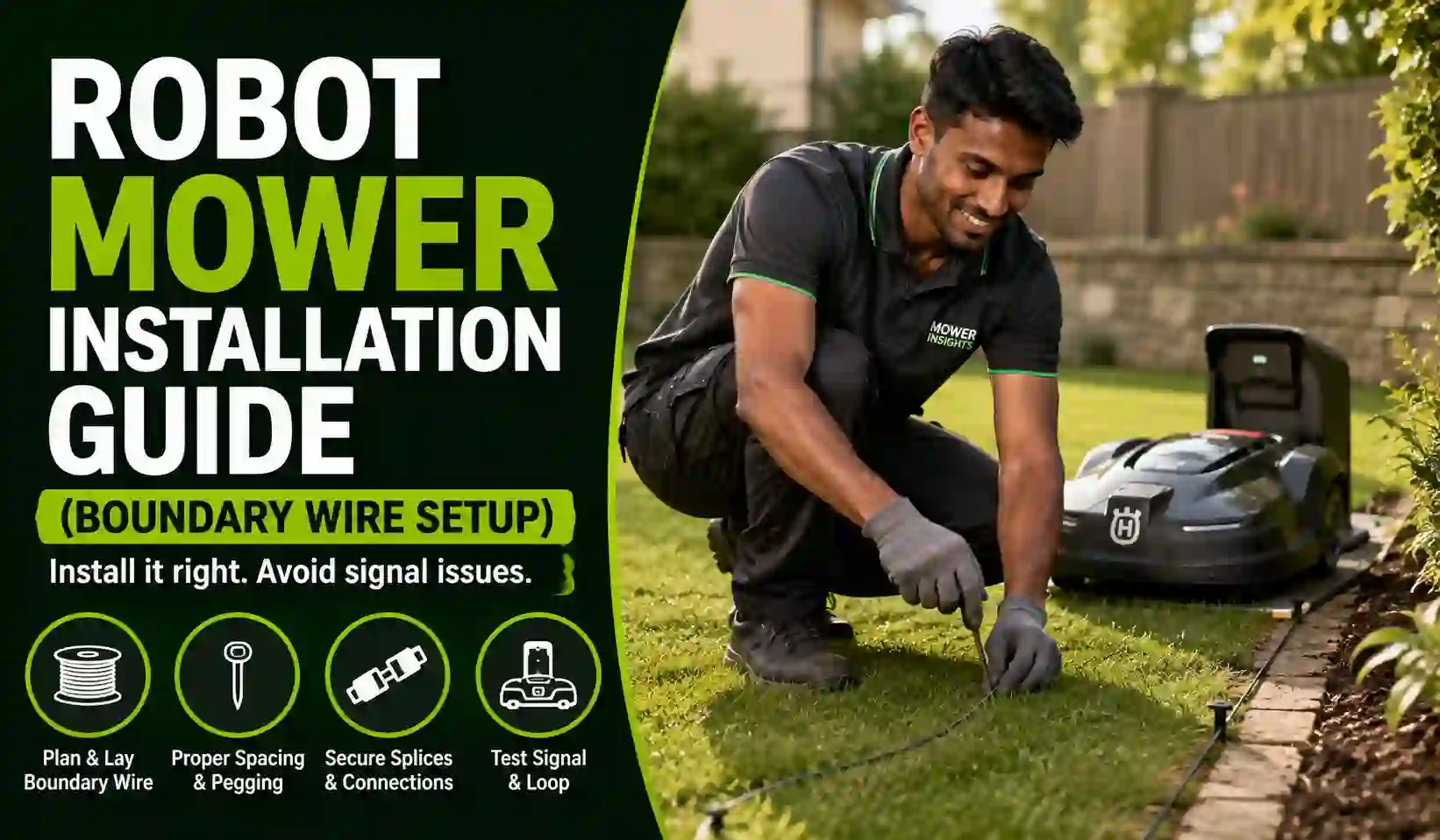
In any Worx Landroid review, setup is where the two families differ most. The Vision Cloud maps your lawn with its camera and cloud positioning, so you place the charging base, pair the app, and let it learn the lawn. The Landroid L needs a boundary wire pegged around the lawn and around any island you want to protect. Reviewers put the wire install at roughly four hours for a typical yard, and it is the step most owners dislike.
Wire-free setup on the Vision Cloud
Mapping took reviewers only a short time, including around trees and a pop-up soccer goal. Updates arrive over the air. The mower wants a flat, dedicated spot for its charging mat with clear access to the lawn.
Wire setup on the Landroid L
Pegs go in every two to three feet, and many owners add more on uneven ground. The wire runs about 10 inches from raised edges like steps and walls. A broken or loose wire triggers a “wire missing” error that some owners saw repeatedly.
The first week
Plan to watch the first few runs. Walk the lawn before the first cut and remove toys, hoses, and fallen branches. Check the mower after each of the first three sessions for stuck spots, then adjust zones or move the charging base if it keeps returning to the same trouble area. After that first week, most owners check the app once a day and rescue the mower only now and then.
The app
The Landroid app handles schedules, zones, rain delay, and notifications. On the Landroid L it can estimate your lawn area using your phone camera. Some owners report Wi-Fi pairing trouble and, on early Vision Cloud units, a “cannot connect to NTRIP” mapping error.
What worked
- Wire-free mapping removes the biggest setup chore.
- Schedules, rain delay, and push notifications are easy to find in the app.
- Alexa and Google Assistant support on the Landroid L.
What didn’t
- Boundary wire on the Landroid L takes hours and can be cut by the mower.
- Pairing and mapping errors show up in some owner reports and need support help.
- You still have to watch the first few runs.
Ease of Use: 8.0/10
Best for: smartphone-comfortable owners who want to skip wire installation.
Maintenance
A Worx Landroid review of upkeep is short, because the work is light. Worx recommends changing the blades every three to four months, and a large-yard owner reported getting about a year from a set before replacing it, with old blades sharpened and reused. Clean the underside with a hose or compressed air, check the wheels, and store the mower and battery out of freezing weather over winter. The yearly cost is mostly blades and, eventually, a battery.
Blade care
Blades are small and cheap. Tighten the screws carefully, because loose blade screws were a reported problem. Spare blade sets come in the box on many models.
Wire and cleaning care
On the Landroid L, walk the wire once a season to check for lifted sections and cuts. On the Vision Cloud, wipe the camera lens so dust and clippings do not confuse the AI.
Long-term upkeep
Some Landroid L owners replace the wheels or add spike rings after about a year. Keep a spare wire connector kit nearby if you run a wire model. Weatherproof garages are sold for both families and protect the mower from sun and rain.
What worked
- No fuel, oil, or spark plugs.
- Cheap, reversible blades that can be sharpened.
- Hose washable bodies on current models.
What didn’t
- Wheels and wire on the Landroid L need regular checks.
- Blades dull faster in sandy soil or on debris-heavy lawns.
Maintenance: 7.5/10
Best for: owners who are happy to spend a few minutes each month on cleaning and blade checks.
Pros & Cons
This table pulls together every finding from the five scored sections of this Worx Landroid review.
| Pros | Cons |
|---|---|
| Quiet at 59 to 63 dB, so it can run day or night | Gets stuck on roots, raised edges, and tall grass |
| Wire-free setup on the Vision Cloud | Weak on sticks, pinecones, and leaf-heavy lawns |
| Shared 20V battery with Worx tools | Large lawns can need three to four charge cycles |
| Cut-to-Zero edge blade reaches close to borders | Charging base needs a flat, dedicated spot |
| App scheduling, rain delay, and notifications | Landroid L needs hours of boundary wire work |
| 3-year limited warranty | No handle or front bumper on the Vision Cloud |
| Hose-washable body | Support speed varies in owner reports |
Decision-changing con: if your yard has lots of roots, ditches, or fallen branches, expect to rescue the mower often. For those yards, a different mower type may save you time.
Worx Landroid Review: How It Compares
The Landroid sits in the middle of the robot mower price range. The two tables below put each Landroid family next to its closest rival. Ratings for non-Worx models are retail averages, not MowerInsights scores.
| Model | Price | Best for | Main difference | Winner | Rating |
|---|---|---|---|---|---|
| Landroid Vision Cloud WR340 | About $1,750 | Tidy lawns up to 1 acre, wire-free setup | Built-in Cut-to-Zero edge blade | Edge cutting | 7.8/10 (MowerInsights) |
| Roborock RockMow X115H | About $1,725 to $1,740 | Buyers who want a wider cut | 9.4 in cutting width, optional edge cutting | Price and width | 4.6/5 retail average |
| Model | Price | Best for | Main difference | Winner | Rating |
|---|---|---|---|---|---|
| Landroid L WR155 | About $900 to $1,500 | Half-acre yards that can take a wire | Larger yard rating, shared Worx battery | Yard size | 7.0/10 (MowerInsights) |
| Husqvarna Automower 115H | About $600 to $700 | Small, simple wire yards | Lower price, smaller yard rating | Budget | Not scored here |
The Vision Cloud wins on edges and setup. The Roborock wins on price per cut width at the time of writing. The Landroid L wins on lawn rating and battery sharing. The Husqvarna 115H wins on price for small lawns.
Who Should Buy?
This Worx Landroid review points to the following yards and owners as the best fit.
- Flat or gently sloped suburban lots: a 1/4 to 1 acre yard with open grass suits the Vision Cloud, and a 1/4 to 1/2 acre yard suits the Landroid L.
- Homeowners who hate weekend mowing: daily light cuts replace the weekly job, and you only need a string trimmer for fence lines.
- People with Worx tools: the shared 20V battery saves money on spares.
- Buyers in quiet neighborhoods or with HOA noise rules: 59 to 63 dB is quiet enough for early morning or evening runs.
Who Should Avoid?
Skip the Landroid, or step up to a higher model, in these cases.
- Steep hills over 30% to 35%: look at a 4WD robot mower rather than the 2WD Vision Cloud or Landroid L.
- Yards full of sticks, pinecones, and leaves: a cordless self-propelled push mower will mulch that debris better.
- Overgrown lawns: the Landroid keeps grass short but will stall on tall, neglected growth. Mow it down once by hand first.
- Yards over one acre: consider a larger robot mower or two machines.
Price & Value
The Landroid Vision Cloud typically lists from about $1,000 for the half-acre version up to about $1,750 for the one-acre WR340, with 4WD versions near $2,050. The Landroid L WR155 has been listed from about $1,400 to $1,500, with sale prices near $900. Prices may vary by retailer and change over time.
Cost over time
A Worx Landroid review of value has to look past the sticker price. A mower with no gas, oil, or spark plugs costs little to run. Blades are the main yearly expense, and a replacement battery is the main long-term one. A homeowner who pays someone to mow weekly may earn back the purchase in a few seasons. A homeowner who mows alone gets back time instead of money.

What the price buys
For roughly the cost of a good riding mower, the Landroid replaces most of your weekly mowing. The Vision Cloud 2WD gives you wire-free mapping and an edge blade for less than many wire-free rivals. The Landroid L costs less but adds hours of wire installation.
Add-on costs
Accessories add up. A collision-avoidance module for wire models was listed at $249, a weatherproof garage at about $130, and digital fencing at about $130. A 4G tracking unit came with a year of coverage on some Landroid L kits. Budget for a garage if your charging base sits in the open.
Warranty & Support
Both Landroid families carry a 3-year limited warranty from Worx covering manufacturing defects. Read the current terms and exclusions on the Worx warranty page, since coverage can differ by region and retailer.
How support works
Owners reach Worx by phone and online channels, and Worx replies publicly to some complaints. Experiences vary. Some owners praise fast help, while others report long waits for repairs or a mower stuck on an error code for weeks. Buying from a local dealer can shorten service time. Keep your receipt and photos of any issue. Register the mower soon after purchase, and note the serial number from under the rear hood. If an error code repeats, write down the code and the date before you call, since support will ask for both.
FAQs
Is the Worx Landroid worth the money?
Yes, by the numbers in this Worx Landroid review, for a flat or gently sloped yard where you want hands-off daily mowing. It is a good value in the Vision Cloud 2WD form at roughly $1,000 to $1,750. It is less worth it on rough, root-heavy, or wooded lots.
Does the Worx Landroid need a boundary wire?
The Landroid Vision Cloud does not need one. It maps with a camera, AI, and cloud RTK. The Landroid L does need a boundary wire laid around your yard and any off-limits islands.
How big a yard can a Worx Landroid mow?
Ratings range from about 1/8 acre to 1 acre depending on model. The Landroid L WR155 is rated for 1/2 acre and the Vision Cloud WR340 for 1 acre. Firmware limits the area, so a bigger battery will not stretch the rating.
Can the Worx Landroid handle slopes?
The Landroid L is rated for slopes up to about 35%, and the Vision Cloud 2WD for 30%. The 4WD Vision Cloud is promoted for steeper terrain. Soft or wet ground cuts the real-world limit.
How loud is the Worx Landroid?
The Vision Cloud is rated at 59 dB and the Landroid L at 63 dB. Both are quiet enough to run in the evening or early morning. That is about the volume of normal conversation.
How often should I change Landroid blades?
Worx recommends every three to four months. Some owners get closer to a year from a set and sharpen old blades for reuse. Check them monthly if your lawn is sandy or full of debris.
Does the Worx Landroid work in the rain?
It has a rain sensor and stays home when the grass is wet. It will make up lost time on dry days. Both families can be rinsed with a hose after mowing, and a garage adds protection.
Does the Worx Landroid need Wi-Fi?
The app and automatic updates use Wi-Fi, and the Vision Cloud also has 4G and Bluetooth. The Landroid L has onboard controls, so you can run it without the app, but you lose cloud features like automatic updates.
What does this Worx Landroid review cover?
This Worx Landroid review covers the wire-free Vision Cloud and the wire-guided Landroid L. It scores design, performance, battery, ease of use, and maintenance, then compares the line with close rivals on price and fit.
Final Verdict
This Worx Landroid review ends at 7.8 out of 10. Its best use is a flat, open, tidy yard of 1/4 to 1 acre where daily quiet mowing and a wire-free setup matter most. The Vision Cloud 2WD is the model to buy for most people. Choose the Landroid L only if the lower price outweighs the wire work. Look elsewhere if your yard is steep, wooded, or littered with branches, because the mower will need frequent rescues there.
Why Trust This Worx Landroid Review
Siddik Kazi runs a lawn mower repair service in Italy, and that workshop experience shapes which wear points, failures, and upkeep tasks this guide pays attention to.
Sources and methodology: this guide draws on manufacturer specifications, published owner feedback from US and international retail listings, and a review of existing coverage of the Landroid line. It does not include hands-on testing by MowerInsights. Scores are MowerInsights editorial judgments based on that comparison.