Quick Answer
A 4-stroke engine uses two kinds of fuel: gas and oil, kept apart. It runs clean and quiet. It is the top choice for push and riding mowers today. A 2-stroke engine mixes oil right into the gas. It runs light and strong for its size. You’ll find it in trimmers, edgers, and a few small mowers. For most yards, pick a 4-stroke mower. Save 2-stroke for tools you carry or swing, not push.
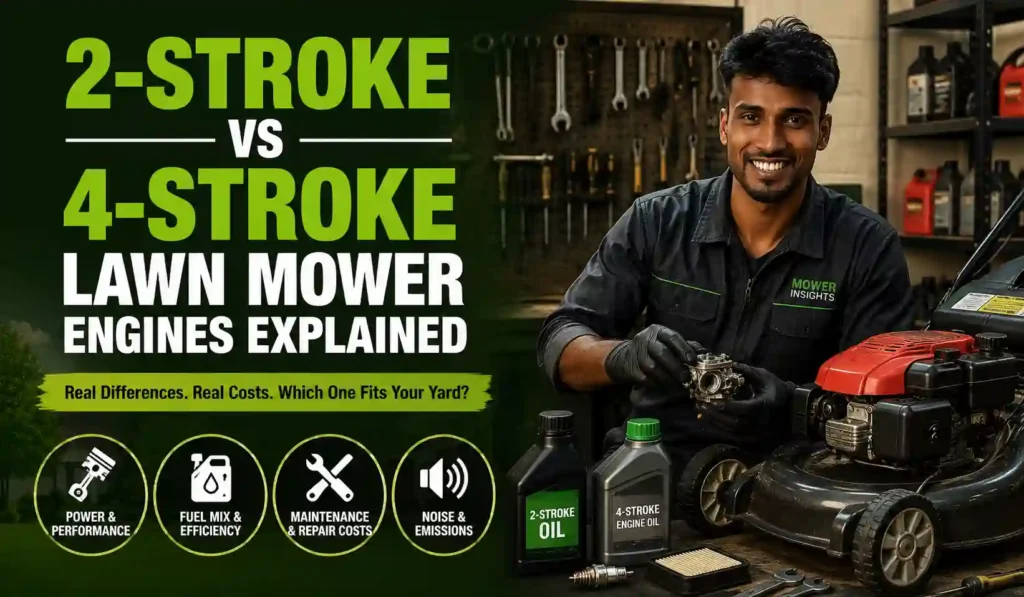
What Is a 2-Stroke Engine?
A 2-stroke engine does its full job in one round trip of the piston. That’s one turn of the crankshaft. It skips a separate oil tank. Instead, you mix oil right into the gas before you fill the tank. A common mix is 40:1 or 50:1, gas to oil. The exact ratio depends on the brand.
This build is why 2-stroke engines show up in tools you hold: trimmers, chainsaws, blowers, and older push mowers made before strict rules hit in the early 2000s. Fewer parts means less weight. No oil pan means the engine can tilt or run at odd angles without starving the crank of oil. That helps on a slope.
Most people who own a 2-stroke mower today got it as an older machine, or bought a cheap, light model. New 2-stroke mowers are rare now in the US and EU. They burn oil along with gas, which pushes emissions past what most current rules allow (EPA, 2024).
What Is a 4-Stroke Engine?
A 4-stroke engine splits its job into four piston strokes across two full crank turns: intake, squeeze, spark, and exhaust each get their own stroke. Oil sits in its own case and coats the engine at all times, much like a car engine.
This is the engine in nearly every push mower, self-propelled mower, and riding mower sold new today. Briggs & Stratton, Honda, and Kohler build their current home mower lines around 4-stroke design (Briggs & Stratton, 2025). It burns fuel more fully, makes less smoke, and runs quieter at idle. Those three things matter more on a mower you push for 30 to 60 minutes than on a trimmer you use for five.
The cost is weight and more parts. A 4-stroke engine has more inner parts: an oil pump or splash system, a separate oil cap, and a heavier block. That adds bulk to the mower.
How the Two Engines Actually Work
Here is the plain version. No charts. No jargon.
Inside a 2-stroke: the crankcase itself acts as a squeeze chamber. As the piston moves up, it squeezes the fuel-air mix above it. At the same time, it pulls a fresh dose of fuel, air, and oil mist into the space below it. When the piston fires and drops back down, it pushes that fresh dose up into the cylinder. This happens right as the exhaust port opens. That overlap wastes fuel. Some of the fresh mix slips out the exhaust unburned.
Inside a 4-stroke: valves handle intake and exhaust one at a time. There is no overlap and no lost fuel out the exhaust port at that step. Oil stays in the crankcase. It gets pumped or splashed onto moving parts. It never mixes with the gas that reaches the cylinder. This is the main reason 4-stroke engines use less gas and make far less smoke.
| Stage | 2-Stroke | 4-Stroke |
|---|---|---|
| Power strokes per turn | 1 per turn | 1 per two turns |
| Oil delivery | Mixed into fuel | Held in its own case |
| Typical weight (mower engine) | 6-10 lbs lighter | Heavier due to oil system |
| Fuel use | Lower – some fuel exits unburned | Higher – no overlap loss |
| Smoke at start | Blue-gray smoke is normal | Little to none |
| Common use today | Trimmers, blowers, older mowers | Nearly all new push and riding mowers |
Power, Weight, and Fuel: The Real Differences
A 2-stroke engine fires once per crank turn, not once per two turns. That’s why a small 2-stroke can push out more power for its weight than a same-size 4-stroke. This is why hand tools, tools you hold up against gravity for a long time, still lean on 2-stroke design even now.
On a mower, this edge matters less. The wheels carry the engine’s weight, not your arm. So the 4-stroke’s extra bulk is not a real problem in daily use. What you gain instead is better fuel use: a 4-stroke mower burns less gas per hour of mowing, since no fuel-air mix slips out unburned.
Getting the fuel mix right matters more than most owners think. Too little oil in a 2-stroke mix, and the engine runs hot. Piston rings wear down fast. Too much oil, and you get fouled spark plugs, soot buildup, and thick blue-gray smoke.
Expert Tip: In the shop, the fastest sign of a 2-stroke run with no oil is a piston with clear scuff marks on one side. That harm is permanent. The engine needs a new piston and cylinder. A clean won’t fix it.
Noise, Smell, and Emissions
A 4-stroke mower often runs at 85-90 dB near the operator’s ear while cutting. A 2-stroke engine of like power tends to run 3-5 dB louder. It has a higher-pitched note and no muffled burn cycle. [VERIFY: exact dB figures vary by model and should be confirmed against maker spec sheets before publishing]
Smell is an easy way to tell the two apart, even with the hood shut. A 2-stroke burns oil at all times as part of how it works. Its exhaust has a sweet, sharp smell most link to go-karts, jet skis, or old chainsaws. A 4-stroke’s exhaust smells more like a car. It’s faint, with none of that oily sweetness, unless something is wrong.
Emission rules are the top reason 2-stroke mowers have left store shelves. Since oil burns along with the fuel, 2-stroke engines put out more raw hydrocarbons and soot per hour of use than 4-stroke engines (EPA, 2024). Some cities and states, including parts of California, have pushed new limits on small 2-stroke gas tools in recent years. That has pushed more buyers toward 4-stroke and battery mowers.
Maintenance and What Breaks First
This is where shop time gives real, not generic, advice.
On 2-stroke engines, the top fix we see is a clogged carb from gas with ethanol left to sit too long. The fuel-oil mix splits apart, and the tiny carb jets clog fast. This hits hard on mowers stored over winter with fuel left in the tank. The next most common fix is a worn piston or rings from a bad or uneven oil ratio. Once that wear starts, it does not reverse.
On 4-stroke engines, the top fix we see comes from old, dirty, or low oil. People treat mower oil like they treat car oil: they forget it. By the time the engine starts to knock, the bearings are often already scarred. The next most common fix is a clogged air filter that chokes the engine. 4-stroke engines feel a blocked air path more than 2-strokes do.
| Engine Type | Most Common Failure | Typical Cause | Typical Repair Cost |
|---|---|---|---|
| 2-Stroke | Clogged carburetor | Old ethanol fuel left to sit | $40-$90 for a clean or rebuild |
| 2-Stroke | Worn piston/rings | Wrong oil ratio or no oil at all | $120-$220, at times not worth the fix |
| 4-Stroke | Worn bearings, engine knock | Old or low oil, skipped oil changes | $150-$350, at times close to a swap |
| 4-Stroke | Blocked air filter | Skipped filter cleaning or swap | $10-$25 for a new filter |
Common Mistakes Homeowners Make
- Using plain gas in a 2-stroke mower, since “it’s just a small engine.” This wrecks the piston in a few hours with no oil in the mix.
- Letting a 4-stroke sit for months with old oil still in the case, then asking why it knocks at start-up.
- Storing either engine type with a full tank of ethanol gas over winter with no stabilizer. This gums up the carb by spring.
- Thinking 2-stroke and 4-stroke oil are the same. They are made for different jobs. Use the wrong one, and wear speeds up in either engine.
Total Cost of Ownership
Price at the store is not the whole story. A 2-stroke mower often costs $50-$100 less up front than a like 4-stroke model. That gap shrinks fast once you add up fuel and oil.
- 2-stroke mower: lower cost up front, but it burns oil at all times. Plan on $15-$25 a season for oil, plus more carb cleaning if the mower sits idle between uses.
- 4-stroke mower: higher cost up front, but one oil change (about $8-$15 in oil) often covers a full season. Fuel use is much better across a summer of mowing.
Over five years of use, a 4-stroke mower often costs less to run day to day, even with a higher buy-in price. The 2-stroke wins on simple fixes: fewer parts mean a home owner with basic tools can often fix one. A 4-stroke’s oil system and extra parts make some fixes more of a shop job.
Which One Should You Buy?
[IMAGE PLACEHOLDER: Siddik pushing a 4-stroke mower across a mid-size residential lawn]
For a standard push or riding mower in 2026, pick a 4-stroke as your default. It’s quiet. It burns fuel well. It’s what most current mower models use, which means parts and service are easy to find.
A 2-stroke mower still fits a few cases:
- You already own one and it runs fine. No need to swap it out just to change engine type.
- You want the lightest mower for a small, flat plot, and you don’t mind mixing fuel each time.
- You’re buying a hand tool like a trimmer or edger, not a wheeled mower. 2-stroke stays the norm there, since weight matters most.
If your yard is under about 500 m² (near 5,400 sq ft) and mostly flat, either engine type will do the job. Your choice comes down to noise and how much you mind fuel mixing.
If your yard is larger, has slopes, or you mow more than once a week in season, go with a 4-stroke mower. Better fuel use and fewer fixes add up fast at that pace.
Who this is NOT for: if this is your first mower and you want the simplest path, no fuel math, no mix ratios, less risk of a costly slip, skip 2-stroke. Go straight to a 4-stroke or a battery mower.
Troubleshooting: Signs You Have the Wrong Fuel Mix
If you own or inherit a 2-stroke mower and don’t know if the last owner mixed fuel right, check for these signs before you run it hard.
Too little oil in the mix:
- The engine runs hot fast, within a few minutes of use.
- A faint hot-metal smell shows up while you mow.
- Power drops off bit by bit, instead of staying steady.
Too much oil in the mix:
- Thick blue-gray smoke that does not clear after the first minute.
- The spark plug fouls again and again, which causes hard starts or stalls.
- Black, oily buildup forms near the exhaust port.
If you see either pattern, drain the tank. Flush it with a fresh, correct mix. Check the spark plug before you run the mower again. Keep running it on a bad mix, and a $10 fuel fix turns into a $150+ piston repair.
Frequently Asked Questions
What is the difference between a 2-stroke and 4-stroke lawn mower engine?
A 2-stroke engine mixes oil into the fuel and fires once per crank turn. A 4-stroke engine keeps oil in its own case and fires once per two turns. 4-stroke engines run cleaner, quieter, and use less fuel, which is why most mowers today use them.
Are 2-stroke lawn mowers still made?
New wheeled 2-stroke push mowers are rare now due to emission rules. 2-stroke engines still show up in hand tools, like trimmers and blowers. Most 2-stroke mowers in use today are older models.
Can I put regular 4-stroke oil in a 2-stroke engine?
No. 2-stroke oil is made to burn clean along with the fuel. 4-stroke oil is made to stay in a case and is not meant to burn. Use the wrong oil, and you get fouling and faster wear.
Which engine type is more fuel-efficient?
4-stroke engines use less fuel. There is no overlap between intake and exhaust strokes, so less raw fuel slips out the exhaust. 2-stroke engines lose some fuel-oil mix out the exhaust as part of how they run.
Is a 2-stroke or 4-stroke mower easier to maintain?
A 2-stroke has fewer parts, so a home owner may fix it with basic tools. But it needs the right fuel mix each time you fill it. A 4-stroke needs regular oil changes and filter checks, but it runs on plain pump gas with no mixing.
How long do 2-stroke and 4-stroke mower engines typically last?
With the right fuel mix and steady upkeep, a well-kept 2-stroke hand tool engine can run for many seasons. Mower-size 2-strokes are less common now, so parts can be harder to find long term. 4-stroke mower engines, with steady oil changes, often run 8-10+ years of normal home use before they need real work.
Key Takeaways
- 4-stroke engines are the norm for new push and riding mowers. They give better fuel use, less noise, and cleaner exhaust.
- 2-stroke engines still fit hand tools and a few light mower cases, but they need the right fuel mix every time.
- The top 2-stroke fix is a clogged carb from old ethanol fuel. The top 4-stroke fix is worn bearings from skipped oil changes.
- Total cost tends to favor 4-stroke mowers over several years, even with a higher price up front.
- Getting the fuel mix right is the single biggest factor in a 2-stroke’s life span. Get it wrong, and the harm sticks.
Pingback: How a Lawn Mower Engine Works: A Simple Step-by-Step Guide