Quick Answer
Steel decks cost less. They are easy to fix. But they rust over time and add weight to the mower. Aluminum decks cost more. They do not rust and stay light for years. But a cracked aluminum deck often can’t be patched. It has to be swapped out. For a flat yard under 1,000 m² (about 10,800 sq ft), steel is the better value. If you store the mower outside, live in a damp climate, or want a mower that is easy to push, pick aluminum.
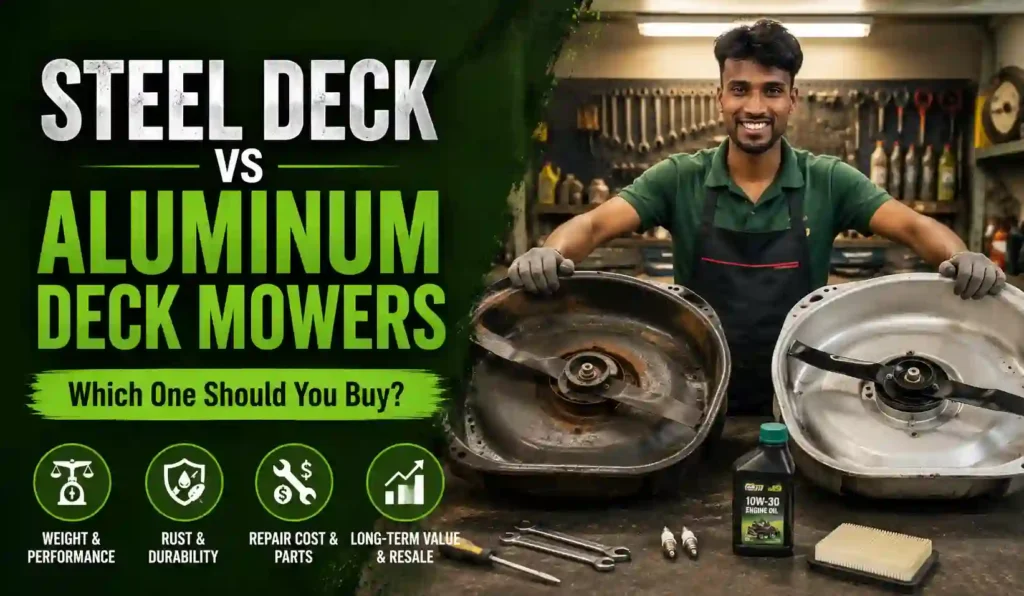
What “Deck Material” Actually Means
The deck is the metal shell over the spinning blade. It is not just a cover. It shapes how grass moves, how the mower takes a hit, and how much the whole tool weighs.
Two materials lead the market. One is stamped or welded steel. The other is cast or formed aluminum. Some high-end mowers use plastic decks, but this guide sticks to the two metals, since they cover most walk-behind mowers sold today.
Deck material affects four things buyers care about most. How heavy the mower feels. How it takes a hit from a rock or root. How long it lasts. And what it costs to fix.
Steel Decks: How They’re Built and What They Cost
Steel decks are stamped from one sheet or welded from two or three pieces. Then they get a paint or powder coat to slow rust. Most mid-range mowers from Toro, Honda, and Craftsman use 20 to 22-gauge steel.
A gas push mower with a steel deck runs $250 to $450 at retail as of 2026. This is based on current listings from Home Depot, Lowe’s, and brand sites. Steel is cheap to stamp and weld. That is why it shows up on most budget and mid-range mowers.
Steel takes a hit well. A rock, a stump, or a sprinkler head will dent the deck, not crack it. The dent rarely changes how the mower cuts. In the shop, we see steel decks that took a hard hit from a hidden root. They kept mowing fine for years, just with a dent.
The trade-off is rust. Steel rusts wherever paint chips off. Wet clippings packed under the deck hold moisture against bare metal for hours after each mow.
Aluminum Decks: How They’re Built and What They Cost
Aluminum decks are cast or die-formed. This gives fewer seams and a smoother underside. Brands like EGO, Snapper, and higher-end Honda models use aluminum for buyers who want light weight and no rust.
Aluminum push mowers run $350 to $600 at retail as of 2026. That is about $100 to $150 more than steel. This is based on current EGO, Snapper, and Honda pricing. Aluminum costs more as raw material. Casting it also costs more than stamping steel.
Aluminum forms a thin outer layer that blocks rust. That layer lets an aluminum deck sit outside in the rain for years with no flaking or orange rust. This is the top reason buyers pick aluminum.
The trade-off is how it fails. A hard hit can crack or split aluminum, most often near bolts and stress points. A cracked aluminum deck usually can’t be welded back to full strength. So the fix is often a full swap, not a patch.
Steel vs Aluminum Deck Comparison Table
| Factor | Steel Deck | Aluminum Deck |
|---|---|---|
| Typical retail price (2026) | $250-$450 | $350-$600 |
| Weight (21-inch push mower) | 65-80 lbs | 50-65 lbs |
| Rust resist | Low – rusts where paint chips | High – resists rust on its own |
| Impact response | Dents, keeps working | Can crack, often needs a swap |
| Repair cost for damage | $30-$80 (patch or repaint) | $150-$300+ (full deck swap) |
| Typical lifespan (moderate use) | 6-10 years | 10-15+ years |
| Best climate fit | Dry to moderate humidity | High humidity, coastal, or wet storage |
Prices reflect current listings. Check them again close to publish date, since retailers run sales that shift price by $30-$80.
Weight and How It Affects Real Mowing
A light mower is easier to push, turn, and lift. Aluminum decks run 15 to 20 pounds lighter than a steel deck on the same model. On a flat, small yard, this barely matters. On a slope, or a yard over 500 m² (about 5,400 sq ft), it adds up fast.
The weight gap matters most in three spots. Pushing up a slope. Lifting the mower into a truck bed or over a shed step. And tight turns around flower beds. If any of these fit your yard, the lighter aluminum deck cuts down on real strain.
For flat yards under 500 m², the weight gap is close to a non-issue. Most people will not notice it after the first few mows.
Rust, Cracks, and Which Damage Is Worse
Rust starts small and gets worse over time. It often begins at a scratch or a paint chip. This tends to happen where the deck rubs the wheel brackets, or where clippings pack against bare metal. Left alone, rust eats through the deck. This leaves holes that let clippings escape. In bad cases, it weakens the deck enough that it flexes under the blade.
A crack in an aluminum deck acts in a different way. It shows up as a thin line near a stress point, like a bolt hole, after a hard hit. Cracks do not spread from moisture the way rust does. But they do not heal or slow down either. Once a crack starts, it grows with vibration and use until the deck fails.
In the shop, rust is the more common repair call by far. That is mostly because steel decks outnumber aluminum ones in the mowers people bring in. But when an aluminum deck does fail, it is often a full swap, not a patch job. That tends to cost more per repair, even though it happens less often.
A typical rust job looks the same almost every time. The owner mowed through fall and put the mower away wet, with clippings still packed under the deck. Come spring, orange flakes show up near the discharge chute. That spot rusts first, since clippings sit there longest and the paint takes the most wear as grass gets forced out under the blade.
Aluminum cracks show up in a different way. The mower usually hit something solid: a curb, a sprinkler head, or a buried rock. The deck flexed past what the metal could take. The crack starts as a thin line near the bolt hole closest to the hit. It does not show up as a mowing problem right away. It often gets caught during a routine blade change, when the deck flexes more than it should under hand pressure.
Cut Quality on Wet, Thick, and Uneven Grass
Deck material has almost no direct effect on how clean the cut looks. Cut quality comes down to blade sharpness, deck height, and engine or motor power, not the deck’s material.
Where material does matter is clipping buildup. Steel decks have a rougher factory paint texture. They tend to hold wet clippings against the underside a bit more than the smooth cast finish on most aluminum decks. That buildup can cause clumps on wet grass. If left packed in, it feeds the rust problem too.
On thick or tall grass, deck shape and blade design matter far more than material. A high-lift blade under a well-built steel deck will beat a poorly shaped aluminum deck every time. Do not choose material for cut quality. Choose it for weight, climate, and how much repair you can tolerate.
One spot where material shows up is airflow noise. Aluminum decks are cast as one smoother piece. They tend to run a bit quieter at the same engine speed than a welded steel deck with seams and rough inner surfaces. The gap is small, just a few decibels, and will not matter to most people. But it is worth noting if you mow early near a neighbor’s window.
Repair Cost and Parts stock levels
Steel deck repairs are cheap and fast. A rust patch, weld fix, or repaint at a local shop runs $30 to $80. Most small-engine shops can do this without ordering special parts.
Aluminum deck repairs cost more. Welding aluminum needs different gear and more skill than steel, and many shops just do not offer it. A full aluminum deck swap runs $150 to $300, based on the mower model, plus labor if you do not install it yourself.
Steel replacement decks are also easier to find. Steel is the more common material across budget and mid-range brands, so aftermarket and factory steel decks sit on more shelves. Aluminum parts sometimes have to be special-ordered straight from the maker.
Long-Term Ownership and Resale Value
Over a 10-year span, a steel deck mower usually needs one rust fix or repaint. That runs $30 to $80. There is also a higher chance of a full deck swap if rust reaches load-bearing spots. An aluminum deck mower usually needs no deck work at all in that same span, barring a hard hit.
On the resale market, rust hurts price. A mower with visible rust or a repainted deck sells for less than one with a clean deck. This is true even if the engine and blade run just as well. Buyers judge deck condition by sight before they check anything else. An aluminum deck mower of the same age tends to hold its resale value better, since it still looks new.
Total cost over 10 years, price plus repairs, lands close for both. Steel costs less up front and more in small fixes. Aluminum costs more up front and less in upkeep.
ow Deck Material Affects Blade Balance and Vibration
Most buying guides skip this, but it comes up often in the shop. A dented steel deck rarely throws off blade balance, since the dent sits in the housing, not the blade. Vibration on steel deck mowers almost always traces back to a bent blade or a worn spindle bearing, not the deck.
Aluminum decks flex a bit more than steel under vibration, since the metal is less stiff at the same thickness. On an aluminum deck mower with a loose deck bolt, that extra flex can make vibration feel worse than the same fault would on steel. It is a good reason to check deck bolt torque on aluminum mowers at the start of each season.
Expert Tip: If an aluminum deck mower starts to shake more than usual, check the deck bolts first. Do this before you assume the blade needs balance work. A loose bolt on a flexing aluminum deck mimics blade imbalance almost exactly. We have seen customers pay for a blade balance that fixed nothing, when the real fault was a quarter-turn loose bolt.
Who Should Buy a Steel Deck Mower
Steel fits best in a clear case. Your yard is flat, under about 1,000 m² (10,800 sq ft). You store the mower in a dry garage or shed. It also fits if budget matters more than long-term upkeep. The up-front savings of $100 to $150 usually beat the cost of the odd rust fix.
Steel also makes sense if you do basic upkeep yourself, or have a small-engine shop nearby, since steel fixes are cheap and easy to get.
Not a good fit if: You live in a coastal or humid climate. You store the mower outside or in a damp shed. Or you have a sloped yard where the extra 15-20 pounds will wear you out.
Who Should Buy an Aluminum Deck Mower
Aluminum fits best in a few cases. You live somewhere humid or coastal. You store the mower outside or in a damp shed. Or you want the lightest mower you can find for a sloped or large yard.
It is also the right call if you plan to keep the mower for 10+ years. The deck will still look good when you sell it.
Not a good fit if: Budget is your main limit. Or your yard is flat and small enough that weight and rust will not turn into real issues over a normal ownership span.
Buying Mistakes to Avoid
- Do not assume a painted steel deck is rust-proof. Paint only slows rust. It does not stop it once the coat chips, which happens from normal use in the first season or two.
- Do not pick aluminum for weight alone without checking if the yard needs it. On a flat, small yard, the price bump buys little real gain.
- Do not ignore deck gauge on steel models. A thinner 22-gauge deck dents easier and rusts through faster than a thicker 20-gauge deck, even from the same brand.
- Do not skip the underside wash after each mow. Clipping buildup speeds up rust on steel and can mask early rust until it turns serious.
- Do not skip deck bolt torque checks on aluminum models. A deck that flexes more than it should is often a upkeep gap, not a design flaw. A quick check with a wrench before the season can head off the vibration issues above.
- Do not store either mower against a damp outer wall or right on bare concrete. Both decks do better with airflow underneath during storage, and steel suffers most when moisture sits trapped under the deck for weeks.
Frequently Asked Questions
Which deck material lasts longer, steel or aluminum?
Aluminum decks tend to last 10-15+ years, since they do not rust. Steel decks last 6-10 years before rust turns into a real concern. Actual lifespan depends a lot on storage and how often you clean the underside.
Is an aluminum deck mower worth the extra cost?
Yes, if you store the mower outside, live in a humid or coastal spot, or need the light weight for a sloped yard. For a flat, small yard with dry indoor storage, steel gives you close to the same real-world result for less money.
Can a rusted steel deck be repaired?
Yes, as long as rust has not eaten through the metal. A shop can grind off surface rust, patch small holes, and repaint the deck for about $30 to $80. Once rust cuts holes near the blade housing, a swap is usually safer than a patch.
Does deck material affect how well the mower cuts grass?
Not in a direct way. Cut quality depends on blade sharpness, deck height, and engine or motor power. Deck material only shifts cut quality in a small way, through clipping buildup and clog risk on wet grass.
Are aluminum decks harder to repair than steel?
Yes. Welding aluminum needs different gear and more skill than steel, so fewer general shops offer it. Most aluminum deck damage, cracks most of all, gets fixed with a full deck swap, not a patch.
Do steel decks weigh down the mower’s handling on slopes?
Yes, in a real way. A steel deck mower runs 15-20 pounds heavier than a matched aluminum model. That gap matters when you push uphill or work a slope for a long mow.
Bottom Line
Steel and aluminum decks solve different problems. Steel costs less and repairs cheap, but it rusts and adds weight. Aluminum costs more up front and fights off rust and long-term wear, but a crack often means a full swap, not a patch.
Match the material to your yard and your climate, not to ad copy about “premium” build. A steel deck mower stored dry and cleaned after each mow will often outlast a neglected aluminum deck mower. The same holds true in reverse.
Pingback: Honda vs Briggs & Stratton Engines: Which Lasts Longer
Pingback: Best Lawn Mowers for Small Yards
Pingback: Toro Recycler 20340 vs 21352: Which Mower Fits Your Yard