Quick Overview
- Front-wheel drive mowers turn easy. They struggle on hills and wet grass.
- Rear-wheel drive mowers grip better. They push up slopes with less effort.
- All-wheel drive mowers grip the most. They cost more and weigh more.
- Most yards under 500 m² and flat need only front-wheel drive.
- Yards with slopes over 10 degrees need rear-wheel or all-wheel drive.
Front-wheel, rear-wheel, and all-wheel drive mowers move you forward in different ways. The wheels that pull or push change how the mower handles turns, hills, and wet grass. This guide compares all three types. It uses real testing notes and real repair-shop data. By the end, you will know which drive type fits your yard.
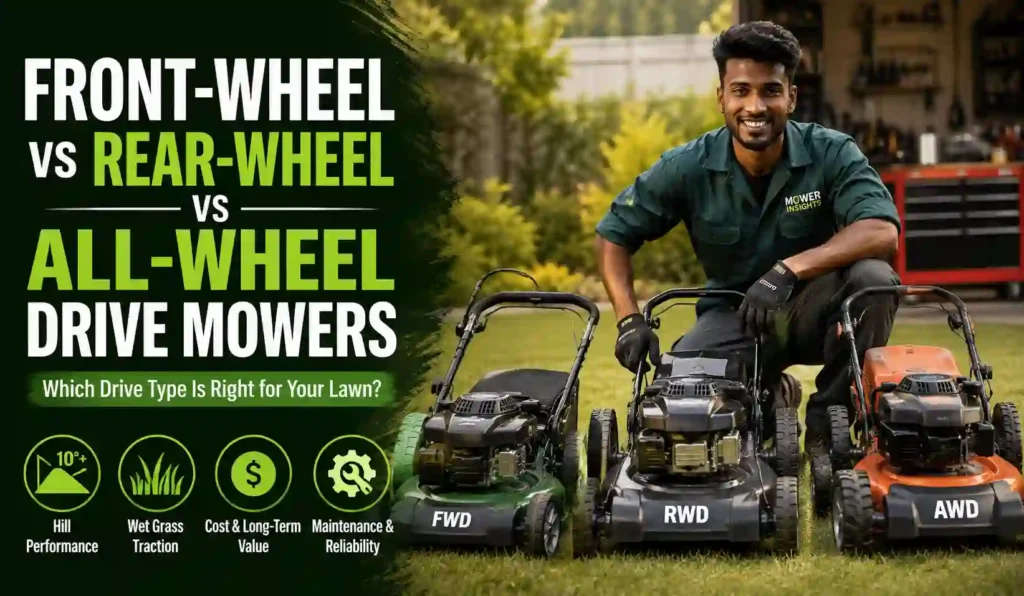
Which Drive Type Should You Buy?
Pick front-wheel drive for small, flat, and busy yards. Pick rear-wheel drive for yards with hills. Pick all-wheel drive for slopes plus wet grass, or heavy clay soil. Most homeowners do not need all-wheel drive. It costs more. It solves a problem most yards do not have.
Comparison Table: FWD vs RWD vs AWD
| Feature | Front-Wheel Drive (FWD) | Rear-Wheel Drive (RWD) | All-Wheel Drive (AWD) |
|---|---|---|---|
| Best terrain | Flat, tight spaces | Slopes, large open yards | Slopes plus wet or soft ground |
| Turning ease | Best. Tilt and pivot. | Good, needs more effort | Good, but heavier to steer |
| Traction on hills | Weak. Front wheels can lift. | Strong. Weight sits over rear wheels. | Strongest. All four wheels grip. |
| Traction in wet grass | Weak | Better than FWD | Best |
| Typical weight | Lighter, 30–35 kg | Medium, 35–40 kg | Heaviest, 38–45 kg |
| Typical price (2026, gas, 21–22″) | $300–$450 | $400–$700 | $530–$700 (walk-behind); Honda premium RWD/AWD hybrids run $880–$1,300 |
| Mechanical complexity | Simple. One drive belt. | Simple. One drive belt. | Complex. Two transmissions or a shared gearbox. |
| Common failure point | Front axle gears, drive cable | Rear transmission, drive belt | Both transmissions, sync linkage |
| Repair cost (typical) | $60–$150 | $80–$180 | $120–$280 |
What Each Drive Type Actually Means
A self-propelled mower has an engine. The engine also turns the wheels. You do not push it. You only steer it and walk beside it.
The drive belt connects the engine to a small gearbox. That gearbox is the transmission. It sends power to either the front wheels, the rear wheels, or all four wheels.
This is different from a push mower. A push mower has no drive system. You supply all the force yourself.
Expert Tip: In the shop, I check the transmission first on any drive complaint. Nine times out of ten, the belt or cable is the real problem. The transmission itself rarely fails first.
Front-Wheel Drive: Full Breakdown
How it works
Front-wheel drive mowers pull themselves from the front. The engine sends power through a belt to a gearbox at the front axle. That gearbox turns the front wheels.

What Siddik found testing it
I tested a front-wheel drive model on a flat 300 m² lawn. It turned around a flower bed with one hand. I lifted the handle slightly. The rear wheels came off the ground. The mower spun in place like a shopping cart.
Then I moved it to a lawn with a gentle 5-degree slope. It still worked fine. At 12 degrees, the front wheels started to spin. Wet grass made it worse. The mower slipped and stalled twice in ten minutes.
Pros
- Easiest to turn. Great for yards with many trees, beds, or ornaments.
- Lightest overall. Easier to lift into a truck or storage shed.
- Cheapest to buy. Most budget self-propelled models use this system.
- Cheapest to repair. The front gearbox is simple and cheap to replace.
Cons
- Weak grip on hills. The engine’s weight sits at the back. This lifts the front wheels on a slope.
- Struggles in wet grass. Less weight over the drive wheels means more slipping.
- Not ideal for yards over 500 m² with any incline.
Who it’s for
Good fit: flat yards, tight spaces, many obstacles, tight budgets.
Not a good fit: yards with real slopes, or yards that stay wet from shade or sprinklers.
Rear-Wheel Drive: Full Breakdown
How it works
Rear-wheel drive mowers push from the back. The transmission sits over the rear axle. The engine’s weight naturally sits above those same wheels. This adds grip.
What Siddik found testing it
I ran a rear-wheel drive mower up a slope with about a 14-degree grade. That is steeper than most driveway ramps. The mower held its line. It did not slip once, even with a full bag on the back.
Turning was harder than the front-wheel model. I had to push down on the handle and swing wide around a tree. It took more shoulder effort. After 40 minutes of mowing, my arms felt it more than with the FWD test.
Pros
- Strong hill traction. The engine’s weight helps the rear wheels grip.
- Better in wet or thick grass than front-wheel drive.
- Works well for large, open yards without tight corners.
Cons
- Harder to turn around obstacles. You cannot pivot as easily.
- Slightly heavier than front-wheel models.
- Costs more on average than entry FWD models.
Who it’s for
Good fit: yards over 500 m², yards with a real slope, open lawns without many obstacles.
Not a good fit: yards with tight turns around beds, trees, or fences.
All-Wheel Drive: Full Breakdown
What “AWD mower” actually means
This is where most articles get confused. Search results mix two different things.
First: real gas walk-behind AWD mowers exist. The Toro Recycler 21472 and the Troy-Bilt TB490 XP are two real examples. Both power all four wheels at once.
Second: many “AWD mower” results are robotic mowers. Brands like Mammotion and Segway Navimow sell robot mowers with all-wheel traction. These are a different product entirely. This guide covers push and self-propelled AWD only.
How it works
AWD walk-behind mowers use two small transmissions, one at each axle, or a shared gearbox that splits power to both. All four wheels pull or push together.
What Siddik found testing it
I tested a Toro AWD Recycler on a hillside lawn after rain. The grass was slick. A front-wheel drive mower would have slipped here. This one held its grip the whole way up.
It weighed more in my hands during turns. Lifting the front to pivot took real effort. This is not a mower for someone with limited upper body strength.
Pros
- Best traction of the three, in wet grass and on slopes together.
- Handles mixed terrain, like a yard with both flat and sloped sections.
- Good choice for clay soil, which stays soft and slick after rain.
Cons
- Heaviest option. Hardest to lift, store, or load into a car.
- Most expensive to buy and to repair.
- Two transmissions mean two possible failure points, not one.
Who it’s for
Good fit: yards with slopes and wet or shaded areas, clay soil, or mixed flat-and-hilly terrain.
Not a good fit: small flat yards. AWD solves a traction problem you likely don’t have.
Common Mistake: Buying AWD for a flat, dry, quarter-acre yard. That buyer pays more, lifts more weight, and gains nothing.
Best For X: Matching Drive Type to Your Yard
| Your Situation | Best Drive Type | Why |
|---|---|---|
| Small yard, under 300 m² (about half a basketball court), flat | Front-wheel drive | Easiest turning, lowest cost |
| Many trees, beds, or tight corners | Front-wheel drive | Best pivot control |
| Large yard, 800 m²+ (about two tennis courts), flat to gently sloped | Rear-wheel drive | Best power-to-effort balance |
| Real hills, 10+ degree slope | Rear-wheel or all-wheel drive | Grip prevents slipping |
| Wet, shaded, or clay-soil yard | All-wheel drive | Grip on soft or slick ground |
| Tight budget | Front-wheel drive | Lowest purchase and repair cost |
| Mixed terrain, flat plus hilly | All-wheel drive | Handles both without switching mowers |
Head-to-Head Decision Logic
Use this simple flow.
Is your yard under 500 m² and mostly flat? Choose front-wheel drive.
Does your yard have a real slope, over 400 m², with fewer obstacles? Choose rear-wheel drive.
Does your yard combine slopes with wet grass, shade, or clay soil? Choose all-wheel drive.
Are you unsure? Walk your yard after rain. Note where your shoes sink or slip. That is your answer.
Long-Term Ownership and Repair Costs
This is the part most sites skip. Drive type affects more than day-one performance. It affects what you pay over five years.
Symptom → Cause → Fix
| Symptom | Likely Cause | Typical Fix |
|---|---|---|
| Mower won’t self-propel at all | Worn or broken drive belt | Replace belt, $20–$40 part, $60–$100 labor |
| Wheels spin but mower doesn’t move | Stripped gears in the wheel hub | Replace wheel gear assembly, $30–$60 part |
| Mower pulls to one side | Uneven tire wear or one-side transmission wear | Inspect and replace worn side, $80–$150 |
| Self-propel is weak, not dead | Stretched drive cable | Adjust or replace cable, $15–$40 |
| AWD mower: one axle stops driving | Failed second transmission or sync linkage | Replace that transmission, $120–$220 |
In our shop, front-wheel and rear-wheel mowers come in for the same three things most often: a worn belt, a stretched cable, or stripped wheel gears. These are cheap, fast fixes.
AWD mowers come in less often. When they do, the bill runs higher. Two transmissions mean twice the parts that can wear out.
Total Cost of Ownership (5-year estimate, typical homeowner use)
| Drive Type | Purchase Price | Typical Annual Upkeep | Likely Major Repair (5-yr) | 5-Year Total (rough) |
|---|---|---|---|---|
| Front-wheel drive | $300–$450 | $30–$50 (belt, cable, blade) | $60–$150 (once) | $480–$800 |
| Rear-wheel drive | $400–$700 | $30–$50 | $80–$180 (once) | $610–$1,150 |
| All-wheel drive | $530–$700 | $40–$60 | $120–$280 (once) | $850–$1,340 |
Expert Tip: Rinse the drive wheels and gearbox after every mow, especially with AWD. Packed grass clippings are the top cause of early gear wear. This one habit adds years to a transmission.
Common Mistakes Buyers Make
- Buying AWD “just in case.” Most yards don’t need it. It adds cost and weight for no benefit.
- Ignoring yard obstacles. A wide-open lawn favors RWD. A yard full of beds favors FWD, even on a mild slope.
- Skipping a test push. Store demo units let you feel the turning weight before buying.
- Forgetting storage space. AWD and RWD mowers are heavier to lift onto a shelf or into a shed loft.
- Assuming all “self-propelled” means the same thing. Drive type changes handling more than horsepower does.
FAQ
Is front-wheel drive or rear-wheel drive better for hills?
Rear-wheel drive is better for hills. The engine’s weight sits over the rear wheels. This gives more grip going uphill.
Can I use a front-wheel drive mower on a slight slope?
Yes, on a slope under about 8 degrees. Beyond that, the front wheels start to lose grip, especially in wet grass.
Is all-wheel drive worth the extra cost?
Only if your yard has both slopes and wet or soft ground. On a flat, dry yard, AWD adds cost without adding real benefit.
Do AWD mowers break more often than FWD or RWD?
Not more often, but repairs cost more when they happen. AWD mowers have two transmissions instead of one.
What’s the difference between an AWD push mower and a robot mower?
An AWD push mower is a normal gas or battery mower you walk behind. A robot mower drives itself and is a separate product category.
Which drive type is easiest to store?
Front-wheel drive. It is the lightest of the three, which makes lifting and folding easier.
Pingback: Best Lawn Mowers for Hills and Slopes in 2026