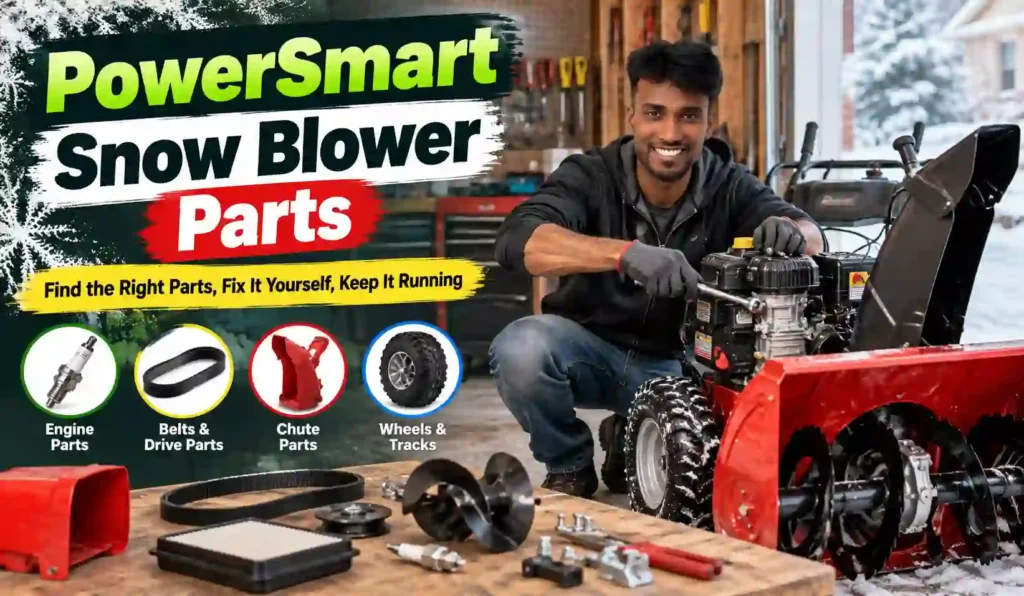
PowerSmart snow blower parts fall into six main groups: engine parts (spark plug, air filter, carburetor), the auger and drive system (belts, blades, shear pins), the chute assembly, skid shoes and scraper bar, the electrical system (battery packs on cordless 80V models, ignition parts on gas models), and wheels or tracks. Most wear items – belts, shear pins, spark plugs – cost between $10 and $50 and can be swapped in under 30 minutes with basic hand tools.
What Are PowerSmart Snow Blower Parts?
PowerSmart snow blower parts are the individual components that make up PowerSmart’s gas, electric, and 80V cordless snow blower lineup. They range from small wear items like shear pins to major assemblies like the auger housing.
PowerSmart builds both single-stage machines (smaller, lighter, aimed at light snow) and two-stage machines (heavier duty, self-propelled, built for deeper or wetter snow). Each design uses a different mix of parts, so the first step in any repair is knowing which category your machine falls into.
Single-stage models rely on a rubber-edged auger that touches the ground directly. Two-stage models use a metal auger to break up snow, then a separate impeller to throw it through the chute. That difference explains why single-stage machines almost never need an impeller belt, while two-stage machines usually run two belts: one for the auger, one for the drive wheels.
How PowerSmart Snow Blower Parts Work Together
A PowerSmart snow blower moves snow through a simple three-stage process, and each stage depends on a specific set of parts. Understanding the sequence makes it much easier to diagnose which part failed when the machine stops working correctly.
Stage 1 – Intake. The auger (a steel or rubber-edged rotating bar) pulls snow into the housing. Shear pins or shear bolts connect the auger to its drive shaft and are designed to snap if the auger hits ice, gravel, or a hidden object, protecting the gearbox from damage.
Stage 2 – Throwing. On two-stage models, the impeller spins at high speed and flings the snow up through the chute. The auger belt and drive belt transfer power from the engine (or motor) to the auger and wheels. A worn or glazed belt slips under load, which shows up as weak throwing distance.
Stage 3 – Direction control. The chute and its control cable or electric chute motor aim the discharge stream. A frayed cable or a chute stuck in one position is almost always a cable or motor problem, not an engine problem.
| Stage | Key Parts Involved | What Fails Most Often |
|---|---|---|
| Intake | Auger, shear pins/bolts, skid shoes | Shear pins snap on hard debris |
| Power transfer | Auger belt, drive belt, pulleys | Belts glaze, crack, or slip |
| Throwing | Impeller, impeller kit, scraper bar | Scraper bar wears thin, reducing pickup |
| Direction | Chute, chute cable, chute crank | Cable stretches or snaps |
| Ignition (gas models) | Spark plug, recoil starter, carburetor | Spark plug fouls, carb gums up with old fuel |
| Power source (cordless models) | 80V battery pack, charger | Battery loses capacity over repeated seasons |
Main Types of PowerSmart Snow Blower Parts
PowerSmart snow blower parts split into a handful of clear categories. Knowing which category a symptom points to narrows the search fast.
Engine and Ignition Parts (Gas Models Only)
- Spark plug – fouls or wears out and is the first thing to check on a hard-starting machine
- Air filter – a clogged filter chokes the engine and cuts power
- Carburetor – gums up if fuel sits in the tank over summer without a stabilizer
- Recoil starter and pull cord – the assembly that lets you hand-start the engine
- Fuel filter and fuel line – control fuel flow from tank to carburetor
Auger and Drive System Parts
- Auger blades/paddles – the rubber or steel edges that make contact with the ground or packed snow
- Shear pins and shear bolts – sacrificial hardware that protects the gearbox
- Auger drive belt and traction drive belt – transfer power from the engine or motor to the auger and wheels
- Gearbox and auger shaft – the mechanical core that shear pins are designed to protect
Chute and Discharge Parts
- Chute assembly – directs where snow is thrown
- Chute control cable or chute rotation motor – lets you aim the chute from the handlebar
- Deflector – adjusts how high or far the snow travels
Skid Shoes and Scraper Bar
- Skid shoes – adjustable feet that set the housing’s height off the ground
- Scraper bar – the bottom edge that scrapes packed snow off pavement; it wears down gradually and needs periodic replacement
Electrical and Power Parts
- 80V battery pack and charger – power source for PowerSmart’s cordless lineup
- Electric start motor and power cord – used on gas models with 120V electric start
- LED headlight assembly – included on many mid-range and premium models
Wheels and Traction Parts
- Drive wheels and tires – some PowerSmart models use airless (foam-filled) tires that never go flat
- Track kits – on select two-stage models, tracks replace wheels for better traction on ice
Key Features of Genuine PowerSmart Replacement Parts
Genuine PowerSmart snow blower parts are built to the exact tolerances of the original machine, which matters more than it sounds.
- Model-specific fit – PowerSmart parts are numbered to match specific model families, so a belt for one two-stage engine size will not fit another
- OEM material specs – auger belts use the rated rubber compound for cold-weather flexibility, which off-brand belts sometimes skip
- Matched shear pin hardness – genuine shear pins are calibrated to snap at the right load; pins that are too hard can crack a gearbox instead of failing first
- Direct bolt-on installation – genuine parts use the original mounting holes and bracket spacing
Benefits of Knowing Your PowerSmart Snow Blower Parts
Understanding PowerSmart snow blower parts pays off in three concrete ways.
Faster diagnosis. A machine that throws snow weakly but still runs points straight to the auger belt or scraper bar, not the engine. That knowledge alone can save an unnecessary trip to a repair shop.
Lower repair cost. Belts, shear pins, and spark plugs are inexpensive and simple to swap. A basic tune-up kit covering these three items typically costs under $40 total, compared to a shop labor charge that can exceed that on its own.
Longer machine life. Replacing a worn scraper bar or glazed belt before it fails protects the gearbox and engine from the extra strain a failing part puts on the rest of the system.
Limitations to Keep in Mind
Knowing your PowerSmart snow blower parts has real limits, and being honest about them prevents wasted time.
- Some repairs need special tools. Pulling a flywheel or rebuilding a carburetor usually calls for a puller or carb cleaning kit most homeowners do not own.
- Warranty work should stay with an authorized service point. Opening the engine or gearbox yourself during the warranty period can void coverage.
- Battery packs on 80V models are not user-serviceable. If a cordless PowerSmart battery fails, it gets replaced as a full unit, not repaired internally.
- Parts availability varies by model age. Older or discontinued PowerSmart models can have longer lead times for less common parts like a specific gearbox housing.
Factors to Consider Before Buying PowerSmart Snow Blower Parts
Before ordering PowerSmart snow blower parts, confirm four things to avoid a part that does not fit.
Model number. It is usually on a sticker on the housing or handlebar frame, not on the box the machine came in. Every part is matched to this number, not the general product name.
Gas vs. cordless. Gas and 80V cordless PowerSmart models share almost no interchangeable parts beyond generic hardware like bolts. Confirm the power type before searching for a belt or blade.
Single-stage vs. two-stage. Single-stage machines use one auger belt and no separate impeller belt. Two-stage machines usually need both, so ordering “the belt” without specifying which one leads to the wrong part.
Part number over description. Two belts can look nearly identical but differ in length by an inch, which is enough to make one slip constantly. Match the exact part number stamped on the old part whenever possible.
| Factor | Why It Matters |
|---|---|
| Model number | Confirms exact part compatibility |
| Power type (gas or 80V cordless) | Gas and cordless parts are not interchangeable |
| Stage (single or two-stage) | Determines belt count and auger type |
| Exact part number | Prevents ordering a close-but-wrong fit |
Common Problems and Misconceptions About PowerSmart Snow Blower Parts
Misconception: a snapped shear pin means something is broken. A shear pin snapping is the system working as designed. It sacrifices a $2 pin to protect a gearbox that costs far more to replace.
Misconception: any generic belt will work. Belt length and profile are specific to the pulley spacing on each PowerSmart model. A belt that is even a quarter-inch too long will ride loose and slip under load.
Common problem: weak throwing distance. This points to a worn scraper bar, a glazed auger belt, or ice packed against the impeller housing, not the engine.
Common problem: hard starting on gas models. Old fuel left in the tank over summer is the single most common cause. A fouled spark plug or a gummed carburetor jet are the next two most likely causes.
Common problem: reduced runtime on 80V cordless models. Cold temperatures reduce lithium battery output. A battery that seems weak at 10°F often performs normally once it warms closer to 40°F.
Practical Tips for Maintaining PowerSmart Snow Blower Parts
- Drain gas or add a fuel stabilizer before storing a gas model for the off-season to keep the carburetor from gumming up
- Check shear pins for hairline cracks at the start of each season, even if they have not snapped yet
- Store 80V batteries indoors at room temperature rather than in an unheated shed or garage
- Adjust skid shoes higher over gravel or uneven surfaces to protect the auger from unnecessary contact
- Keep a spare set of shear pins and a spare spark plug in your garage before the first snowfall of the season, not after
Frequently Asked Questions
What are the most common PowerSmart snow blower parts that need replacing?
The most commonly replaced PowerSmart snow blower parts are shear pins, the auger drive belt, the spark plug, and the scraper bar. All four are considered normal wear items and are expected to need periodic replacement.
How do I find the right part number for my PowerSmart snow blower?
Locate the model number sticker on the machine’s housing or handlebar frame, then match it against the parts diagram for that specific model. The part number stamped on the old, failing component is the most reliable match.
Can I use aftermarket parts instead of genuine PowerSmart parts?
Aftermarket belts, blades, and shear pins exist and often fit correctly, but tolerances vary by manufacturer. For safety-critical parts like shear pins, matching the original hardness rating matters more than saving a few dollars.
Why did my PowerSmart snow blower’s shear pin snap?
Shear pins snap when the auger strikes something hard, like a rock, a curb edge, or thick ice, and this is the part doing its job. It protects the more expensive gearbox from taking the impact instead.
Are PowerSmart 80V cordless parts interchangeable with gas model parts?
No. The 80V cordless lineup uses a brushless motor, battery pack, and different auger mounting hardware than gas models. Parts between the two power types are not interchangeable.
How much do PowerSmart snow blower parts typically cost?
Small wear parts like shear pins and spark plugs usually run under $10 each. Belts typically fall between $15 and $50 depending on the model, and an 80V replacement battery pack runs well above that, reflecting the higher cost of the battery cells themselves.
Final Takeaway
PowerSmart snow blower parts break down into engine components, the auger and drive system, the chute, skid shoes and scraper bar, electrical parts, and wheels or tracks. Most repairs come down to a handful of inexpensive wear items – belts, shear pins, spark plugs, and the scraper bar. Confirm your exact model number, power type, and stage before ordering any part, since PowerSmart parts are matched tightly to each specific machine.
Why Trust This Guide
This guide was put together from hands-on small-engine repair experience, manufacturer parts diagrams, and a review of common failure patterns reported by snow blower owners. Every part function and failure point described here reflects how these machines actually operate in the field, not just what a spec sheet lists.