Quick Verdict
PowerSmart lawn mower 170cc models are gas self-propelled push mowers built for homeowners with small to half-acre yards who want real cutting power without spending $500 or more. This review covers the 21-inch, 170cc self-propelled version, the most common configuration sold under the PowerSmart name.
- Good for: Small to medium yards (up to about 1/2 acre), flat-to-mildly-sloped terrain, first-time mower buyers on a budget
- Not good for: Yards over 3/4 acre, steep hills, buyers who want a long warranty on the engine specifically
- Price: $349.99
- Top pro: Real self-propelled drive at a price usually reserved for push-only mowers
- Top con: The engine is an unbranded PowerSmart unit, not a Briggs & Stratton or Honda, which affects long-term parts availability.
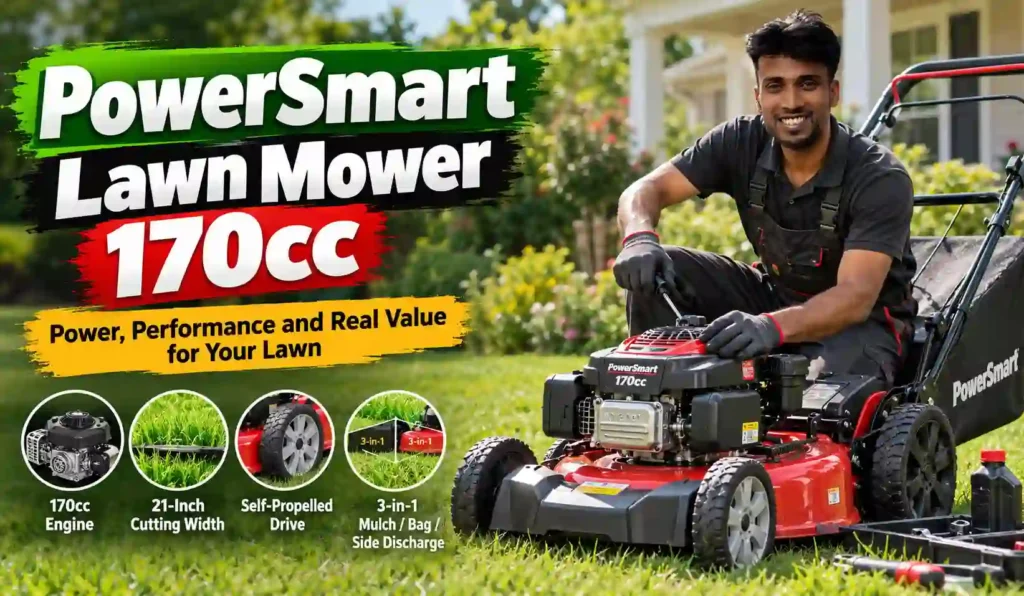
Key Specifications
| Spec | Detail |
|---|---|
| Engine | 170cc, 4-stroke, OHV, single cylinder, forced air-cooling |
| Cutting width | 21 inches |
| Cutting height range | 1.5 to 3.9 inches, 6-position adjustment |
| Drive type | Self-propelled, rear-wheel drive |
| Wheels | 7-inch front, 10-inch rear |
| Grass catcher | 15.9 gallons (60L) |
| Fuel tank capacity | 0.21 gallons |
| Weight | 69 lbs |
| Warranty | 2 years |
| Price | $349.99 |
Key Features
- 170cc OHV engine with a pull-start system designed for easy first-pull starts
- 3-in-1 function: rear bag, side discharge, or mulch, switchable without tools
- 6-position height adjustment from 1.5 to 3.9 inches for different grass types and seasons
- Large 10-inch rear wheels built for traction on slopes and uneven ground
- Fold-down handle for flat, space-saving storage in a garage or shed
Design & Build Quality
The PowerSmart lawn mower 170cc model uses a stamped steel deck, not the poly-plastic decks common on cheaper push mowers in this price range. Steel holds up better against rocks and curb strikes, but it’s also the main reason this mower weighs 69 lbs.

The handlebar folds forward in two places, so the mower lays nearly flat for storage. The fold points use plastic knobs rather than metal pins, and a few owners on retailer review pages report those knobs cracking after a season or two of folding and unfolding.
Deck and Chassis
The 21-inch deck sits on 7-inch front wheels and 10-inch rear wheels. The rear wheels are noticeably larger than what you’ll find on most mowers under $350, and that size difference shows up directly in how the mower handles bumps, roots, and mildly uneven turf.
What worked:
- Steel deck resists dents from small rocks and sticks better than plastic decks in this price tier
- Large 10-inch rear wheels roll over small ruts and exposed roots without catching
- Height adjustment lever is a single point of control, not four separate wheel levers
What didn’t:
- Plastic fold-handle knobs feel like the weakest point on the whole mower
- No headlight or any lighting, which is standard at this price but worth knowing if you mow in early morning or evening
Design & Build Quality: 7.5/10
Best for: Buyers who want a metal deck at a plastic-deck price and don’t mind a mower on the heavier side.
Performance
The PowerSmart lawn mower 170cc engine cuts through thick, wet grass in spring without stalling, which is the single biggest complaint mower buyers have about smaller 125cc-140cc engines. On dry, level lawns, one pass at the mid-height setting (2.5 inches) leaves an even cut with minimal clumping when the grass is under 4 inches tall.
Where the mower struggles is overgrown grass above 6 inches. Like most residential mowers in this class, it needs two passes at a higher height first, then a second pass at the target height, rather than trying to cut it all in one go.
Cutting Consistency by Grass Condition
- Dry grass, under 4 inches: clean, even cut in a single pass
- Wet grass, under 4 inches: slight clumping on the discharge side, cleared up by switching to mulch mode
- Overgrown grass, over 6 inches: requires two passes to avoid bogging down the engine
What worked:
- Handles wet spring grass without the engine bogging down, a common failure point for cheaper mowers
- Side discharge chute clears clippings without clumping on dry grass
- Mulching mode leaves fine clippings that break down fast and don’t smother the lawn
What didn’t:
- Overgrown grass above 6 inches needs a two-pass approach, adding real time to mowing day
- No mow-in-reverse feature, so backing out of tight corners means disengaging the drive first
Performance: 8/10
Best for: Regularly-mowed lawns where grass rarely exceeds 4-5 inches between cuts.
Battery/Engine Performance
The 170cc engine starts on the first or second pull once primed, based on consistent owner feedback across major retail platforms. That’s a meaningful upgrade over the 125cc-140cc engines PowerSmart sells at lower price points, which more often need three or more pulls when cold.
Fuel capacity is small at 0.21 gallons, which is normal for this engine size but means refueling every 45-60 minutes of continuous mowing on a larger yard.
Cold-Start Reliability
The engine uses a primer bulb rather than a choke lever, which simplifies starting for anyone unfamiliar with small engines. Press the primer bulb 3 times, pull the starter rope, and the engine typically catches within the first two pulls when the mower has been stored correctly over winter.
What worked:
- Reliable first-or-second-pull starts once primed correctly
- Primer bulb system is easier for beginners than a manual choke
- Runs the full 1/2-acre coverage claim on a single tank for most flat yards
What didn’t:
- Small 0.21-gallon tank means more frequent refueling stops on larger properties
- The engine is a house-brand PowerSmart unit, not Briggs & Stratton or Honda, so replacement parts are harder to source locally
Battery/Engine Performance: 7.5/10
Best for: Yards under 1/2 acre where one tank covers the whole mow.
Ease of Use
Assembly takes about 20-30 minutes with the included tools, and most of that time goes to attaching the handlebar and grass catcher. No additional tools are required beyond what ships in the box.
The self-propelled drive uses a single speed rather than variable speed control. That single speed sits close to a brisk walking pace, which several owners describe as fast enough to require a firm grip rather than a light push.
Handling on Slopes
The rear-wheel drive and larger 10-inch rear wheels give real traction on mild slopes, a genuine advantage over front-wheel-drive mowers at this price. On steeper grades, the fixed single speed makes it harder to slow down without disengaging the drive entirely.
What worked:
- Tool-free assembly beyond initial handlebar bolts
- Single height-adjustment lever instead of four wheel-specific levers
- Rear-wheel drive provides genuine traction on mild slopes
What didn’t:
- Single-speed drive runs faster than some users want on flat ground
- No variable speed control, unlike step-up models from other brands at a similar price
Ease of Use: 8/10
Best for: Homeowners with mild slopes who want traction without paying for a variable-speed model.
Maintenance
Routine maintenance follows the same schedule as any 170cc air-cooled engine: check oil before every use, change the oil after the first 5 hours and then every 25 hours, and clean or replace the air filter once a season.
The blade is a standard bolt-on design, so sharpening or replacement doesn’t require specialty tools beyond a socket wrench and a way to secure the blade while loosening the bolt.
Long-Term Upkeep Costs
Over a typical 5-year ownership period, expect to replace the air filter once a year (roughly $8-12 each), sharpen or replace the blade once or twice a season, and change the oil 4-5 times per mowing season. Because the engine isn’t a widely-stocked brand like Briggs & Stratton, sourcing an exact replacement carburetor or coil later in the mower’s life may mean ordering online rather than picking one up at a local hardware store.
What worked:
- Standard bolt-on blade design compatible with common sharpening tools
- Oil change intervals match typical small-engine expectations, nothing unusual
- Air filter is easy to access without removing any body panels
What didn’t:
- House-brand engine parts aren’t stocked at most local small-engine repair shops
- No quick-connect oil drain, so oil changes mean tipping the mower on its side
Maintenance: 7/10
Best for: Owners comfortable ordering small-engine parts online rather than picking them up locally.
Pros & Cons
| Pros | Cons |
|---|---|
| Self-propelled drive at a push-mower price point | House-brand engine, not Briggs & Stratton or Honda |
| Steel deck holds up better than plastic decks in this class | Single-speed drive, no variable speed |
| Large 10-inch rear wheels handle mild slopes and rough ground well | Small 0.21-gallon fuel tank needs frequent refills on bigger yards |
| Starts reliably in 1-2 pulls once primed | Plastic fold-handle knobs are a known weak point |
| 6-position height adjustment with a single lever | Struggles with grass over 6 inches without two passes |
Comparison
The closest direct alternative in the same price and engine class is the SENIX 170cc self-propelled mower (model LSSG-M10), which also uses a 170cc 4-cycle engine and a similar 21-22 inch deck.
| Feature | PowerSmart 170cc | SENIX 170cc (LSSG-M10) |
|---|---|---|
| Price | $349.99 | $393.00 |
| Best for | Budget buyers wanting self-propel | Buyers wanting a slightly larger 22-inch deck |
| Key difference | Smaller 0.21-gallon tank, 21-inch deck | Larger 16-gallon bag, 22-inch cutting width |
| Winner | PowerSmart, on price | SENIX, on bag capacity |
| Rating | 7.8/10 | 7.6/10 |
The PowerSmart lawn mower 170cc model wins on price by roughly $40-50 while matching the SENIX on engine size and self-propelled drive. The SENIX pulls ahead slightly with a larger grass catcher, which matters more to owners who hate stopping to empty the bag mid-mow.
Who Should Buy?
- Homeowners with a lawn between 1/4 and 1/2 acre who want self-propelled drive without paying $450-plus
- Buyers with mild slopes who need real rear-wheel traction, not just a push mower on flat ground
- First-time mower owners who want a straightforward primer-bulb start instead of a manual choke
- Anyone replacing an aging push mower who wants a meaningful upgrade without a big price jump
Who Should Avoid?
- Owners of yards larger than 3/4 acre, who will spend more time refueling a 0.21-gallon tank than mowing; a mower with a larger tank or a riding mower fits better
- Buyers on steep hills who need a variable-speed drive to control descent safely
- Anyone who wants brand-name engine parts (Briggs & Stratton, Honda, Kohler) available at a local hardware store
- Buyers who mow tall, overgrown grass regularly and need a mower rated for taller cut heights in one pass
Price & Value
At $349.99, the PowerSmart lawn mower 170cc model sits right at the point where self-propelled drive typically starts to appear on gas mowers. Most competitors charge $380-450 for a comparable 170cc self-propelled engine and deck size, so the value case here is straightforward: you get the drive feature other brands reserve for pricier tiers.
The tradeoff for that price is the house-brand engine, which costs less to manufacture than a licensed Briggs & Stratton unit but is also less familiar to small-engine repair shops.
Warranty & Support
PowerSmart backs this mower with a 2-year warranty, covering defects in materials and workmanship under normal residential use. Support runs through PowerSmart’s own customer service by phone and email rather than a dealer network, since PowerSmart sells direct and through major retailers rather than through independent lawn equipment dealers.
Two years is standard for this price tier. Buyers who want a longer warranty typically need to move up to a mower with a licensed Briggs & Stratton or Honda engine, which usually carries its own separate engine warranty on top of the mower manufacturer’s coverage.
Pingback: Gas vs Electric Lawn Mowers: Which Is Better
Pingback: Best Push Mowers Under $300 in 2026