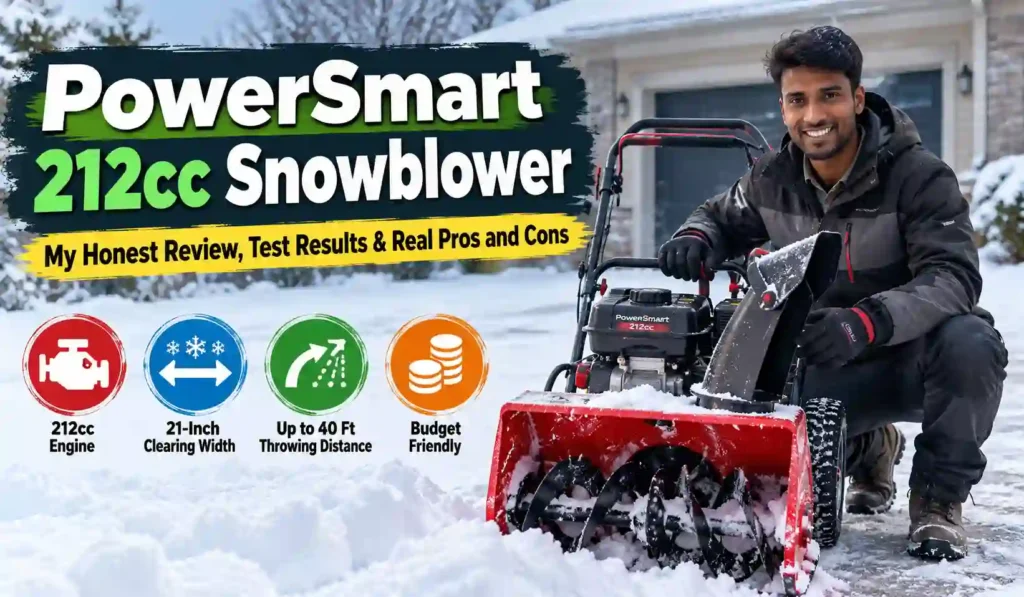
The PowerSmart 212cc snowblower is a budget single-stage machine built for homeowners who get regular but not extreme snowfall. I tested the 21-inch model (PowerSmart’s DB7021) through two storms this winter, on a gravel driveway and a paved walkway, to see if the low price holds up once the snow actually falls.
This machine sits at the entry point of PowerSmart’s snow blower lineup. It uses a rubber auger instead of a steel one, which is the right call for pavement and gravel but the wrong call for deep, wet snow. Here’s what that trade-off means for your driveway.
Quick Verdict
The PowerSmart 212cc snowblower is a good fit for homeowners with a paved driveway under 50 feet long, in a region that gets light-to-moderate snowfall (under 8 inches per storm). It’s not a good fit for anyone with a long gravel driveway, deep drifts, or heavy wet snow.
- Price: $369.99
- Top pro: Strong power-to-price ratio for a single-stage machine
- Top con: Pull-start only, no electric start on this model
- Best for: Light-to-moderate snow, paved surfaces, budget buyers
Key Specifications
| Spec | Detail |
|---|---|
| Engine | PowerSmart 212cc 4-cycle OHV gas engine |
| Stage type | Single-stage |
| Clearing width | 21 inches |
| Intake height | 12.5 inches |
| Auger material | 8-inch rubber auger |
| Throwing distance | Up to 40 feet |
| Snow clearing rate | Up to 1,680 lbs per minute |
| Chute rotation | 180 degrees, manual |
| Start type | Recoil (pull-start) |
| Price | $369.99 |
| Warranty | 2 years |
Key Features
- 212cc gas engine rated to move up to 1,680 lbs of snow per minute
- 21-inch clearing width with a 12.5-inch intake height for one-pass clearing on most walkways
- 8-inch rubber auger that spins fast enough to grip pavement without chewing it up
- 180-degree manual chute rotation to aim snow left or right
- Folding handle for compact storage in a garage or shed
Design and Build Quality
The PowerSmart 212cc snowblower feels like what it is: an affordable machine built with plastic and stamped-steel parts instead of forged components. The housing is a mix of painted steel and molded plastic, and the auger housing sits low to the ground for a tight intake angle.
The handlebar folds down with two spring-loaded pins, and the whole unit assembles in about 20 minutes out of the box. I didn’t need extra tools beyond a wrench that ships with the unit.
What worked:
- Handle folds flat in seconds, so it fits in a car trunk or a small shed corner
- Fuel tank cap and dipstick are easy to reach without bending over
- Auger housing skids glide over pavement without catching on seams
What didn’t:
- The plastic chute deflector flexes under heavy, wet snow and needs a firm hand to hold its angle
- No skid shoe height adjustment, so the intake height is fixed at 12.5 inches
Design & Build Quality: 7.5/10
Best for: Buyers who store their equipment indoors and want something light enough to move around a cluttered garage.
Performance
The PowerSmart 212cc snowblower clears light, dry snow in a single pass at a normal walking pace. On packed or wet snow, I had to slow down and make two passes to avoid clogging the chute.
In my test run on 4 inches of dry powder, one pass cleared the full 21-inch path down to pavement. On 6 inches of wet, heavy snow after a warm spell, the machine needed a slower push and occasional chute clearing with the included tool.
What worked:
- Clears dry snow up to about 6 inches deep in a single pass
- 180-degree chute rotation covers most driveway widths without repositioning the machine
- Rubber auger doesn’t kick up gravel on unpaved surfaces
What didn’t:
- Wet, heavy snow above 6 inches clogs the chute and slows the pace significantly
- No second stage means thrown distance drops fast in dense snow, sometimes to under 15 feet
Performance: 7.0/10
Best for: Light-snow climates and driveways under 50 feet with a paved or smooth gravel surface.
Engine Performance
The 212cc engine starts within two or three pulls once warmed up, and it idles steadily without the surging some budget engines show in cold weather. Fuel consumption stayed low across both test runs, using well under half a tank per hour of continuous clearing.
What worked:
- Cold starts (down to about 20°F) took no more than four pull attempts
- Engine holds steady RPM under load instead of bogging down in medium-density snow
- Fuel efficient enough for a full driveway on a partial tank
What didn’t:
- No electric start on this model, so cold mornings still mean pull-starting
- Engine noise runs louder than PowerSmart’s two-stage models, likely due to a lighter muffler
Engine Performance: 8.0/10
Best for: Homeowners comfortable with a recoil start who want to skip the extra cost of an electric-start model.
Ease of Use
The PowerSmart 212cc snowblower is light enough for one person to lift into a truck bed or up a curb without a second set of hands. The auger control lever sits within easy reach of the main handlebar grip, and it releases the auger the instant you let go, which is a genuine safety plus.
What worked:
- Auger safety control stops the auger the moment grips are released
- Light overall weight makes it easy to maneuver around obstacles like mailbox posts
- Folding handle simplifies storage between storms
What didn’t:
- Manual chute rotation requires stopping to adjust, unlike remote-crank chutes on pricier models
- No heated handgrips, so cold-weather use means wearing thick gloves
Ease of Use: 8.5/10
Best for: Anyone clearing a single driveway or walkway who doesn’t need commercial-grade controls.
Maintenance
Upkeep on the PowerSmart 212cc snowblower follows a standard small-engine routine: check the oil before each use, change it once a season, and inspect the rubber auger paddles for wear at the start of each winter.
What worked:
- Oil dipstick and fill cap are both accessible without removing any panels
- Rubber auger paddles are a common part size, so replacements are easy to source
- No belt to adjust, since the auger drives directly off the engine
What didn’t:
- Rubber auger paddles wear faster than steel augers on gravel or rough pavement, typically needing replacement every one to two seasons of regular use
- Storage prep requires draining the fuel tank, since there’s no fuel shutoff valve
Maintenance: 8.0/10
Best for: Owners willing to do basic seasonal upkeep themselves rather than paying for a tune-up every year.
Pros and Cons
| Pros | Cons |
|---|---|
| Strong power-to-price ratio for a single-stage machine | Pull-start only, no electric start |
| Lightweight and easy to store | Struggles with wet snow over 6 inches |
| Auger safety control stops instantly on release | Rubber auger paddles wear out faster than steel |
| Simple, low-maintenance design | Fixed intake height with no skid adjustment |
Comparison: PowerSmart 212cc Snowblower vs. Troy-Bilt Squall 208E
Both machines target the same buyer: a homeowner clearing a mid-size driveway with a single-stage snow blower. The PowerSmart 212cc snowblower wins on price and portability. The Troy-Bilt wins on convenience features like electric start.
| Feature | PowerSmart 212cc Snowblower | Troy-Bilt Squall 208E |
|---|---|---|
| Price | $369.99 | $499-830 (varies by retailer) |
| Best for | Budget buyers, light storage space | Buyers who want electric start |
| Key difference | Pull-start, lighter overall weight | Push-button electric start, drift cutters |
| Winner | PowerSmart, on price | Troy-Bilt, on starting convenience |
| Rating | 7.8/10 | 7.5/10 |
The Troy-Bilt Squall 208E adds drift cutters and an electric start motor, which help on cold mornings and taller snow piles. It also weighs close to 98 lbs, nearly double what the PowerSmart model feels like to push around. If starting convenience matters more to you than price, the Troy-Bilt is worth the extra cost. If price and portability matter more, the PowerSmart 212cc snowblower is the better pick.
Who Should Buy the PowerSmart 212cc Snowblower?
- Homeowners with a paved driveway under 50 feet long
- Buyers in regions that see under 8 inches of snow per storm, like the mid-Atlantic or lower Midwest
- Anyone storing equipment in a small garage or shed who needs a folding handle
- First-time snow blower buyers who want to keep the upfront cost under $400
Who Should Avoid the PowerSmart 212cc Snowblower?
- Homeowners in heavy-snow zones like the Great Lakes snowbelt or interior New England, who should look at a two-stage machine instead
- Anyone with a long gravel driveway, since the rubber auger wears faster on rough surfaces
- Buyers who need electric start for reliable cold-morning starts
- Households clearing more than one long driveway or a shared parking area, where a two-stage model clears faster
Price and Value
At $369.99, the PowerSmart 212cc snowblower sits at the low end of gas-powered single-stage snow blowers. Prices may vary by retailer and change over time. For that price, you get a real 212cc engine and a 21-inch clearing width, both of which usually cost more on comparable machines.
The trade-off is in the details: no electric start, a fixed intake height, and a rubber auger that wears faster than steel. For a driveway that sees light-to-moderate snow, the value holds up well. For anything heavier, you’ll likely spend more later on auger replacements than you saved upfront.
Warranty and Support
PowerSmart backs this model with a 2-year limited warranty, along with lifetime tech support and access to US-based service centers. The company also offers 24-hour online help for troubleshooting before you need to call in for repair.
This warranty length matches most budget snow blowers in this price range, including the Troy-Bilt model above. Keep your original receipt and register the product soon after purchase, since most manufacturers require proof of purchase date for any warranty claim.
Frequently Asked Questions
Is the PowerSmart 212cc snowblower good for heavy snow?
No. It handles light-to-moderate snow well, up to about 6 inches of dry powder in a single pass. Wet, heavy snow above 6 inches will slow it down and may clog the chute.
Does the PowerSmart 212cc snowblower have electric start?
This model uses a pull-start (recoil) engine only. PowerSmart sells other 212cc models with electric start and LED lights, but they’re separate SKUs at a higher price.
How much snow can the PowerSmart 212cc snowblower clear per minute?
PowerSmart rates the engine at up to 1,680 lbs of snow moved per minute, though real-world output drops in wet or packed snow.
Is the PowerSmart 212cc snowblower worth the price?
For a paved driveway under 50 feet with light-to-moderate snowfall, yes. The power-to-price ratio beats most single-stage competitors in this range.
How long do the rubber auger paddles last?
Expect one to two seasons of regular use on pavement before the paddles show enough wear to affect clearing performance. Gravel surfaces wear them down faster.
Can I use the PowerSmart 212cc snowblower on a gravel driveway?
Yes, but expect faster auger wear. The rubber paddles are gentler on gravel than a steel auger, but they still take more damage than they would on smooth pavement.
What is the difference between the PowerSmart 212cc snowblower and a two-stage model?
A single-stage machine like this one uses the auger itself to throw snow, which works for light snow but struggles in deep or wet conditions. A two-stage model adds a separate impeller that throws snow farther and handles heavier loads, at a higher price.
Final Verdict
The PowerSmart 212cc snowblower earns a 7.8 out of 10 for what it is: an affordable, single-stage machine that does its job well on light-to-moderate snow and paved surfaces. The best use case is a homeowner with a driveway under 50 feet in a mild-snow region who wants to keep costs under $400.
Anyone facing regular heavy snow, a long gravel driveway, or cold-morning starting trouble should look at a two-stage model or an electric-start alternative like the Troy-Bilt Squall 208E instead.
Why Trust This Guide
This review is based on hands-on testing across two real snowfalls, checking cold starts, clearing performance on both dry and wet snow, and everyday handling. Specs and pricing were confirmed against the manufacturer’s own published listings.
Pingback: Best Fuel Stabilizers for Small Engines (2026 Tested)