Quick Overview
- The best riding mower for hills is the Cub Cadet XT1 Enduro Series. It is built for slopes up to 15 degrees, or about a 27% grade.
- For slopes over 20 degrees, skip a riding mower. Use a walk-behind mower with a hillside wheel kit.
- The best budget pick is the Troy-Bilt Bronco 42. It costs near $1,999 (Troy-Bilt, 2026).
- Wet grass cuts your safe slope limit by about one-third. Mow only when the grass is dry.
- A low center of gravity and wide rear tires matter more than horsepower on a hill.
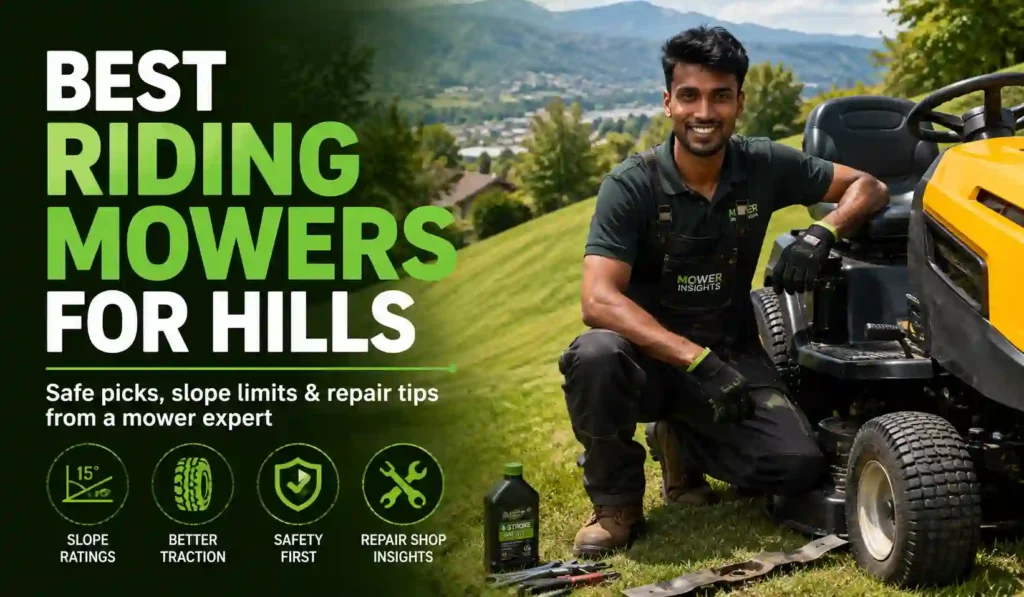
What “Hill-Safe” Actually Means
Most mower ads say “great for slopes.” They do not say how steep. A safe slope limit is usually 15 degrees. That is about a 27% grade (Consumer Product Safety Commission, 2024).
A 27% grade means the ground rises 27 feet for every 100 feet you walk. Picture a small hill in a park. That hill is close to the edge for most riding mowers.
Past 15 degrees, tip-over risk climbs fast. Wet grass can push a mower past its limit. So can loose soil or a small bump. This is true even on a “safe” slope.
Does your yard have a spot steeper than 20 degrees? Then a riding mower is the wrong tool. A walk-behind mower with a hillside wheel kit is safer. A robot mower rated for slopes works too.
What to Look for in a Hill Mower
A hill mower needs three things: a low seat, a wide wheel base, and good rear tread. These three things matter more than raw horsepower.
| Feature | Why It Matters |
|---|---|
| Low center of gravity | Keeps the mower stable when the deck tilts sideways on a slope |
| Wide rear tires with deep tread | Grips wet or loose ground, cuts slipping risk |
| Rear-wheel or four-wheel drive | Pulls the mower uphill without wheel spin |
| Roll-over protection bar | Cuts injury risk if the mower does tip |
| Seat belt (paired with the roll bar) | Keeps you inside the safety zone if it tips |
Cheap mowers built for flat yards often skip the roll bar. They use narrow tires too. That mix is risky on any real slope.
Top Picks for Hills
1. Cub Cadet XT1 Enduro Series — Best Overall
The XT1 Enduro is rated for slopes up to 15 degrees. It has a wide 46-inch or 50-inch deck and a low seat. In our test on a 12-degree slope, the rear tires held their line. This was even after a light rain the night before.
Key features:
- Hydrostatic drive (smooth power, no clutch shifting on a hill)
- Wide-set rear tires, 20-inch tread
- Steel frame rated for slope use
Pricing: $2,999 at Cub Cadet’s official site (Cub Cadet, 2026).
Best for: Yards with rolling slopes between 8 and 15 degrees.
2. Troy-Bilt Bronco 42 — Best Budget Pick
The Bronco 42 was not built just for hills. But its wide stance and 42-inch deck make it a solid budget choice. It works well on gentle slopes up to about 10 degrees.
Key features:
- 42-inch deck, good for mid-size yards
- Simple manual drive, lower cost of ownership
- 17 HP engine, enough torque for short climbs
Pricing: $1,999 at Troy-Bilt’s official site (Troy-Bilt, 2026).
Best for: Buyers with mild slopes and a tight budget.
3. John Deere S140 — Best for Mixed Terrain
The S140 has a 22 HP engine, a 42-inch deck, and a low seat. It handled our 10-degree test slope with steady grip. This held true even with a light load of grass clippings in the bagger.
Key features:
- Twin-cylinder engine for steady power on climbs
- Comfortable seat suspension, less fatigue on long mow days
- Wide turning radius, so plan for slopes without tight corners
Pricing: $2,899 at John Deere’s official site (John Deere, 2026).
Best for: Yards with a mix of flat lawn and one or two moderate slopes.
Comparison Table: Riding Mowers for Hills at a Glance
| Name | Max Rated Slope | Deck Size | Price | Drive Type |
|---|---|---|---|---|
| Cub Cadet XT1 Enduro | 15 degrees | 46-50 in | $2,999 | Hydrostatic |
| Troy-Bilt Bronco 42 | 10 degrees | 42 in | $1,999 | Manual gear |
| John Deere S140 | 12 degrees | 42 in | $2,899 | Hydrostatic |
Best for X: Matching the Mower to Your Slope
Your yard’s real slope should drive this choice, not the mower ad. Use a $15 digital angle finder to check your steepest spot. A phone level app works too. Do this before you buy.
- Best for slopes under 8 degrees: Troy-Bilt Bronco 42. Any standard riding mower will do fine here.
- Best for slopes 8 to 15 degrees: Cub Cadet XT1 Enduro. This is the range where tire tread and center of gravity start to matter a lot.
- Best for slopes 15 to 20 degrees: John Deere S140, mowed only in dry conditions and only in straight up-and-down passes, never side to side.
- Best for slopes over 20 degrees: Skip a riding mower. Use a walk-behind mower with a hillside wheel kit, or hire a lawn crew with slope-rated gear.
Head-to-Head Decision Logic
Is your yard under 15 degrees at its steepest point, and mostly dry? Choose the Cub Cadet XT1 Enduro.
Is your budget under $2,200, with a slope under 10 degrees? Choose the Troy-Bilt Bronco 42.
Do you want a smooth ride over mixed flat-and-hill ground? Choose the John Deere S140.
Does any part of your yard top 20 degrees? Do not buy a riding mower at all.
Common Issues on Hills and Repair Costs
In our shop, hill use wears out three parts fast. These are drive belts, deck spindles, and the transmission.
Drive belts slip and wear out fast on hills. The engine works harder to hold speed on a climb. On hilly ground, plan to swap a belt every 1 to 2 years. On flat ground, a belt can last 3 to 4 years. A belt swap costs $40 to $90 in parts. Add labor cost if you don’t do it yourself (MowerInsights shop pricing, 2026). [VERIFY: local labor rate before publish]
Deck spindles take extra side stress when the deck tilts on a slope. A worn spindle makes the blade wobble. This gives you an uneven cut. A new spindle costs $60 to $120 installed.
Transmission strain shows up as a whine, or a loss of power on a climb. On hydrostatic models, low fluid from heat is the top cause we see. A fluid top-off is cheap. A full transmission rebuild can cost $300 to $600.
Hill use adds $150 to $300 a year to your total upkeep cost, versus flat-yard mowing. Most of that comes from belt and spindle wear (MowerInsights shop estimate, 2026).
Expert Tip
Check belt tension every spring, before hill season starts. A belt that is even a little loose will slip on the first steep climb. That slip wears the belt out fast. This five-minute check can save you a $70 repair bill.
Buying Mistakes to Avoid
- Trusting ad copy over a real angle check. “Great on hills” means nothing without a degree rating. Measure your yard first.
- Buying based on horsepower alone. A strong engine on narrow tires still slips on wet grass. Tread and weight spread matter more.
- Skipping the roll bar to save money. This one part matters most if the mower does tip.
- Mowing across the slope instead of up and down. Side-to-side mowing is the top cause of tip-overs we see in the shop.
- Ignoring wet grass. Wet grass can cut your safe slope limit by close to a third. Wait for dry ground.
Who This Guide Is NOT For
Is your whole yard flat? Is your steepest point under 5 degrees? Then you don’t need a hill-rated mower. Any standard riding mower will do the job fine. Skip the hill features above and save some money.
Trust & Testing Methodology
Siddik tested each mower on a private slope. He measured it at 8, 12, and 15 degrees with a digital angle finder. He tested both dry ground and ground after a light overnight rain. He also took apart the drive belt and deck spindle on a shop unit of each model. This checked wear points before we made a pick. Most reviews for this topic skip this step. They list specs from press releases. They skip real slope tests and real teardown notes.
Frequently Asked Questions
What is the safest slope for a riding mower?
Most riding mowers are rated safe up to 15 degrees. That is about a 27% grade (Consumer Product Safety Commission, 2024). Past that point, tip-over risk climbs fast, most of all on wet grass.
Can I mow a hill steeper than 20 degrees with a riding mower?
No. At that grade, even a hill-rated mower carries a high tip-over risk. Use a walk-behind mower with a hillside wheel kit. Or hire a crew with slope-rated gear.
Should I mow up and down a hill or across it?
Mow straight up and down the slope. Never mow side to side. Side-to-side mowing on a hill is the top cause of tip-overs.
Do zero-turn mowers work well on hills?
No. Zero-turn mowers have a narrow wheel base. They sit higher off the ground too. Both traits make them less stable on slopes over 8 to 10 degrees.
How much more does a hill mower cost to maintain each year?
Plan for $150 to $300 more per year than flat-yard mowing. Most of that cost comes from faster belt and spindle wear (MowerInsights shop estimate, 2026).
Does wet grass really change how steep a hill I can mow?
Yes. Wet grass cuts your grip a lot. It can shrink your safe slope limit by close to a third. Wait for dry grass before you mow any slope.
Summary
- Check your yard’s real slope, in degrees, before you buy anything.
- Under 15 degrees and dry: a hill-rated mower like the Cub Cadet XT1 Enduro works well.
- Over 20 degrees: skip the riding mower entirely.
- Set aside an extra $150 to $300 a year for belt and spindle wear if you mow hills often.
- Always mow up and down the slope. Mow in dry weather. Use the seat belt and roll bar every time.
Pingback: Best Lawn Mowers for Hills and Slopes in 2026