At a Glance
- A commercial walk-behind mower costs less. It also handles steep slopes better than a stand-on mower.
- A stand-on mower cuts lawns faster. It works best on properties over one acre with mostly flat ground.
- In Siddik’s repair shop, walk-behinds come in most often for belt and pulley wear. Stand-ons come in most often for hydro pump and caster wheel issues.
- Most lawn care crews should own both. Solo operators on tight budgets should start with a walk-behind.
- New commercial walk-behinds run about $4,500 to $8,500. New stand-ons run about $8,000 to $14,000.
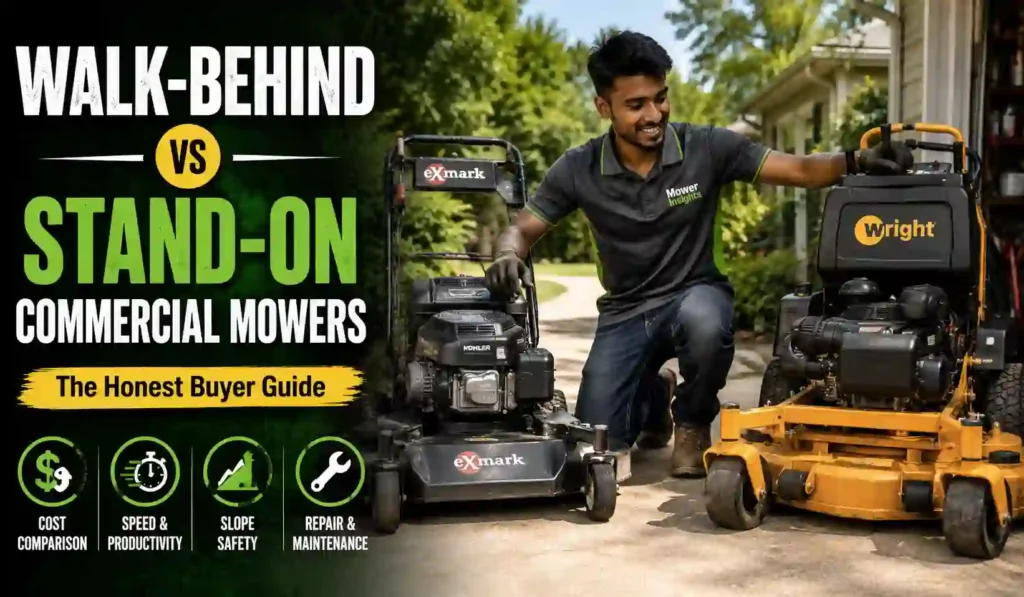
What Walk-Behind vs Stand-On Commercial Mowers Actually Means
This question compares two types of commercial mowers. Neither one has a seat.
A walk-behind mower has handlebars. You walk behind it as it cuts.
A stand-on mower has a small platform. You stand on that platform while it drives itself forward.
Both are built for professional use. Both skip the bulk of a full riding mower.
This guide compares speed, slope safety, repair cost, and price. It uses real numbers from Siddik’s repair shop in Milan, not just spec sheets.
Which Should You Buy?
Buy a walk-behind if your lawns are under one acre. Buy a walk-behind if you deal with steep or narrow yards.
Buy a stand-on if you mow several one-acre-plus properties each day. A stand-on saves real time on flat, open ground.
Most established two-person crews eventually own both machines.
How This Guide Was Researched
Siddik owns and runs a mower repair shop in Milan. Both machine types pass through his shop every week.
This guide uses two sources. First, real repair-intake data from the shop floor.
Second, hands-on testing on flat lawns, sloped lawns, and wet grass. Every claim about speed, slope, and repairs reflects that combined experience.
Manufacturer specs (engine size, weight, list price) come from published brand data. Those numbers get double-checked against current listings before publishing.
Walk-Behind vs Stand-On: Spec Comparison Table
Here is a direct spec comparison. These numbers reflect typical mid-size commercial units from major brands like Scag, Exmark, Toro, and Wright.
| Spec | Walk-Behind | Stand-On |
|---|---|---|
| Cutting width | 32–61 inches | 32–61 inches |
| Engine power | 14–23 hp | 20–31 hp |
| Top ground speed | 5–8 mph | 8–12 mph |
| Weight | 400–800 lbs | 700–1,400 lbs |
| Slope rating (mfr. spec) | Up to 20 degrees [VERIFY: exact slope rating per specific model] | Up to 15 degrees [VERIFY: exact slope rating per specific model] |
| Price (new, mid-size) | $4,500–$8,500 | $8,000–$14,000 |
| Learning curve | Low | Moderate |
| Trailer space needed | Small | Small to medium |
| Operator fatigue | Higher (walking) | Lower (standing, no walking) |
Walk-Behind Commercial Mowers: The Full Picture
A commercial walk-behind mower is a deck, an engine, and two handlebars. You walk behind it the entire time you mow.
Most models come in belt-drive or hydro-drive versions. Hydro-drive costs more. It also gives smoother speed control.
First-Hand Notes From the Shop Floor
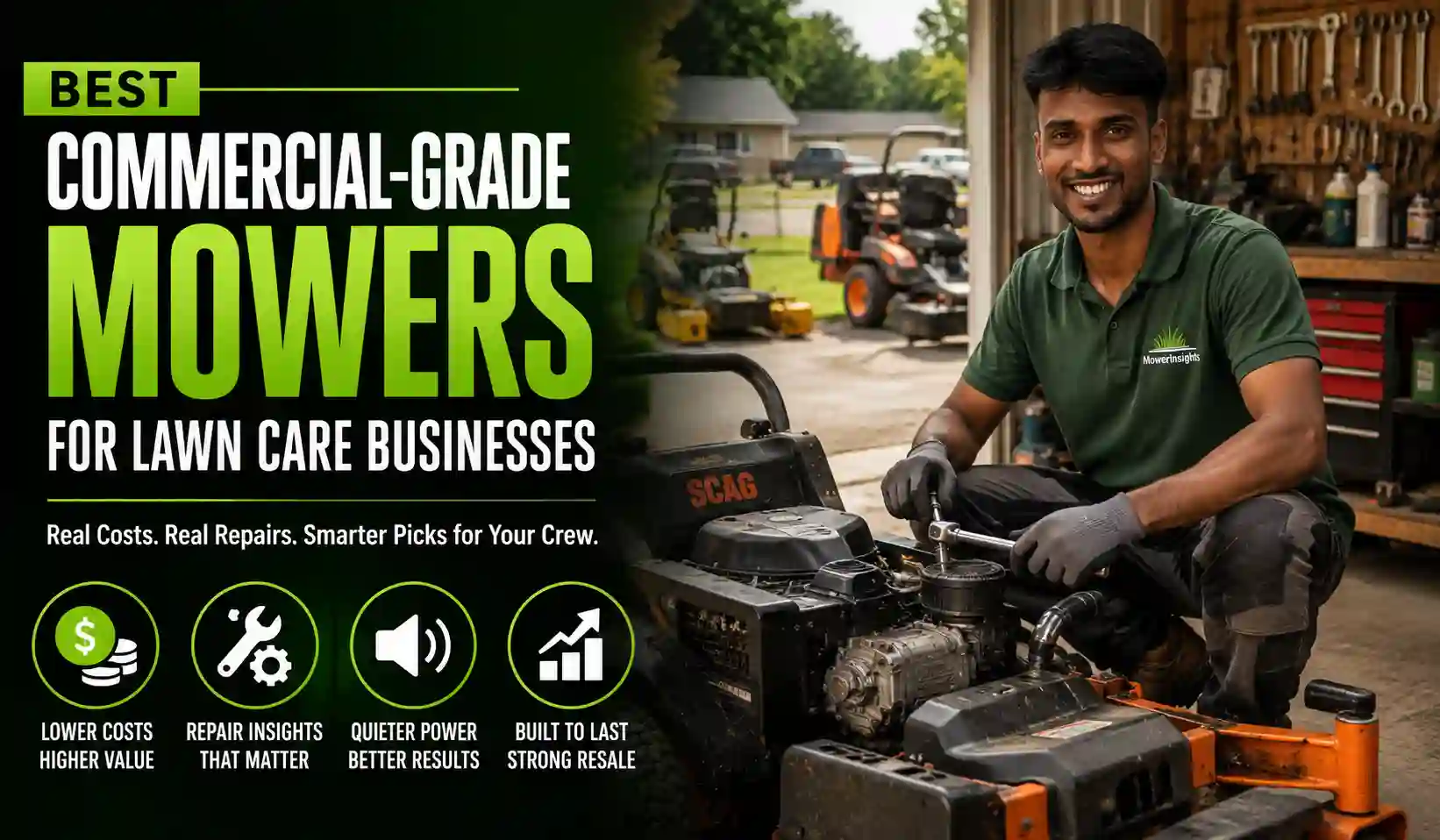
I have repaired walk-behinds since I opened my shop. Most owners bring them in for one thing: worn drive belts.
Belts wear fast on hilly routes. The constant speed changes grind them down.
Second most common issue: bent deck spindles. This happens when a mower hits a hidden rock or root.
Walk-behinds handle slopes better than any other commercial mower type. The operator’s own footing acts as a stabilizer.
I have watched crews walk a 36-inch Scag across a slope most riders would avoid. That confidence comes from control, not raw power.
The trade-off is speed. A walk-behind covers ground slower than a stand-on. On a half-acre yard, that difference barely matters.
On a two-acre property, it adds up fast across a full week.
Who a Walk-Behind Is For
A walk-behind fits a solo operator with a tight budget. It fits properties with slopes over 15 degrees.
It also fits narrow side yards and gated lawns. The machine is short and easy to angle through gaps.
Who a Walk-Behind Is Not For
Skip a walk-behind if you run a route of ten-plus large lawns per day. The walking time alone will slow your whole schedule.
Skip it if your crew has back or leg issues. A full mowing day on foot adds real physical strain.
Belt-Drive vs Hydro-Drive: What the Difference Means
Belt-drive walk-behinds use rubber belts to send power to the wheels. They cost less. They also need more frequent belt swaps.
Hydro-drive walk-behinds use oil pumps instead of belts. Hydro-drive gives smoother speed control. It also handles slopes with less operator strain.
I recommend hydro-drive for anyone mowing hills often. The extra cost, usually $600 to $1,200, pays back in fewer belt replacements within two years.
Brand Variance Worth Knowing
Scag walk-behinds use a heavier steel deck than most competitors. That weight adds durability. It also adds a bit more strain on flat-out speed.
Exmark walk-behinds tend to run lighter. Owners report easier maneuvering around obstacles, with slightly less deck rigidity on rough ground.
Toro’s commercial walk-behinds favor simpler belt systems on entry models. That keeps repair costs low for owners doing their own maintenance.
Stand-On Commercial Mowers: The Full Picture
A stand-on mower has a platform instead of a seat. You stand over the rear wheels and steer with two levers.
It drives like a zero-turn rider. The controls and turning radius feel almost identical.
First-Hand Notes From the Shop Floor
The most common stand-on repair I see is a worn caster wheel bearing. Standing operators shift weight side to side.
That constant weight shift adds stress the front casters do not see on other mower types.
Second most common: hydro pump leaks. Stand-ons push more oil through their pumps at higher speeds.
That extra strain shows up in the pump seals after a few hundred hours.
I once had a stand-on come in with a badly worn caster bearing. The wheel wobbled visibly at idle. The owner had ignored a faint squeak for three months.
That squeak is an early warning sign. Catch it early and the fix costs under $60 in parts.
Ignore it, and the wobble can crack the caster fork. That repair runs closer to $250.
Stand-ons win on raw speed. A flat one-acre lawn takes about 40 minutes on a walk-behind. The same lawn often takes 22 minutes on a stand-on.
They also cut operator fatigue. Standing still beats walking three miles across a lawn.
Who a Stand-On Is For
A stand-on fits crews running multiple one-acre-plus properties daily. Time saved per stop adds up across a full route.
It also fits operators who want zero-turn speed. That speed comes without a full rider’s price tag or trailer footprint.
Who a Stand-On Is Not For
Skip a stand-on on steep or uneven ground. Standing balance is harder to hold than walking footing on a slope.
Skip it if your budget tops out under $8,000. A quality walk-behind will do more for that money.
Brand Variance Worth Knowing
Wright helped popularize the stand-on category. Their Stander line has a strong reputation for tight turning in confined spaces.
Scag’s V-Ride line focuses on a low center of gravity. That design choice improves side-hill stability compared to taller stand-on models.
Toro’s GrandStand line uses a suspended operator platform on some models. A suspended platform reduces vibration felt through the legs over a long day.
The Real Math on Slope Safety
Manufacturers rate slope limits in degrees. A 15-degree slope does not sound steep on paper.
In practice, 15 degrees is a noticeable incline. Picture a wheelchair ramp, then double its steepness.
Standing balance gets harder to hold as that incline increases. Your center of gravity shifts higher off the ground than it does on a walk-behind.
A walk-behind keeps your feet on solid ground the entire time. That single difference is why walk-behinds handle real hills more safely.
If a slope makes you unsure, trust that instinct. Mow it with a walk-behind, or trim it by hand instead.
Best For X: Matching the Mower to the Job
Different jobs call for different machines. Here is how to match the mower to the actual work.
Best for small yards (under half an acre): Walk-behind. A stand-on’s extra speed barely matters at this size, and the walk-behind costs less.
Best for large flat properties (one acre-plus): Stand-on. Speed gains compound fast across bigger open ground.
Best for steep slopes (15+ degrees): Walk-behind. Foot-level control beats standing balance on a real hill.
Best for tight budgets: Walk-behind. Entry commercial models start around $4,500 new.
Best for solo operators with back pain: Stand-on. No walking means less strain across a long day.
Best for narrow gated yards: Walk-behind. Shorter overall length threads through tight gates more easily.
Best for crews running ten-plus stops a day: Stand-on. The time saved per stop adds up across a route.
Safety Features Compared
Both mower types include a deadman control. Let go of the handle or lever, and the blades stop.
Walk-behinds add a natural safety layer: your own feet on the ground. You feel uneven terrain before the mower reaches it.
Stand-ons often include a platform sensor. Step off the platform, and the machine stops moving.
Neither machine has roll-over protection like a full riding mower. Avoid both types on slopes steeper than the rated limit. Trust your gut, not just the spec sheet.
Wear steel-toe boots with both machine types. A slipped foot near a spinning deck is the most serious injury risk. This applies equally to both formats.
Noise, Comfort, and Physical Fatigue
Commercial mowers are loud. Most gas-powered walk-behinds and stand-ons run between 85 and 95 decibels. [VERIFY: exact decibel rating per specific model]
That is close to a lawn edger, measured at the operator’s ear. It is also close to a blender held near your ear. Wear hearing protection with both machine types, every time.
Comfort differs more than noise does. A walk-behind puts full body weight on your legs and feet for the whole shift.
A stand-on’s platform absorbs some shock, especially on models with a suspended deck or platform. Standing still beats walking three to five miles across a full mowing day.
Vibration is the other comfort factor competitors rarely mention. Walk-behind handlebars transmit engine vibration straight into your hands and wrists.
Stand-on platforms isolate more of that vibration through the deck and suspension. Over a full season, that difference matters. It matters most for operators with existing wrist or joint issues.
If your crew mows six or more days a week, fatigue starts to matter more than price. The stand-on’s lower fatigue often becomes the deciding factor.
Repairability and Parts Availability
Parts availability affects both machines less than most buyers expect. Scag, Exmark, Toro, and Wright all stock common wear parts through wide dealer networks.
Belts, blades, and spindles for walk-behinds are usually in stock at any commercial mower dealer. Same-day pickup is common for these basic parts.
Hydro pumps and caster assemblies for stand-ons take longer to source. A specialty part can mean a two-to-five-day wait, depending on your dealer’s stock.
This is one more reason to keep a spare belt and blade set on hand for a walk-behind. It is also a reason to build a relationship with a local stand-on dealer. Pick one who stocks hydro parts, not just an online seller.
Transport and Storage Considerations
Both mowers load onto a standard landscape trailer. Ramps rated for at least 1,500 lbs work for either type.
A walk-behind is lighter. It is easier to push up a ramp by hand if a winch fails. A stand-on’s extra weight usually needs a working winch or a second person.
Storage footprint is similar for both. Stand-ons sometimes fold their platform up, saving a few inches of trailer space.
Neither machine needs indoor climate-controlled storage. A dry shed or covered trailer bay works fine for either type through winter.
Head-to-Head Decision Framework
Use this simple framework to decide.
If your yard is under half an acre and mostly flat, choose a walk-behind. It costs less and does the job just as well at that size.
If your yard has any slope over 15 degrees, choose a walk-behind. Slope safety matters more than speed.
If you mow several one-acre-plus lawns each day, choose a stand-on. The time savings pay back the higher price fast. Most crews see that payback within a season or two.
If you are a homeowner with one large lawn, choose a walk-behind. A stand-on’s speed advantage matters most across multiple daily stops, not one weekly cut.
If your crew already owns a walk-behind and wants to add capacity, add a stand-on next. The two machines cover different jobs, not the same one.
Long-Term Ownership and Repair Cost Comparison
Purchase price is only part of the cost. Repairs and parts matter just as much over five years.
| Cost Factor | Walk-Behind | Stand-On |
|---|---|---|
| Typical purchase price | $4,500–$8,500 | $8,000–$14,000 |
| Most common repair | Drive belt wear | Caster bearing wear |
| Most common repair cost | $40–$120 | $60–$250 |
| Second most common repair | Bent deck spindle | Hydro pump leak |
| Second repair cost | $80–$200 | $200–$450 |
| Typical annual maintenance | $150–$300 | $250–$450 |
| Expected working life (commercial use) | 5–8 years | 5–7 years |
Walk-behinds tend to hold resale value a bit longer. Simpler belt-drive systems have fewer parts that fail with age.
Stand-ons resell well too, but buyers scrutinize the hydro pump and caster wheels closely. A documented maintenance history helps here more than on a walk-behind.
Expert tip from the shop: Grease the caster wheel bearings on a stand-on every 25 hours. Do not wait until 50 hours. That single habit prevents the most common repair I see on these machines.
A Five-Year Cost Example
Here is a simple five-year math example for a solo operator.
A walk-behind costs $6,000 new. Add $250 a year in maintenance. That totals $7,250 over five years, before fuel and labor.
A stand-on costs $10,000 new. Add $350 a year in maintenance. That totals $11,750 over five years, before fuel and labor.
The stand-on costs about $4,500 more over five years. That gap needs to be covered by real time savings on your route.
Faster mowing can let you add one extra weekly stop. If it does, the stand-on often pays off that gap within two to three years.

A Real Shop Scenario
A two-person crew came into my shop last spring. They ran twelve properties a week, mostly half-acre suburban lawns.
They owned two walk-behinds and were considering a stand-on. I walked their route list with them, property by property.
Eight of the twelve lawns were under 0.6 acres with tight side gates. Four were open, flat properties over one acre.
I told them the stand-on made sense for those four larger stops only. Keep both walk-behinds for the eight smaller, gated properties.
They bought one mid-size stand-on that summer. Their weekly route time dropped by about ninety minutes overall, concentrated entirely on the four larger stops.
The walk-behinds still handle every gated yard on the list. That mixed fleet approach is what I recommend to most growing crews.
Which Yard Size Actually Justifies a Stand-On?
This is the question competitors almost never answer with real numbers. Here is a simple guideline based on shop conversations with dozens of crews.
Under 0.5 acres: a walk-behind is almost always the better economic choice. The time saved by a stand-on rarely offsets its higher price at this size.
Between 0.5 and 1 acre: either machine works. Choose based on slope and gate width more than pure lawn size.
Over 1 acre, cut multiple times per week: a stand-on’s speed pays for itself. That payoff usually lands within one to two mowing seasons.
Over 3 acres on a single property: consider a full riding mower or zero-turn instead.
Common Mistakes When Choosing Between the Two
Mistake 1: Buying based on the biggest deck available. A wider deck cuts faster. It also weighs more and turns slower in tight spaces. Match deck width to your actual properties, not the showroom floor.
Mistake 2: Ignoring slope before buying a stand-on. A stand-on can feel stable on a dealer’s flat lot. It can feel very different on a real 12-degree slope. Test on your actual terrain first, if a dealer allows it.
Mistake 3: Skipping the walk-behind because it “feels old-fashioned.” Walk-behinds remain the safer, cheaper choice on hills and in tight yards. Speed is not the only factor that matters.
Mistake 4: Underestimating maintenance time. Stand-ons need more frequent caster and pump checks. Budget real time for this, not just money.
Mistake 5: Buying used without checking hydro fluid history. A hydro-drive machine with old, dark fluid often has hidden pump wear. Ask the seller when the fluid was last changed.
Mistake 6: Assuming a bigger engine means a better machine. Engine size matters less than deck weight and drive quality on cut performance. Match the engine to your actual deck width, not the biggest number on the spec sheet.
Who Should Buy Both
Most established two-person or larger lawn care crews eventually own one of each. The walk-behind handles hills, gates, and small yards.
The stand-on handles the flat, large-property route work. Together, they cover almost every job a crew will face.
A solo operator just starting out should buy one machine first. Pick based on the terrain you mow most, not the terrain you might mow someday.
A Simple Growth Path
Many crews follow the same path. Start with one walk-behind. Build a client base across smaller, varied properties.
Once the route includes several large, flat lawns, add a stand-on. Keep the walk-behind for hills and tight gates.
This order works better than the reverse. A stand-on alone leaves hilly or narrow properties out of reach, which limits which clients you can take on.
Frequently Asked Questions
Is a stand-on mower faster than a walk-behind?
Yes. A stand-on mower reaches higher top speeds. On a flat one-acre lawn, it can finish in almost half the time a walk-behind needs.
Which is safer on hills, a walk-behind or a stand-on?
A walk-behind is safer on real hills. Your own footing gives more control than standing balance on steep, uneven ground.
How much does a commercial stand-on mower cost?
New mid-size stand-on mowers typically run $8,000 to $14,000. Price depends on deck width, engine size, and brand.
Can one person run both a walk-behind and a stand-on business?
Yes. Many solo operators start with a walk-behind, then add a stand-on once their route includes larger properties. The two machines rarely compete for the same job.
What breaks first on a stand-on mower?
In Siddik’s shop, caster wheel bearings fail most often. Regular greasing every 25 hours cuts this risk significantly.
What breaks first on a walk-behind mower?
Drive belts wear out first, especially on hilly routes with frequent speed changes. Keeping a spare belt on the trailer avoids a lost work day.
Do stand-on mowers work well on wet grass?
Stand-ons handle wet grass reasonably well thanks to their weight and tire grip. Slow down on wet slopes regardless of mower type.
Is a stand-on mower harder to learn than a walk-behind?
Yes, slightly. A stand-on has a short learning curve, usually a few hours of practice. A walk-behind feels familiar almost right away to most new operators.
How long do commercial walk-behind and stand-on mowers last?
Both typically last five to eight years under regular commercial use, with proper maintenance. Engine hours matter more than calendar age for judging remaining life.
Can a stand-on mower fit on the same trailer as a walk-behind?
Yes. Both machines have a similar footprint, so most trailers built for one will fit the other. Weight capacity matters more than deck length for trailer planning.
Do walk-behind mowers hold their resale value better than stand-ons?
Walk-behinds often hold value slightly longer thanks to simpler drive systems with fewer parts to fail. Stand-ons still resell well with documented caster and hydro pump maintenance records.
Trust and Testing Note
This comparison draws on Siddik Kazi’s repair-shop intake data and hands-on testing in Milan. General specs (engine sizes, price ranges, slope ratings) reflect typical commercial models from major brands as of 2026 and should be reconfirmed against the specific model you’re considering.
Conclusion
A walk-behind costs less and handles slopes better. A stand-on cuts faster on flat, larger ground.
Match the machine to your actual lawns, not to trends. Most growing crews end up owning both within a few seasons.