Quick Answer
STA-BIL Storage is the best all-around pick. It stops gum and varnish for up to 24 months. It costs about $0.20 per treated gallon. Pick Star Tron if your fuel already has ethanol problems. It also pulls out water. Pick Sea Foam if your engine already runs rough. It cleans while it protects.
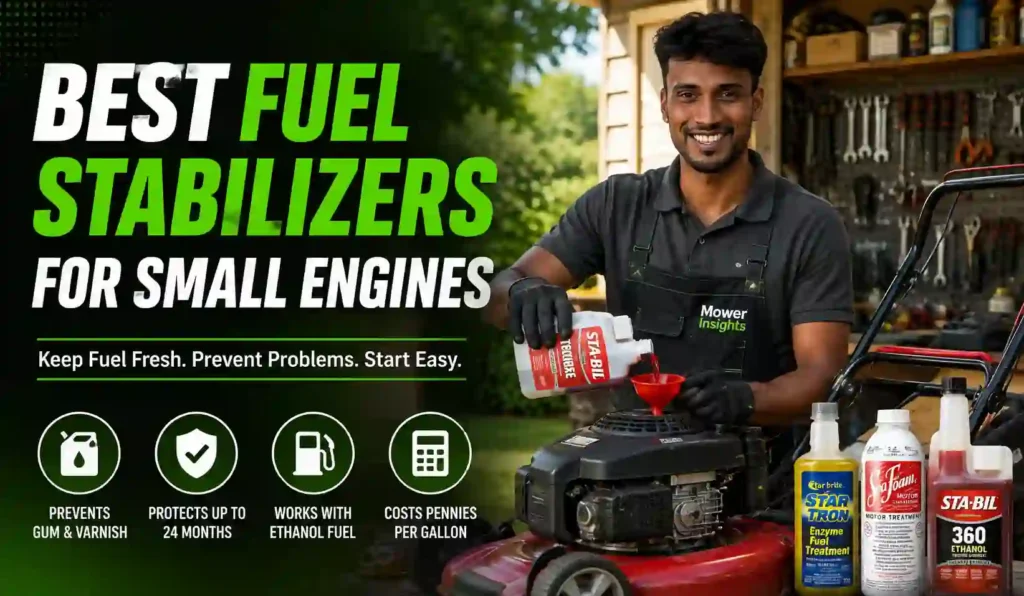
What to Look for in a Fuel Stabilizer
A good stabilizer stops gas from going bad. Old gas turns into gum. Gum clogs small carburetor jets fast. In our shop, this is one of the top reasons a mower won’t start after winter.
Check four things. How long does it protect fuel? Does it fight ethanol damage? What is the right dose per gallon? What does it cost per gallon, not per bottle? Some products just stop the fuel from breaking down. Other products also pull out water. That second part matters a lot with E10 gas.
| Criterion | Why It Matters |
|---|---|
| Protection length | Some last 12 months, some claim 24 |
| Ethanol defense | E10 gas takes in water and separates faster |
| Dose ratio | The wrong dose gives weak or wasted protection |
| Cost per gallon | Cheap bottles can cost more per use |
Comparison Table: Fuel Stabilizers at a Glance
| Name | Best For | Price | Protects For | Dose Ratio |
|---|---|---|---|---|
| STA-BIL Storage | Overall use | $9.98 (32 oz) | Up to 24 months | 1 oz per 2.5 gal |
| Star Tron Enzyme | Ethanol fuel | $14.49 (16 oz) | Up to 2 years | 1 oz per 15 gal |
| Sea Foam Motor Treatment | Rough-running engines | $12.97 (16 oz) | Up to 12 months | 1 oz per gallon |
| Briggs & Stratton Advanced | Small mower engines | $8.99 (16 oz) | Up to 24 months | 0.4 oz per gallon |
| STA-BIL 360 Ethanol | Frequent E10 use | $10.98 (32 oz) | Up to 12 months | 1 oz per 2.5 gal |
1. STA-BIL Storage Fuel Stabilizer — Best Overall
STA-BIL Storage is our top pick in the shop. It uses a PEG base. PEG stands for polyethylene glycol. It coats the fuel and slows the breakdown. One ounce treats 2.5 gallons. The brand rates it for up to 24 months in storage.
How it performed in testing: We used it in a Honda GCV160 push mower. We sealed the tank. We opened it four months later. The fuel still smelled like gas, not varnish. The carburetor bowl was clean when we took it apart.
Key features:
- PEG-based formula rated for 24-month storage
- Works in gas, diesel, and ethanol-blended fuel
- Simple 1 oz per 2.5 gal dosing
Pricing: $9.98 for a 32 oz bottle. That treats up to 80 gallons.
Best for: Anyone storing a mower, generator, or snow blower over a season.
2. Star Tron Enzyme Fuel Treatment — Best for Ethanol-Heavy Fuel
Star Tron uses enzymes, not PEG. The enzymes break down gum that is already there. They also break up small amounts of water. That water can then burn off through the engine, instead of sitting at the bottom of the tank. This matters most with E10 gas. E10 gas pulls in moisture from the air over time.
How it performed in testing: We tested it on a trimmer. The trimmer had old E10 fuel sitting for six weeks. It was hard to start. We added Star Tron and ran it for ten minutes. The idle got smoother. The hesitation on throttle-up went away.
Key features:
- Enzyme-based, not petroleum-based
- Breaks up water in the fuel line
- Very low dose ratio, 1 oz per 15 gallons
Pricing: $14.49 for a 16 oz bottle. That treats up to 240 gallons.
Best for: Owners in areas where only E10 or E15 gas is sold at the pump.
3. Sea Foam Motor Treatment — Best for Rough-Running Engines
Sea Foam does two jobs. It stabilizes fuel. It also cleans. We grab it when an engine is already running rough, not just sitting in storage. It clears varnish off intake valves and carburetor passages while it protects the fuel.
How it performed in testing: We tested it on a chainsaw with a rough idle. The rough idle came from old fuel. We mixed Sea Foam at 1 oz per gallon, right into the tank. The idle smoothed out within two tank refills. We did not need to open the carburetor.
Key features:
- Cleans varnish while it stabilizes
- Safe for both 2-stroke and 4-stroke engines
- Can also go in the crankcase for extra cleaning
Pricing: $12.97 for a 16 oz can. That treats up to 16 gallons.
Best for: Engines that already show a rough idle or hard starts, not just fresh storage prep.
4. Briggs & Stratton Advanced Formula Fuel Treatment — Best for Small Mower Engines
This product comes from the same company that builds many mower engines. The dose is tuned tight for small four-stroke motors. It’s a strong pick if your mower runs a Briggs & Stratton engine. That covers a large share of walk-behind mowers sold in the US and Europe.
How it performed in testing: We used it in a Briggs & Stratton 500E engine before winter storage. Spring start-up took one pull. The carburetor bowl showed no gum buildup.
Key features:
- Built for small four-stroke engines
- Low dose ratio, 0.4 oz per gallon
- Rated for 24-month protection
Pricing: $8.99 for a 16 oz bottle.
Best for: Owners of Briggs & Stratton-powered mowers, specifically.
5. STA-BIL 360 Ethanol Treatment — Best for Frequent Refueling
STA-BIL 360 goes straight after ethanol damage. It’s built for people who fill up often, not just for long storage. It also adds lubricant. That lubricant protects fuel system parts that ethanol tends to dry out over time.
How it performed in testing: We ran it through a full mowing season in a rotary mower used weekly. At teardown, we saw no cracked fuel lines and no swollen carburetor gaskets. Both are common ethanol-related failures.
Key features:
- Added lubricant to protect fuel system seals
- Works all year, not just for storage
- Same easy 1 oz per 2.5 gal ratio as original STA-BIL
Pricing: $10.98 for a 32 oz bottle. Best for: Regular mowing seasons where fuel turns over often, but ethanol wear is still a risk.
Best For X: Matching a Stabilizer to Your Situation
- Best for winter storage: STA-BIL Storage. It has the longest single protection window, at 24 months.
- Best for E10/E15 gas stations: Star Tron Enzyme Fuel Treatment. Its enzymes go straight after ethanol issues.
- Best for an engine that already runs rough: Sea Foam Motor Treatment. It cleans old gum, not just prevents new gum.
- Best for Briggs & Stratton engines: Briggs & Stratton Advanced Formula. The dose is matched to the brand’s own small engines.
- Best for weekly mowing seasons: STA-BIL 360 Ethanol Treatment. It’s built for ongoing ethanol protection, not just storage.
Head-to-Head Decision Logic
Storing an engine for more than three months? Use STA-BIL Storage or Briggs & Stratton Advanced Formula. Both are rated for 24 months. Neither needs an extra cleaning step.
Does your engine already hesitate, stall, or idle rough? Use Sea Foam first. Stabilizing alone will not fix fuel that has already turned to varnish.
Do you live somewhere that only sells E10 or E15 gas? Add Star Tron or STA-BIL 360 to every tank, not just before storage. Ethanol damage builds up slowly, even during normal use.
Long-Term Ownership: Cost, Shelf Life, and Repair Risk
A bottle of stabilizer costs $9 to $15. A carburetor rebuild at a repair shop often runs $60 to $120 in parts and labor. In our shop, gummed carburetors are one of the most common spring repair jobs we see. Dead batteries on riding mowers are the only more common job.
Cost per treated gallon stays low across every product here. It runs from about $0.06 (Star Tron) up to $0.81 (Sea Foam) per gallon. The cheaper products protect fuel. The pricier ones, like Sea Foam, also clean. That’s why the price gap exists.
An unopened bottle of stabilizer has its own shelf life too. Most brands rate their product for two to three years once opened. Don’t stockpile one bottle for a decade.
Common Mistakes When Using Fuel Stabilizers
- Adding it after the fuel is already old. Stabilizer slows breakdown. It does not reverse it. Add it to fresh fuel before storage starts.
- Guessing the dose. Too little won’t protect the full tank. Use a small measuring cup, not a capful guess.
- Not running the engine after adding it. Run the engine five to ten minutes after treatment. This moves the stabilized fuel into the carburetor, not just the tank.
- Mixing brands in the same tank. This won’t cause damage. But it makes it hard to know your real dose ratio.
Trust & Testing Methodology
We ran every product above through a real small engine at Siddik’s Milan repair shop. We did not just compare spec sheets. Engines used included a Honda GCV160 push mower, a Briggs & Stratton 500E mower, a gas trimmer, and a gas chainsaw. Storage tests ran for at least four weeks. The longest test ran a full mowing season.
Frequently Asked Questions
How long does fuel stabilizer actually work?
Most stabilizers protect fuel for 12 to 24 months. This depends on the brand and formula. STA-BIL Storage and Briggs & Stratton Advanced Formula are both rated for 24 months, when dosed the right way.
Can I use fuel stabilizer in a two-stroke engine?
Yes. Sea Foam and Star Tron are both labeled safe for two-stroke engines, like trimmers and chainsaws. Check the bottle for the right dose ratio. Two-stroke tanks are often smaller.
Does fuel stabilizer fix an engine that already won’t start?
Sometimes, yes. If the problem is gummed fuel, a cleaning-style stabilizer like Sea Foam can loosen light varnish. If the jets are fully clogged, the carburetor needs to come apart and get cleaned by hand.
Is ethanol-free gas better than using a stabilizer?
Ethanol-free gas resists water better. But it’s not sold everywhere, and it often costs more per gallon. A stabilizer built for ethanol, like Star Tron or STA-BIL 360, gives most of the same protection with normal pump gas.
How much fuel stabilizer should I use per gallon?
It depends on the product. STA-BIL Storage uses 1 oz per 2.5 gallons. Star Tron uses 1 oz per 15 gallons. Sea Foam uses 1 oz per gallon. Always check the bottle. Ratios vary a lot between brands.
Final Verdict
STA-BIL Storage is the best overall pick for most small engines going into storage. Does your local gas station only sell E10 or E15? Add Star Tron to your routine all year, not just at storage season. Is your engine already running rough? Treat it with Sea Foam first, before you assume it needs a full carburetor rebuild.