Quick Overview
- Robot mowers are the best pick for allergy sufferers. They keep you out of the pollen and mold cloud. The iRobot-style and Husqvarna Automower lines lead this group.
- Do you need to walk behind a mower? Pick a battery mulching model. Point the discharge chute away from you. This cuts your exposure more than a gas mower does.
- Gas mowers are the worst choice. Exhaust mixes with pollen and mold in the air. This makes breathing harder for allergy sufferers.
- Riding mowers with a closed, filtered cab cut exposure on big yards. Use one when a robot mower or push mower won’t work.
- Mow between 3 p.m. and 5 p.m. Morning pollen has settled by then. Evening humidity has not yet brought it back up. Timing matters as much as your mower choice.
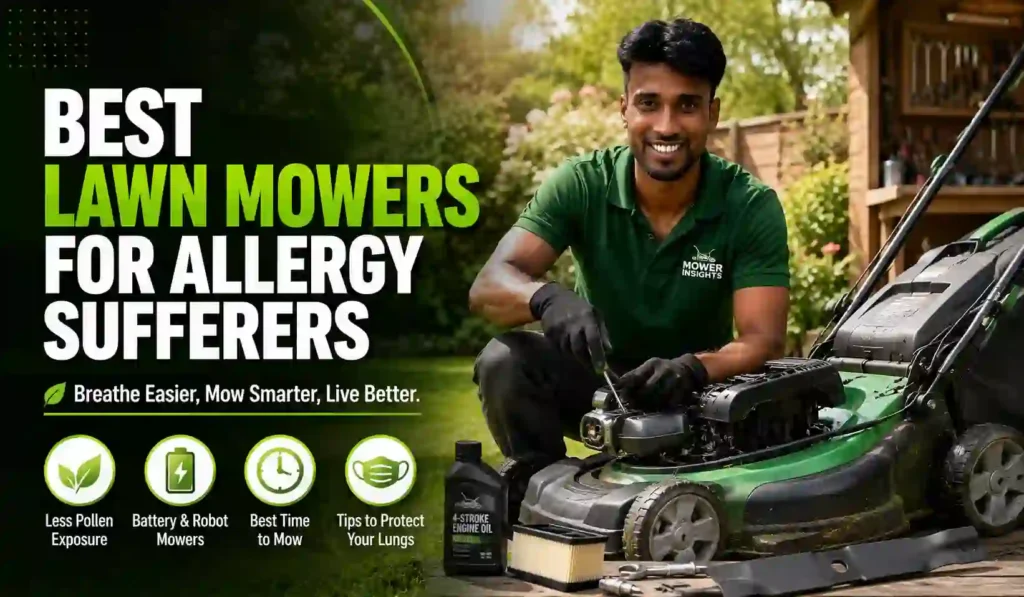
What “Allergy-Friendly” Actually Means for a Lawn Mower
A mower does not cause allergies. It stirs up what is already there. Grass pollen. Mold spores in damp thatch. Fine dust from dry clippings. The best mower keeps that cloud away from your nose and lungs. Or it keeps you out of the yard.
People lump three triggers into one word: “allergies.” Grass pollen is worst in early morning, right after dew dries. Mold spores live in the thatch layer. A blade or wheel stirs them up the moment it hits damp grass. Dust comes from dry, overgrown lawns. It gets worse late in a mow if you let the yard grow too long.
Each trigger reacts to a different fix. Pollen exposure drops most when you stand farther from the deck. This is why robot and riding mowers beat push mowers. Mold spore exposure drops when clippings are mulched fine and left low. Bagging stirs up more spores during the dump step. Dust drops with shorter, more frequent cuts.
Grass type also plays a role, though it sits outside the mower itself. Bermuda, ryegrass, and Kentucky bluegrass release pollen at different times and at different strengths. A reader with a Bermuda lawn in the southern US often faces a longer pollen season than someone with fescue up north. Knowing your grass type sets fair expectations for what a mower alone can fix.
It helps to split what a mower can control from what it cannot. A mower changes how much allergen material gets into the air. It changes how close you stand to that air. It does not change how much pollen your neighbor’s yard puts out. Or a nearby field. Or the trees overhead. On a high pollen-count day, even a great robot mower will not block outdoor exposure on its own. Mower choice is one lever. It is not the only one.
How to Think About This Purchase
Four factors decide which mower actually helps: how much of the mowing you’ll do yourself, your yard size, your specific trigger (pollen, mold, or dust), and your budget for reducing operator exposure versus just managing symptoms with medication and a mask.
Yard size and layout. Robot mowers work best on yards under roughly 0.5 acres (about 2,000 m²) with clear boundaries. Larger, more complex properties usually need a riding mower or a walk-behind, since robot mower navigation struggles with heavy obstacle density.
Your specific trigger. If pollen is your main issue, physical distance from the deck (robot or riding mower) does the most good. If mold from damp thatch is the trigger, a sharp blade and a mulching deck that finely shreds clippings matters more than distance, since it reduces how much spore-laden material becomes airborne in the first place.
How much you’ll actually operate it. A robot mower removes the exposure question entirely for the 90% of mowing it handles. A battery push mower still puts you in the cloud, just without gas exhaust added to it.
Budget for exposure reduction. Robot mowers run $800 to $3,500 [VERIFY: current market range for 2026 models]. Battery push mowers run $300 to $700. The gap is real, and for someone with a mild seasonal reaction, a $25 N95-style mask and a battery mulching mower is a reasonable middle ground rather than a full robot mower purchase.
There’s a fifth factor worth naming separately: how severe the reaction actually is. Someone with mild, occasional sneezing during peak pollen weeks has more flexibility to choose based on budget. Someone with diagnosed asthma or a history of a serious reaction to grass pollen should weight exposure reduction far more heavily than cost, since a bad flare-up is a health event, not just an inconvenience. If that’s your situation, talk to your doctor about mowing-day precautions in addition to whatever mower you choose. [VERIFY: this guide is not medical advice; consult a physician for individual allergy or asthma management.]
Think of these four factors as a short filter rather than a checklist to satisfy all at once. A reader with a small, obstacle-light yard, a mold-dominant trigger, and a flexible budget lands on a robot mower almost automatically. A reader with a large, hilly property and a tight budget is realistically looking at a well-maintained battery push mower and a respirator, not a cab-equipped rider they can’t afford. Matching the mower to the actual constraint, not the ideal scenario, is what makes the purchase worth it.
Types of Mowers Explained (Allergen-Exposure Angle)
Every mower type handles clippings and operator position differently, and that difference is the whole story for allergy sufferers. See for the full mechanical breakdown; here’s the exposure-relevant summary.
Robot mowers cut in short, frequent passes and leave the yard almost entirely unattended. Because they mulch fine clippings constantly rather than in one long session, they never generate the kind of dense pollen-and-mold cloud a weekly mow does. The operator’s total exposure is close to zero. See our for model-specific picks.
Battery push mowers put the operator directly behind the deck, same as gas, but without combustion exhaust adding particulates to the mix. A mulching deck on a battery mower reduces airborne debris compared to a bagging setup, since there’s no dumping-and-hauling step that kicks material back into the air.
Gas push mowers are the worst combination for allergy sufferers. Combustion byproducts irritate airways on their own, and that irritation compounds with pollen and mold exposure rather than sitting separately from it. In our shop, gas mower owners with seasonal allergies report worse symptoms on mowing days than battery mower owners doing the same yard, though this is anecdotal shop observation rather than a controlled study.
Riding mowers and zero-turns put more physical distance between the operator’s face and the cutting deck than any walk-behind. Some higher-end riding mowers offer enclosed, filtered cabs, which is the closest a non-robot option gets to the robot mower’s exposure profile. Without a cab, though, a rider still puts the operator downwind of the discharge chute for most of the mow, so the exposure benefit over a push mower is real but smaller than most buyers assume. See for full reviews.
Zero-turn mowers deserve a separate note. Their tighter turning radius means fewer passes and less time spent in the yard overall on a large property, which shortens total exposure time even without a cab. For a reader choosing between a standard riding mower and a zero-turn purely on allergy grounds, the zero-turn’s shorter mowing time is a genuine, if secondary, advantage.
Top Picks by Use Case
Best Overall: Robot Mower with Rain Sensor and Fine-Mulch Blades
A robot mower with a rain sensor avoids mowing wet grass, which is exactly when mold spores are most likely to become airborne if disturbed. Fine-mulch blades break clippings down small enough that they settle back into the lawn instead of drifting. Price range: $1,200 to $2,800.
Good fit for: yards under 0.5 acres, relatively flat terrain, clear perimeter for boundary wire or GPS mapping. Not a good fit for: heavily wooded, obstacle-dense yards, or properties over roughly 1 acre without a premium high-capacity model.
Best Walk-Behind: Battery Mulching Mower, Side-Discharge Disabled
For anyone who needs or wants to walk behind the mower, a battery mulching model with the side-discharge chute closed keeps clippings under the deck rather than spraying them toward the operator’s legs and lower face. Price range: $350 to $650.
Good fit for: small to medium yards, owners who want the exercise or enjoy mowing, budgets under $700. Not a good fit for: anyone with a severe reaction who can tolerate zero direct exposure; a robot mower is the better call.
Best for Larger Properties: Zero-Turn or Riding Mower with Enclosed Cab
On properties over an acre, a robot mower usually isn’t practical, and hours behind a walk-behind add up fast. An enclosed, filtered cab on a riding mower cuts direct exposure the most of any non-robot option. Price range: $4,500 to $9,000 for cab-equipped models.
Good fit for: yards over 1 acre, owners who already own or are considering a riding mower for time savings. Not a good fit for: small lots, where the cost isn’t justified by the exposure reduction gained.
Best Budget Option: Basic Battery Mower Plus a Half-Mask Respirator
If a robot mower or cab-equipped rider isn’t in the budget, a basic battery mulching mower paired with a half-mask particulate respirator (not just a cloth mask) closes most of the exposure gap for a fraction of the cost. Combined price range: $300 to $400 mower plus $20 to $40 for a reusable respirator [VERIFY: current respirator pricing].
Good fit for: tight budgets, mild to moderate seasonal symptoms. Not a good fit for: anyone with asthma or a severe reaction; that reader should prioritize a robot mower over a mask-and-budget-mower combination.
Comparison Table: Allergy-Friendly Mowers at a Glance
| Type | Operator Exposure | Best Yard Size | Price Range | Repair-Shop Note |
|---|---|---|---|---|
| Robot mower (fine mulch, rain sensor) | Lowest | Under 0.5 acre | $1,200-$2,800 | Mowing deck vents clog with pollen dust; needs a quick brush-out monthly during high-pollen weeks |
| Battery push mower (mulching) | Moderate | Small-medium | $350-$650 | Underdeck buildup from wet mulching is the most common reason these come in for a deck-scrape service |
| Gas push mower | Highest | Any | $250-$500 | Air filters clog fastest of any mower type during pollen season; most frequent allergy-adjacent complaint in-shop is a bogging engine from a pollen-clogged filter |
| Riding mower with enclosed cab | Low (non-robot) | Over 1 acre | $4,500-$9,000 | Cab filters need replacement roughly twice a season in high-pollen regions |
Buying Mistakes to Avoid
Don’t buy a robot mower for a yard it can’t handle. Dense obstacles, steep slopes over the model’s rated limit, or a property over the mower’s coverage rating will leave you back on a push mower anyway, and you’ll have spent robot-mower money for nothing.
Don’t assume “electric” alone solves the problem. A battery mower without a mulching deck, or one you run with a bag attached, still kicks up as much airborne debris as a gas mower during bagging and dumping. The motor type matters less than the discharge handling.
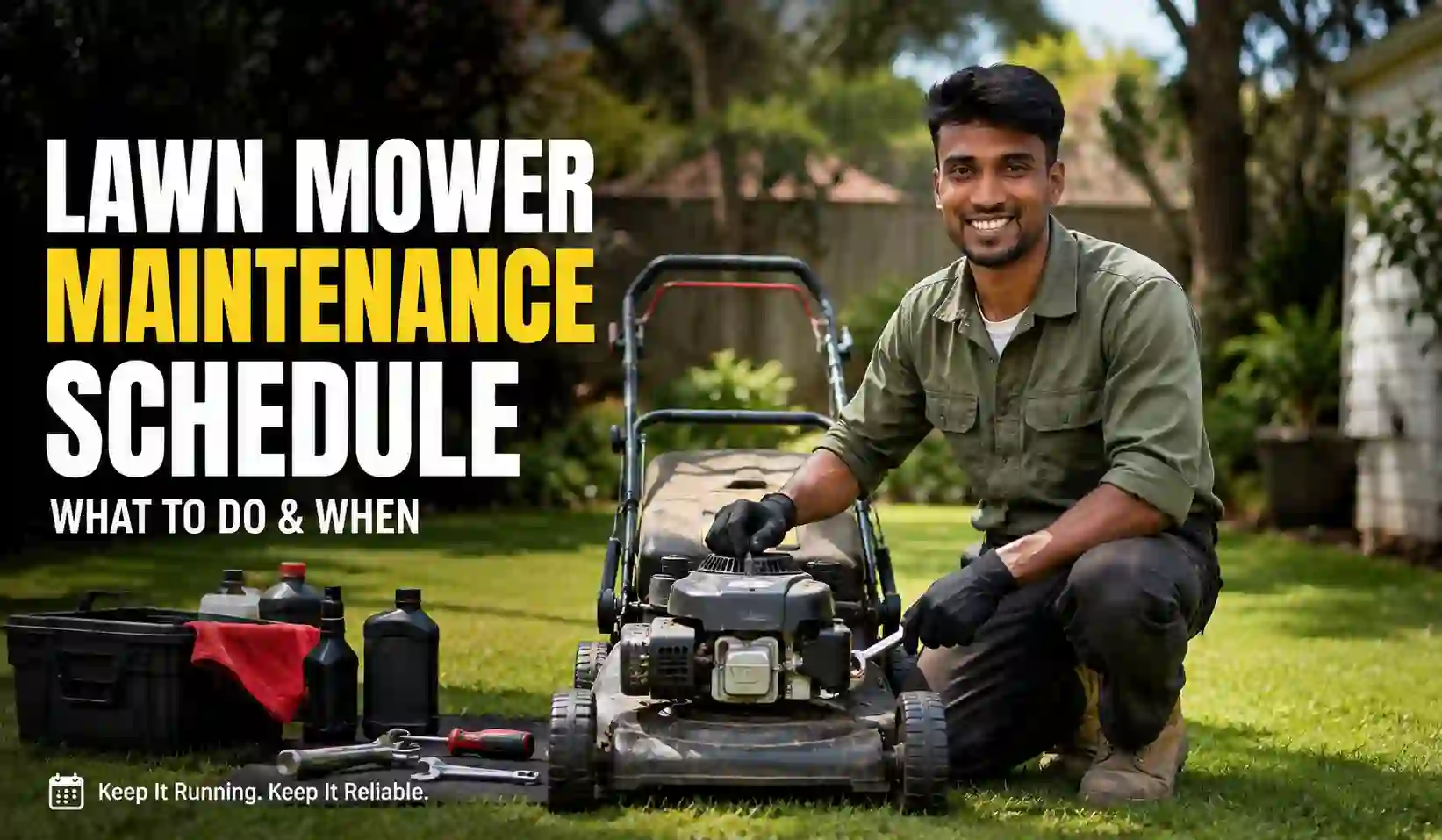
Don’t skip the filter on a cab-equipped riding mower. In our shop, owners who bought a cab model for allergy relief but never replaced the cabin air filter get almost none of the benefit they paid for. covers filter intervals in detail.
Don’t mow at the worst time of day for your trigger. Early morning, right after dew evaporates, is peak pollen release for most grass species. If your budget mower is the only option, shifting your mowing window to mid-afternoon does more for symptom control than most people expect.
Don’t ignore blade sharpness because it seems unrelated to allergies. A dull blade tears grass instead of cutting it cleanly, which bruises the plant tissue and releases more plant matter and moisture into the air per pass. In our shop, a fresh sharpening on a mulching mower is one of the simplest fixes we suggest to customers who say their allergy-friendly mower “doesn’t seem to be helping.”
Don’t buy based on marketing language like “allergy-friendly” or “hypoallergenic” printed on a mower box. No mower is certified hypoallergenic in any regulated sense; the phrase is a marketing claim, not a tested standard. Judge the mower on the mechanics covered in this guide (mulching quality, discharge handling, operator distance) rather than a label.
Maintenance and Total Cost of Ownership
Every mower type on this list needs allergy-specific maintenance beyond the standard schedule, and skipping it both worsens exposure and shortens the machine’s life.
Robot mowers: Brush pollen dust out of the intake vents and blade housing every two to three weeks during peak season. Left uncleaned, this buildup is one of the more common reasons a robot mower comes into a shop with a motor running hot or a blade motor drawing more current than it should. Estimated annual maintenance: $40-$80 in blades and cleaning supplies.
Battery mulching mowers: Wet-mulched clippings cake onto the underside of the deck fastest of any mower type, and a caked deck reduces mulching quality, which sends more debris airborne, not less. Scrape the deck after every mow during high-pollen or damp weeks. Estimated annual cost: $30-$60 in blade sharpening or replacement.
Gas mowers: Air filters are the single most common allergy-season repair-shop visit for gas mowers. A clogged filter chokes the engine and, separately, does nothing to reduce the exhaust particulates that make gas mowers the worst allergy option to begin with. Estimated annual maintenance: $80-$150 including filter, oil, and spark plug.
Cab-equipped riding mowers: Replace the cabin air filter on the manufacturer’s schedule, typically twice per season in high-pollen regions. Skipping this turns an expensive allergy-reduction feature into a sealed box full of the same air outside it. Estimated annual maintenance: $150-$300 including cab filter, engine service, and blade sharpening.
Frequently Asked Questions
Do robot mowers actually help with lawn mowing allergies?
Yes. Robot mowers cut in short, frequent passes and keep the operator away from the yard entirely during mowing, which removes the main source of direct pollen and mold exposure. They still need periodic vent cleaning to keep performing well through peak pollen season.
Is an electric mower better than gas for allergy sufferers?
Generally yes, because electric mowers don’t add combustion particulates to the pollen and mold already in the air. The mulching deck design and how you handle clippings matter as much as the power source, though; a poorly maintained electric mower with a bagging attachment still kicks up significant airborne debris.
What time of day is best for mowing if I have grass allergies?
Mid to late afternoon, roughly 3 to 5 p.m., after morning pollen release has settled and before evening humidity brings pollen counts back up. This timing matters as much as which mower you choose, especially on a budget.
Do HEPA filters exist for lawn mowers?
Enclosed cabs on higher-end riding mowers use cabin air filters, and some manufacturers offer HEPA-rated options as an upgrade. Standard push and robot mowers don’t have cabin filtration since there’s no enclosed operator space to filter.
Should I wear a mask while mowing if I have allergies?
Yes, a half-mask particulate respirator helps regardless of which mower you use, and it’s the cheapest exposure-reduction option available if a robot mower or cab-equipped rider isn’t in the budget. A cloth mask offers far less protection against fine pollen and mold particles than a rated particulate respirator.
Can mulching mowers make allergies worse?
A well-maintained mulching mower with sharp blades reduces airborne debris compared to bagging, since clippings are shredded fine and settle rather than getting kicked up during a dump-and-haul step. A dull blade or a caked deck reverses that benefit and can make a mulching mower perform worse than a clean bagging setup.
Pingback: Best Robot Lawn Mowers in 2026