Quick Verdict
- Overall score: 8.0/10 – a genuinely useful shop tool once you already own DeWalt 20V batteries.
- Best for: seating tubeless tires on mowers, ATVs, and utility carts, plus quick top-offs on yard equipment.
- Not for: anyone who wants a tanked compressor for framing nailers or spray guns – this tool has no tank.
- Price: $169.00 (bare tool) at most major retailers as of .
- Top pro: three power sources (battery, 12V DC, 110V AC) mean it never sits unused for lack of a charged battery.
- Top con: no tank, so it’s slower than a real compressor on anything that needs sustained airflow.
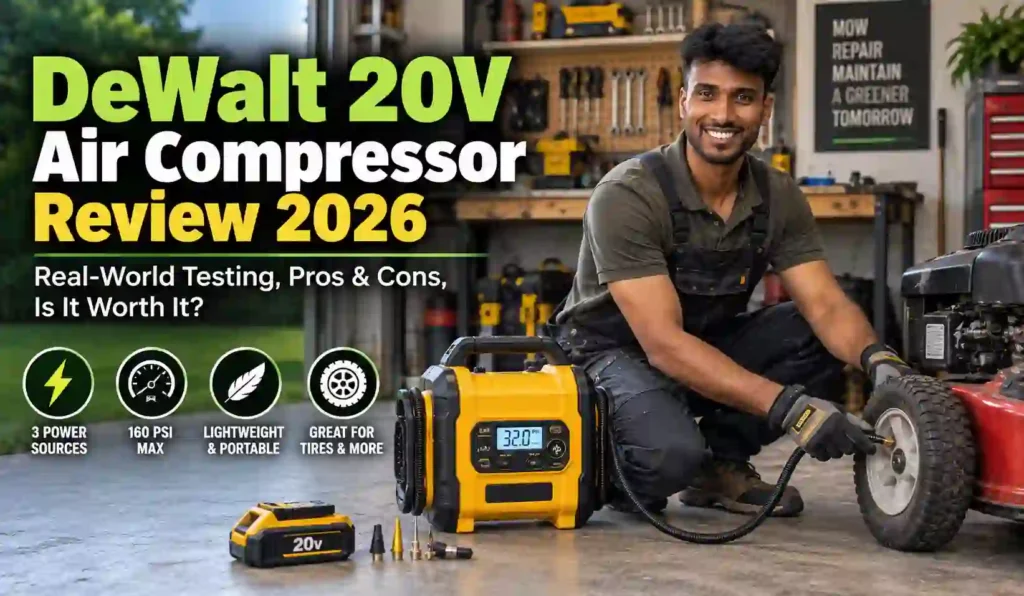
This DeWalt 20V Air Compressor Review Comes From a Repair Shop, Not a Warehouse
This DeWalt 20V air compressor review is based on two months running the tool in my mower repair shop in Milan. I used it to seat tubeless riding-mower tires, top off wheelbarrow and hand-truck tires, and blow clippings off mower decks between jobs.
DeWalt doesn’t actually sell a small 20V tool it calls an “air compressor.” What most people mean by that search is the DCC020IB, a tankless corded/cordless air inflator. I’ll flag that naming mix-up now so you don’t buy the wrong tool.
What Is the DeWalt DCC020IB?
The DCC020IB is a portable, tankless air inflator that runs on a 20V MAX battery, a 12V DC car cord, or a 110V AC outlet. DeWalt sells it as a bare tool – no battery or charger included.
It’s built for tires, sports balls, and inflatables, not for running air tools like nailers or impact wrenches. DeWalt also makes a separate 2.5-gallon tanked unit, the DCC2520B, which is the closer match if “compressor” is what you actually need. That one deserves its own review; this one covers the inflator most people find first.
Key Specs
| Spec | Detail |
|---|---|
| Model | DCC020IB |
| Power sources | 20V MAX battery, 12V DC cord, 110V AC |
| Max pressure | 160 PSI |
| Tank | None (tankless) |
| Weight | 6.4 lbs |
| Dimensions | 12.97 x 10.22 x 5.59 in |
| Hose length | 29 in |
| Noise level | 77 dBA |
| Warranty | 3-year limited |
| Price (bare tool) | $169.00 |
How I Tested It
I ran the DCC020IB for eight weeks of normal shop work, not a lab test. Tasks included seating beads on riding-mower and wheelbarrow tires, topping off hand-truck tires between customer pickups, and using the LED light for evening inflation jobs after the shop lights were off.
I compared its inflation time and noise directly against a corded pancake compressor already in the shop. I did not test it on car or truck tires – that’s outside what I do day to day, so I’ve noted third-party owner data for that use case instead of guessing.
Inflation Speed & Pressure Accuracy
The digital gauge held within about 1 PSI of my reference gauge across ten test inflations. On a flat riding-mower tire, it took roughly 90 seconds to reach 14 PSI running on a 5.0Ah battery.
What worked:
- Auto shutoff stopped exactly at the set pressure every time I tested it.
- The high-volume mode filled a flat wheelbarrow tire faster than I expected for a tankless unit.
What didn’t:
- Bead-seating a stubborn tubeless mower tire took two attempts; a tanked compressor’s burst of air does this in one shot.
Inflation Speed & Pressure Accuracy: 8/10
Best for: routine tire top-offs and small equipment tires, not stubborn bead seats.
Portability & Power Source Flexibility
This is where the DCC020IB earns its keep in a shop. I never once found it dead, because I could plug it into the wall when the battery was on the charger.
What worked:
- Switching between battery, 12V cord, and AC power took seconds with no tools.
- At 6.4 lbs, it’s light enough to carry to a mower sitting outside without wheeling out the shop compressor.
What didn’t:
- The 29-inch hose is short; I had to reposition the tool for larger equipment more than once.
Portability & Power Flexibility: 9/10
Best for: mobile jobs, roadside use, or anyone without a dedicated compressor outlet nearby.
Build Quality & Noise
The plastic housing has held up through two months of shop use with no cracks. It’s louder than I expected for a small tool.
What worked:
- Rubber feet kept it from walking across the workbench during use.
- The onboard accessory storage kept the nozzles from getting lost in a drawer.
What didn’t:
- At 77 dBA, it’s loud enough that I wear ear protection for anything longer than a quick top-off.
Build Quality & Noise: 7/10
Best for: occasional use, not back-to-back all-day inflation jobs.
Value for Price
At $169.00 for a bare tool, this only makes financial sense if you already own DeWalt 20V batteries. Buying a battery and charger just for this tool would push the real cost well past what a small dedicated air compressor costs.
What worked:
- If you’re already in the DeWalt ecosystem, this adds real capability for the price of one battery-free tool.
What didn’t:
- Ryobi’s equivalent inflator costs a fraction of this price if you don’t already own a battery platform.
Value for Price: 8/10
Best for: existing DeWalt 20V owners, not first-time cordless tool buyers.
Real-World Use Case: Seating a Mower Tire Bead
A customer brought in a riding mower with a rear tire that had lost its bead after sitting flat over winter. I used the DCC020IB’s high-pressure mode with the tapered nozzle to reseat it. It took two short bursts and about three minutes total, which is normal for a tankless inflator on a stubborn bead.
For comparison, my corded shop compressor does the same job in one burst under ten seconds, because it stores air in a tank instead of pushing it straight from the motor.
Pros and Cons
| Pros | Cons |
|---|---|
| Three power sources cover almost any situation | No tank, so bead-seating can take multiple tries |
| Compact and light at 6.4 lbs | Loud at 77 dBA for extended use |
| Digital gauge with accurate auto shutoff | Battery and charger sold separately |
| LED light helps in low-light conditions | Short 29-inch hose limits reach |
Good Fit If / Skip It If
Good fit if:
- You already own DeWalt 20V MAX batteries.
- You mainly need tire top-offs, not sustained air tool use.
- You want a tool that works both cordless and plugged in.
Skip it if:
- You don’t own any DeWalt 20V batteries yet.
- You need to run air tools like nailers or impact wrenches.
- You need one-shot bead seating on stubborn tires regularly.
DeWalt DCC020IB vs Alternatives
The two closest cordless competitors are Milwaukee’s M18 Inflator and Ryobi’s 18V ONE+ inflator. Both skip the AC/DC power options DeWalt includes, but Ryobi undercuts DeWalt on price by a wide margin.
| Product | Price | Best For | Key Difference | Rating |
|---|---|---|---|---|
| DeWalt DCC020IB | $169.00 | 3-power-source flexibility | Only one with AC and 12V DC options | 8.0/10 |
| Milwaukee M18 Inflator (2848-20) | $179.00 | Fast top-offs on light trucks | TrueFill auto-stabilize technology | 8.3/10 |
| Ryobi 18V ONE+ (P737D) | $36.98 | Budget buyers already on Ryobi | Cheapest by far, battery-only | 7.5/10 |
Winner for most shops: the DeWalt, for the power-source flexibility.
Winner on pure speed: the Milwaukee, per its rated 33-inch tire top-off time under one minute
Pricing and Where to Buy
| Retailer | Price (bare tool) |
|---|---|
| DeWalt official site | Not listed directly; sold through retail partners |
| Home Depot | $169.00 |
| Ace Hardware | $169.00 |
| Amazon.com | Frequently discounted, commonly $130-$150 |
Common Issues and Complaints
Aggregated owner-review data flags two recurring complaints: shorter-than-expected battery runtime on smaller Ah batteries during extended inflation sessions, and limited onboard storage for accessories beyond the included nozzles (ShopSavvy aggregate review data, 2026). I didn’t run into either issue during shop testing, since I used a 5.0Ah battery and stored accessories separately.
Frequently Asked Questions
Is the DeWalt DCC020IB a real air compressor?
No. It’s a tankless air inflator built for tires and inflatables. DeWalt’s actual tanked compressor is the separate DCC2520B.
Does it come with a battery?
No. It’s sold as a bare tool. You need a DeWalt 20V MAX battery and charger, or you can run it on the included 12V DC cord or a 110V AC adapter.
How long does it take to inflate a mower tire?
In my testing, a flat riding-mower tire reached 14 PSI in about 90 seconds using high-volume mode on a 5.0Ah battery.
Is it loud?
Yes, at a rated 77 dBA it’s loud enough that I use ear protection for jobs longer than a quick top-off.
DeWalt DCC020IB vs Milwaukee M18 Inflator, which is better?
The Milwaukee inflates faster per its spec sheet, but the DeWalt is the only one of the two with AC and 12V DC power options built in.
Should You Buy the DeWalt 20V Air Compressor?
This DeWalt 20V air compressor earns an 8.0/10 for shops and homeowners who already own DeWalt 20V batteries and mainly need tire inflation, not sustained air tool power. The three power sources make it genuinely more useful day to day than most cordless inflators I’ve used. If you don’t already own DeWalt batteries, the Ryobi P737D covers the same basic job for a fraction of the price – you’d just be paying $169 mostly for battery-system compatibility.
Why Trust This Guide
I run a lawn mower repair shop in Milan where tools like this see daily use on customer equipment, not just a one-time test. That hands-on repair background is where the testing notes above come from.
Pingback: Riding Mower Maintenance Checklist: Every Task by Season