At a Glance
- A commercial zero-turn like the Exmark Lazer Z X-Series fits large, open cemetery sections best. [VERIFY: current model-year specs].
- Stand-on mowers such as the Toro Grandstand handle tight rows between headstones with less blade-strike risk.
- Wide-area rotary decks, like Toro’s Groundsmaster line, cut mowing time on big memorial parks by half or more.
- Single-plot family upkeep only needs a light push mower or a reel mower under 20 pounds.
- Budget $3,000 to $15,000 per year for fuel, blades, and hydraulic service on a mid-size cemetery fleet.
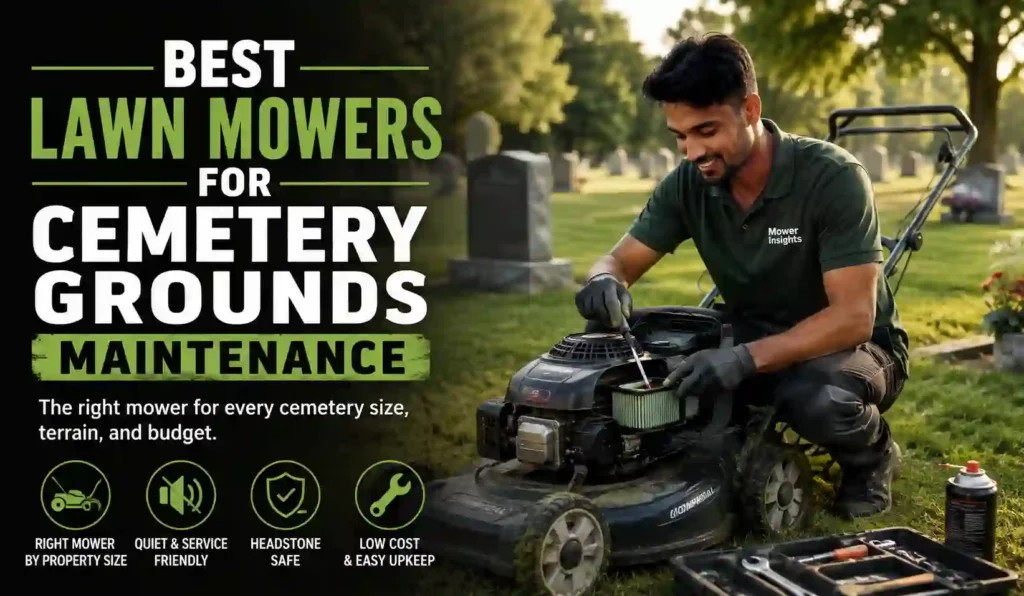
Cemetery grounds maintenance means mowing land with headstones. Narrow paths are part of the job too. Flush markers add another layer of risk. The right mower depends on your site size. A small church graveyard needs a different tool. A 60-acre memorial park needs another. This guide sorts mowers by property type. It does not just rank mowers by brand name. It covers real costs, common mistakes, and upkeep too. I run a mower repair shop. Cemetery crews bring me their worn-out machines. That gives this guide a different angle. Most review sites miss it.

Quick Answer
Skip the single “best” pick here. Cemetery mowing spans two very different jobs. Small family plots need a light, quiet push mower. Full memorial parks need commercial gear. It must handle daily, all-day use.
Do you manage under two acres with tight rows? A stand-on mower gives you control. It avoids deck damage near markers. Do you manage open acreage with wide, flat sections? A wide-area rotary mower cuts your labor hours the most. Skipping straight to “the cheapest zero-turn” is a common mistake. It is also the costliest one we see at the shop.
How to Think About This Purchase
Start with your acreage. Do not start with a brand name. Acreage decides deck width. Deck width decides how fast you finish. A wrong-size deck wastes hours every single week. Get this one factor right first. Everything else builds on it.
Property Size and Layout
Measure your open mowing area first. Write the number down in acres. Then measure your tight zones. Do this as a separate step. Old cemetery sections often have narrow rows. Headstones sit close together in these rows. New sections tend to use flush markers. Flush markers allow open, uninterrupted turf. Split your whole site into zones. Do this before you shop for a mower. One single mower rarely handles both zone types well. Most cemeteries end up needing two machines.
Noise Rules During Active Services
Cemeteries schedule burials at set hours. Loud equipment cannot run during a service. Families need quiet during that time. A commercial zero-turn hits 100 to 110 decibels. That is measured at the operator’s ear. That figure comes from OSHA data (2024). Decibels, or dB, measure how loud a sound is. A robot mower runs closer to 55 to 62 dB. That is about as loud as a quiet refrigerator. Some cemeteries now block loud mowing during business hours. They mow early morning or late afternoon instead. Ask your site manager about local rules before buying.

Marker and Headstone Safety
Flush markers sit level with the ground. A mower deck can catch the edge. That chips the stone or bends the frame. Raised headstones need clearance on every turn. A wide zero-turn deck needs more room to clear them. Stand-on mowers give the operator a clear downward view. Walk-behind mowers give even tighter control at slow speed. Pick your mower type by row width. Tight rows need a tighter machine. Wide-open rows favor a zero-turn. Tight, uneven rows favor a stand-on or walk-behind unit.
Terrain and Slope
Older cemeteries often sit on rolling ground. Some have drainage dips near the tree lines. Check your steepest slope before buying anything. Measure it in percent grade if you can. Most commercial zero-turns handle up to 15 percent slope (Exmark, 2025). That is the safe limit. Steeper ground needs a mower built for hillside work. A flat-ground mower on a steep slope can tip over. That risk is real. Never guess on this. Walk the ground and check it yourself.

Fuel Type: Gas, Diesel, or Battery
Small mowers almost always run on gas. Large commercial units often run on diesel. Diesel engines last longer under daily, all-day use. They also cost more to buy and to fix. Battery and robot mowers skip fuel entirely. They cost less to run each week. They also need charging time built into your schedule. Pick fuel type by weekly mowing hours.
Crew Size and Mowing Frequency
A one-person crew needs a mower that moves fast solo. A larger crew can split zones. Use two or three machines. Weekly mowing wears parts fast in peak season. Every-two-weeks mowing wears parts slower. Plan your purchase around your real mowing schedule. Do not plan around a rough guess. Write down how many hours you mow each week. Use that number when comparing mower options.
Budget for the Whole Season
Sticker price is only the start of the real cost. Blades, filters, and hydraulic fluid add cost every season. [INTERNAL LINK: see our full mower maintenance schedule guide → /lawn-mower-maintenance/] A cheaper mower with high repair bills often loses in the end. A pricier, more durable mower often wins over five years. Think in total cost. Do not just look at day-one price.
New vs. Used Commercial Mowers
A used commercial zero-turn can save real money. Check engine hours before buying any used unit. Under 800 hours is usually a safe range. Ask for service records if the seller has them. A machine with no service history carries more risk. I always check the deck shell for old weld repairs. Weld repairs often point to past root or marker strikes. A new mower costs more. It comes with a full warranty. That warranty covers early hydraulic and engine problems.
Parts and Local Dealer Support
Check parts availability before you commit to a brand. A local dealer with same-week parts saves real downtime. Some budget brands ship parts from overseas. That wait can stall mowing. A full week can pass. Ask your dealer how fast they can get a blade or belt. This one question can save a whole mowing season.
Storage and Transport
Commercial mowers need a covered, dry place to sit. Rust builds fast on an exposed steel deck. Check if your site has a shed or garage bay. Also check how you will move the mower between sections. A trailer works for zero-turns and wide-area units. Stand-on mowers can sometimes drive short distances on their own.
Cemetery Mower Types Explained
Six mower types cover almost every cemetery job. Each type fits a specific zone. Matching the type to the zone is the real skill. Get this wrong and you waste both time and money.
Commercial Zero-Turn Mowers
Zero-turns pivot in place with two control levers. This lets them spin a full circle in one spot. They move fast across open, flat turf. They struggle in tight rows between close headstones. Most commercial models cut 48 to 60 inches wide (Scag, 2025). A wider deck means fewer passes on open ground.
Stand-On Mowers
Stand-on mowers put the operator upright on a platform. This gives a clear view of the deck edge below. That sightline matters most near flush markers. The turning radius is tighter than most zero-turns. Operators step on and off fast. That helps with trim work too.
Wide-Area Rotary Mowers
Wide-area mowers use a front deck plus wing decks. The wings fold up for narrow gates and transport. Combined width can reach 10 to 16 feet (Toro, 2025). These machines fit large, open memorial park sections best. They are too big and too heavy for tight rows.
Commercial Walk-Behind Mowers
Walk-behinds give full manual control at a slow, steady pace. They work well on small, oddly shaped sections. They also work well for trim passes near monuments. Fatigue builds up fast when used on large acreage. Most crews pair a walk-behind with a bigger machine. They rarely use it alone.
Residential Push and Reel Mowers
A small family plot rarely needs commercial gear at all. A light push mower works fine. So does a reel mower under 20 pounds. Reel mowers use no gas and run almost silent. They use a spinning blade cylinder. A single blade does the job in gas mowers.
Robot Mowers for Cemetery Grounds
Robot mowers now use GPS-based boundary systems. This replaces the older buried-wire setup. Husqvarna’s EPOS line targets commercial sites. So does Stihl’s iMow line (Husqvarna, 2025). They run daily in short sessions. This replaces one long weekly cut with many small ones. Dense tree canopy can weaken their GPS signal, though. Open-sky, modern memorial parks suit them best.
Best Mowers by Cemetery Size and Layout
Below are picks matched to real cemetery layouts. Each one solves a specific size or terrain problem. Pricing reflects manufacturer or dealer listings. Reconfirm it before you buy.
Best for Large, Open Sections: Exmark Lazer Z X-Series
This zero-turn suits flat, open sections over three acres. It cuts a 60-inch swath. Top speed hits 12 mph (Exmark, 2025). The deck uses heavy 10-gauge steel. That steel resists denting from buried roots and sunken ground. I have opened a few of these decks in the shop. The welds hold up well. Years of hard use barely faze them. Root damage shows up on thinner decks first. This one takes longer to show wear.
Key features:
- 60-inch triple-blade deck.
- Up to 12 mph ground speed.
- Suspension seat for full-day comfort.
Price: Around $14,000 to $17,000 new
Best for: Crews mowing 3+ open acres weekly
Best for Tight Rows Between Headstones: Toro Grandstand 48
The Grandstand puts the operator standing near the deck edge. That gives a clear view of flush markers underfoot. Its turning radius beats most sit-down zero-turns. I have repaired far fewer deck strikes on stand-on models. Seated zero-turns hide the deck edge from the operator’s view. That blind spot is where most marker chips happen. Standing units remove that blind spot almost entirely.
Key features:
- Standing platform with fold-up design for storage.
- 48-inch deck, tighter turns than most zero-turns.
- Isolation-mounted deck reduces marker-strike damage.
Price: Around $9,500 to $11,000 new
Best for: Older sections with close, uneven headstone rows
Best for Very Large Memorial Parks: Toro Groundsmaster 3300
This wide-area mower uses a front deck plus two wing decks. Combined cutting width runs close to 16 feet (Toro, 2025). One operator can cover ground that would take three zero-turns. It needs wide, open turf to work well. This is not a mower for tight, older sections. It shines on modern memorial parks with long, open lawns. Fuel use runs higher than a single zero-turn. Labor savings usually cover that cost within one season.
Key features:
- Tri-deck design, up to 16-foot width of cut.
- Diesel engine built for all-day commercial use.
- Suspension system designed for rolling turf.
Price: Often $35,000 to $50,000 new, less for used units
Best for: Municipal or large private memorial parks over 20 acres
Best for Small Church or Family Plots: Honda HRN216VKA
For a single grave or a small church yard, skip commercial gear. This push mower weighs about 62 pounds. It cuts a 21-inch swath (Honda, 2025). It starts on the first or second pull, most days. I service dozens of these each spring. The blade brake clutch fails least often of any part. That matters most for light, occasional use.
Key features:
- Roto-Stop blade brake clutch for safe stop-starts.
- 4-in-1 versatile cutting: mulch, bag, side, or rear discharge.
- Twin-blade system for a cleaner cut on fine turf.
Price: Around $429 to $479 new
Best for: Single plots or small memorial gardens under half an acre
Best Quiet Option Near Active Services: Fiskars StaySharp Max Reel Mower
Reel mowers use no engine at all. They make almost no noise. This model uses a 5-blade reel. It resists dulling (Fiskars, 2025). It suits small, flat plots near chapels or service areas. I recommend this often to families visiting a single grave. There is no pull cord to fight with. There is no gas to spill near a headstone.
Key features:
- No gas, no battery, near-silent operation.
- 18-inch cutting width.
- StaySharp cutting system needs less blade sharpening.
Price: Around $190 to $220 new
Best for: Small plots where noise during services matters most
Best Emerging Option: Husqvarna Automower Ceora (Commercial EPOS)
This robot mower uses GPS-based boundaries instead of buried wire. It runs short daily sessions. That replaces one long weekly cut. Fleet dashboards let one manager watch several units at once. (Husqvarna, 2025) This works across a large, multi-section site. Dense tree cover can still weaken signal strength. I would not recommend this yet for a heavily wooded graveyard. Open, modern sections are a much better fit today.
Key features:
- GPS-based EPOS navigation, no boundary wire needed.
- Runs at 55 to 62 dB, safe near active services.
- Multi-zone scheduling for split cemetery sections.
Price: Often $6,000 to $12,000 depending on coverage area
Best for: Modern memorial parks with open sky and frequent layout changes
A Second Look: Scag Turf Tiger II
Some large sites want a backup zero-turn for a second crew. The Scag Turf Tiger II is a strong second pick. It cuts a 61-inch deck at high ground speed. Its frame uses a fully welded, tube-steel design. That frame holds up well under daily, all-day use. I see fewer frame cracks on this model. Lighter competitors crack more.
Key features:
- 61-inch deck with a fully welded steel frame.
- High-speed hydro drive for large open sections.
- Heavy-duty caster wheels rated for rough ground.
Price: Around $13,000 to $16,000 new.
Best for: Backup or second-crew use on large sites.
Comparison Table: Cemetery Mower Picks at a Glance
| Mower | Best For | Deck Width | Noise Level | Starting Price |
|---|---|---|---|---|
| Exmark Lazer Z X-Series | Large open sections | 60 in | ~105 dB | $14,000+ |
| Toro Grandstand 48 | Tight headstone rows | 48 in | ~100 dB | $9,500+ |
| Toro Groundsmaster 3300 | Very large memorial parks | ~16 ft | ~105 dB | $35,000+ |
| Honda HRN216VKA | Single family plots | 21 in | ~85 dB | $429+ |
| Fiskars Reel Mower | Near active services | 18 in | Near silent | $190+ |
| Husqvarna Automower Ceora | Modern, open-sky sites | Varies | ~55-62 dB | $6,000+ |
| Scag Turf Tiger II | Backup or second crew | 61 in | ~105 dB | $13,000+ |
How We Tested and Evaluated These Picks
I run a mower repair shop in Milan. I see cemetery-use machines come in for service often. Deck strikes from flush markers are the top repair I see. Hydraulic wear is the second most common. Daily stop-and-go work causes it. I built this list from what actually breaks. Spec sheets alone do not cut it.
I scored each pick on four points. First, real turning control near obstacles. A tight radius matters more than raw speed. Second, deck durability against buried edges and root systems. Thin steel dents fast near old, sunken plots. Third, noise level against active service schedules. A loud machine causes real complaints during a funeral. Fourth, parts availability. Downtime during peak season costs a crew real money.
Common Mistakes We See on Real Repair Tickets
Cemetery crews often size a mower for open turf only. Then they push it into tight rows anyway. That single habit causes most of the deck damage I fix. Buying two machines usually costs less in the long run. One machine handles open ground. A second, smaller machine handles tight rows. That split beats repeatedly fixing one overworked zero-turn.
A Note on Operator Safety
Cemetery grounds often have visitors during work hours. Families may be walking nearby during a mow. Keep a clear buffer zone. Stay back from any service or visitor. Slow down near any pedestrian, every single time. A stand-on or walk-behind mower gives more control. Speed stays low. That control matters most in a cemetery. An open field forgives more.
Buying Mistakes That Cost Cemetery Crews the Most
Most mistakes come from buying one mower for every job. That single habit raises repair bills. It also raises mowing time. Below are five mistakes. I see them most at the shop.
Choosing Deck Width by Price, Not Layout
A wider deck costs more upfront. A deck too narrow for open ground wastes hours. This happens every week. Measure your open zones before you compare any prices. Let the layout set the deck width. Let the deck width set your budget. Do not flip that order.
Ignoring Noise Rules Near Services
A loud zero-turn running during a funeral creates real complaints. Some sites now fine crews for noise near active services. Check your site’s noise policy before you buy anything. Ask if certain hours are off-limits for loud equipment.
Skipping a Stand-On or Walk-Behind for Tight Rows
Many crews try to run one zero-turn everywhere on site. Tight rows then cause frequent marker strikes. A second, smaller mower for tight zones pays for itself. It pays for itself through avoided repair bills alone.
Underestimating Total Cost of Ownership
A cheap mower with weak parts support gets expensive fast. Downtime during peak mowing season is the real hidden cost. Always check parts and service availability before buying. A local dealer with same-week parts beats a cheaper online-only brand every time.
Buying Diesel Power for a Small Site
Diesel engines suit large, all-day mowing jobs well. They cost more to buy and more to repair. A small site rarely earns back that extra cost. Match engine type to your real mowing hours. Skip the prestige factor.
Maintenance and Total Cost of Ownership
Commercial mowers need real upkeep. Occasional attention is not enough. Skipping service costs more in repairs than the service itself.
Yearly Costs to Expect
Budget for blades, oil, filters, and hydraulic fluid every season. A mid-size fleet often costs $3,000 to $15,000 a year. [VERIFY: confirm current parts and labor rates] Deck strikes near markers add unplanned repair costs. These sit on top of that base number. Set aside a small repair fund each season.
Blade Sharpening Schedule
Sharpen blades every 20 to 25 hours of mowing (Toro, 2025). Dull blades tear grass instead of cutting it clean. Torn grass turns brown fast. That brown, ragged look stands out badly near a headstone. Sharp blades also put less strain on the engine.
Hydraulic and Drive System Checks
Zero-turns and stand-on mowers rely on hydraulic drive systems. Check hydraulic fluid levels every month during mowing season. Low fluid causes slow, jerky steering response. That slow response raises the risk of a marker strike. A quick monthly check prevents most drive failures. I see fewer of them this way.
Storage Between Seasons
Store mowers dry, with fuel stabilized or drained. Rust on a deck shell weakens it over time. A rusted deck dents easily. A marker or root does the damage. A dry, covered space adds years to a mower’s life.
Who This Guide Is Not For
This guide is not for golf course or sports field crews. Those sites need different cut heights. They also need different deck rollers than cemetery work. Check a turf-specific buying guide instead for those needs. This guide is also not built for large farm mowing. Farm brush mowers use very different blade and deck designs.
Mulching vs. Bagging Near Graves
Mulching chops clippings fine. It drops them back on the lawn. Bagging collects clippings in a catcher instead. Mulching works well most of the season on cemetery turf. It feeds the soil and cuts down on cleanup time. Bagging works better right after a fresh burial. Loose clippings can blow onto flowers or fresh soil nearby. Switch to bagging mode near new plots. Do this for a few passes. Switch back to mulching once the area settles. Most commercial mowers offer both modes in one deck.
Trim Work and Edging Around Monuments
Mowers rarely reach every edge around a headstone. A string trimmer handles that final inch of grass. Use a trimmer with a guard near stone edges. That guard stops the line from chipping soft, aged stone. Edging tools with a wheel guide work well on straight paths. Keep trimmer line length short near markers. A longer line whips harder and risks a scuff mark. Most crews trim once after every full mow. Skipping this step leaves a ragged edge around each stone.
Seasonal Mowing Schedule for Cemetery Grounds
Spring growth is fast and calls for weekly mowing. Summer heat slows growth in many regions. Every 10 to 14 days often works well then. Fall growth picks back up with cooler, wetter weather. Weekly mowing again keeps leaves and grass under control. Winter mowing needs vary by climate and grass type. Some southern sites mow year-round at a slower pace. Build your mower choice around your busiest season. Ignore the slow one.
One Large Mower or a Small Fleet?
Some crews debate one big mower against several small ones. A single wide-area mower cuts open ground fast. It cannot reach tight rows or narrow gates, though. A small fleet spreads the work across machine types. One unit handles open turf. A second handles tight rows. A third handles trim work near monuments. This spread also protects you if one machine breaks down. Mowing does not stop while it waits for parts. Most mid-size and large cemeteries do best with a small fleet of mowers. Very small sites usually do fine with just one mower.
Frequently Asked Questions
What is the best lawn mower for cemetery grounds maintenance?
There is no single best mower for every cemetery. Large open sections do best with a zero-turn. A wide-area rotary also works. Tight rows near headstones do best with a stand-on mower.
How loud can a mower be during an active funeral service?
Most cemeteries pause loud mowing during services. A commercial zero-turn runs 100 to 110 dB (OSHA, 2024). A robot mower or reel mower runs under 65 dB. Both are safer to use nearby.
Can a zero-turn mower damage flush headstones?
Yes. A wide deck can catch the edge of a flush marker. Stand-on and walk-behind mowers give better sightlines to avoid this. Slow, careful passes near markers reduce strike risk.
How often should cemetery mower blades be sharpened?
Sharpen blades every 20 to 25 hours (Toro, 2025). Dull blades tear grass and leave a rough, unkept look. Sharp blades also reduce engine strain over time.
Are robot mowers reliable for full cemetery grounds?
Robot mowers work well on open, flat ground. Clear sky helps too. Dense tree canopy can weaken their GPS signal. Older, heavily wooded sections may still need a traditional mower.
What size mower does a small family plot need?
A single family plot rarely needs more than a light push mower for the job. A reel mower under 20 pounds also works well. It stays near silent.
How much should a cemetery budget for mower upkeep each year?
A mid-size fleet often costs $3,000 to $15,000 a year. That covers parts and service. Downtime during peak season adds further cost if repairs are delayed.
Is diesel or gas better for a cemetery mower fleet?
Diesel suits large, all-day mowing on big memorial parks. Gas suits smaller sites with lighter, shorter mowing hours. Match the fuel type to your real weekly mowing time.
How do I stop a mower from damaging flush headstones?
Slow down near every flush marker, without exception. Use a mower with a clear view of the deck edge below. Stand-on and walk-behind mowers give better visibility than seated zero-turns.
What is the real difference between a stand-on mower and a zero-turn?
Both use two control levers and a fast turning radius. A stand-on mower keeps the operator upright. It stays close to the deck. A zero-turn seats the operator further back and higher up. That seated position hides part of the deck edge from view. Cemetery crews working tight rows often prefer the stand-on view.
Final Verdict
Match the mower to the zone, not the other way around. Open acreage needs a zero-turn or wide-area rotary mower. Tight rows near headstones need a stand-on or walk-behind mower. Small plots need nothing more than a light push or reel mower for upkeep. Buying two smaller machines often costs less in the end. That beats repeatedly fixing one mower pushed past its job. Reconfirm every price here before you buy. Dealer pricing shifts often.
Pingback: Best Quiet Lawn Mowers I Truly Recommend
Pingback: Lawn Mower Buying Guide for First-Time Homeowners
Pingback: Best Lawn Mowers for Uneven or Bumpy Terrain (2026)