Quick Answer
Got a yard under 500 m² (about 5,400 sq ft) and flat ground? Get a battery push mower. It’s quiet. It needs almost no upkeep. It skips the gas-engine repair bills we see every week in our shop. Got a bigger or hilly yard? A gas self-propelled mower or a small rider works better. Plan to spend $300-$600 on battery, $250-$500 on gas push, or $1,200+ on a rider.
You just closed on a house. A lawn came with it. No one gave you a manual. This guide walks you through the real choice. Not a spec dump. Just the questions that decide which mower fits your yard, your budget, and how much time you want to spend fixing it later.
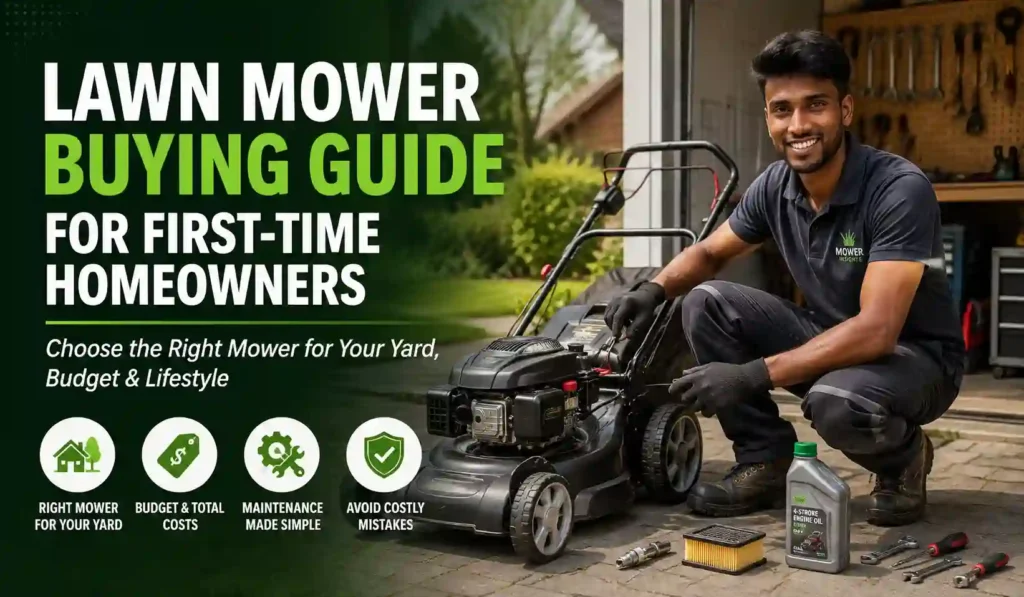
I run a mower repair shop in Milan. Most mowers that come through our door are not bad machines. They’re the wrong machine for that yard. This guide exists to stop that mismatch before it costs you money.
How to Think About This Purchase
Before you compare models, walk your yard. Ask four things: How big is it? How steep is it? Where will you store the mower? How much time do you want to spend on upkeep? These four answers rule out most options fast.
Yard Size
Measure your lawn. Use square meters or square feet. Under 500 m² (5,400 sq ft)? A battery push mower does the job in under 30 minutes. Between 500 and 1,500 m² (5,400-16,000 sq ft)? A gas self-propelled mower makes more sense. Battery runtime starts to work against you at that size. Above 1,500 m² (about a third of an acre)? A riding mower or zero-turn starts to pay off in time saved.
Terrain and Slope
Flat, open yards work with almost any mower. Slopes over 15 degrees change the math. Battery mowers lose runtime fast on a hill. Standard riders can be unsafe on steep grades. Got a hill? Look for a self-propelled gas mower with rear-wheel drive. Or pick a mower rated for slope use.
Storage Space
A push mower folds down. It fits in a garage corner. A rider needs its own shed or garage bay. Plan for about 2 x 1.2 meters (6.5 x 4 feet) of floor space. Add room to drive it in and out. Tight on space? That alone can rule out a rider, no matter your yard size.
Maintenance Tolerance
This is the part most guides skip. Gas mowers need oil changes. They need new spark plugs. They need a clean air filter. They need fuel stabilizer if they sit all winter. Battery mowers need almost none of this. Charge the battery. Clean the deck. Done. Don’t want to own a toolbox for this machine? Go battery.
What to do right now: Grab a tape measure. Or use a satellite map tool. Get your real yard size in square meters before you read on. Everything below assumes you know that number.
Types of Mowers Explained
Three power types cover most first-time buyers: gas, battery, and corded electric. Each one has a real tradeoff in cost, noise, and upkeep. This is not just “eco-friendly” marketing talk.
| Type | Best Yard Size | Noise Level | Annual Maintenance | Typical Price |
|---|---|---|---|---|
| Corded electric push | Under 250 m² | 75-80 dB | Near zero | $150-$300 |
| Battery push/self-propelled | Under 1,000 m² | 75-80 dB | Near zero | $300-$700 |
| Gas push | 500-1,500 m² | 90-95 dB | $60-$120/year | $250-$500 |
| Gas self-propelled | 500-2,000 m² | 90-95 dB | $80-$150/year | $400-$800 |
| Riding/zero-turn | 1,500+ m² | 85-95 dB | $150-$300/year | $1,200-$4,000+ |
| Robot mower | Under 2,000 m² | 55-65 dB | $30-$80/year | $600-$2,500 |
Robot mowers deserve a note here. They’re a real option now for buyers who don’t want to mow at all. MowerInsights covers robot mowers in a separate guide. The buying rules are different enough – boundary wire vs. GPS, slope rating, theft risk – that they need their own space.
Gas Mowers
Gas mowers are the old standby. They still make sense for big yards, thick grass, or steep ground. There, battery runtime and torque both matter. The tradeoff is noise, fumes, and a real upkeep schedule. Oil. Spark plugs. Air filters. And the yearly “why won’t it start” spring ritual.
Expert Tip: Old fuel is the top reason a gas mower won’t start in spring. Ethanol-blend gas breaks down in about 30 days. It gums up the carburetor. Run the tank dry before winter storage. Or use a fuel stabilizer. It’s a five-minute fix. It saves you an $80-$150 carburetor cleaning.
Battery-Electric Mowers
Battery mowers have closed the gap with gas in the last few years. A good 56V-80V model can handle up to about 1,000 m² on one charge. It cuts nearly as well as gas on normal grass. It falls short on very thick or tall grass, where raw torque still wins.
Good fit: Standard suburban lawns. Anyone who wants to skip yearly engine work. Anyone with noise-sensitive neighbors.
Not a good fit: Very large yards. Thick or overgrown grass. Anyone who needs to mow for hours without a break.
Corded Electric Mowers
Corded mowers cost the least. They need the least upkeep. But the cord keeps you close to an outlet, under about 250 m². They’re a fair choice for small city lots. Not much else.
Top Picks by Use Case
Prices shift with sales. Treat the numbers below as a snapshot. Reconfirm before you buy.
Best for Small Yards (Under 500 m²): EGO Power+ LM2135SP
The EGO LM2135SP is a 21-inch self-propelled battery mower. It handles small to mid suburban lawns with no runtime scare. EGO’s own site prices the kit, with battery and charger, at around $599. In our tests, the self-propel drive made an uphill 400 m² yard much less tiring than pushing a similar gas mower.
Good fit: Flat to mildly sloped yards under 500 m². Buyers who want to be done in under 30 minutes. Not a good fit: Anyone who often cuts wet, thick, overgrown grass. The blade bogs down faster than a gas engine would.
Best for Larger Yards (1,000-1,500 m²): Honda HRX217VKA
The Honda HRX217VKA is a gas self-propelled mower with a variable-speed drive and a tough GCV200 engine. Honda’s own price sits at about $739. In the shop, Honda engines rarely fail on us. The blade clutch and drive cable wear out first, not the motor.
Good fit: Larger yards. Moderate slopes. Buyers willing to do basic seasonal upkeep. Not a good fit: Anyone who wants zero upkeep, or lives near neighbors bothered by engine noise.
Best Budget Option: Sun Joe MJ401E
The Sun Joe MJ401E is a corded electric mower. It typically lists around $130-$150 on Amazon. It’s a fair pick only for small yards near an outlet. The 12-amp motor is too weak for anything beyond light, regular cuts.
Good fit: Small city or townhouse lots under 250 m². A first mower on a tight budget. Not a good fit: Any yard where you’d walk the cord more than about 15 meters from an outlet.
Best for Large Properties (1,500+ m²): Cub Cadet XT1 Enduro Series
The Cub Cadet XT1 is a riding mower with a 42-inch deck. It’s priced at about $1,999 on Cub Cadet’s site. On a yard this size, a rider cuts mowing time from over an hour to about 20-25 minutes. The most common repair we see on entry riders like this is a worn deck belt after 2-3 seasons. Budget for a swap around year three.
Good fit: Properties over 1,500 m². Buyers with real storage space for a rider. Not a good fit: Anyone with no shed space, or a yard with tight corners a 42-inch deck can’t handle.
Buying Mistakes to Avoid
- Buying a gas mower for a small, flat yard. Under 500 m² and mostly flat? Gas gives you more machine, and more upkeep, than you need. This is the top overbuy we see.
- Ignoring deck width vs. yard shape. A wide deck cuts fast on open lawn. It struggles around trees, beds, and tight corners. Measure your tightest turn before you pick a deck size.
- Skipping self-propel to save money. Over 300 m², or on any slope, a plain push mower turns a 20-minute job into a 45-minute one. The upgrade costs $80-$150 more. It pays for itself in one season.
- Not checking battery runtime against real yard size. Brand runtime claims are often measured on flat, dry, trimmed grass. Real runtime on thick or wet grass runs 15-25% shorter.
- Forgetting where the mower will live. Buying a rider before you check shed space is the top return reason we see.
Common Mistakes Callout: In our shop, the top reason a battery mower comes in during its first year isn’t the motor. It’s the blade. A homeowner hits a hidden rock or root. The blade shaft bends. It vibrates. Over time, it wrecks the motor mount. A $15 blade guard, or just one walk of the yard before the first mow, stops most of this.
Maintenance and Total Cost of Ownership
The sticker price is not the real cost. Gas mowers carry an ongoing bill that battery and electric mowers mostly skip.
| Mower Type | Purchase Price | Typical Annual Maintenance | Common Repair (3-5 yr mark) |
|---|---|---|---|
| Corded electric | $150-$300 | $0-$20 | Cord/motor replacement, $40-$80 |
| Battery push/self-propelled | $300-$700 | $10-$30 (blade sharpening) | Battery replacement, $150-$250 |
| Gas push | $250-$500 | $60-$120 (oil, plugs, filter) | Carburetor cleaning, $80-$150 |
| Gas self-propelled | $400-$800 | $80-$150 | Drive cable/clutch, $100-$180 |
| Riding mower | $1,200-$4,000+ | $150-$300 | Deck belt, $120-$250 |
Trust & Testing Methodology: These ranges come from what we see and charge in our shop. They are not brand estimates. Real cost varies by brand, hours of use, and local labor rates. Treat this table as a planning guide, not a quote. [VERIFY: confirm current local labor rates before publishing if quoting shop-specific pricing]
What should you do with this? Add the yearly upkeep number to the buy price over five years. Then compare mower types. A $300 battery mower at $15/year in upkeep can cost less over five years than a $250 gas mower at $100/year in upkeep.
Who This Guide Is Not For
Do you manage a lot over 4,000 m² (about an acre)? Do you have a yard with steep, terraced levels? Do you never want to touch mower upkeep, of any kind? Then a mowing service may beat owning a mower. Most local services run $40-$80 per visit. Weigh that against the cost of the machine, its storage, and your own time, before you assume owning one is the cheaper path.
Frequently Asked Questions
What size mower do I need for my yard?
Match deck width and power type to your yard size in square meters, not acres alone. Under 500 m², an 18-21 inch battery push mower is enough. Above 1,500 m², look at self-propelled gas or riding mowers.
Is a battery-powered mower powerful enough for a first home?
Yes, for a standard yard under 1,000 m². Modern 56V-80V battery mowers cut nearly as well as gas. Thick, tall, or wet grass is where battery mowers start to lose to gas engines.
How much should a first-time homeowner budget for a lawn mower?
Plan for $300-$600 for a battery push mower. Or $250-$500 for gas push. Or $1,200 and up for a rider. Then add the yearly upkeep cost from the table above. Don’t judge by sticker price alone.
What’s the difference between self-propelled and push mowers?
A self-propelled mower drives its own wheels. You guide it; you don’t push it. This matters most on yards over 300 m² or on any slope. A plain push mower costs less and works fine on a small, flat lawn.
How often does a lawn mower need maintenance?
A gas mower needs an oil change, a spark plug check, and a clean air filter at least once a season. A battery mower mainly needs blade sharpening once or twice a season and a charged battery. No oil. No spark plug. No fuel system to fuss with.
Should I buy a used lawn mower to save money as a first-time homeowner?
A used gas mower can be a good deal if it starts easy and the deck isn’t rusted through. Budget for an instant tune-up either way. A used battery mower is riskier. Battery health is hard to check. A worn pack can cost more to replace than the mower is worth.
Conclusion
Match the mower to your real yard. Not the biggest model in the store. Not the one with the most features. Measure your yard in square meters. Check the slope. Confirm your storage space. Be honest about how much upkeep you want to do. Most first-time homeowners with a normal suburban lawn end up happiest with a battery self-propelled mower. It’s quiet. It needs little upkeep. It’s the right size for a yard under 1,000 m². Bigger or steeper yards are where gas or riding mowers earn their higher price and upkeep.
Pingback: Best Lawn Mowers for Small Yards
Pingback: How Much Should You Spend on a Lawn Mower