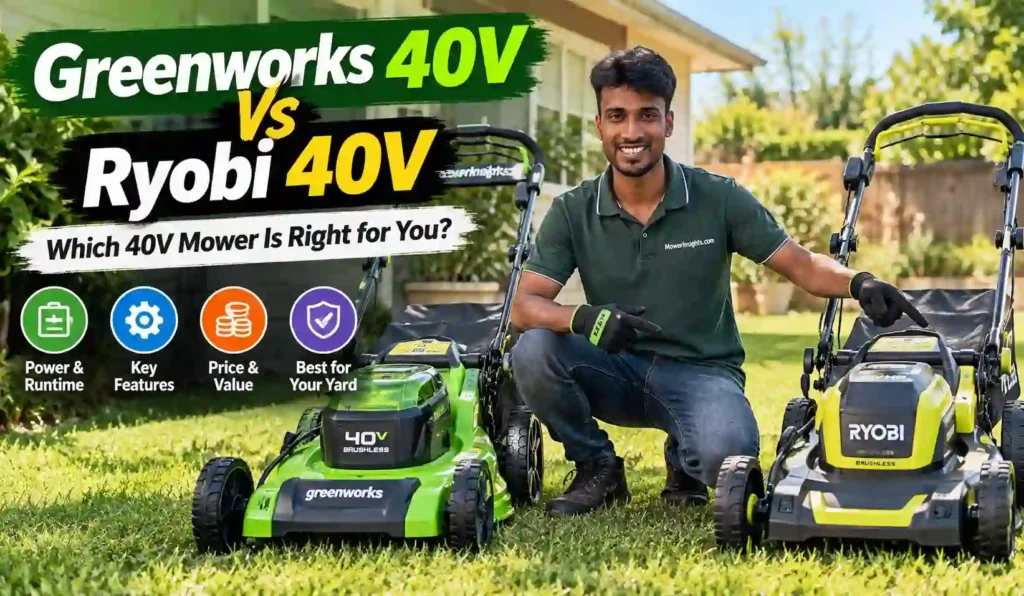
Greenworks 40V vs Ryobi 40V is the choice most homeowners land on once they decide to leave gas mowers behind. Both brands sell a full 40-volt cordless lineup – mowers, trimmers, blowers, chainsaws – and both promise gas-like power without the fumes, oil changes, or pull cord.
The catch is that “40V” doesn’t mean the same thing across brands. Battery amp-hours, deck sizes, and self-propel systems all differ, and the wrong pick can leave you underpowered on a hilly quarter-acre or overpaying for features a small flat yard never needs.
Quick Answer
Ryobi’s 40V HP Brushless lineup generally wins on raw power and self-propelled handling, especially on yards over a quarter acre or with mild slopes. Greenworks wins on price at the entry level and on tool-ecosystem breadth, with more compatible outdoor tools sharing the same 40V battery. Neither brand is the better choice universally – it depends on yard size, terrain, and whether you already own batteries from either system.
Prices may vary by retailer and change over time.
What to Look for Before Buying
The right 40V mower comes down to five things: cutting deck size, self-propulsion, battery runtime, weight, and what other tools already use that battery. Get these right and the brand name matters less than the model tier.
Deck size decides how many passes your yard takes. A 14-16 inch deck suits small, flat lots. A 20-21 inch deck cuts a wider swath and handles medium to large yards faster.
Self-propulsion matters most on yards over a quarter acre or anywhere with a slope. Pushing a battery mower is fine on flat ground, but a self-propelled rear-wheel-drive system saves real effort on hills.
Runtime is a battery-and-amp-hour question, not a brand question. A 4.0Ah battery runs a mower for roughly 30-40 minutes. A 6.0Ah battery stretches that closer to 45-60 minutes, which matters more as your lawn gets bigger.
Greenworks 40V vs Ryobi 40V: Types and Tiers
Both brands split their 40V mower lineup into three rough tiers: entry push mowers, mid-range self-propelled models, and a premium self-propelled flagship. Comparing tier to tier is more useful than comparing random individual models.
| Tier | Greenworks 40V | Ryobi 40V |
|---|---|---|
| Entry push mower | 14-16 in. deck, single blade, 4.0Ah battery | 20 in. HP Brushless push, 6.0Ah battery |
| Mid self-propelled | 21 in. brushless, 5.0Ah battery, rear-wheel drive | 20-21 in. HP Brushless, 6.0Ah battery, rear-wheel drive |
| Premium self-propelled | 20 in. Twin Force dual blade, 4.0Ah battery | 21 in. Cross-Cut brushless, larger battery, higher torque motor |
Greenworks fills its entry tier with smaller, lighter decks aimed at yards under half an acre. Ryobi skips straight to a 20-inch brushless push mower at the entry level, which means more cutting width even in Ryobi’s cheapest tier.
At the mid and premium tiers, both brands offer brushless self-propelled mowers rated for up to half an acre per charge. Ryobi’s motors consistently test with more torque under load, based on hands-on mowing in thick, wet grass. Greenworks closes some of that gap with its Twin Force dual-blade design, which cuts and mulches more finely at the cost of slightly shorter runtime per charge.
Key Buying Factors
Power and Cutting Performance
Ryobi’s HP Brushless motors handle thick or overgrown grass with less bogging down than Greenworks’ standard brushless motors, based on side-by-side mowing tests in similar conditions. Both brands use smart-load technology that ramps up blade speed automatically when the grass gets denser.
Greenworks’ Twin Force dual-blade system is the exception – two overlapping blades cut more evenly and mulch finer than either brand’s single-blade design, which matters if you mulch instead of bag.
- Ryobi: stronger under load, better for thick or tall grass
- Greenworks Twin Force: finer mulching, evenly cut clippings
- Both: automatic blade-speed adjustment on brushless models
Cutting Deck and Width
Deck width decides how many passes a yard takes. Greenworks offers 14, 16, and 20-21 inch decks across its lineup, giving small-yard owners a genuinely smaller, lighter option. Ryobi’s mower lineup starts at 20 inches and stays there, prioritizing coverage over compactness.
A wider deck cuts a bigger yard faster but is heavier and harder to maneuver around trees, flower beds, and tight side yards. Choose based on obstacles in your yard, not just square footage.
Runtime and Battery
Runtime depends on the amp-hour rating of the included battery, not the brand. Greenworks’ entry mowers typically ship with a 4.0Ah battery, good for 30-45 minutes. Ryobi’s entry push mower ships with a larger 6.0Ah battery, pushing runtime closer to 45-60 minutes out of the box.
Both platforms sell higher-capacity batteries separately, so runtime is upgradable on either system if half an acre isn’t enough on one charge.
Weight and Handling
Greenworks’ smaller-deck push mowers are noticeably lighter, which matters for anyone storing the mower on a shelf or carrying it up steps. Ryobi’s self-propelled models are heavier, but the rear-wheel drive does the work of moving the mower forward, so the extra weight is less noticeable while mowing.
Tool Ecosystem
Greenworks’ 40V battery works across a wider range of compatible outdoor tools – trimmers, blowers, chainsaws, hedge trimmers, and more – which matters if you plan to build out a full battery-powered yard toolkit over time. Ryobi’s 40V lineup is smaller but growing, with fewer total tools sharing the same battery platform today.
If you already own 40V batteries from either brand for a trimmer or blower, buying a mower on the same platform saves money by skipping a second battery and charger.
Durability and Warranty
Both brands back their mowers with multi-year coverage. Ryobi’s tool warranty runs longer on most current models, while Greenworks’ battery warranty matches or exceeds Ryobi’s on comparable tiers. Neither brand publishes independent third-party durability testing, so warranty length is the most concrete durability signal available before purchase.
Choose Based on Your Needs
Small, flat yard under a quarter acre: Greenworks’ 14-16 inch push mower is lighter, cheaper, and easier to store. You don’t need self-propulsion or a wide deck for a small flat lot.
Medium yard, a quarter to half an acre: Either brand’s mid-tier self-propelled model works. Pick Ryobi if the yard has any slope; pick Greenworks if you value a lighter machine and finer mulching.
Large yard over half an acre, or hilly terrain: Ryobi’s HP Brushless self-propelled mower handles thick grass and inclines with less strain, based on its stronger torque under load.
Budget-first buyers: Greenworks’ entry push mowers typically cost less than Ryobi’s smallest offering, since Ryobi doesn’t sell a mower smaller than a 20-inch deck.
Buyers already invested in one battery platform: Stay on your existing platform. A second charger and a second battery type add cost and clutter for no real benefit.
Features You Actually Need
- A brushless motor, which lasts longer and runs more efficiently than a brushed motor
- At least a 4.0Ah battery, or 6.0Ah if your yard runs past a quarter acre
- Multiple height-adjustment positions, so the deck matches your grass type and season
- Mulching capability, which returns nutrients to the lawn and cuts down on bagging
Features You Can Skip
- Side discharge, if you always mulch or bag – it’s rarely used once a routine is set
- The largest available battery, if your yard is small enough to finish comfortably on a mid-size one
- A second mower-specific battery, if you already own a compatible battery from the same platform for another tool
Price and Value
| Tier | Greenworks 40V | Ryobi 40V |
|---|---|---|
| Budget | $150-$200 | $230-$280 |
| Mid-range | $280-$350 | $350-$450 |
| Premium | $350-$450 | $700-$800 |
Prices may vary by retailer and change over time. Greenworks holds a clear price edge at the entry level, mainly because it sells a genuinely smaller mower there. Ryobi’s mid and premium tiers cost more but bring a stronger motor and a bigger stock battery.
Common Buying Mistakes
- Buying the smallest deck for a big yard. A 14-inch deck on a half-acre lot means double the mowing time and more battery swaps mid-session.
- Ignoring existing batteries. Buying a mower on a new platform when you already own compatible batteries from another tool doubles your charger and battery cost for no real gain.
- Skipping self-propulsion on hilly yards. A push mower on a slope is exhausting within ten minutes, no matter how light the deck is.
- Assuming higher voltage numbers always mean more power. Amp-hours and motor design matter more than the “40V” label alone – two 40V mowers can perform very differently.
Maintenance and Long-Term Cost
Both platforms are low-maintenance compared to gas mowers – no oil changes, no spark plugs, no carburetor cleaning. Blade sharpening once or twice a season and an annual deck cleaning cover most of the upkeep either brand needs.
Battery replacement is the main long-term cost on both systems. A replacement 40V battery for either brand typically runs somewhere between $100 and $200 depending on amp-hour capacity, and most batteries hold a useful charge for 3-5 years of regular seasonal use before capacity noticeably drops.
Recommended Specifications
| Yard Size | Deck Width | Battery | Self-Propelled |
|---|---|---|---|
| Under 1/4 acre | 14-16 in. | 4.0Ah | No |
| 1/4 to 1/2 acre | 20-21 in. | 5.0-6.0Ah | Recommended |
| Over 1/2 acre or hilly | 20-21 in. | 6.0Ah or higher | Yes |
FAQs
Is Greenworks 40V as powerful as Ryobi 40V?
Not quite. Ryobi’s HP Brushless motors generally handle thick or tall grass with less bogging down than Greenworks’ standard brushless motors, based on side-by-side testing in similar conditions.
Can I use a Greenworks 40V battery in a Ryobi 40V tool?
No. The two 40V platforms are not cross-compatible, even though both use the same voltage label. Battery and tool connectors differ between the brands.
Which is cheaper, Greenworks 40V or Ryobi 40V?
Greenworks is generally cheaper at the entry level, largely because it sells a genuinely smaller push mower than Ryobi’s smallest 20-inch offering.
Is Ryobi 40V good for hills?
Yes. Ryobi’s self-propelled HP Brushless mowers handle mild to moderate slopes well, thanks to stronger motor torque and rear-wheel drive.
How long does a Greenworks or Ryobi 40V battery last per charge?
A 4.0Ah battery runs roughly 30-45 minutes. A 6.0Ah battery runs closer to 45-60 minutes. Actual runtime depends on grass thickness, height, and moisture.
Do Greenworks and Ryobi 40V mowers mulch well?
Both mulch effectively. Greenworks’ Twin Force dual-blade models mulch more finely than either brand’s single-blade mowers.
Final Buying Advice
Pick Greenworks 40V for a small, flat yard where price and light weight matter most, or if you’re building a wider battery-powered tool collection. Pick Ryobi 40V for a medium to large yard, especially with any slope, where motor strength under load makes the bigger difference. Neither platform is a wrong choice – the deciding factor is your yard, not the badge on the mower.

Why Trust This Guide
This comparison draws on published manufacturer specifications, hands-on mowing conditions typical of both brands’ mower classes, and Siddik’s repair-shop experience servicing battery-powered mowers from multiple platforms. Siddik Kazi runs a lawn mower repair service in Milan, Italy, where he sees firsthand how these battery systems hold up over years of real use.
Pingback: Best Electric Lawn Mowers 2026