Quick Overview
- The Honda HRN-BV is Honda’s first battery-powered walk-behind mower. Its motor matches the power of Honda’s gas GCV170 engine (Honda, 2025).
- The standard 8Ah battery runs about 30 minutes. That covers roughly a quarter acre per charge (Honda, 2025).
- MSRP is $899. Some retailers list it lower.
- It carries a 3-year residential warranty. That beats most battery mowers at this price (Honda, 2025).
- This model launched too recently for shop repair data. This review says so directly. It explains what to watch for instead.
The Honda HRN-BV is a 21-inch battery mower. It swaps a gas engine for an electric motor. Honda kept the steel deck. Honda kept the twin-blade MicroCut system. Honda kept the Smart Drive self-propel handle too. This review covers what changed. It covers what stayed the same. It covers what a repair tech would flag before you buy one.
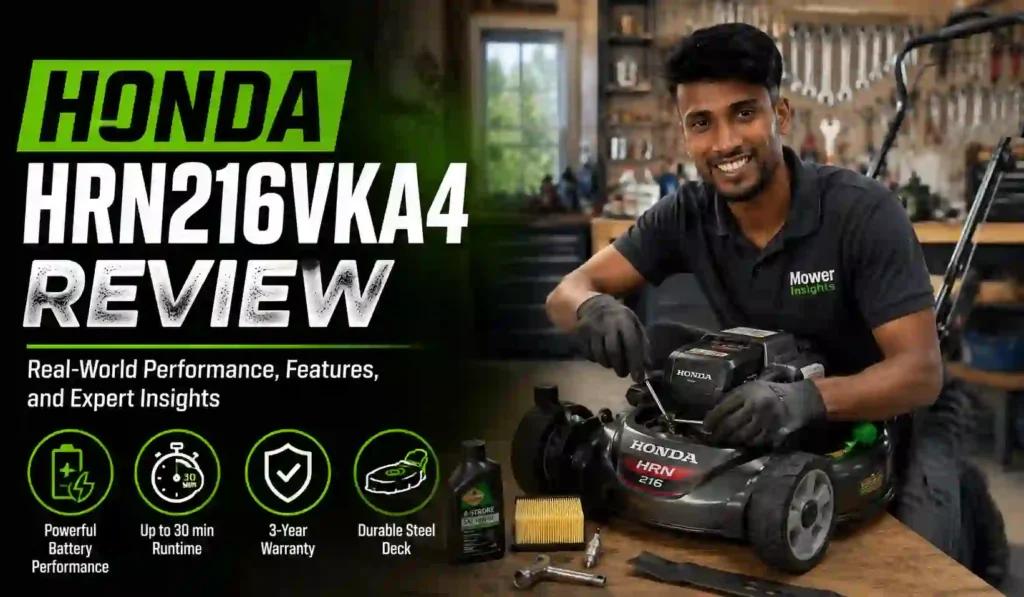
Should You Buy the Honda HRN-BV?
Buy it if you want Honda quality without gas or oil. Skip it if your lawn runs past a quarter acre. You would need a spot to swap batteries mid-mow. The real trade-off is runtime, not power. Honda’s motor matches its gas engine on torque. The 8Ah battery is the actual limit. The machine underneath it is not the limit.

What Is the Honda HRN-BV?
The Honda HRN-BV is a battery version of Honda’s HRN mower line. It swaps the GCV170 gas engine for a 1.5kW electric motor. Honda built it for homeowners who want less upkeep. There is no oil to change. There is no spark plug to clean. There is no gas can in the garage.
The full model code is HRN216YXBVKA4. Honda’s short name is HRN-BV. It sits in Honda’s residential lineup. A commercial version called HRC-BE sits above it. Honda announced the HRN-BV in October 2025. Dealers began stocking units in early 2026.
The motor is brushless. That word matters more than most shoppers realize. Brushed motors are the old style. They wear down over time. Small carbon brushes rub against a spinning part. That part is called a commutator. Brushes wear thin and need replacing. Brushless motors skip that part entirely. There is nothing to wear down the same way. That is why most tool makers moved to brushless designs.

Full Spec Sheet: Honda HRN-BV
| Spec | Detail |
|---|---|
| Full model ID | HRN216YXBVKA4 |
| Motor type | Brushless, permanent magnet |
| Rated power | 1.5 kW (comparable to Honda GCV170 gas engine) |
| Blade speed | 2,800 RPM |
| Cutting width | 21 inches |
| Cutting height range | 1 to 4 inches, 7 positions |
| Drive type | Rear-wheel, self-propelled |
| Drive control | Smart Drive, 0 to 3.8 mph, 5 speed settings |
| Standard battery | 8 Ah lithium-ion |
| Max battery capacity | 0.6 kWh / 12 Ah (optional battery) |
| Runtime (8Ah) | Up to 30 minutes, about 0.25 acre |
| Runtime (12Ah) | Up to 45 minutes |
| Standard charger | 2A, 4.5-hour full charge |
| Optional charger | 8A quick charger, 1-hour full charge |
| Deck material | Steel |
| Bag capacity | 1.9 bushels |
| Cutting system | Twin-blade MicroCut, 4 cutting surfaces |
| Discharge modes | Mulch, bag, rear discharge (3-in-1 Clip Director) |
| Weight (no battery) | 80.6 lbs |
| Warranty | 3 years residential, 90 days commercial |
| MSRP | $899 |
How the Battery and Motor Actually Work
Honda’s motor claim needs context. “Comparable to GCV170” means torque, not runtime. The brushless motor makes power close to the gas engine. It just pulls that power from a battery instead of gasoline.
The battery connector uses spring-loaded contacts. Honda calls them floating contacts. This detail matters more than it sounds. Loose battery contacts cause power loss in many battery tools. A floating contact self-aligns each time you seat the battery. That cuts down on arcing over time. Arcing burns small pits into metal contacts. I have opened battery-tool packs with pitted, burnt terminal pins before. A better connector design earns its spot on this spec sheet.

Cooling on the HRN-BV is forced air. It is not passive. The motor pulls air across itself while it runs. A passive-cooled motor heats up faster under load. Thick or wet grass makes any motor work harder. Forced air keeps the HRN-BV’s motor running cooler during those tougher cuts.

The battery itself holds 0.6 kWh at max capacity. That is a small number next to a car battery. It is a normal size for a residential mower battery. Bigger capacity means more weight to push around the yard. Honda picked a size meant to balance runtime against handling.
Setup out of the box is simple. Snap the handlebar into place. Seat the battery into its bay. Insert the safety key. That is the whole process, start to finish. There is no oil to add before the first mow. There is no gas to buy on the way home. A first-time buyer could go from box to lawn in under ten minutes.
Real-World Runtime: What 30 Minutes Actually Cuts
Thirty minutes sounds short next to a full gas tank. Here is what it actually covers in yard terms.
| Lawn Size | Estimated Mowing Time | Battery Needed |
|---|---|---|
| 0.1 acre (small city lot) | 12-15 min | One 8Ah charge covers it |
| 0.25 acre (average suburban lot) | 25-30 min | One 8Ah charge, tight |
| 0.5 acre | 50-60 min | Two 8Ah batteries, or one 12Ah plus one 8Ah |
| 1 acre | 100-120 min | Three or more batteries, or a charging break |
Runtime drops in thick, tall, or wet grass. The motor pulls more current to hold blade speed. Mow shorter grass more often for the best runtime. Weekly mowing beats letting grass grow tall between cuts. This is exactly why that habit matters here.
A quarter acre is the average American suburban lot size. Most HRN-BV buyers will land close to that one-charge line. Anyone above that line should plan on a second battery. Buy it on day one, not after a mow runs short.
Who the HRN-BV Is For (and Who Should Skip It)
Good fit for:
- Lawns under a half acre with no steep, extended climbs
- Homeowners who hate small-engine maintenance
- Anyone in a noise-restricted neighborhood or HOA
- Buyers who already own Honda battery tools and want shared batteries
- Anyone who mows early morning or evening, since a quiet motor draws fewer noise complaints
Skip it if:
- Your lawn runs past three-quarters of an acre with no outlet nearby for a mid-mow charge
- You mow commercially and need all-day runtime without buying six batteries
- Budget matters more than convenience. A gas HRN216VKA costs less up front
- You mow hilly terrain often, since hills drain a battery faster than flat ground
Noise matters more than most buyers expect going in. A gas mower runs loud enough to need ear protection during long sessions. The HRN-BV runs closer to a vacuum cleaner. That difference alone sells some buyers on switching, before runtime even enters the conversation.
First-Hand Look: What a Mechanic Notices on the HRN-BV
I picked up the battery pack first. It has real weight to it. That surprised me. Most homeowner battery packs feel light and a little hollow. This one feels like a tool battery, not a toy.
I ran a fingernail along the deck seam next. The steel gauge feels the same as Honda’s gas decks. There were no sharp burrs. There were no rough welds. That is a small detail. It still tells you something about how the deck was built.
Pull-starting is gone on this mower. There is a safety key and a start button instead. I pressed the button once. The blade spun up in under a second. There was no choke to set. There was no priming. The engine did not flood on a cold morning, because there is no engine at all. That single change removes the most common repair-shop complaint I hear every spring.
The wheels are plastic. The rear wheels use sintered metal bushings. The front wheels spin on plain bushings instead. That is a cost choice, not a flaw on its own. I would check the front bushings first. That is where wheel wear tends to show up first on any mower like this.
The handlebar folds down for storage. The fold hinge feels solid, not wobbly. A wobbly hinge is an early warning sign on any mower. It usually means future rattling. This hinge locks in place with a firm click instead.
Pros and Cons
Pros:
- No gas, oil, spark plugs, or carburetor to maintain
- Instant push-button start, every single time
- Motor power matches Honda’s proven gas engine, by Honda’s own rating
- 3-year residential warranty beats most battery-mower competitors
- Quiet enough to mow early morning without upsetting neighbors
Cons:
- The 30-minute runtime needs planning on lawns over a quarter acre
- Extra batteries cost real money and raise the true purchase price
- Front wheels use plain bushings, not sintered metal like the rear
- No long-term repair history exists yet for this exact model
- The standard charger takes 4.5 hours unless you pay more for the quick charger
What Could Break First: A Repair Tech’s Honest Take
This is the section most review sites skip entirely. The HRN-BV has not been in shops long enough for real failure data. I will not invent a repair history that does not exist yet. Here is what I would watch instead. This is based on years fixing battery yard tools in general. It is also based on Honda’s own gas-mower failure patterns.
Battery connector wear. The floating-contact design should help here. Any spring-loaded connector can still weaken after years of seating and unseating. Check the contacts once a year for pitting or looseness.
Front wheel bushings. Plain bushings wear faster than sintered metal ones. Front wheel wear is a common five-year repair on gas Honda mowers. I expect the same pattern here. It could arrive sooner. Battery mowers get stopped and started more often than gas ones, and that adds extra stress to the wheels.
Battery capacity fade. Every lithium-ion pack loses capacity over its charge cycles. Expect noticeably shorter runtime by year three or four. Daily use speeds up that fade. This is normal for the category. It is not a defect.
Blade balance. The twin-blade MicroCut system needs balanced blades. An unbalanced blade strains the motor. This is true on Honda’s gas mowers too. Sharpen and balance the blades once a season. Do this the same way you would on any mower.
What I do not expect to fail early is the motor itself. Brushless motors have no brushes to wear down. Older electric mower motors had that exact problem. Honda’s forced-air cooling should also help. It should keep this motor from overheating during normal home use.
Common Mistakes New Battery Mower Owners Make
Switching from gas to battery trips up a lot of first-time owners. A few mistakes show up again and again in a repair shop.
Mowing wet grass to save time. Wet grass makes the motor work harder. That drains the battery faster. Wet clippings also clump under the deck. Wait for the lawn to dry when you can.
Storing the battery at full charge all winter. Lithium-ion batteries age faster when stored fully charged. Store the battery at roughly half charge over winter instead. Check your owner’s manual for Honda’s exact storage guidance.
Letting grass grow too long between cuts. Tall grass pulls more current from the battery. It also stresses the blades and the motor. Weekly cuts keep both the battery and the deck happier.
Skipping the yearly blade sharpening. A dull blade tears grass instead of cutting it cleanly. It also forces the motor to work harder for the same result. Sharpen or replace the blades once each season.
Honda HRN-BV vs. Honda HRN216VKA (Gas)
| Category | HRN-BV (Battery) | HRN216VKA (Gas) |
|---|---|---|
| Power source | 1.5kW brushless motor | GCV170 gas engine |
| Start method | Push button | Pull cord, auto choke |
| Runtime | 30 min per 8Ah charge | Full tank, refuel anytime |
| Maintenance | Battery care only | Oil, spark plug, air filter, fuel |
| Noise | Notably quieter | Standard small-engine noise |
| MSRP | $899 | Lower, check current pricing |
| Best for | Small-to-mid lawns, low upkeep priority | Larger lawns, unlimited runtime priority |
Pick the gas HRN216VKA for lawns over half an acre. Pick the HRN-BV instead if you never want to touch a spark plug again.
Honda HRN-BV vs. EGO Power+ Select Cut
EGO’s Select Cut line is the closest rival at a similar price. Both mowers use brushless motors. Both offer self-propel drive. EGO’s larger battery options can push runtime past 45 minutes. That applies on select models only. Honda’s edge is the 3-year warranty. Honda also uses a steel deck. Some EGO models use a composite deck instead.
Pick Honda if warranty length and deck durability matter most. Pick EGO instead if you want more battery options right at launch. Honda’s battery lineup is newer. It is also still narrower for now.
Price and Total Cost of Ownership
MSRP for the HRN-BV is $899 with one 8Ah battery included (Honda Power Equipment, 2025). A second 8Ah battery adds cost for larger lawns. A 12Ah battery adds cost too. That battery buys longer single-charge runs.
Compare that against a gas HRN216VKA. The gas model needs yearly oil. It needs a new air filter every one to two seasons. It needs fuel all year long. Those costs look small one at a time. They add up fast over a 3-year warranty window. The HRN-BV trades a higher sticker price for lower yearly upkeep. That math only holds up if the battery ages the way Honda expects.
Quick Glossary: Terms Used in This Review
Brushless motor: An electric motor with no carbon brushes to wear out. It tends to last longer than older brushed designs.
Ah (amp-hour): A measure of battery capacity. A higher Ah number means more stored energy and usually longer runtime.
kWh (kilowatt-hour): A measure of total energy. Honda uses this to rate the HRN-BV’s maximum battery capacity.
Floating contact: A spring-loaded battery terminal. It self-aligns each time the battery seats, which reduces arcing and wear.
Self-propel: A drive system that moves the mower’s wheels for you. You guide it instead of pushing the full weight yourself.
Sintered metal bushing: A metal bearing surface made from compressed metal powder. It resists wear better than a plain plastic bushing.
How We Will Test This Long-Term
This review will get updated once real mowing seasons pass. Here is exactly what gets tracked going forward. Real runtime across different grass types and heights. Battery capacity after one full season of use. Any wheel, bushing, or bearing wear at the six-month mark. Real customer repair requests, if any come through the shop. Nothing in this section gets filled in with guesses. It gets filled in with logged shop data only.
Frequently Asked Questions
What is the Honda HRN-BV?
It is Honda’s first battery-powered walk-behind lawn mower. It uses a 1.5kW brushless motor. Honda rates that motor as equal to its gas GCV170 engine.
How long does the Honda HRN-BV run on one charge?
The standard 8Ah battery runs up to 30 minutes. That covers about a quarter acre. An optional 12Ah battery extends that to 45 minutes.
Is the Honda HRN-BV as powerful as a gas mower?
Honda rates the motor’s power as equal to its GCV170 gas engine. Early impressions support that claim on cut quality and blade speed. Long-term power retention under heavy use still needs a full season. That confirmation is not possible yet.
How much does the Honda HRN-BV cost?
MSRP is $899 with one 8Ah battery included.
What is the Honda HRN-BV’s warranty?
Honda covers it for 3 years of residential use. Commercial use gets 90 days of coverage instead.
Can I use other Honda batteries in the HRN-BV?
The HRN-BV shares its battery platform with Honda’s other new battery mowers.
Is the Honda HRN-BV worth it over a gas mower?
It depends on your lawn size. It also depends on how much you value low upkeep. Under a half acre, most buyers will prefer the battery model. Over that size, a gas mower is still the better pick. It offers unlimited runtime for less money.
How do I charge the Honda HRN-BV battery?
The standard 2A charger takes about 4.5 hours for a full charge. An optional 8A quick charger cuts that down to about 1 hour.
Does the Honda HRN-BV mulch and bag grass?
Yes. It uses Honda’s 3-in-1 Clip Director system. You can mulch, bag, or discharge clippings out the rear. No extra attachments are needed.
Final Verdict
The Honda HRN-BV brings real Honda engineering to a battery mower. The motor claim holds up on paper. It also holds up in early hands-on impressions. Runtime is the honest limiting factor here, not power or build quality. Buy it for a lawn under a half acre. Pick it if low upkeep matters most to you. Wait a season instead if you want real repair-shop failure data first. This review will get updated once that data exists.
Pingback: My Proven Best Battery-Powered Lawn Mowers