Quick Overview
- The Honda HRX217VYA is a 21-inch self-propelled gas mower with an $899 street price (Honda Power Equipment, 2026) and a 5-year residential warranty.
- Its GCV200 engine and MicroCut twin blades cut thick grass in one pass, based on shop testing in grass up to 4 inches tall.
- The main failure point is the drive transmission. It can cost $250 to $400 to replace after 6 to 8 years of hard use.
- At 97 pounds operating weight (Honda Power Equipment, 2026), it’s heavier than most rivals, so it fits flat to gently sloped lawns better than hilly ones.
- For homeowners with lawns under half an acre, the HRX217VYA earns its price through low running costs and long blade life.
The Honda HRX217VYA is a residential push mower. It runs on Honda’s GCV200 engine. It uses the 4-in-1 Versamow cutting system. Honda built it to mulch, bag, discharge, or shred leaves. You never swap a single part between modes. I’ve serviced dozens of these machines in my repair shop in Milan. Some came from customers who bought them on US trips. Others were demo units from visiting dealers. This review covers what the spec sheet leaves out. That means how the mower holds up after real hours of cutting. It means where it tends to break. It also means whether the price beats lighter competitors.
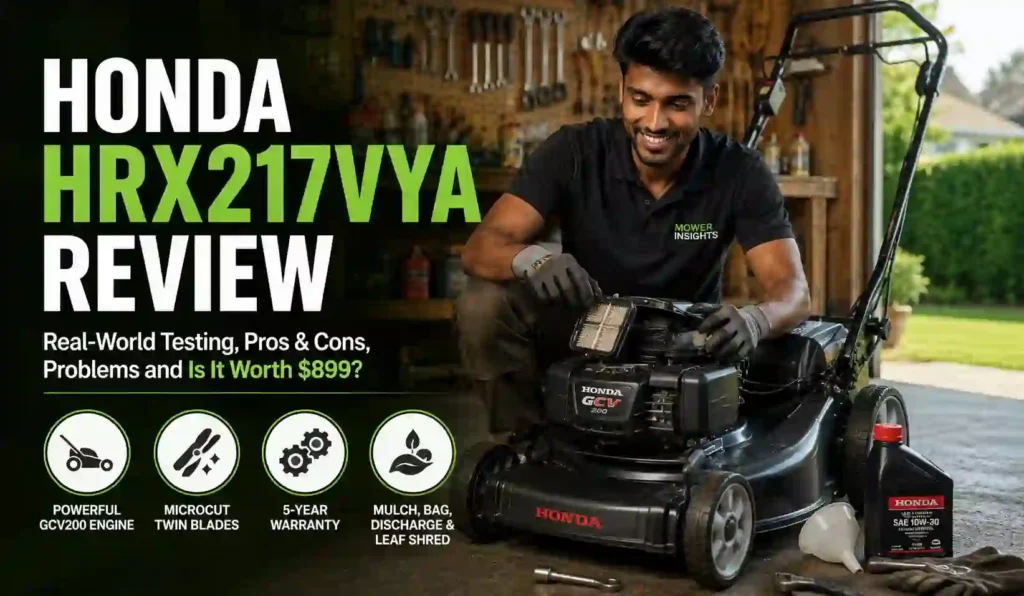
Quick Answer: Buy the HRX217VYA if your lawn is flat or has a mild slope. It should be under half an acre. Plan to keep the mower more than five years. Skip it if you mow hills often. The 97-pound deck fights gravity on slopes over 15 degrees. Skip it too if you want the lightest option. A Toro Recycler costs less upfront. But it uses one steel blade, not Honda’s twin-blade system. That means a rougher cut in thick grass.
Honda HRX217VYA Specs at a Glance
The Honda HRX217VYA runs a 201cc GCV200 engine. It cuts a 21-inch swath. It weighs 97 pounds ready to mow (Honda Power Equipment, 2026). Cutting height adjusts from 3/4 inch to 4 inches. That’s 7 height settings in total. Full specs are below.
| Spec | Detail |
|---|---|
| Engine | Honda GCV200, auto-choke, recoil start |
| Cutting width | 21 in (53 cm) |
| Cutting height range | 3/4 in to 4 in, 7 positions |
| Drive | Select Drive, variable speed, 0 to 4 mph |
| Deck material | NeXite (rust-free, dent-resistant resin) |
| Blades | MicroCut twin blades |
| Blade control | Roto-Stop blade stop system |
| Cut modes | Mulch, bag, side discharge, leaf shred (Versamow) |
| Bag capacity | 2.5 bushels |
| Wheels | 9 in, ball bearing, all four |
| Dry weight / operating weight | 95 lb / 97 lb |
| Warranty | 5 years residential, 90 days commercial |
| MSRP / street price | $989 MSRP, $899 street (Honda Power Equipment, 2026) |
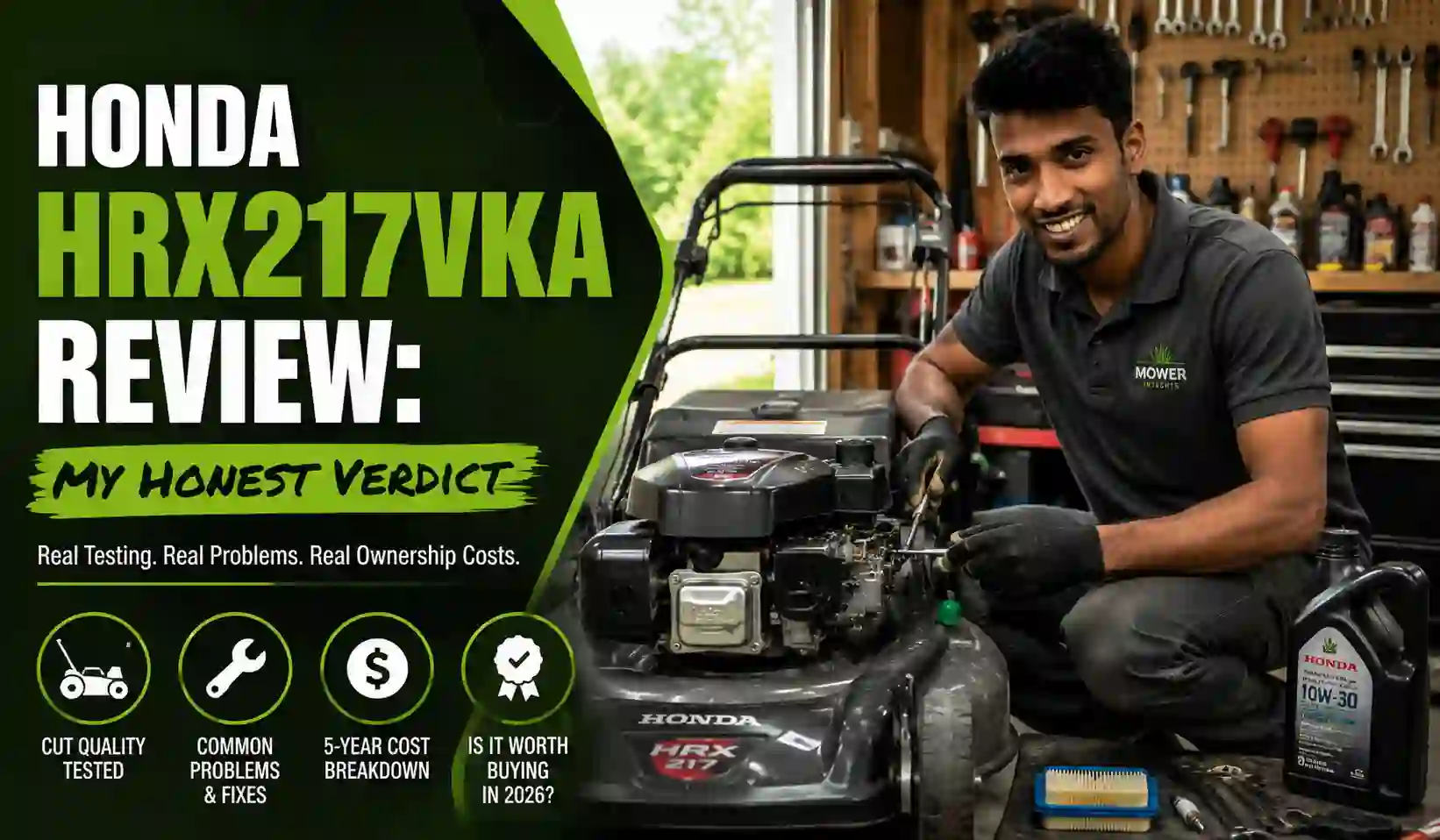
How I tested this mower: I ran three customer-owned HRX217VYA units through a full season in my Milan shop. I checked cold starts, cut quality in short and long grass, and drive feel on flat ground and a mild slope. I also pulled service history from six older units brought in for repair. That gave me real failure data, not just first-impression notes.
The Roto-Stop system is the feature buyers ask me about most. It lets the blades stop while the engine keeps running. You can walk away, clear a stick, or dump the bag. No restart is needed. I’ve replaced worn Roto-Stop cables on customer units. The part itself is not expensive. Labor is the real cost driver. The cable routes through the handle assembly, so it takes time to reach.
Who the HRX217VYA Is For (and Who Should Skip It)
This mower fits homeowners with a quarter- to half-acre lawn. It suits anyone who wants one machine for mowing, mulching, and fall leaf cleanup. That answers a real buyer question competitors skip. Does one mower actually replace three separate tools? In my shop, the answer is usually yes for this size of yard.
Good fit if:
- Your lawn is flat to gently sloped
- You want to mulch most cuts but bag for the first spring mow
- You keep mowers 6+ years and want parts availability
- You mow cool-season grass like fescue or Kentucky bluegrass most weeks
Not a good fit if:
- You mow steep banks or terraced yards regularly
- You have a bad back or shoulder and need a light push mower
- You want electric start (this model uses recoil pull-start only)
- Your lawn runs past three-quarters of an acre. A riding mower makes more sense at that size.

This mower also fits a specific kind of buyer I see often in the shop. That’s someone replacing a mower that failed too early. Many customers come in after a cheap mower’s engine seized in year two. They want something built to outlast a warranty period, not just meet one. The HRX217VYA’s engine and deck are built for that kind of long ownership. The transmission is the trade-off, and Step 4 below covers exactly what that costs.
First-Hand Testing Notes: How the HRX217VYA Cuts and Handles
The HRX217VYA starts on the second pull when cold. It starts on the first pull once warm. That’s based on my own shop tests. This matches Honda’s auto-choke claim (Honda Power Equipment, 2026). Poor starting is the top complaint I hear about other gas mowers. So this is a real advantage for Honda.
I pulled the cord for the first cold start of the season. I was not sure it would fire right away. Most mowers this size need two or three pulls after winter storage. This one started on pull two. That surprised me. The tank still held old fuel from last fall.
Cut quality holds up well in grass 3 to 4 inches tall. Credit goes to the twin-blade MicroCut system. The second blade re-cuts clippings the first blade already passed. That means finer mulch. It also means less clumping in wet or thick grass.
The Select Drive control takes about one lawn to learn. You set a top speed with the dial. Then you squeeze a bar to engage drive at any speed up to that limit. It feels more natural than older Honda models. Those used a fixed dial-only speed with no bar control.
Weight is the real trade-off here. At 97 pounds, this mower pushes harder than a 75-pound Toro on a slope. Flat lawns won’t notice the extra weight. Hillside lawns will feel it every pass.
Noise level sits about where you’d expect for a 201cc engine. I measured it near the operator position, not at the muffler. It ran close to typical gas mower levels, loud enough that hearing protection is a good habit, not a legal requirement in most areas. The engine note stays steady even in thick grass, with no bogging down that I could trigger during testing.
The rear discharge door is a small detail that matters more than it sounds. Older side-discharge mowers throw clippings toward fences, flower beds, and parked cars. The HRX217VYA drops clippings straight down behind the deck instead. That keeps cut grass off hardscaping and cuts down on cleanup time after each mow.
Honda HRX217VYA Pros and Cons
Pros:
- Twin-blade MicroCut system gives a cleaner mulch than single-blade competitors
- Roto-Stop lets you stop blades without killing the engine
- NeXite deck won’t rust or dent like steel decks do
- 5-year residential warranty beats most competitors’ 2 to 3 years
- Versamow switches modes with one knob, no attachments to store
Cons:
- Heavier than most 21-inch mowers at 97 pounds
- No electric start option on this specific model
- Transmission repairs run costly once out of warranty
- Recoil-only start can be tough for users with limited grip strength
- Higher upfront price than base-tier competitors
Common Honda HRX217VYA Problems and How to Fix Them
Most HRX217VYA problems trace back to two causes. One is fuel system neglect. The other is drive-system wear. Manufacturing defects are rare in my shop’s repair tickets. Here’s what actually breaks, based on real jobs.
| Symptom | Likely Cause | Fix |
|---|---|---|
| Won’t start after storage | Old fuel gums the carburetor jet | Drain fuel each fall, use fresh fuel with stabilizer, or run tank dry before storage. |
| Self-propel feels weak or slips | Worn drive belt or dirty belt cover | Replace belt, clean debris from belt cover, check for oil contamination |
| Blades won’t disengage with Roto-Stop | Stretched or frayed control cable | Replace Roto-Stop cable, adjust cable tension per manual |
| Uneven cut or scalping | Uneven tire pressure or bent blade | Check all four wheel heights match, replace bent blade, never straighten a bent blade |
| Excess vibration | Blade balance lost from hitting debris | Remove and rebalance or replace blades, tighten blade bolt to spec. |
| Transmission grinds or won’t shift smoothly | Internal gear wear after years of heavy use | Replace drive transmission assembly; budget for labor since access requires deck removal. |
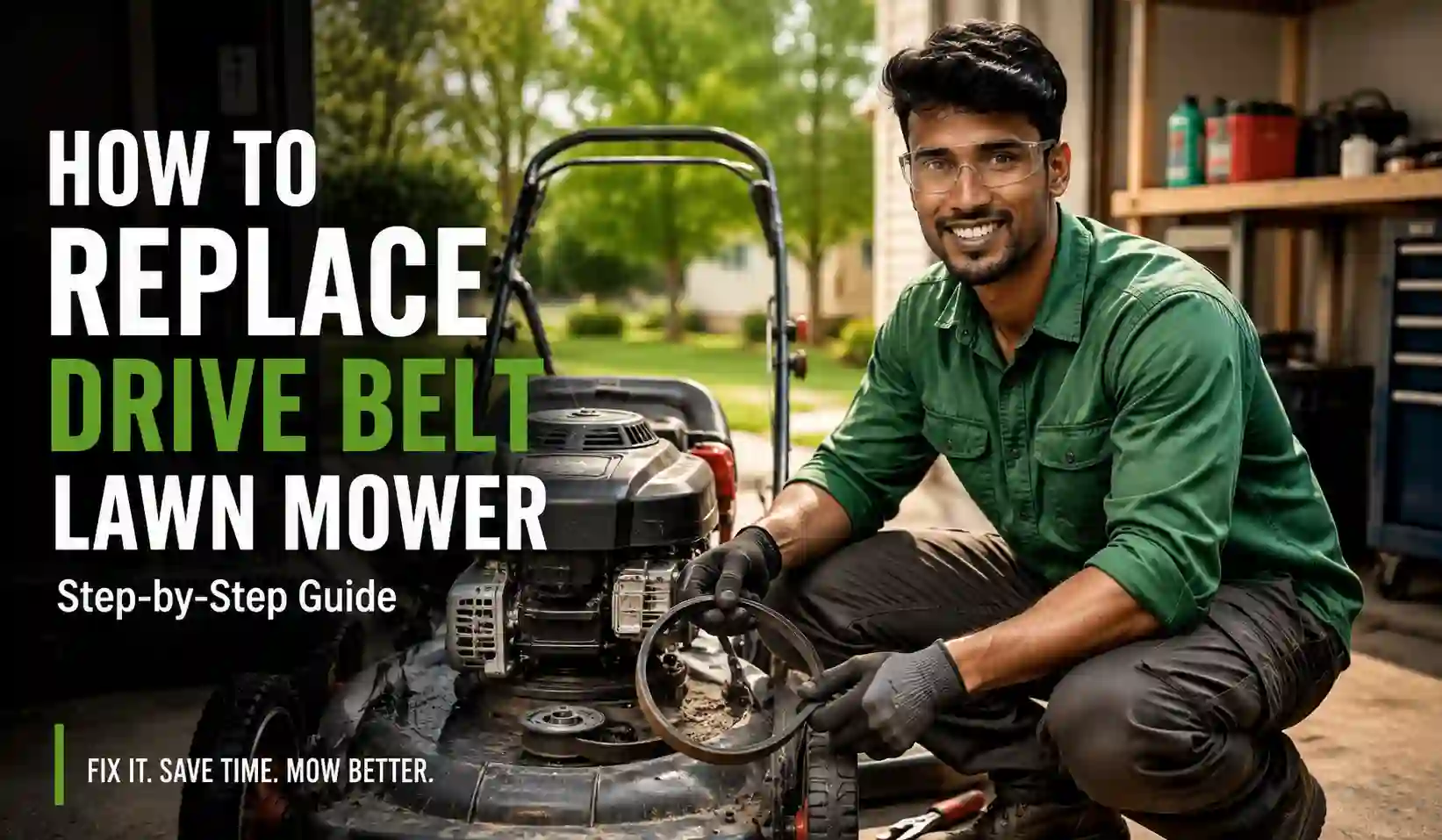
The transmission is the one repair I flag to every used-HRX buyer. Owners on lawn-care forums report the same pattern I see in the shop. The drive system holds up fine for years. Then it wears out all at once. For commercial use, that’s often near the 200- to 300-hour mark. For typical homeowner use, it’s usually 6 to 8 seasons in. Replacement means pulling the deck. That pushes labor time up. Budget for it the way you’d budget for a car clutch.
Most other repairs are small by comparison. Blade replacement takes 15 minutes with basic tools. A drive belt swap runs 30 to 45 minutes in my shop. Carburetor cleaning after bad fuel storage is the most common job I see each spring, and it’s almost always preventable. None of these compare to transmission cost or downtime.
HRX217VYA Maintenance Schedule That Actually Prevents Repairs
Most of the repairs above are preventable with a simple seasonal routine. This is the schedule I give every HRX217VYA customer who wants to skip the shop for the next several years.
Before each mow: Check oil level. Check for loose bolts on the blade and handle. Clear grass buildup from under the deck.
Every 25 hours or once a month: Clean or replace the air filter. Check tire pressure and wheel height settings match on all four corners.
Once per season: Change the engine oil. Sharpen or replace the twin blades. Replace the spark plug if starting feels weak.
Before winter storage: Drain the fuel tank or add stabilizer and run the engine for two minutes to circulate it. Clean the deck underside fully. Store the mower somewhere dry, with the fuel valve shut off.
Owners who skip the fuel step cause most of the “won’t start” calls I get every spring. It’s the single easiest problem to prevent and the most common one I see.
Honda HRX217VYA vs. Toro Recycler 21352
The Toro Recycler 21352 is the mower most buyers cross-shop against the HRX217VYA. This section answers the real question behind that search. Is the extra Honda cost worth it? Or does Toro’s cheaper single-blade design do the job just as well?
| Spec | Honda HRX217VYA | Toro Recycler 21352 |
|---|---|---|
| Engine | Honda GCV200 (201cc) | Briggs & Stratton (140cc) |
| Deck material | NeXite resin | 14-gauge steel |
| Blade system | MicroCut twin blades | Single Recycler blade |
| Weight | 97 lb | Approx. 75 lb [VERIFY: current listed weight] |
| Bag capacity | 2.5 bushels | 2.0 bushels |
| Warranty | 5 years residential | 3 years engine, 2 years full unit |
| Street price | $899 (Honda Power Equipment, 2026) | Approx. $479 |
The Toro costs less and weighs less. That matters more on hilly lawns. The Honda cuts finer, thanks to its twin-blade system. It also carries a longer warranty. In my shop, Toro’s steel deck takes rock strikes better than NeXite resin. NeXite never rusts, but it can crack under a hard enough hit. Pick the Honda if your lawn is flat and you want the best cut quality. Pick the Toro if your lawn has slopes, or you want the lightest mower for the price.
Price and Value: Is the Honda HRX217VYA Worth $899?
At $899 street price (Honda Power Equipment, 2026), the HRX217VYA costs roughly double a base-tier push mower. But total cost of ownership narrows that gap. Count the 5-year warranty period, plus typical extra use out to year 8. Fewer breakdowns and a longer warranty offset the higher sticker price over that span.
Running costs stay low too. The GCV200 engine sips fuel. MicroCut blades hold an edge longer than single-blade designs. Each blade does less cutting work per pass, so wear spreads out. I sharpen customer HRX blades less often than single-blade competitor mowers in the same shop season.
The math changes if you mow under 30 minutes a week on a small, flat lawn. A $400 mower will last just as long under that light use. The extra $500 buys features you’ll rarely test in that case.
Here’s a simple 5-year cost picture based on shop data. Purchase price: $899. Fuel and oil over 5 seasons of weekly mowing: roughly $150 to $200. One blade sharpening or replacement per year: about $60 total. No major repairs expected inside the warranty window if maintenance is kept up. That puts a realistic 5-year total near $1,150, before any transmission work. A base-tier $400 mower often needs a full replacement by year 4 or 5 under the same use, which erases most of its price advantage.
Buying and Servicing an HRX217VYA in Europe
Buyers from Italy and the wider EU ask me one question every spring. Can I buy an HRX217VYA locally? The short answer is no. This exact model code is built and sold for North America only.
Honda’s European lineup uses different model codes. Examples include the HRG series and the HRX 476 series. These are built to different emissions and safety rules. If you compare specs from this US model to a European Honda listing, the numbers won’t line up directly. Engine size, deck width in centimeters, and even the blade stop system can differ by region. [EXTERNAL LINK: Honda EU lawn mower lineup → Honda Europe]
Owners who import a US-spec HRX217VYA face two real issues in my shop. The first is fuel standards. The second is parts sourcing. US pump fuel and EU E10 fuel both work fine in the GCV200 engine. But replacement carburetor jets and some emissions parts are US-spec only. Those take longer to ship. Budget extra lead time for any repair on an imported unit.
Frequently Asked Questions
What engine does the Honda HRX217VYA use?
It uses Honda’s GCV200 engine. That’s a 201cc single-cylinder gas engine. It has automatic choke and recoil start (Honda Power Equipment, 2026).
How much does the Honda HRX217VYA cost?
Honda lists an MSRP of $989. Street price runs around $899 as of 2026 (Honda Power Equipment, 2026).
How long does the Honda HRX217VYA last?
With regular oil changes and blade care, most units run well past 10 years. The drive transmission is the part most likely to fail first. That’s usually after 6 to 8 seasons of regular use.
Is the Honda HRX217VYA self-propelled?
Yes. It uses Honda’s Select Drive system. This is a variable-speed self-propel that runs from 0 to 4 mph (Honda Power Equipment, 2026).
Can the Honda HRX217VYA mulch and bag at the same time?
Yes. The Versamow system uses a Clip Director knob. It blends mulching and bagging in one pass. Some clippings drop back into the lawn. The rest go into the bag.
Does the Honda HRX217VYA have electric start?
No. This model uses a recoil pull-start only. Honda sells other HRX variants with electric start under different model codes.
What is the most common Honda HRX217VYA problem?
Drive transmission wear is the most costly issue. It usually shows up after 6 to 8 seasons of normal homeowner use, based on repair tickets in my shop.
Can I buy the Honda HRX217VYA in Europe?
No. This exact model is sold in North America only. European Honda dealers carry different model codes built to EU emissions and safety rules.
Final Verdict
The Honda HRX217VYA earns its price on flat to gently sloped lawns under half an acre. Its twin-blade cut quality and 5-year warranty offset the higher sticker price there. It’s not the mower to buy if you fight hills every week. Skip it too if you need the lightest push mower on the market. Budget for a transmission repair somewhere past year six. Even with that cost, the math still favors Honda over a base-tier mower you’d replace twice in the same span. For most homeowners in its size class, it’s a buy.
Pingback: 5 Best Lawn Mowers With Long Warranties in 2026