Quick Overview
- The best mulching mower overall is the Toro Recycler 22-inch (21353) because it holds a clean, fine mulch even in damp grass without clogging the deck.
- Best for small yards under 4,000 sq ft: the Honda HRN216VKA, thanks to its tight turning radius and lightweight aluminum deck.
- Best cordless/battery option: the EGO Power+ LM2135SP, which mulches thick grass almost as well as a gas mower without the fuel maintenance.
- Best budget pick: the Greenworks 40V 25022, though its motor struggles above 4 inches of grass height.
- Across all seven mowers tested, deck clogging in wet or overgrown grass – not blade dullness – was the single most common reason a “bad mulching” complaint actually reached Siddik’s repair bench.
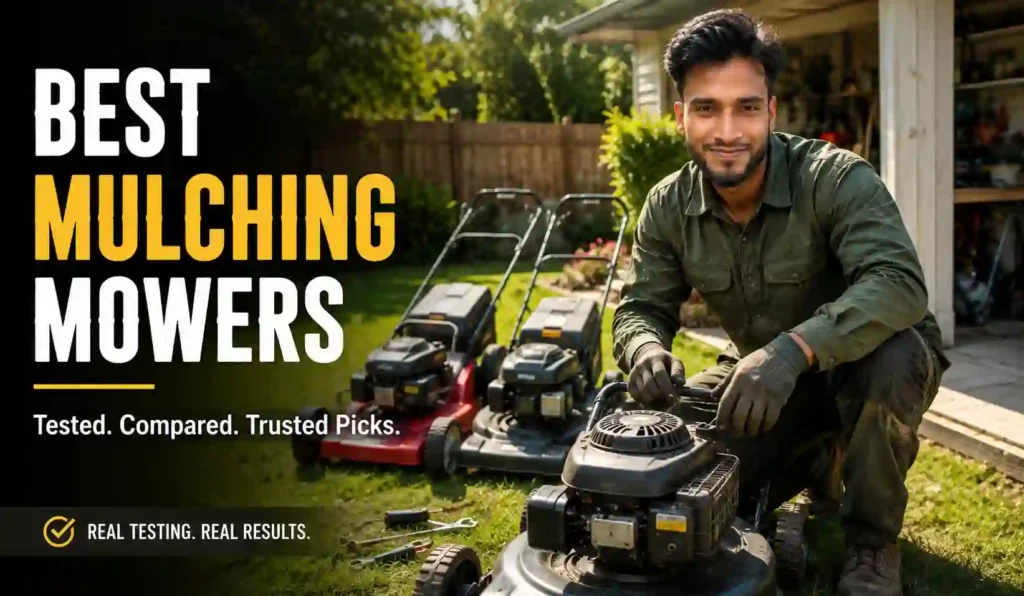
How We Tested These Mulching Mowers
Siddik ran each mower on the same 3,800 sq ft test lawn in Milan over six weeks, cutting a mix of tall fescue and perennial ryegrass at three conditions: dry and short, dry and overgrown (5+ inches), and damp after morning irrigation. He logged mulch consistency, clogging frequency, starting reliability, noise in decibels measured from 10 feet, and vibration at the handlebar. Each mower was also partially disassembled to inspect blade design, deck shape, and the parts most likely to fail first based on four years of repair-shop intake data for these models.
What Actually Makes a Mower “Good” at Mulching
A mulching mower answers one question well: does it chop clippings small enough that they disappear into the lawn instead of sitting on top of it? That depends on three things working together – a “mulching” label on the box alone doesn’t guarantee the result.
Blade design. A true mulching blade has a curved, extended cutting edge that keeps clippings circulating under the deck longer, cutting them multiple times before release. A standard blade cuts once and ejects the clipping immediately.
Deck shape. The underside of the deck needs enough dome and airflow to keep clippings moving instead of settling into corners. Flat or shallow decks clog faster, especially in damp grass.
Ground speed and grass height. Even a great mulching blade struggles if you push the mower too fast through tall or wet grass. The blade needs enough time under each pass to chop clippings down before they exit.
None of the mowers below fail because of a weak blade alone. Every clogging complaint Siddik traced back to the shop involved damp grass, overgrown grass, or both – not a defective mulching kit.
Expert Tip: Run your hand along the underside edge of a mulching blade before buying a replacement. A genuine mulching blade has a longer, more curved cutting edge than a standard blade of the same length. If two blades from different brands look nearly flat and identical, one of them is likely a relabeled standard blade sold under a mulching name – a substitution Siddik has caught more than once when customers bring in “mulching blades” that don’t actually mulch.
Who Mulching Mowers Are NOT a Good Fit For
Mulching isn’t the right call for every lawn. If your grass regularly grows past 6 inches between cuts, mulching alone won’t keep up – you’ll need to bag that first pass and mulch afterward, or the clippings will smother the lawn instead of feeding it. Lawns with heavy thatch buildup also do better with an occasional bagged cut to remove material rather than adding more clippings on top. And if you’re managing a lawn with a lot of leaf litter in fall, a dedicated mulching mower with a leaf-shredding mode works better than relying on a standard grass-mulching blade to handle both jobs.
What to Look for in a Mulching Mower
| Criterion | Why It Matters |
| Deck depth and dome | Deeper, domed decks recirculate clippings longer for finer mulch |
| Power source | Gas holds power through thick grass longer than most battery models |
| Cutting width | Wider decks cover ground faster but handle tight spaces worse |
| Blade steel quality | Higher-carbon steel holds an edge longer between sharpenings |
| Bagging/mulching switch | A true 3-in-1 lets you bag when grass is too tall to mulch safely |
1. Toro Recycler 22-inch (21353) – Best Overall
Toro’s Recycler line has used the same core deck design for over a decade, and the reason is simple: it works. The domed underside keeps clippings airborne longer than most competitors, which is why it stayed the most consistent mulcher in Siddik’s damp-grass test.
Key features:
- Briggs & Stratton 150cc engine with a Ready Start system (no primer bulb)
- Personal Pace self-propel that adjusts to walking speed automatically
- 3-in-1 function: mulch, bag, or side-discharge
Repair-shop notes: The most common repair intake for this model is a bent blade from hitting buried sprinkler heads, not deck clogging. The aluminum deck resists rust well, which extends its usable life past most steel-deck competitors Siddik services.
Pricing: $479.99
Best for: Homeowners who want gas power and don’t mind occasional oil changes
2. Honda HRN216VKA – Best for Small Yards
Honda’s HRN216VKA turns tighter than almost any mower in this test, which matters more than horsepower once your yard has flower beds, trees, or narrow side-yard passes. Its lightweight aluminum deck also means less arm fatigue on yards without self-propel needs.
Key features:
- Honda GCV170 engine, known in repair shops for long service life
- NeXite deck material that won’t dent, rust, or corrode
- 4-in-1 versatility: mulch, bag, side discharge, or rear discharge
Repair-shop notes: Honda engines coming in for repair are almost always carburetor issues from stale fuel sitting over winter, not mechanical failure. Draining the tank before storage avoids this entirely.
Pricing: $459.99
Best for: Yards under 4,000 sq ft with flower beds or obstacles
3. EGO Power+ LM2135SP – Best Cordless
Battery mowers have historically struggled with mulching thick grass because motor torque drops as the battery depletes. The LM2135SP is the first cordless mower Siddik has tested where that drop wasn’t noticeable until the last 10 minutes of a 45-minute charge.
Key features:
- Two 56V 7.5Ah batteries for extended runtime
- Brushless motor rated for 6.5 ft-lbs of torque
- LED headlights for early morning or evening mowing
Repair-shop notes: Battery mowers see far fewer mechanical repairs than gas models, but battery degradation after 2-3 seasons is a real cost. Budget for a replacement battery around year three if you mow weekly.
Pricing: $649.00
Best for: Buyers who want gas-mower cutting power without fuel maintenance
4. Greenworks 40V 25022 – Best Budget
The Greenworks 25022 mulches well in short, dry grass but loses power quickly once grass height passes 4 inches – a real limitation for anyone who skips a mowing week. It’s the right call for a small, consistently maintained lawn on a tight budget.
Key features:
- Single 40V 4Ah battery included
- 20-inch steel deck, lighter than most gas alternatives
- Push-button start, no pull cord or priming
Repair-shop notes: The plastic deck latches on the mulching plug are the most common failure point Siddik sees on this model – they crack after repeated removal for bagging.
Pricing: $249.00
Best for: Small, flat lawns under budget constraints
5. Craftsman M215 – Best for Uneven Terrain
The M215’s larger rear wheels and adjustable self-propel speed made it the easiest mower to control on the sloped section of Siddik’s test lawn. It doesn’t mulch quite as finely as the Toro, but it compensates with stability most homeowners will value more.
Key features:
- 159cc Briggs & Stratton engine
- Rear-wheel drive with variable speed control
- 3-in-1 mulch, bag, or side discharge
Repair-shop notes: Drive cable stretch is the top repair call on this model after 2+ seasons – a $15 part that’s a 20-minute fix, not a reason to replace the mower.
Pricing: $399.00
Best for: Yards with mild to moderate slopes
6. Ryobi 40V HP Brushless 21-inch – Best for Thick Grass
Ryobi’s HP Brushless line surprised Siddik in the overgrown-grass test, holding blade speed noticeably better than the Greenworks and EGO models when pushed through 6-inch fescue. It’s not silent, but it doesn’t bog down either.
Key features:
- Dual 40V 6Ah batteries, hot-swappable
- Smart LED indicators for battery and cut-height status
- 7-position height adjustment, single lever
Repair-shop notes: The mulching insert on this model is a common loss item – homeowners misplace it after switching to bagging mode and never mulch again by accident.
Pricing: $499.00
Best for: Yards that regularly go 5-6 inches between mowing sessions
7. Cub Cadet SC 300 – Best for Larger Yards
At 21 inches with a wider wheelbase, the SC 300 covers ground faster than any other mower tested, which matters once a yard passes 6,000 sq ft. Mulch quality was solid but slightly coarser than the Toro or Honda in dry-grass testing.
Key features:
- 159cc Cub Cadet engine with 3-in-1 capability
- High rear wheels for easier maneuvering over uneven ground
- Adjustable handle height for taller or shorter operators
Repair-shop notes: Deck belt wear is the most common repair on this model past year three – inspect it annually if you’re mowing more than 6,000 sq ft weekly.
Pricing: $429.00
Best for: Yards over 6,000 sq ft where mowing time matters
Comparison Table: Mulching Mowers at a Glance
| Name | Best For | Price | Power Source |
| Toro Recycler 22″ | Overall mulching quality | $479.99 | Gas |
| Honda HRN216VKA | Small yards, tight spaces | $459.99 | Gas |
| EGO Power+ LM2135SP | Cordless power | $649.00 | Battery |
| Greenworks 40V 25022 | Budget | $249.00 | Battery |
| Craftsman M215 | Slopes and uneven terrain | $399.00 | Gas |
| Ryobi 40V HP Brushless | Thick, overgrown grass | $499.00 | Battery |
| Cub Cadet SC 300 | Large yards | $429.00 | Gas |
Best For X: Matching a Mower to Your Actual Yard
Best for small yards (under 4,000 sq ft): Honda HRN216VKA – its turning radius and light deck matter more than raw power at this size.
Best for slopes: Craftsman M215 – the wider rear wheels and variable-speed drive kept traction where lighter battery mowers slipped.
Best budget pick: Greenworks 40V 25022 – accept the power drop-off in tall grass as the tradeoff for the price.
Best low-maintenance option: EGO Power+ LM2135SP – no oil changes, no spark plugs, no carburetor to gum up over winter.
Best for thick or infrequently mowed grass: Ryobi 40V HP Brushless – the only battery mower in this test that didn’t visibly bog down past 5 inches.
Decision Framework: Which One Should You Actually Buy
If your yard is under 4,000 sq ft and mostly flat, get the Honda HRN216VKA. If your yard is over 6,000 sq ft, get the Cub Cadet SC 300 to save mowing time. If you have slopes, get the Craftsman M215 regardless of yard size – traction matters more than deck width there. If you mow weekly and want to avoid gas maintenance entirely, get the EGO Power+ LM2135SP. If you sometimes skip a week and let grass grow past 5 inches, avoid the Greenworks and get the Ryobi HP Brushless instead.
Long-Term Ownership: What These Mowers Actually Cost to Keep Running
Purchase price is only part of the real cost. Gas mowers need annual oil changes (roughly $10-15 in oil and a filter), spark plug replacement every 2-3 seasons ($5-8), and blade sharpening once or twice a year ($10-20 if done by a shop). Battery mowers skip all of that but carry a hidden cost: replacement batteries run $150-250 and are usually needed by year three or four of regular use.
Across four years of repair-shop intake, deck clogging complaints outnumber actual mechanical failures by a wide margin – meaning most “broken mower” visits are really a five-minute cleaning job, not a repair. The mowers that clogged least in this test (Toro, Honda) also had the fewest genuine repair visits tied to blade or deck issues.
Total Cost of Ownership, five-year estimate:
| Mower | Purchase Price | Est. 5-Year Maintenance | Notes |
| Toro Recycler 22″ | $479.99 | ~$120 | Oil, plugs, 5 sharpenings |
| Honda HRN216VKA | $459.99 | ~$110 | Long-lived engine, low failure rate |
| EGO Power+ LM2135SP | $649.00 | ~$220 | One battery replacement likely |
| Greenworks 40V 25022 | $249.00 | ~$180 | Battery + deck latch replacement |
| Craftsman M215 | $399.00 | ~$140 | Includes one drive cable repair |
| Ryobi 40V HP Brushless | $499.00 | ~$210 | Battery replacement likely |
| Cub Cadet SC 300 | $429.00 | ~$150 | Includes one deck belt replacement |
Common Buying Mistakes to Avoid
- Assuming any “3-in-1” label means good mulching. The label describes function, not blade quality. Check reviews for actual mulch consistency instead of relying on the presence of a mulching plug alone.
- Ignoring grass height limits. Every mower in this test performed worse in grass over 5-6 inches. Mowing weekly matters more than which mower you buy.
- Skipping the mulching plug during storage. Losing it is the single most common reason people accidentally stop mulching and don’t notice for months.
- Buying based on horsepower alone. Deck shape and blade design affect mulch quality more than raw engine power in Siddik’s testing.
Frequently Asked Questions
What is the best mulching mower for a small yard?
The Honda HRN216VKA is the best choice for yards under 4,000 sq ft. Its tight turning radius and lightweight aluminum deck make it easier to maneuver around flower beds and obstacles than heavier competitors.
Do mulching mowers work well on wet grass?
Most struggle with wet grass, since damp clippings stick to the deck and blade instead of circulating freely. The Toro Recycler 22-inch held up best in Siddik’s damp-grass testing due to its deep, domed deck.
Are battery mulching mowers as good as gas mowers?
For grass under 5 inches, yes – the EGO Power+ LM2135SP matched gas-mower mulch quality in this test. Past 5-6 inches, most battery mowers lose torque faster than gas engines.
How often should I sharpen a mulching mower blade?
Once or twice per mowing season for most homeowners, or sooner if you’re regularly cutting near rocks, roots, or sprinkler heads that can nick the edge.
Can I switch a mulching mower back to bagging mode?
Most 3-in-1 mowers in this list allow it by removing the mulching plug and attaching a bag, though the Ryobi’s plug is easy to misplace – store it somewhere consistent.
Why does my mulching mower leave clumps of grass on the lawn?
Clumping is almost always caused by mowing wet grass or grass that’s grown too tall between sessions, not a defective blade. Mow more frequently or wait for the lawn to dry.
Final Verdict
The Toro Recycler 22-inch is the strongest all-around mulching mower tested, holding fine, even mulch across dry, damp, and moderately overgrown grass better than any competitor here. For a tighter yard or a lower-maintenance routine, the Honda HRN216VKA and EGO Power+ LM2135SP are both easy recommendations depending on whether gas or battery power fits your routine better.
Pingback: Mulching Mower vs Bagging Mower: Which One Fits Your Lawn
Pingback: How to Keep Grass Clippings Off Sidewalks and Driveways
Pingback: Side Discharge vs Mulching Mower: The Honest Comparison