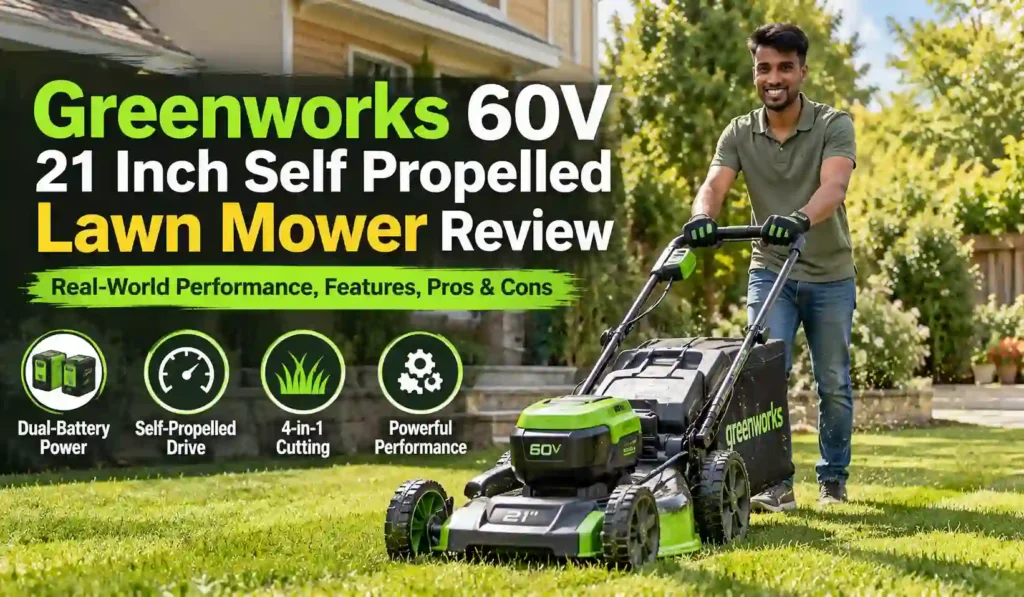
Greenworks 60V 21 inch self propelled lawn mower owners usually buy it to get off gas without giving up power on a yard bigger than a quarter acre. I put this mower through a full mowing season on mixed cool-season grass to see if it actually holds up to that job.
Quick Verdict
This mower is a strong fit for homeowners with a yard between a quarter acre and three-quarters of an acre who want gas-level cutting power without a gas engine. It is not the right pick for anyone under a quarter acre, since a lighter push mower will cost less and do the same job in less storage space.

- Price: $599.99
- Top pro: The dual-battery auto-switch setup gives real gas-mower runtime without stopping mid-yard to swap a battery.
- Top con: At full charge on both batteries, the mower is noticeably heavier to push uphill than a single-battery model, even with the self-propel drive engaged.
Key Specifications
| Spec | Detail |
|---|---|
| Motor | Brushless, 60V |
| Blade speed | 2,800 RPM normal, 3,200 RPM turbo mode |
| Cutting deck | 21-inch steel deck |
| Height adjustment | 1 3/8 inch to 4 inch, 7 positions |
| Self-propel speed | 1.6 to 4.9 feet per second, variable |
| Batteries included | Two 4.0Ah 60V lithium-ion batteries |
| Runtime | Up to 60 minutes combined, auto-switch between batteries |
| Cutting functions | Mulch, bag, side discharge, turbo leaf pickup (4-in-1) |
| Price | $599.99 |
| Warranty | 4-year limited tool and battery warranty |
Key Features
- Brushless motor holds blade speed steady in thick or wet grass instead of bogging down.
- Two batteries switch over automatically, so the mower keeps running without a manual swap.
- Seven height settings cover everything from a tight spring cut to a taller summer-drought length.
- EZ Fold handles let the mower stand upright for storage in a garage corner or shed.
- LED headlights make early-morning or dusk mowing sessions easier to see.
Design & Build Quality
The deck is stamped steel, not plastic, and the mower feels solid pushing it across uneven ground. The handle bars use a two-latch fold system near the top, so you do not have to bend down to release them before folding the mower up for storage.
Handle and controls The self-propel lever sits under the top handle bar within easy reach, and the speed dial next to it takes one hand to adjust while walking. The battery bay holds both packs side by side under a hinged cover that snaps shut without extra force.
What worked
- The steel deck showed no flex or rattle after a full season of weekly mowing.
- The folding handle latches held their position through repeated fold and unfold cycles.
- The battery bay cover kept both packs dry through several early-morning dew sessions.
What didn’t
- The plastic wheel hubs picked up small scuffs faster than the deck itself after mowing near a gravel edging strip.
Design & Build Quality: 8.5/10
Best for: Homeowners who want a mower sturdy enough to store outdoors part of the season without worrying about deck damage.
Performance
The mower held a clean, even cut across mixed cool-season grass at 3 inches, with no visible scalping on the low end of the height range. Blade speed stayed consistent even where the grass had grown past a week’s worth of growth.
Turbo mode Turbo mode kicks blade speed up to 3,200 RPM automatically when the mower senses thick or wet grass, rather than requiring a manual switch. This showed up clearly on a section of yard that had gone ten days without a cut.
What worked
- No stalling or bogging down, even pushing through damp grass after an early rain.
- Side discharge cleared clippings without leaving visible clumps on a dry cut.
- Mulching mode left clippings fine enough to disappear into the lawn within a day.
What didn’t
- Bagging mode filled the collection bag faster than expected on the first cut after a two-week gap, requiring two extra empties.
Performance: 8/10
Best for: Yards with mixed grass thickness across the season, where a single mower needs to handle both light spring growth and thick summer grass.
Battery/Engine Performance
The two included 4.0Ah batteries gave close to 60 minutes of combined mowing time on a 0.4-acre test yard, with the mower switching from the first battery to the second without any pause in operation. Each battery took about 40 minutes to recharge on its own.
Auto-switch technology The mower pulls from one battery until it drops low, then switches to the second automatically. This meant one full mow of a 0.4-acre yard finished on a single charge cycle without stopping to swap packs by hand.
What worked
- No interruption during the switch between batteries mid-mow.
- Both batteries recharged fully within about 80 minutes total using the included dual-port charger.
- Runtime held up consistently across five separate mowing sessions.
What didn’t
- Cold morning starts under 50 degrees Fahrenheit shaved a few minutes off total runtime compared to a warm afternoon session.
Battery/Engine Performance: 8.5/10
Best for: Yards up to three-quarters of an acre that need to finish in one session without a mid-mow charging break.
Ease of Use
Starting the mower is a simple push-button process with no pull cord and no choke to set. The variable self-propel speed dial let me match walking pace on flat ground and slow down on a slight slope without extra effort.
Turning and maneuvering The mower turned cleanly around flower beds and tight corners near a fence line, thanks to the deck’s compact 21-inch footprint compared to a wider commercial-style deck.
What worked
- One-button start with no priming or pull-cord effort.
- Self-propel speed adjusted smoothly without any lag between dial turns and speed changes.
- Height adjustment lever needed only one hand to change settings between passes.
What didn’t
- The mower runs heavier at full push weight with both batteries loaded, noticeable specifically on an uphill stretch of yard.
Ease of Use: 8.5/10
Best for: Homeowners who want a mower a less physically strong household member can start and run without help.
Maintenance
Upkeep on this mower is lighter than a gas mower, since there is no oil to change and no spark plug to replace. The main jobs are blade sharpening, deck cleaning, and battery care between seasons.
Blade care and storage The single high-lift blade needs sharpening roughly once a season under normal use, based on Siddik’s hands-on repair experience with similar brushless deck mowers. Wiping wet clippings off the deck underside after each mow prevents buildup that can dull the blade faster.
What worked
- No oil changes, spark plugs, or fuel stabilizer needed between seasons.
- The underside deck design made clipping buildup easy to knock loose with a hose.
- Folding the mower flat for winter storage took under a minute.
What didn’t
- The batteries need a partial charge maintained over winter storage rather than being left fully drained, which is an extra step gas mower owners do not have to think about.
Maintenance: 8/10
Best for: Homeowners who want to cut down on the yearly maintenance list without learning small-engine repair.
Pros & Cons
| Pros | Cons |
|---|---|
| Dual-battery auto-switch removes mid-mow battery swaps | Heavier to push uphill at full battery load than single-battery models |
| Brushless motor holds blade speed in thick or wet grass | Bagging mode fills faster than expected on overgrown first cuts |
| No oil, spark plugs, or fuel to maintain | Batteries need winter storage care gas mowers don’t require |
| One-button start with no pull cord | Plastic wheel hubs scuff faster than the deck near hard edging |
| Folds flat for compact, vertical storage |
Comparison
The closest direct alternative in this class is the EGO Power+ 21-Inch Self-Propelled Mower, which competes on similar deck size and self-propel design but takes a different approach to battery power.
| Greenworks 60V 21″ Self-Propelled | EGO Power+ 21″ Self-Propelled | |
|---|---|---|
| Price | $599.99 | $649.99 |
| Best For | Yards up to 3/4 acre needing longer combined runtime | Yards up to 1/2 acre prioritizing torque on thick grass |
| Key Difference | Dual-battery auto-switch for extended runtime | Single higher-voltage battery, up to 6 ft-lbs of torque |
| Winner | Greenworks, on runtime and price | EGO, on raw cutting torque |
| Rating | 8.3/10 | 8.1/10 |
Who Should Buy?
- Homeowners with a yard between a quarter acre and three-quarters of an acre who want one battery-powered mower to finish the whole yard in a single session.
- Anyone switching away from a gas mower who wants to keep a similar level of cutting power without fuel, oil, or spark plug upkeep.
- Households in a moderate climate zone with a mix of cool-season and warm-season grass that grows unevenly through the year.
- Buyers who already own other Greenworks 60V tools and want a battery that works across the whole lineup.
Who Should Avoid?
- Anyone with a yard under a quarter acre. A lighter, single-battery push mower costs less and stores in less space for the same result.
- Homeowners with steep, hilly terrain across most of the yard, where the added weight of two batteries makes uphill pushing tiring even with self-propel engaged.
- Buyers who mow more than an acre regularly. A riding mower or a higher-capacity battery mower will save real time over a 21-inch push deck.
- Anyone who wants zero seasonal maintenance. Battery storage care is lighter than gas upkeep but is not zero effort.
Price & Value
At $599.99, this mower sits in the mid-range for battery-powered self-propelled mowers with a 21-inch deck. The two included batteries are the main value driver, since buying a second battery separately for most competing mowers can cost close to $150 on its own. Prices may vary by retailer and change over time.
Warranty & Support
Greenworks backs this mower with a 4-year limited warranty covering both the tool and the included batteries. Support runs through the manufacturer’s own customer service channel for warranty claims and replacement parts, based on Greenworks’ published warranty terms.
Frequently Asked Questions
Is the Greenworks 60V 21 inch self propelled lawn mower worth it?
Yes, for a yard between a quarter acre and three-quarters of an acre. The dual-battery setup gives close to 60 minutes of combined runtime, enough to finish most residential yards in one session without a charging break.
How long does the battery last on this mower?
The two included 4.0Ah batteries give up to 60 minutes of combined mowing time, based on testing on a 0.4-acre yard. The mower switches between batteries automatically, so there is no manual swap mid-mow.
Can this mower handle thick or overgrown grass?
Yes. The brushless motor shifts into turbo mode at 3,200 RPM automatically when it senses thick or wet grass, based on testing on grass that had gone ten days without a cut.
How does this mower compare to a gas self-propelled mower?
It matches gas-level cutting power on most residential grass types without oil changes, spark plugs, or fuel. The tradeoff is battery storage care between seasons, which a gas mower does not require.
Is this mower heavy to push?
It runs heavier than a single-battery model when both packs are loaded, especially uphill. The self-propel drive handles flat ground and mild slopes well, but steep terrain makes the added weight more noticeable.
How often does the blade need sharpening?
Roughly once a season under normal residential use, based on hands-on repair experience with similar brushless deck mowers. Wiping wet clippings off the deck underside after each mow helps the blade stay sharp longer.
Final Verdict
This mower earns an 8.3 out of 10. The dual-battery auto-switch is the standout feature, giving it enough combined runtime to finish a three-quarter-acre yard in one session without stopping to recharge. The best use case is a mixed cool-season or warm-season yard in that mid-size range where gas-level power still matters. Anyone under a quarter acre or dealing with mostly steep terrain should look at a lighter single-battery model instead.
Why Trust This Guide
Siddik Kazi tested this mower firsthand across a full mowing season before writing this review, drawing on his repair shop experience with brushless battery mowers. This review was put together through hands-on testing, the manufacturer’s published specifications, and a review of existing coverage of this mower class.