The PowerSmart 209cc lawn mower engine is a 4-stroke, air-cooled gas engine built for mid-size push and self-propelled mowers. It powers several models in the PowerSmart lineup, from basic push mowers to rear-wheel-drive self-propelled units, and it’s designed for homeowners who need enough muscle to cut a quarter-acre yard or larger without stepping up to a commercial-grade machine.

Quick Answer
The PowerSmart 209cc engine is a single-cylinder, OHV (overhead valve) gas engine with forced-air cooling and a recoil pull-start. You’ll find it on 21-inch push and self-propelled mowers, all offering 3-in-1 cutting (mulch, bag, or side discharge) and a 5-position height adjustment from 1.18 to 3.0 inches. It’s a solid, no-frills engine for small to mid-size residential yards, not a heavy-duty or commercial unit.
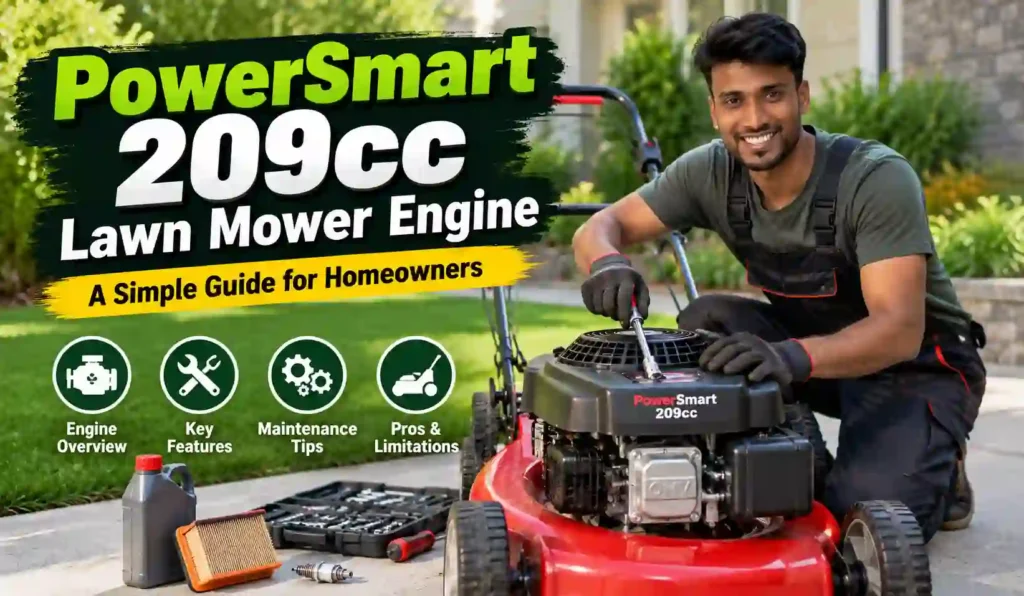
What Is the PowerSmart 209cc Lawn Mower Engine?
The PowerSmart 209cc lawn mower engine is a 4-stroke, single-cylinder gas engine measuring 209 cubic centimeters of displacement. Displacement is just the total volume the piston moves through in one cycle – a rough stand-in for how much air and fuel the engine can burn, and by extension, how much cutting power it can deliver.
At 209cc, this engine sits in the mid-range for residential walk-behind mowers. It’s bigger than the small 125-140cc engines found on light-duty push mowers, and it’s in the same class as many Briggs & Stratton and Honda engines used by competing mower brands. PowerSmart builds it in-house rather than sourcing it from a name-brand engine maker, which is one reason these mowers cost less than comparable Honda- or Kohler-powered models.
How the PowerSmart 209cc Engine Works
The PowerSmart 209cc engine runs on a standard 4-stroke cycle: intake, compression, combustion, and exhaust, repeated hundreds of times per minute to spin the mower blade. It uses an OHV (overhead valve) design, which places the intake and exhaust valves directly in the cylinder head instead of the engine block.
That layout matters for two practical reasons. First, OHV engines burn fuel more completely than older side-valve designs, so you get more cutting power from the same amount of gas. Second, the design runs cooler and needs less frequent adjustment, which is part of why most mower brands moved to OHV engines over the past two decades.
Cooling comes from a forced-air system: a fan built into the flywheel pulls air across metal cooling fins on the cylinder as the engine runs. There’s no radiator or coolant to check, but the fins need to stay clear of grass clippings and debris, or the engine can run hot.
Starting is handled by a recoil pull-cord, the same style found on nearly every residential gas mower. PowerSmart markets this engine as easy to start in one or two pulls when the mower is properly primed and the fuel is fresh, which matches what’s typical for a well-maintained 209cc OHV engine at this price point.
Which PowerSmart Mowers Use the 209cc Engine
PowerSmart puts this engine in several different mower models, split mainly between push and self-propelled versions. All of them share the same core cutting setup:
| Drive Type | Deck Size | Height Adjustment | Discharge Options | Typical Yard Size |
|---|---|---|---|---|
| Push (walk-behind) | 21 inches | 1.18″ to 3.0″ (5 positions) | Mulch, bag, side discharge | Up to 1/4 acre |
| Self-propelled (rear-wheel drive) | 21 inches | 1.18″ to 3.0″ (5 positions) | Mulch, bag, side discharge | 1/4 acre and up |
The push models are the lighter, simpler option – you supply all the forward motion, and the engine only powers the blade. The self-propelled versions add rear-wheel drive, so the mower pulls itself forward at a set pace while you steer and control the handle. That drive system adds weight (self-propelled models typically run close to 69 pounds versus a lighter push model) but takes real physical effort out of mowing hills or larger lawns.
Both versions use the same 3-in-1 cutting system: a rear bag with roughly 2.5-bushel capacity for collecting clippings, a mulching mode that chops clippings fine enough to leave on the lawn, and a side or rear discharge chute for when the grass is too tall or wet to bag or mulch cleanly.
Key Features of the PowerSmart 209cc Engine
- 209cc 4-stroke OHV design for stronger, more efficient combustion than older side-valve engines
- Forced-air cooling system that doesn’t require coolant or a radiator
- Recoil pull-start with no battery or electric-start hardware to maintain
- Pairs with a 21-inch steel cutting deck across every model that uses it
- Powers both push and self-propelled (rear-wheel drive) mower configurations
Benefits of the PowerSmart 209cc Lawn Mower Engine
The biggest benefit is straightforward: enough power for a mid-size lawn without paying for a commercial-grade engine you don’t need. A 209cc OHV engine handles normal grass, moderately overgrown grass, and light debris without bogging down, which covers what most homeowners deal with week to week.
Simplicity is the second benefit. There’s no battery to charge, no electronic fuel injection to diagnose, and no computer module to fail. Everything on this engine – the carburetor, the recoil starter, the air filter – is a part a home mechanic can service with basic hand tools. That’s a real advantage for anyone who wants to do their own oil changes and spark plug swaps instead of hauling the mower to a shop for routine work.
Cost is the third benefit. Because PowerSmart builds this engine itself rather than licensing one from Briggs & Stratton, Honda, or Kohler, mowers built around it list well below name-brand-engine competitors with similar specs. Mowers using this engine typically list between 250 and 400 dollars, depending on whether you pick the push or self-propelled version. Prices may vary by retailer and change over time.
Fuel efficiency rounds out the list. A single-cylinder 209cc engine at this power level typically burns through a tank slowly enough to cut a quarter-acre yard multiple times before a refill, which keeps ongoing costs low compared to larger V-twin engines built for riding mowers.
Limitations to Know Before You Buy
No engine is the right fit for everyone, and this one has real limits worth knowing before you buy.
Parts availability is the main one. Because PowerSmart engines aren’t built by Briggs & Stratton, Honda, or Kohler, you generally can’t walk into a small-engine repair shop and expect them to stock carburetor kits or air filters on the shelf. You’ll usually order parts directly from PowerSmart or a retailer that carries their branded parts, which takes longer than picking up a generic Briggs part locally.
Resale value is lower than name-brand-engine competitors. Buyers shopping the used market tend to pay a premium for mowers with a recognized engine brand on the shroud, even when the actual performance is similar.
Heavy-duty and commercial use isn’t what this engine is built for. At 209cc with a single cylinder, it’s sized for weekly residential mowing, not daily commercial cutting or extremely thick, tall grass on a large acreage. Pushing it into that kind of workload will shorten its service life.
Factors to Consider Before Choosing a 209cc Mower
Yard size and terrain. A push model with this engine handles flat to gently sloped yards up to about a quarter acre comfortably. Larger yards, or yards with noticeable hills, are a better match for the self-propelled version, since the rear-wheel drive does the work of moving the mower forward.
Grass type and growth rate. Thicker Southern grasses like Bermuda or St. Augustine, and yards that grow fast in spring and summer, put more load on the engine than thinner Northern grasses. A 209cc engine handles both, but expect to mow more often, and at a slightly higher deck height, if your grass is dense.
Storage and off-season handling. This is a gas engine, so it needs the same seasonal care as any other: fuel stabilizer or a drained tank before long storage, and a fresh spark plug and oil change each spring. Skipping that step is the single biggest cause of hard-starting complaints on engines like this one.
Physical ability to push a mower. If pushing a loaded mower across a full lawn isn’t practical for you, budget for the self-propelled model from the start. The self-propelled version costs more but saves real effort on anything larger than a small, flat yard.
Bagging versus mulching habits. If you plan to bag most of the season, check that the 2.5-bushel bag capacity fits how often you’re willing to stop and empty it on a larger lawn. Mulching cuts down on stops but works best when you mow before the grass gets too tall.
Common Problems and Misconceptions
“All small engines are basically the same.” They’re not. Displacement, valve design, and build quality all affect how much power an engine delivers and how long it lasts under regular use. A 209cc OHV engine outperforms a smaller side-valve engine even at a similar price, but it’s still a different class from a name-brand 209cc unit built to tighter tolerances.
Hard starting after storage. The most common complaint with any small gas engine, including this one, traces back to old fuel left in the tank and carburetor over winter. Gasoline breaks down within a few months and leaves a gummy residue that clogs the small carburetor jets. Draining the tank or using a fuel stabilizer before storage prevents most of this.
Losing power midway through a mow. This usually means either a dirty air filter choking off airflow, or a full grass bag and clogged deck underside making the blade work harder than it needs to. Both are simple checks before assuming the engine itself has a problem.
Assuming more cc always means more power. Displacement is one factor in output, but valve design, compression, and tuning all matter too. A well-tuned 209cc OHV engine can outperform a poorly tuned engine with a slightly larger displacement.
Practical Maintenance Tips
- Change the oil after the first 5 hours of use, then every 25 hours or once per season, whichever comes first
- Clean or replace the air filter at the start of each mowing season, and more often in dusty conditions
- Replace the spark plug once a year to keep starting easy and combustion clean
- Empty the fuel tank or add a fuel stabilizer before storing the mower for more than a month
- Clear grass buildup from the cooling fins and underside of the deck after every few mows
- Sharpen or replace the blade at least once a season – a dull blade forces the engine to work harder for the same cut
Most air-cooled engines in this size class use SAE 30 or 10W-30 oil, but check your specific model’s manual for the exact type and capacity before your first oil change, since PowerSmart varies this slightly across different mower models.
Frequently Asked Questions
Is the PowerSmart 209cc engine any good?
For a residential mower under a quarter-acre to half-acre yard, yes. It’s a capable, no-frills OHV engine that handles normal mowing conditions well. It’s not built to compete with commercial-grade or name-brand engines on durability or resale value.
What size yard can a PowerSmart 209cc mower handle?
The push version is best suited to yards up to about a quarter acre. The self-propelled version, thanks to its rear-wheel drive, comfortably handles a quarter acre and up, including yards with moderate slopes.
How much horsepower does a 209cc engine produce?
PowerSmart doesn’t publish an exact horsepower figure for every model using this engine, so treat any specific number you see elsewhere as an estimate rather than a confirmed spec. In general, engines in the 200-210cc OHV class produce output comparable to residential mowers rated in the 5 to 6.5 horsepower range.
What type of oil does the PowerSmart 209cc engine need?
Most air-cooled small engines in this displacement range use SAE 30 or 10W-30 oil. Check the owner’s manual for your exact model, since PowerSmart’s recommended oil type and capacity can vary slightly between the push and self-propelled versions.
Why won’t my PowerSmart 209cc mower start after winter storage?
The most common cause is old fuel left in the tank or carburetor over the off-season. Drain the tank or add a fuel stabilizer before storage, and start each new season with a fresh spark plug and clean air filter.
Can I find replacement parts for the PowerSmart 209cc engine locally?
Not always. Because it’s PowerSmart’s own engine rather than a licensed Briggs & Stratton, Honda, or Kohler unit, most parts come directly from PowerSmart or retailers that stock their branded parts, rather than a general small-engine repair counter.
Is the self-propelled or push version better?
That depends on your yard. Push mowers are lighter and cheaper, and work fine on small, flat lawns. Self-propelled models cost more but take the physical effort out of larger yards or anything with a slope.
Final Takeaway
The PowerSmart 209cc lawn mower engine is a capable, budget-friendly OHV engine built for regular residential mowing, not heavy-duty or commercial work. It suits homeowners with yards up to about a quarter acre on the push version, or larger sloped yards on the self-propelled model. Keep up with basic seasonal maintenance – oil changes, a clean air filter, fresh fuel – and it will handle years of normal mowing without major issues.
Why Trust This Guide
This guide draws on current manufacturer listings and specifications for PowerSmart’s 209cc mower lineup, cross-checked against how small OHV engines in this class typically perform and hold up over time. Any figure that isn’t directly confirmed by PowerSmart, such as an exact oil capacity, is flagged as a general estimate rather than stated as a hard spec.
Pingback: Lawn Mower Buying Guide for First-Time Homeowners