Quick Answer
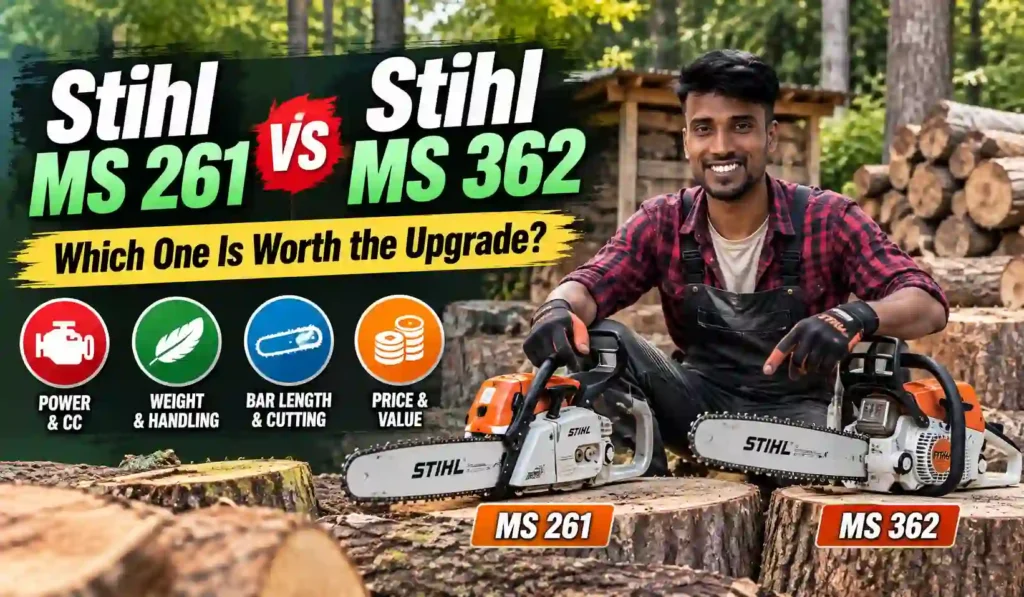
Stihl MS 261 vs MS 362 comes down to displacement and weight. The MS 261 runs a 50.2 cc engine at about 10.8 lbs and handles firewood, storm cleanup, and mid-size felling. The MS 362 steps up to a 59 cc engine at about 12.3 lbs, built for all-day forestry work and larger hardwood. If you cut under 5 cords a year on your own property, the MS 261 is enough saw. If you cut for income or clear big timber regularly, the MS 362 earns its extra weight and cost.
What to Look for Before Buying
Picking between these two saws is not about which one is “better.” Both are professional-grade Stihl saws built on the same platform family. The real question is which displacement class matches your workload.
Four things decide the answer: engine displacement, bar length you actually need, how many hours a week you run the saw, and whether you cut for a living or for your own yard. Get those four right and the choice becomes obvious.
Stihl MS 261 vs MS 362: Where Each One Fits
Both saws share the same professional lineage – anti-vibration handles, a pre-separation air filter, and a magnesium housing. The difference is displacement class: the MS 261 is Stihl’s mid-range professional saw, and the MS 362 sits a step above it in the same professional lineup.
| Feature | Stihl MS 261 | Stihl MS 362 |
|---|---|---|
| Engine displacement | 50.2 cc | 59.0 cc |
| Power output | About 3.0 kW (4.0 bhp) | About 3.5 kW (4.6-4.8 bhp) |
| Weight (bare, no bar/chain) | 10.8 lbs | 12.3 lbs |
| Bar length range | 16-20 inches | 16-25 inches |
| M-Tronic engine management | Available on some versions | Standard on the C-M version |
| Best suited for | Firewood, limbing, mid-size felling | Forestry work, larger hardwood, daily professional use |
The MS 261 was built to replace Stihl’s older MS 260 while cutting fuel use and exhaust emissions. The MS 362 is a heavier-duty saw meant for people running a chain all day, not just on weekends.
Key Buying Factors
Engine Displacement and Power
Displacement decides how much wood the saw removes per second, not how “strong” it feels in your hands. The MS 261’s 50.2 cc engine is plenty for softwood and most hardwood up to about 20 inches in diameter.
The MS 362’s 59 cc engine pulls through thick, dense hardwood with less bogging down. If you fell a lot of oak, hickory, or other dense species, the extra 9 cc shows up as less strain per cut, not just a bigger number on a spec sheet.
Weight and Power-to-Weight Ratio
At 10.8 lbs, the MS 261 is lighter and easier to run overhead or for long limbing sessions. Your arms and shoulders feel the difference after three or four hours, not after the first ten minutes.
The MS 362 adds about 1.5 lbs. That is not much on paper, but it matters if you are running the saw for a full workday, five days a week. Professionals who fell timber for a living generally accept the extra weight for the extra cutting speed.
Bar Length and Cutting Capacity
The MS 261 tops out around a 20-inch bar before the engine starts to struggle. That covers most residential trees and firewood-diameter logs.
The MS 362 handles bars up to 25 inches, which matters if you are dropping larger trees or bucking wide trunks into rounds. A longer bar on an underpowered saw just drags the chain slower – the MS 362’s extra displacement is what makes the longer bar option practical.
Fuel Consumption and Runtime
Both saws use Stihl’s 2-MIX engine technology, which cuts fuel consumption compared to older two-stroke designs. The MS 362’s larger engine burns more fuel per hour of use, but it also finishes felling and bucking jobs faster.
For a homeowner cutting firewood a few weekends a year, this difference in fuel cost is close to nothing. For someone running a saw eight hours a day, it adds up over a season.
Vibration and Comfort
Both models include Stihl’s anti-vibration system between the engine and the handles. In practice, the MS 261 feels slightly smoother over long limbing sessions simply because there is less mass moving.
The MS 362 is still comfortable for a professional-grade saw, and most users who move up from the 261 report no meaningful increase in fatigue for a normal workday.
M-Tronic vs Standard Carburetor
M-Tronic is Stihl’s electronic engine management system. It reads temperature, altitude, and fuel quality automatically, so you never adjust the carburetor by hand.
The MS 362 C-M comes with M-Tronic standard. The MS 261 was sold in both M-Tronic and standard-carburetor versions depending on the market and year, so check the specific saw you’re looking at rather than assuming. M-Tronic adds convenience and consistent starting, not more raw power.
Durability and Build
Both saws use a magnesium crankcase and the same general parts-and-service network through Stihl dealers. Neither saw has a reputation for being the “weaker” build – the durability gap between them is close to zero when both are maintained on schedule.
Price
The MS 261 typically runs somewhere in the $750-$800 range depending on bar length and dealer stock. The MS 362, especially the C-M version with M-Tronic, typically runs from around $900 up to roughly $1,050 depending on bar length. Prices may vary by retailer and change over time.
Choose Based on Your Needs
Occasional firewood cutter (a few cords a year): The MS 261 covers this completely. You will not notice a difference in cutting speed at this usage level, and the lighter weight is easier on your body.
Homeowner clearing storm damage or downed trees: The MS 261 with an 18-inch bar handles nearly everything a typical residential lot produces.
Small-scale firewood business or regular weekend cutting: This is the gray area. If most of your wood is oak, hickory, or other dense hardwood, the MS 362 pays for itself in reduced cutting time.
Professional arborist, logger, or full-time tree service: The MS 362 is the right tool. The extra displacement and longer bar capacity match daily, all-day use.
Budget-first buyers: The MS 261 gets you a genuine professional-grade Stihl saw for less money, and it is not a “lesser” saw – it is simply sized for lighter work.
Features You Actually Need
- A bar length matched to your typical log diameter – going longer than you need just adds drag and weight for no benefit.
- Chain brake and anti-vibration handles – both saws include these as standard, and neither should be skipped.
- A dealer within reasonable driving distance – Stihl saws need dealer-level service for warranty work and major repairs, so proximity matters more than most buyers expect.
Features You Can Skip
- Going straight to the longest bar Stihl offers for either saw. A 25-inch bar on an MS 362 you use for firewood is dead weight you carry all day for no real cutting benefit.
- Paying extra for M-Tronic if you already know how to tune a carburetor and don’t mind doing it. It is a convenience feature, not a performance upgrade.
- Buying the MS 362 “for future-proofing” if your actual cutting needs match the MS 261. Extra displacement you never use is extra weight you carry on every single cut.
Price & Value
At roughly $750-$800, the MS 261 is the better value if your workload fits its displacement class – you are not paying for capacity you will not use. At roughly $900-$1,050, the MS 362 costs more upfront, but it also cuts faster in hardwood and holds up better under daily professional use, which lowers your cost per cord or per job over time. Prices may vary by retailer and change over time.
Common Buying Mistakes
- Buying based on bar length alone. A longer bar on an underpowered engine just slows the chain down – match bar length to the engine, not the other way around.
- Assuming “bigger is always better.” Carrying an MS 362 all day for work the MS 261 handles fine just adds fatigue for no cutting benefit.
- Skipping the M-Tronic question. Buyers who assume every MS 362 has M-Tronic sometimes end up with a standard-carburetor model and are surprised when they need to adjust it manually.
- Ignoring parts and service availability. Both saws need periodic dealer service – buy from a dealer who actually stocks parts for your specific model.
- Underestimating chain and bar costs. The saw price is not the full cost of ownership – chains, bars, and mix oil add up over a season regardless of which model you pick.
Maintenance & Long-Term Cost
Both saws use the same basic maintenance routine: air filter cleaning, chain sharpening or replacement, bar maintenance, and periodic spark plug changes. The MS 362’s larger engine burns slightly more two-stroke mix per hour, and its parts – clutch, chain, bar – tend to be sized a step up from the MS 261’s, which usually means a modestly higher replacement cost per part.
Neither saw has unusual or hard-to-find service parts. Both are common enough that most Stihl dealers stock filters, chains, and bars for them without a special order. Over a multi-year ownership period, the real cost difference between the two comes down to fuel and chain wear, not repair frequency.
Recommended Specifications
| Use Case | Recommended Saw | Suggested Bar Length |
|---|---|---|
| Occasional firewood, small yard | MS 261 | 16-18 inches |
| Storm cleanup, mixed hardwood/softwood | MS 261 | 18 inches |
| Regular firewood cutting, mostly hardwood | MS 362 | 18-20 inches |
| Professional felling, daily use | MS 362 | 20-25 inches |
FAQs
What is the main difference between the Stihl MS 261 and MS 362?
The MS 261 has a 50.2 cc engine and weighs about 10.8 lbs. The MS 362 has a 59 cc engine and weighs about 12.3 lbs. The MS 362 handles larger bars and dense hardwood with less strain.
Is the Stihl MS 362 worth the extra money over the MS 261?
It depends on your workload. If you cut hardwood regularly or run a saw for a living, the MS 362’s extra power reduces cutting time enough to justify the price gap. For occasional firewood cutting, the MS 261 does the job for less money.
Can the Stihl MS 261 handle a 20-inch bar?
Yes, the MS 261 supports bar lengths up to 20 inches, though it performs best with an 18-inch bar for most residential cutting.
Does the Stihl MS 362 come with M-Tronic?
The MS 362 C-M version comes with M-Tronic standard. Some earlier or region-specific MS 362 models were sold with a standard carburetor, so confirm which version you’re buying.
Which saw is easier to use for a beginner?
The MS 261 is generally the easier starting point. It is lighter, has slightly less kickback force, and covers the cutting jobs most beginners actually face.
How much more fuel does the MS 362 use compared to the MS 261?
The MS 362’s larger 59 cc engine burns somewhat more fuel per hour than the MS 261’s 50.2 cc engine, though both use Stihl’s fuel-efficient 2-MIX technology. The difference only becomes noticeable with heavy daily use.
Final Buying Advice
Pick the Stihl MS 261 if you cut firewood a few times a year, clear storm damage, or want a lighter saw for general property upkeep. Pick the Stihl MS 362 if you cut dense hardwood regularly, run bars over 20 inches, or use a saw for work rather than occasional yard tasks. Both are genuine professional-grade Stihl saws – the right one is whichever displacement class actually matches how often and how hard you cut, not which one costs more.
Why Trust This Guide
This comparison draws on Stihl’s published engine, weight, and displacement specifications for both models, along with pricing patterns observed across major US retailers. Siddik Kazi has serviced and repaired professional-grade chainsaws, including Stihl’s 260-series and 360-series lines, as part of his lawn and outdoor power equipment repair work.