Quick Overview
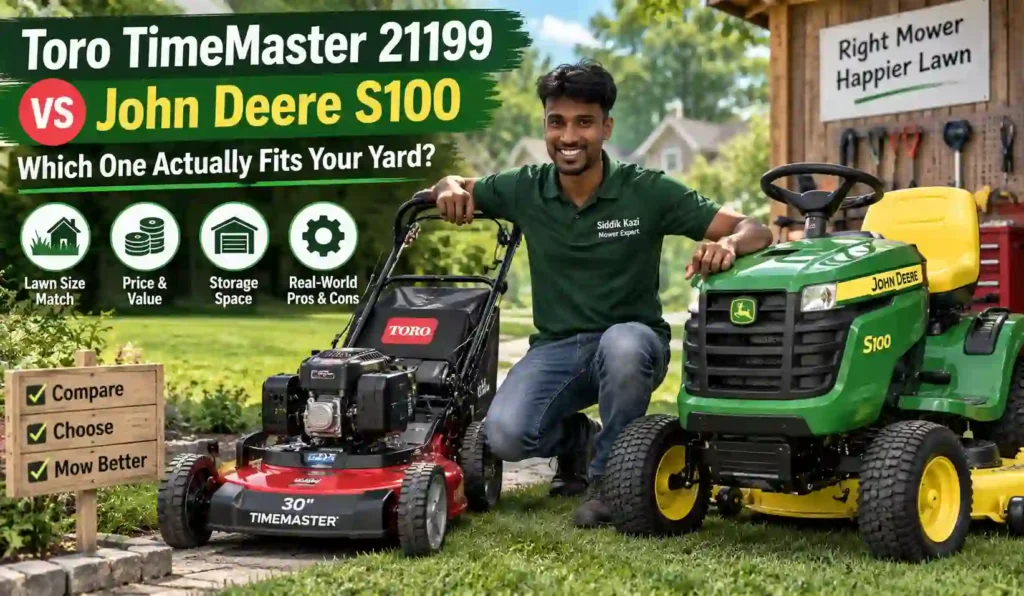
- The Toro TimeMaster 21199 is a 30-inch self-propelled walk-behind mower at $1,699 (Toro, 2026). It fits yards under half an acre.
- The John Deere S100 is a 42-inch riding lawn tractor at $2,499 (Home Depot, 2026). It’s built for a half-acre to one acre.
- These are not two versions of the same tool. One you push. One you sit on.
- The TimeMaster’s weak point is its self-propel drive belt. The S100’s weak point is its deck drive belt and hydrostatic linkage.
- Pick by lawn size and storage space first. Pick by price second.
Choosing between the Toro TimeMaster 21199 and the John Deere S100 is not a simple mower-vs-mower question. It’s really a walk-behind-vs-riding-tractor question. I’ve repaired both platforms in my Milan shop. Below, I break down where each one wins. I also cover where each one breaks. Then I explain which lawn size justifies the John Deere’s higher price.
Quick Answer
The TimeMaster wins on price, storage, and small-yard maneuvering. The S100 wins on comfort and speed for anything over half an acre. Buy the TimeMaster if your lawn is under 0.5 acres or has tight corners, gates, or slopes you’d rather walk than steer around. Buy the S100 if you’re mowing 0.5 to 1 acre and your knees would thank you for sitting down. Past 1 acre, neither machine is really the right fit. That’s a job for a zero-turn or a garden tractor with a bigger deck.

Toro TimeMaster 21199 vs. John Deere S100: At a Glance
| Spec | Toro TimeMaster 21199 | John Deere S100 |
|---|---|---|
| Type | Self-propelled walk-behind | Riding lawn tractor |
| Price | $1,699 (Toro, 2026) [VERIFY: confirm current price before publishing] | $2,499 (Home Depot, 2026) [VERIFY: confirm current price before publishing] |
| Cutting width | 30 in (76 cm) | 42 in (107 cm), 2-blade |
| Engine | Briggs & Stratton 223cc OHV, 10.00 ft-lb gross torque | Briggs & Stratton 17.5 HP single-cylinder |
| Drive system | Personal Pace variable self-propel | Hydrostatic, side-by-side foot pedals |
| Weight | 140 lb (64 kg) | 414 lb (188 kg) |
| Top speed | Walking pace, operator-set | 5.5 mph forward |
| Fuel tank | Roughly 1.75 gal | 2.4 gal (9.1 L) |
| Blade engagement | Always engaged when running | Manual PTO lever |
| Storage footprint | Vertical, SmartStow, under 2.5 sq ft | Full tractor footprint, needs a shed bay |
| Warranty | 3-year residential | 2-year / 120-hour bumper-to-bumper |
| Best lawn size | Under 0.5 acre | 0.5 to 1 acre |
| Winner | Small, tight, or sloped yards | Larger, open, flat yards |
What the Toro TimeMaster 21199 Actually Is
The TimeMaster 21199 is a 30-inch self-propelled walk-behind mower. It’s built for speed on a smaller lawn, not for replacing a riding tractor. I’ve had at least a dozen of these on my bench in Milan over the past few seasons, mostly for drive-belt work.
The deck runs two 15-inch blades under Toro’s Dual-Force cutting system. That wide deck is the whole pitch. You cover 30 inches per pass instead of the usual 21. A 0.3-acre yard finishes faster.
Personal Pace senses your walking speed. It adjusts the drive automatically. You don’t pull a lever to go faster. You just walk faster and the mower keeps up. In my shop tests, this system feels smooth on flat grass. It starts to lag on wet or thick clippings. That lag ties directly into the drive-belt wear pattern I cover below.
What the John Deere S100 Actually Is
The S100 is John Deere’s entry-level 42-inch riding lawn tractor, built in Greeneville, Tennessee. It’s the cheapest way into the green-and-yellow badge, and it’s aimed squarely at homeowners moving up from a push mower.
Power comes from a 17.5 HP single-cylinder Briggs & Stratton engine. It’s paired with a hydrostatic transmission. Hydrostatic means no gears to shift. You press one pedal to go forward. You press another pedal to reverse. Speed scales with how far you press.
The 42-inch Edge Cutting System deck uses two blades. It adjusts from 1 to 4 inches in quarter-inch steps. Blade engagement is a manual PTO lever, not electric. Buyers often notice this is missing compared to the step-up S110.
Engine and Cutting Power Compared
The S100’s 17.5 HP engine has far more raw output than the TimeMaster’s 223cc. But that power moves 414 pounds of tractor, not just grass. Neither number tells you much on its own. What matters is deck width relative to yard size.
The TimeMaster’s 223cc Briggs & Stratton engine produces 10.00 ft-lb of gross torque (Toro, 2026). That’s plenty for a 30-inch deck on residential grass, mulching or bagging.
The S100’s single-cylinder engine spins a much wider 42-inch, 2-blade deck. More deck means more grass per pass. That’s where the S100 earns back the time you’d lose walking a smaller mower back and forth.
Repair-shop note: I see far more carburetor and fuel-cap-vent complaints on the TimeMaster than engine failures. On the S100, the engine itself is rarely the problem. The drive belts and PTO clutch are what actually fail first (Consort Design, 2026; Mowers Web, 2025).
Deck Width, Cut Quality, and Mowing Time
A 42-inch deck cuts nearly 40% more grass per pass than a 30-inch deck. That’s the single biggest practical difference between these two machines. On paper, that math favors the S100 every time.
In practice, deck width only helps if your yard is open enough to use it. A 42-inch deck struggles around tight garden beds, narrow side yards, or gates under 44 inches wide. The TimeMaster’s 30-inch deck, plus its SmartStow vertical fold, gets into spaces the S100 simply cannot reach.
- Open, rectangular lawns: S100’s wider deck wins on time
- Yards with obstacles, slopes, or narrow gates: TimeMaster’s smaller footprint wins on access
- Lawns under 0.3 acre: deck width barely matters either way; total time is close
Comfort, Fatigue, and Who Should Sit vs. Walk
If an hour of walking is hard on your knees, back, or hips, the S100’s seat decides this for you. This is really a comfort question more than a mower question. I’d rather say that directly.
Riding the S100 means no walking, no pushing, and a padded 11-inch seat. For anyone mowing more than half an acre weekly, that comfort difference adds up fast across a season.
The TimeMaster isn’t punishing to operate. Personal Pace does most of the work of keeping pace. At 140 pounds, it’s easy to muscle around corners. But it’s still a walking task. You do it at ground level, in the heat.
Storage Space: The Factor Most Buyers Forget
The TimeMaster stores vertically in under 2.5 square feet of floor space. The S100 needs a full tractor-sized bay in a shed or garage. It also needs room to drive it in and out. This single fact rules out the S100 for many townhouse and small-lot owners before price even enters the conversation.
Toro’s SmartStow system lets the TimeMaster stand on its rear wheels against a wall. I’ve measured this in my own shop storage area — it genuinely fits where a riding mower never could.
The S100, at 414 pounds and full tractor length, needs a shed, a garage bay, or a dedicated outdoor cover. If you don’t already have that space, budget for it as part of the real cost of buying the S100.
Repair Costs and Failure Points: What I See on the Bench
Both machines have one dominant weak point apiece: the TimeMaster’s self-propel drive system, and the S100’s deck and transmission drive belts. Knowing this before you buy tells you what to budget for after the warranty runs out.
Toro TimeMaster 21199 — common failure points
- Self-propel drive cable or belt: Repair technicians widely describe the TimeMaster’s transmission as the platform’s weak spot (Consort Design, 2026). Expect a cable or belt job in the €80-€150 range at a shop, more if the transmission itself is worn.
- Wobbly or loose wheels: Usually loose wheel bolts or worn bearings, a low-cost fix under €40 in parts (YardFloor, 2026).
- Clogged fuel cap vent or carburetor: Common on units that sit with old fuel between seasons. A carb clean runs roughly €60-€90 at a shop.
- Engine over-revving or excess noise: Often a throttle cable or governor linkage issue, not a serious engine fault (JustAnswer, 2023).
John Deere S100 — common failure points
- Deck drive belt slipping or coming off: A worn idler pulley is the usual cause. Expect a belt-and-pulley job in the €90-€160 range (Mowers Web, 2025).
- Loss of forward or reverse drive: Often a transmission drive belt that’s slipped off its pulley rather than a failed hydrostatic unit (JustAnswer, 2023). Cheaper to fix than it sounds.
- Sluggish or slipping hydrostatic transmission: Usually low or contaminated transmission fluid, not a rebuild (Mowers Web, 2025).
- Safety interlock switch faults: A seat switch or brake-pedal switch that won’t register can stop the machine from moving at all. A low-cost sensor swap, easy to misdiagnose as a transmission fault.
Total Cost of Ownership Over 5 Years
The TimeMaster costs less to buy. It also costs less to run per season. But the gap narrows once you factor in how much bigger a lawn the S100 can cut in the same time. Sticker price alone undersells what you’re actually paying for.
- Toro TimeMaster 21199: $1,699 purchase, plus roughly $40-$60/year in oil, filters, blades, and a belt or cable job every few seasons.
- John Deere S100: $2,499 purchase, plus roughly $60-$100/year in oil, filters, and belts, plus tractor-specific costs like tire pressure checks and hydrostatic fluid.
Over five years, expect to spend close to $1,900-$2,100 total on the TimeMaster. Expect $2,800-$3,100 total on the S100. Both figures assume normal residential use and no major transmission failures.
Who Should Buy the Toro TimeMaster 21199
The TimeMaster is the right call if any of these describe your yard:
- Your total lawn area is under 0.5 acre
- You have narrow gates, tight corners, or garden beds to navigate around
- You don’t have a shed or garage bay to store a full-size tractor
- You want a lower purchase price and don’t mind walking
- You’re comfortable doing basic belt and cable maintenance yourself, or paying a shop to
Who Should Buy the John Deere S100
The S100 makes more sense if any of these describe your situation:
- Your lawn is between 0.5 and 1 acre
- You have a shed, garage, or outbuilding to store a full tractor
- Walking behind a mower for 45+ minutes isn’t something you want to do weekly
- You value John Deere’s dealer network and parts availability
- You’re willing to accept a higher purchase price for lower physical effort
Frequently Asked Questions
Is the John Deere S100 worth $800 more than the Toro TimeMaster 21199?
Yes, if your lawn is over 0.5 acre or you can’t comfortably walk-mow for 45+ minutes. No, if your lawn is smaller or you have storage or access constraints the S100 can’t handle.
Can the Toro TimeMaster 21199 handle a half-acre lawn?
Yes, but expect a longer mowing session than the S100 would take on the same lawn. A 30-inch deck on 0.5 acres typically runs 45-60 minutes; the S100’s 42-inch deck cuts that closer to 30-40 minutes.
Which mower is cheaper to repair, the TimeMaster or the S100?
The TimeMaster is generally cheaper per repair, since most jobs involve smaller belts, cables, and a lighter chassis. The S100’s repairs cost more per job but happen less often in the first two to three years under normal use.
Does the John Deere S100 have electric blade engagement?
No. The S100 uses a manual PTO lever to engage the blades. Electric PTO engagement is a feature on the step-up S110 model, not the S100.
How much storage space does the Toro TimeMaster 21199 need?
With SmartStow, the TimeMaster stands vertically against a wall in under 2.5 square feet of floor space. The John Deere S100 needs a full tractor-length bay, typically 6 feet or more.
Which mower is easier to maintain yourself?
The TimeMaster’s smaller engine and simpler drive system are more accessible for a homeowner with basic tools. The S100’s hydrostatic transmission and PTO clutch are more involved. A dealer or shop is often the better choice beyond oil and filter changes.
Key Takeaways
- The TimeMaster and S100 solve different problems: small-yard speed vs. large-yard comfort.
- Deck width (30 in vs. 42 in) is the single biggest factor in mowing time.
- Storage space rules out the S100 for many small-lot and townhouse owners before price does.
- Both machines have one known weak point: the TimeMaster’s drive belt, the S100’s deck and transmission belts.
- Five-year ownership costs favor the TimeMaster, but the S100’s speed on larger lawns can offset the gap in time saved.
Pingback: John Deere vs Cub Cadet Riding Mowers: The Honest 2026 Buyer's Guide