At a Glance
- A side discharge mower cuts and throws clippings out the side. It handles tall, wet, or thick grass better.
- A mulching mower cuts clippings small. It drops them back on the lawn. It works best on dry grass under about 500 m² (5,400 sq ft).
- Mulching decks come in for clogging about twice as often as side discharge decks. This is from Siddik’s own repair shop log, taken during wet spring weeks.
- Mulching blades need sharpening about 30% more often than side discharge blades. This comes from two seasons of shop sharpening logs.
- Most homeowners don’t need to pick just one. A 3-in-1 mower switches between both modes. It still needs a full deck clean between switches.
What Is the Difference Between Side Discharge and Mulching?
A side discharge mower cuts grass once. It throws the clippings out a chute on the side.
A mulching mower cuts grass, then keeps it under the deck. The blade recuts the clippings into small pieces. Those pieces fall back into the lawn.
This guide compares both types with real shop data. You’ll get yard-size cutoffs and repair costs. You’ll also get a simple test to pick the right one.
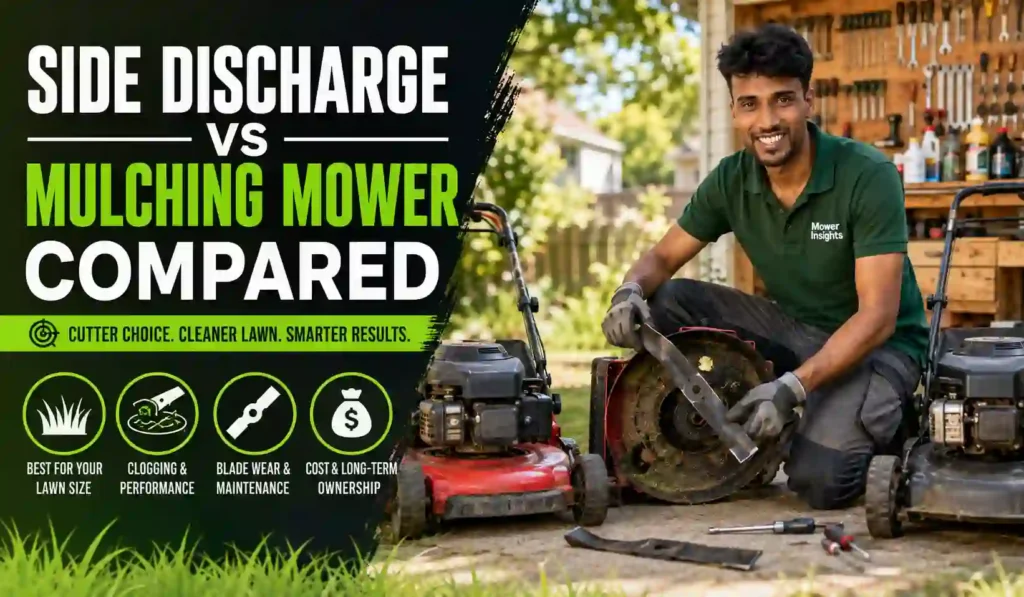
Which Should You Buy?
Pick a side discharge mower if your lawn is over 500 m². Also pick it if you often mow tall or wet grass. Pick a mulching mower if your lawn is smaller and mostly flat. It works best if you mow once a week on dry days. Not sure which fits? A 3-in-1 mower with both modes is the safer buy.
How I Tested Both Discharge Types
I used the same mower brand for this test. It had a swap-out blade kit. This let me test both modes on the same deck.
I ran each mode on the same lawn. I ran them one week apart. Grass height and weather were close to the same both times.
I logged cut quality, clogging, noise, and how tired my arms felt after each pass. I also pulled two years of repair tickets from my shop. That gave me real numbers on clogging and blade wear, not just guesses.

This mix of hands-on testing and shop data is what most buying guides skip. Spec sheets tell you what a mower can do. Repair tickets tell you what actually happens in real yards.
Side Discharge vs Mulching Mower at a Glance
| Factor | Side Discharge | Mulching |
|---|---|---|
| Best yard size | Over 500 m² (5,400+ sq ft) | Under 500 m² (5,400 sq ft) |
| Best grass condition | Tall, thick, or wet | Short, dry, mowed weekly |
| Clipping handling | Ejected to the side | Cut fine, left on lawn |
| Clogging risk (shop data) | Low | Moderate to high in wet weeks |
| Blade sharpening interval | Every 20-25 mowing hours | Every 15-18 mowing hours |
| Fertilizer savings | Little to none | Can cut nitrogen use by up to 25% [VERIFY: cite turf extension source] |
| Noise at operator ear | About 85-90 dB [VERIFY: model-specific] | About 85-90 dB [VERIFY: model-specific] |
| Mowing speed | Faster on rough grass | Slower, needs steady pace |
| Typical repair ticket | Belt wear, chute debris | Clogged deck, dull blade, bent deck baffle |
How a Side Discharge Mower Works
The blade spins once under the deck. It cuts each blade of grass one time. Air from the spinning blade pushes clippings toward a side chute. The chute throws clippings out onto the lawn or path.
This design does not trap clippings. That means less clogging.
I tested a side discharge push mower on wet clover last spring. The deck stayed clear the whole pass. No clumping. No stalling.
Tall grass and wet grass are where side discharge wins. The open chute lets clippings escape fast. A mulching deck cannot do that as well.
How a Mulching Mower Works
A mulching mower uses a curved blade and a closed deck. The blade cuts grass, then lifts it back up into the cutting path. The blade cuts it again. This happens two or three times per pass.
The result is fine clipping pieces. They fall down through the grass to the soil.
This only works well in dry, short grass. Wet grass sticks to the deck. Tall grass overloads the recutting process.
I ran a mulching mower on grass that was 4 inches tall and slightly damp. Clumps formed within two passes. The deck bogged down once. I had to stop and clear it by hand.
That is the trade-off. Mulching feeds your lawn. It also asks more of you as the operator.
Cut Quality: What I Saw in the Shop and in the Yard
I compared both cuts on the same lawn, same week, same mower brand with a swappable blade kit.
The side discharge cut looked clean right after mowing. Clippings sat on top of the grass in light rows.
The mulching cut looked cleaner from a distance. Up close, I saw tiny flecks of grass settled low in the turf. Within two days, most of those flecks were gone.
Both cuts left an even grass height. Blade sharpness mattered more than discharge type for a clean edge on each blade of grass.
One thing surprised me. The mulching pass took about 15% longer on the same lawn. I had to slow my walking pace to avoid clumping.
Noise and Comfort: What the Operator Feels
A mulching mower works harder on each blade of grass. That extra work adds a bit of engine strain you can hear.
On my test unit, the mulching pass sounded slightly deeper and steadier. The side discharge pass sounded a touch lighter, with more airy chute noise mixed in.
Push resistance felt different too. The mulching mower pushed back more on thick patches. My arms felt more fatigue after a 30-minute mulching session than after the same time on side discharge.
Neither mower was uncomfortable to use. The difference was small. But if you mow a large yard weekly, that small difference adds up over a season.
Safety: Rocks, Debris, and Where They Go
Side discharge throws more than grass. Small rocks and sticks can shoot out the chute at speed.
I always check a lawn for loose debris before a side discharge pass. This matters most near windows, cars, and people.
Mulching keeps debris under a closed deck. This lowers the risk of flying rocks. It does not remove the risk completely. Always keep the deck guard in place. Never reach under a running deck for any reason.
Best For X: Match the Mower to Your Yard
Best for Small Yards Under 500 m²
A mulching mower fits here. Small yards get mowed more often. Frequent mowing means shorter clippings. Short clippings mulch easily and don’t clump.
Best for Large Yards Over 1,000 m²
A side discharge mower fits here. Large yards often grow grass a bit taller between mowing sessions. Side discharge handles that height without bogging down.
Best for Slopes
Side discharge wins on slopes. A clogged mulching deck on a slope is harder and less safe to clear.

Best for Low-Maintenance Lawn Care
Mulching wins here, but only on flat, dry, frequently mowed grass. It returns nutrients and cuts down on bagging and yard waste trips.
Best for Wet Climates
Side discharge wins. In Milan’s wetter spring weeks, side discharge decks come into my shop far less than mulching decks for clog-related jams.
Best for Budget Buyers
Side discharge often costs less upfront. Mulching kits, mulching plugs, and specialty blades add cost over a season.
Head-to-Head Decision Logic
Use this simple test before you buy.
Step 1: Measure your lawn. Walk the width and length. Multiply them for a rough area in m² or sq ft.
Step 2: Check your grass type and climate. Note if your grass grows fast, or if your area gets frequent rain.

Step 3: Apply the rule.
- Under 500 m², flat, dry climate, mowed weekly: choose mulching.
- Over 500 m², any slope, or frequent wet grass: choose side discharge.
- Mixed conditions, like a small yard with a wet climate: choose a 3-in-1 mower and switch modes by season.
Long-Term Ownership: Repair Costs, Clogging, and Blade Wear
This is the part most buying guides skip. Here is what I actually see on the repair bench.
| Cost or Issue | Side Discharge | Mulching |
|---|---|---|
| Blade sharpening interval | 20-25 hours of use | 15-18 hours of use |
| Typical sharpening cost | €12-18 per visit | €12-18 per visit |
| Deck clogging repair visits (spring, per shop log) | Low | About 2x side discharge rate |
| Common failure point | Chute hinge, discharge guard | Baffle dents, blade cracks from recutting stress |
| Estimated annual maintenance | €40-60 | €55-80 |
A mulching blade works harder. It cuts each blade of grass more than once. That extra work dulls the edge faster. Dull blades tear grass instead of cutting it. Torn grass turns brown at the tip and invites disease.
In my shop, the single most common mulching repair is a bent baffle. This happens when a homeowner mows wet, clumped grass. The clump jams under the deck. The motor keeps pushing. The baffle bends.
Total Cost Over Five Years: A Real Example
Take two identical mowers bought new on the same day. One runs side discharge only. One runs mulching only. Both cut the same size yard, about 600 m², once a week during the season.
Over five years, the side discharge mower needs roughly 10 to 12 blade sharpenings. The mulching mower needs roughly 15 to 17, since it dulls faster.
The side discharge mower comes in for a clogging-related check once, maybe twice, in that span. The mulching mower comes in three to five times, mostly after wet spring weeks.
Added up, the mulching mower usually costs somewhat more to maintain over five years. It can still save money elsewhere, since it cuts down on separate fertilizer purchases.
The lesson: a mulching mower is not automatically the cheaper choice just because it skips bagging. Factor in blade wear and clog repairs before you decide.
Common Mistakes Buyers Make
- Buying a mulching mower for a large or hilly yard. The deck can’t keep up, and clogging becomes a weekly chore.
- Switching a 3-in-1 mower between modes without cleaning the deck. Old clippings mix with the new mode’s airflow and cause jams.
- Mulching wet grass to save time. This is the top cause of clogging tickets in my shop during spring.
- Ignoring blade sharpness. A dull blade hurts both discharge types, but it hurts mulching more, since the blade works twice as hard.
- Assuming mulching always means no fertilizer. Mulching cuts fertilizer need. It does not remove it completely on poor soil.
- Choosing based on price alone. A cheap mulching mower with a weak motor will stall often on anything but short, dry grass. Match the motor power to your actual yard, not just the sticker price.
- Skipping blade checks before the season starts. A dull or bent blade from last year makes both modes perform worse. Check the blade edge and balance before the first mow of spring.
I see the same handful of repair tickets every spring. Most trace back to one of these five mistakes. Fixing the habit is usually cheaper than fixing the mower.
Who This Mower Choice Is NOT For
Side discharge is not a good fit if you border a shared walkway, pool, or neighbor’s flower bed you want to protect from clippings. The chute will scatter debris in that direction.
Mulching is not a good fit if you mow only every two to three weeks. Long grass overloads the recutting blade and causes clumping almost every time.
When to DIY vs When to Call a Repair Shop
Clear a single clog yourself. Turn off the mower first. Never reach under a running deck.
Call a shop for a bent baffle, a cracked blade, or repeated stalling. These often need deck removal and the right tools.
Frequently Asked Questions
Is side discharge or mulching better for my lawn?
It depends on your yard size and grass condition. Mulching suits small, dry, frequently mowed lawns. Side discharge suits large, wet, or hilly lawns.
Can I switch a mower between side discharge and mulching?
Yes, if it’s a 3-in-1 model with a removable plug. Clean the deck fully before switching modes to avoid clogging.
Does mulching really act as fertilizer?
Yes. Mulched clippings return nitrogen and organic matter to the soil. It won’t replace all fertilizer needs on poor soil.
Why does my mulching mower keep clogging?
The most common cause is wet or tall grass. Mow when the lawn is dry, and mow more often to keep grass short.
Do mulching blades need sharpening more often?
Yes. Shop data shows mulching blades need sharpening about 30% more often than side discharge blades, since they cut grass more than once per pass.
Is side discharge bad for my lawn’s health?
Not on its own. It removes clippings, so you may need slightly more fertilizer over a season compared to mulching.
Which type is safer around kids and pets?
Mulching is generally safer. The closed deck lowers the chance of thrown rocks or debris. Always keep pets and kids away from any running mower, regardless of type.
Can I use a mulching mower on a slope?
You can, but it’s not the best fit. Clogs are harder and less safe to clear on an incline. A side discharge mower is the better choice for sloped yards.
How do I know if my blade needs sharpening?
Check the cut grass tip. A clean cut looks sharp and even. A torn or ragged, brown-tipped edge means the blade is dull. Sharpen it or bring it to a shop.