Quick Overview
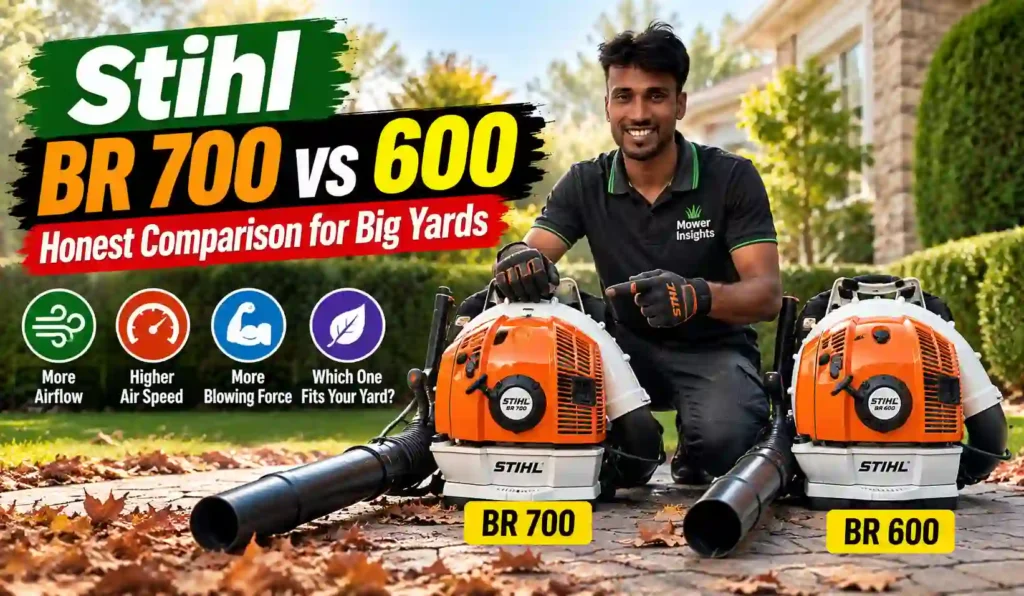
- The Stihl BR 700 moves about 35% more air than the BR 600 (912 vs 677 CFM) and has higher blowing force (35 vs 32 Newtons).
- The BR 600 has faster air (up to 238 mph vs 197 mph), weighs about 2 lb less, and costs about $130 less than the BR 700 X.
- Both share a 64.8 cc engine, a 47.3 oz tank, and a 75 dB(A) sound rating, so fuel stops and noise are about the same.
- Pick the BR 700 for open lawns and big piles. Pick the BR 600 for tight beds, stuck-down debris, and a lower budget.
Stihl BR 700 vs 600 is the matchup most buyers of a pro backpack blower end up researching. The two machines look almost the same and sit only about $130 apart. They share one 64.8 cc engine and one tank size. The real difference is how each one moves air. This guide walks through the numbers, the design changes, and the yards each blower suits best.
Quick Answer: Stihl BR 700 vs 600
Choose the BR 700 if you clear large, open areas or heavy piles of leaves. It moves about 35% more air and pushes about 9% harder. Choose the BR 600 if you work in tight spaces, scrape stuck-down debris, or want to save money. Its air is about 21% faster, and it weighs less.
Stihl BR 700 vs 600 at a Glance
The Stihl BR 700 vs 600 spec table below shows where the two blowers match and where they split. The engine, tank, and sound rating are the same. Air volume, force, weight, and tube design are not. All figures come from Stihl’s published US specs as listed by Stihl dealers.
| Spec | BR 600 | BR 700 | BR 700 X |
|---|---|---|---|
| Engine | 64.8 cc, 4-MIX | 64.8 cc, 4-MIX | 64.8 cc, 4-MIX |
| Air volume at nozzle | 677 CFM | 912 CFM | 901 CFM |
| Max air speed | 238 mph | 197 mph | 193 mph |
| Average air speed | 199 mph | 165 mph | not listed |
| Blowing force | 32 N | 35 N | 34 N |
| Weight (no fuel) | 21.6 lb | 23.4 lb | 23 lb |
| Fuel tank | 47.3 oz | 47.3 oz | 47.3 oz |
| Sound rating | 75 dB(A) | 75 dB(A) | 75 dB(A) |
| Tube | Adjustable, 3 positions | Telescopic | Fixed length |
| Price | $549.99 | Ask your dealer | About $680 |
Prices may vary by retailer and change over time.
Which BR 700 Are You Comparing in the Stihl BR 700 vs 600 Question?
Stihl sells two versions of the 700. The BR 700 has a telescopic tube you can lengthen or shorten. The BR 700 X has a fixed tube, a flexible pleated hose, and weighs about half a pound less.
This matters because shoppers mix the two up. The BR 700 X lists 901 CFM, 193 mph, and 34 Newtons. The BR 700 lists 912 CFM, 197 mph, and 35 Newtons. The gap is small, so every point in this guide applies to both unless noted.
Many dealers also list these numbers a little differently. A few sources show the BR 700 at 895 CFM or the BR 600 at 22.3 lb. Those come from older or rounded sheets. This guide uses the figures from Stihl’s own US spec listings.
Airflow and Air Speed: Stihl BR 700 vs 600
The BR 700 wins on air volume. It moves 912 cubic feet of air per minute (CFM) at the nozzle, while the BR 600 moves 677. The BR 600 wins on air speed. Its air leaves the nozzle at up to 238 miles per hour (mph), while the BR 700 tops out at 197.
Think of a garden hose. CFM is how wide the stream is. MPH is how hard the stream hits. A wide stream pushes a big pile along. A narrow, fast stream digs under a stuck leaf.
Here is what the numbers mean in a yard:
- The BR 700 sweeps a wider path. It clears an open lawn in fewer passes.
- The BR 700 keeps leaves moving after they leave the nozzle. That helps on long driveways and big turf areas.
- The BR 600 hits harder at the nozzle tip. That helps lift matted leaves, acorns, and wet debris stuck to pavement.
- The BR 600 loses force faster with distance, because it moves less air behind that speed.
Neither number tells the full story alone. Blowing force, measured in Newtons, combines both. That is why Stihl ranks the BR 700 stronger overall.
Blowing Force in Real Yard Jobs
Blowing force is the best single number for comparing power. The BR 700 produces 35 Newtons and the BR 600 produces 32. That is about 9% more push for the BR 700.
A 9% gap sounds small, but you feel it over a full day of work. The extra air volume lets the BR 700 roll a pile instead of nibbling at its edge. On a 1-acre lot with mature oaks, that can cut the number of passes you make.
The BR 600 still holds its own. Its narrower nozzle and higher speed make it good at scraping. Damp leaves pressed onto a deck or driveway lift more easily with a fast, focused stream.
Here is how each blower fits common jobs, based on its spec profile and on Siddik’s workshop experience servicing both:
| Job | Better pick | Why |
|---|---|---|
| Dry leaves across a large open lawn | BR 700 | More air volume moves more leaves per pass |
| Thick piles of wet leaves | BR 700 | Higher blowing force rolls heavy piles |
| Matted leaves stuck to pavement | BR 600 | Faster air lifts material off hard surfaces |
| Grass clippings off a driveway | Either | Both clear light material easily |
| Pine needles in beds and corners | BR 600 | Narrower stream is easier to aim |
| Gravel and small debris | BR 600 | Higher speed scatters loose material |
Weight, Comfort, and Noise
The BR 600 is the lighter blower. It weighs 21.6 lb without fuel, against 23.4 lb for the BR 700 and 23 lb for the BR 700 X. The gap is under 2 lb, so both feel similar on your back.
A full tank adds weight to either machine. The 47.3 oz tank is the same on both, so the fueled weight gap stays about the same. Over a two-hour session, that extra pound or two is noticeable but not tiring for most adults.
Both blowers share these comfort features:
- A padded backpack frame with wide, adjustable straps.
- The Stihl anti-vibration system, which isolates the engine from the handle.
- A rubber-coated handle with a throttle lock and a built-in stop switch.
- A 75 dB(A) sound pressure rating, so neither is louder than the other on paper.
Sound pressure rating is a measured number, but your ears also hear the engine and the air. Both blowers are loud enough that you should wear ear protection every time.
Tubes and Nozzles: Where the Designs Differ
The tube setup is the biggest design change. The BR 600 uses an adjustable tube with three positions. The BR 700 uses a telescopic tube you slide to any length. The BR 700 X uses one fixed-length tube.
A telescopic tube helps tall and short users share one machine. It also lets you shorten the tube to work under shrubs and lengthen it to reach across beds. The three-position tube on the BR 600 gives fewer choices, and some taller users find it short.
The nozzle is the second change. The BR 700 has a larger nozzle opening, which is why it moves more air at a lower speed. The BR 600 has a narrower opening, which explains its higher speed. If you want a feel for the difference, picture a wide fan against a narrow jet.
The BR 700 X trades adjustment for a simpler build. A fixed tube has fewer moving parts and no joint to wear or loosen. If one person always runs the machine, a fixed tube is a fine choice.
Engine, Fuel, and Running Cost
The two blowers use the same engine size, 64.8 cc, with Stihl’s 4-MIX design. This is a two-stroke style engine that runs on a fuel and oil mix but burns cleaner than a standard two-stroke. Both hold 47.3 oz of fuel.
Stihl does not publish an official runtime for either model. Because the engine and tank match, plan on similar time between fill-ups. The BR 700 moves more air from the same engine, so it may use a bit more fuel when you run it at full throttle for long stretches.
Running cost is close to equal. You need the same fuel mix, the same spark plug type, and the same filter style. Stihl’s service kit even covers the BR 500, BR 550, BR 600, and BR 700 together, which means one set of maintenance parts fits both machines.
Stihl BR 700 vs 600 Price and Value
The BR 600 costs $549.99. The BR 700 X costs about $680, which is roughly $130 more, or about 24% higher. The telescopic BR 700 is priced by your dealer.
Is the extra $130 worth it? You pay about 24% more and get about 35% more air and 9% more blowing force. On a per-dollar basis, the BR 700 is the better deal for anyone who needs the extra reach.
The BR 600 is the better deal if you do not need that reach. If your yard is under half an acre, you may never use the extra airflow. Putting $130 toward ear protection, a good fuel can, and spare filters can be a smarter spend.
Stihl sells through dealers, and many dealers require in-store pickup. Plan a trip to a local dealer rather than expecting a package at your door. Prices may vary by retailer and change over time.
Pros and Cons of Each Blower
Each blower has a clear strength and a clear limit. This table lists both sides so you can weigh them against your own yard.
| BR 600 | BR 700 / BR 700 X | |
|---|---|---|
| Pros | Lower price at $549.99 | Moves about 35% more air |
| Faster air for lifting stuck debris | Higher blowing force at 35 N | |
| About 2 lb lighter | Telescopic tube on the BR 700 | |
| Same engine and tank as the 700 | Fixed-tube BR 700 X is simpler | |
| Cons | 677 CFM clears open lawns slower | About $130 more |
| Tube has only three positions | About 2 lb heavier | |
| Loses push at long distance | Slower air at the nozzle tip |
The single con that should change a buyer’s mind is price versus yard size. On a small lot, the BR 700 is more machine than you will use.
Which Stihl Blower Fits Your Yard?
The right blower depends on your yard size, your trees, and your budget. Use this section as a quick match between your situation and a pick.
Under half an acre. The BR 600 is plenty. You will finish quickly with either, and the lower price and weight are a better fit.
One acre or more with open lawn. The BR 700 saves time. More air per minute means fewer passes across wide turf.
Heavy oak, maple, or sycamore leaf drop. The BR 700 handles deep, heavy piles better. Big leaves catch a lot of air, and the extra volume moves them in a mass.
Pine needles, mulch beds, and tight corners. The BR 600 gives you a narrower, faster stream that is easier to aim.
Tall users or shared machines. The BR 700 with the telescopic tube fits more heights.
Daily commercial use. The BR 700 is the stronger choice because it finishes big jobs faster. Time saved each day pays back the higher price.
Tight budget. The BR 600 gets you a pro-grade Stihl for less.
Who Should Buy the BR 700?
Buy the BR 700 if any of these describe you:
- You clear an acre or more of lawn each fall.
- You deal with deep piles of wet or heavy leaves.
- You share the blower with people of different heights.
- You run it for several hours at a time and want to cut passes.
Who Should Avoid the BR 700?
Skip the BR 700 if you fit any of these:
- Your lot is under half an acre, and you use a blower a few times a season.
- You mostly work in tight beds, where a big nozzle is harder to control.
- You want the lightest back-carry you can get.
- You would rather put the $130 toward other tools.
Common Buying Mistakes with the Stihl BR 700 vs 600
Most mistakes come from reading one number alone. Avoid these:
- Choosing by MPH alone. The BR 600 has the higher speed, but the BR 700 has the higher blowing force. Speed without volume loses power at distance.
- Choosing by CFM alone. More air volume does not help much if your debris is stuck down. A fast, narrow stream may lift it better.
- Mixing up the BR 700 and BR 700 X. They have different tubes and slightly different specs. Check the model name on the tag before you pay.
- Buying for peak yard size. If you have one big cleanup each fall, ask whether a dealer rental or service is cheaper than a larger machine.
- Skipping the dealer. Stihl dealers fit the harness, set up the tube, and explain the fuel mix. That setup is part of what you pay for.
Maintenance and Long-Term Cost
Both blowers need the same upkeep, so maintenance should not decide this choice. Plan the following on either model:
- Check the air filter before each use. A clogged filter starves the engine and cuts power.
- Mix fresh fuel and oil to the ratio on the tank label. Old fuel is the top cause of hard starting in my shop.
- Replace the spark plug and fuel filter on a regular schedule, and more often in dusty yards.
- Empty the tank before winter storage, or add a fuel stabilizer.
- Inspect the tube, hose, and harness for cracks and wear each season.
One small difference is the tube. The telescopic and three-position tubes have joints that can collect grit. Wipe them clean and check the lock after dusty jobs. The fixed tube on the BR 700 X has no joint to worry about.
Because both share a service kit, you can keep one set of spare parts for two machines. That is handy if you ever own both.
Frequently Asked Questions
Is the Stihl BR 700 better than the BR 600?
The BR 700 is stronger overall, with 912 CFM and 35 Newtons against 677 CFM and 32 Newtons. The BR 600 is lighter, cheaper, and has faster air. Better depends on your yard. For big open areas, the BR 700 wins. For tight work and lower cost, the BR 600 wins.
How much more powerful is the BR 700 than the BR 600?
The BR 700 moves about 35% more air and has about 9% more blowing force. Both use the same 64.8 cc engine, so the gain comes from the larger nozzle and fan design. The BR 600 has the higher top air speed.
What is the difference between the BR 700 and the BR 700 X?
The BR 700 has a telescopic tube you can adjust. The BR 700 X has a fixed tube and a flexible pleated hose, and it weighs about half a pound less. The BR 700 X lists 901 CFM and 34 Newtons, just under the BR 700.
Are the BR 600 and BR 700 loud?
Both carry a 75 dB(A) sound pressure rating, so they are equal on paper. They are still loud engines. Wear ear protection, and check your local noise rules and HOA hours before you run either one.
How much do the Stihl BR 600 and BR 700 cost?
The BR 600 costs $549.99. The BR 700 X costs about $680. The telescopic BR 700 is priced by your dealer. Prices may vary by retailer and change over time.
Do the BR 600 and BR 700 use the same fuel?
Yes. Both use a 64.8 cc 4-MIX engine and a fuel and oil mix. Both have a 47.3 oz tank, so time between refills should be close. Stihl does not publish an official runtime for either one.
Can the BR 600 handle wet leaves?
Yes. Its fast, narrow stream lifts damp leaves that are stuck to a surface. The BR 700 moves large wet piles faster, but the BR 600 is a capable wet-leaf machine on small to medium yards.
Should a homeowner buy a BR 600 or BR 700?
Most homeowners with under an acre are well served by the BR 600. Homeowners with an acre or more of open lawn or heavy tree cover get more value from the BR 700. If you are on the fence, the extra air is useful, and the extra weight is small.
Final Buying Advice: Stihl BR 700 vs 600
Buy the BR 700 if you clear an acre or more, face heavy leaf drop, or run a blower for hours at a time. Buy the BR 600 if your yard is smaller, your work is detail-focused, or you want to keep $130. Both are pro-grade machines with the same engine and tank. Neither is a wrong choice, so match the airflow to your acreage and go.
Why Trust This Guide
Siddik Kazi runs a lawn mower repair and maintenance shop in Italy. That shop work gives him a close view of how Stihl engines wear, fail, and get serviced.
This guide compares published manufacturer specs from Stihl dealer listings, adds general owner feedback from public forums, and applies mechanical knowledge of how nozzle size, air volume, and speed affect real yard work. Where sources differ, the Stihl US spec figures were used.
Pingback: 2-Stroke vs 4-Stroke Lawn Mower Engines Explained