STIHL BR 700 backpack blower review in one line: it is one of the lightest pro-grade gas blowers you can buy, and it costs $729.99. You get strong wet-leaf power, easy starts, and low vibration. You also get a small fuel tank that sends you back to the gas can often.
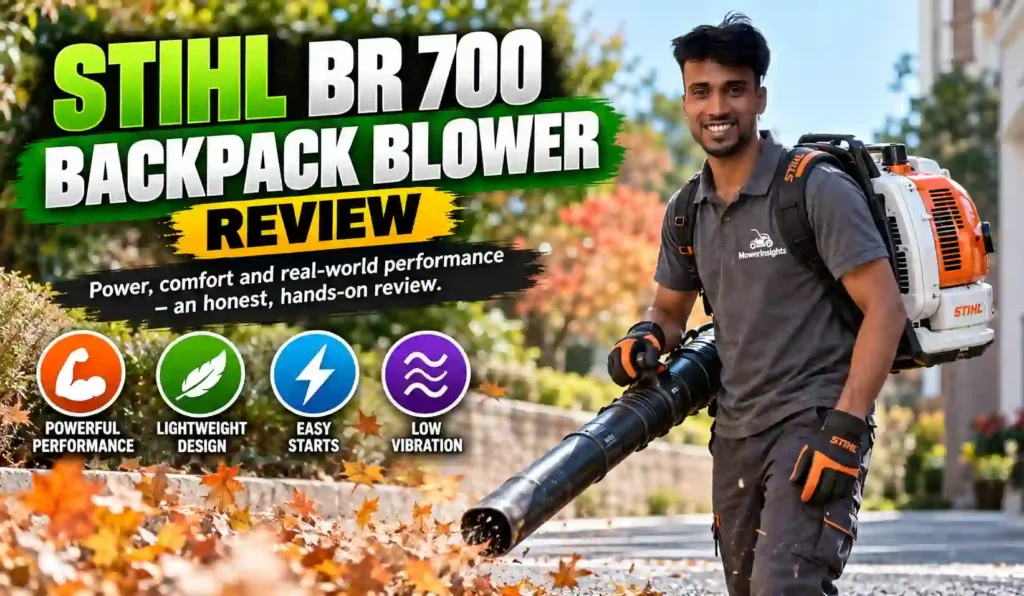
Quick Verdict
The STIHL BR 700 earns an overall score of 8.2 out of 10. It is a great pick if you clear big properties and want less weight on your back. It is a poor pick if you need long runs between fill-ups or only have a small suburban lot.
- Good for: Large yards, estate cleanup, wet leaves, and landscapers who work long days.
- Not good for: Small lots, buyers on a tight budget, and anyone who hates stopping to refuel.
- Price: $729.99
- Top pro: It is light for its power class and starts easily.
- Top con: The 47.3 fl oz tank gives about 54 minutes at full throttle in bench testing.
Specifications at a Glance
The BR 700 is a 64.8 cc four-stroke backpack blower made for professional use. It weighs 23.4 lbs and moves up to 912 cubic feet of air per minute (CFM). Here are the main numbers from the manufacturer and from independent bench testing.
| Spec | Value |
|---|---|
| Engine | STIHL 4-MIX four-stroke, 64.8 cc |
| Engine power | 3.8 bhp |
| Weight (no fuel) | 23.4 lbs |
| Fuel tank | 47.3 fl oz |
| Rated air volume | 912 CFM |
| Rated air speed | 197 mph |
| Rated blowing force | 35 N |
| Rated sound pressure | 75 dB(A) |
| Rated runtime (full tank) | About 1 hr 8 min |
| Price | $729.99 |
A newton (N) is a unit of force. It tells you how hard the air pushes on debris. CFM is how much air the blower moves. Mph is how fast that air travels.
Standout Features
The BR 700 is built around easy starts, adjustable fit, and low weight. These are the features that matter most in daily use.
- The semi-automatic choke and purge pump make starting a simple, short routine.
- A throttle lockout stops you from applying the full choke at the wrong time.
- The one-touch stop switch kills the engine and resets the throttle to the start position.
- The control handle and tube length both adjust without tools.
- The multi-function handle puts the controls in one hand, for right-handed and left-handed users.
- The STIHL anti-vibration system uses springs and buffers to soften engine shake.
Design and Build Quality
The BR 700 is built to be light and snag-free. At 23.4 lbs without fuel, it was the lightest blower in an independent seven-model bench test. It also ranked first for ergonomics there. The housing is rounded, so it does not catch on branches in tight beds, and the straps are extra wide.
The manufacturer says most of its gas tools sold in the US are built here from US and global parts.
Harness and Back Pad
The harness has wide shoulder straps, a hip belt, and a back pad. Weight is spread across your shoulders and back, which helps on long jobs. Bench testers found the back pad less comfortable than they hoped. The strap adjusters sit in a hard-to-reach spot on the strap.
Vibration Control
The anti-vibration system worked well in testing. Testers could barely feel engine shake in the handle. That is a real gain when an engine is strapped to your back for hours.
What worked:
- It is the lightest blower in a seven-model bench test at 23.4 lbs.
- The anti-vibration system keeps handle shake low.
- The rounded body slides past branches and shrubs.
What didn’t:
- The back pad is less comfortable than the rest of the harness.
- The strap adjusters are awkward to reach.
- It has no active cooling that pulls air across your back, which most rivals in the test had.
Design and Build Quality: 8.5/10
Best for: Landscapers who wear a blower for hours and care about back fatigue.
Performance
The BR 700 is strong where it counts, which is moving wet, stuck debris. Bench testing measured 36.7 N of force, 173 mph of air speed, and 903 CFM. It placed first in a real-world sand-swath test, clearing 888 square inches of wet sand from asphalt, well ahead of rivals.
Rated and measured numbers differ because makers test under ideal conditions. Here is how they compare.
| Measure | Rated by STIHL | Measured in bench test |
|---|---|---|
| Blowing force | 35 N | 36.7 N |
| Air speed | 197 mph | 173 mph |
| Air volume | 912 CFM | 903 CFM |
The measured force beat the rating. Air volume came within 1 percent of the rating. Air speed came in lower than the rating, and it was the weakest number in the test. Even so, the blower finished first in the practical swath test.
Why did a blower with modest speed win that test? Air volume does a lot of the work when you push wet leaves across pavement. High volume acts like a broom that is wide as well as fast. For heavy, matted debris, that balance suits a pro crew.
An adjustable round nozzle sold as an accessory switches between max air volume and max air speed. If you want more reach for dry debris, that is a useful add-on.
What worked:
- It finished first in a real-world swath test on wet material.
- Force and air volume both landed at or above the rated numbers.
- It handles wet leaves, grass clippings, and hedge trimmings.
What didn’t:
- Measured air speed was about 24 mph under the rating.
- It placed third for force, behind two bigger blowers.
- Larger rival engines move more air for pure power.
Performance: 8.5/10
Best for: Clearing wet leaves and matted debris from large areas.
Engine Performance and Fuel Runtime
The BR 700 uses a fuel-efficient engine, but its small tank cuts the runtime. In a 6 fl oz fuel test, it ran 6 minutes 50 seconds, the best in a seven-blower field. On a full tank at full throttle, it ran only 53 minutes 52 seconds, which was last. STIHL rates a full tank at about 1 hour 8 minutes.
The 4-MIX Engine
The engine is a STIHL 4-MIX. It is a four-stroke that runs on a gas and oil mix, so it has no separate oil sump to check or fill. STIHL says it is lighter and needs less upkeep than a standard four-stroke. It makes 3.8 bhp.
STIHL says to use fuel with no more than 10 percent ethanol. Higher blends can damage the engine and may void the warranty.
What the Tank Means Per Day
The tank holds 47.3 fl oz. A listed fuel use of 1.28 liters per hour is about 43 fl oz, or roughly a third of a gallon. At full throttle, the bench test suggests you will refuel about every 54 minutes.
For a four-hour job, plan on four to five fill-ups. At $4 a gallon for mixed fuel, the blower burns about $1.35 an hour. That is a MowerInsights estimate, and your fuel price will differ. The cost is low. The real cost is the stops.
Noise
Noise numbers differ by source. STIHL lists a 75 dB(A) sound pressure rating, which is measured at a set distance. Bench testers recorded 103 dB(A) at the operator’s ear. The ear number is the one you live with, so wear hearing protection. Check HOA rules and local noise limits, since some cities and states limit gas blowers.
What worked:
- It sipped fuel better than any blower in the 6 fl oz test.
- The 4-MIX engine needs no separate oil level checks.
- Rated runtime is about 1 hour 8 minutes.
What didn’t:
- The full-tank run was the shortest in the group at 53 minutes 52 seconds.
- The tank is at least 20 fl oz smaller than every rival in the test.
- Noise at the ear reached 103 dB(A).
Engine Performance and Fuel Runtime: 7.0/10
Best for: Users who can top off the tank during breaks and want fuel savings.
Ease of Use
The BR 700 is among the easiest blowers to start and run. In bench testing, it was the easiest starter of the group. The throttle lockout stops you from using the full choke at the wrong time. This keeps you on the right starting routine and cuts the chance of flooding.
The Start Routine
The start steps are short. You prime with the purge pump, set the choke, and pull. After the engine fires, you move the choke off. STIHL notes that flooding is still possible if you leave the choke on after the engine fires. Take that step seriously.
Controls and Adjustments
The handle slides to fit your height with no tools. The tube telescopes with a lock ring, so you turn it, slide it, and lock it. You can shorten it for tight spaces. The throttle lever locks at any setting, which gives you a cruise-control feel.
What worked:
- It was the easiest starter in a seven-blower test.
- The one-touch stop resets the throttle for the next start.
- Handle and tube adjust fast with no tools.
What didn’t:
- Choke-off after firing still matters, or the engine can flood.
- The strap adjusters are hard to reach.
Ease of Use: 9.0/10
Best for: New backpack blower users and crews with mixed experience levels.
Maintenance
The BR 700 asks for ordinary gas-engine care and little more. The pleated paper air filter is built for a long service life. You clean it on a schedule and replace it when it is worn. The 4-MIX engine skips the oil sump, so you have one fewer fluid to check.
Fuel is where most small-engine trouble starts. Based on Siddik’s hands-on repair experience, stale or high-ethanol fuel causes more no-start calls than any worn part. Use fuel within the 10 percent ethanol limit. Add a stabilizer if the blower sits for a winter or a dry summer.
Routine care list:
- Clean the air filter after dusty jobs, and swap it when it is damaged.
- Check the spark plug and the spark arrestor screen at each season start.
- Drain or stabilize fuel before long storage in the North.
- Wipe the housing and tube so grit does not build up around the fan.
- Tighten the harness and handle hardware after heavy use.
STIHL sells through a dealer network, so parts and service are easy to find. That helps if you rely on the blower every day.
What worked:
- The air filter is built for long life.
- No oil sump means less to check.
- Parts and service run through dealers.
What didn’t:
- It is a gas engine, so fuel care and storage still apply.
- Fuel stays the main source of problems if you ignore the ethanol limit.
Maintenance: 8.0/10
Best for: Owners who follow a basic seasonal care routine.
STIHL BR 700 Backpack Blower Review: Pros and Cons
The STIHL BR 700 backpack blower wins on weight, starting, and wet-debris power. It loses on tank size and price. Here is the full list from every test section above.
| Pros | Cons |
|---|---|
| Lightest blower in a seven-model bench test at 23.4 lbs | Small 47.3 fl oz tank means frequent refueling |
| First place in a real-world sand-swath test | Full-tank runtime of 53 min 52 sec ranked last in the group |
| Easiest starter in the group, with choke lockout | Measured air speed of 173 mph was under the 197 mph rating |
| Effective anti-vibration system | No active back cooling |
| Tool-free handle and tube adjustment | Back pad and strap adjusters could be better |
| Efficient engine in the short fuel test | $729.99 price is high for homeowners |
The con that would change a buyer’s decision is the tank. If your job runs three or four hours without a break, the stops add up. If you work in short bursts, the small tank barely matters.
Comparison With the Husqvarna 580BTS
The Husqvarna 580BTS is the closest rival. It costs less and pushes harder. The BR 700 weighs less and starts easier. Husqvarna lists 1,000 CFM, 220 mph, and 47 N of force, with a tank of about 88 fl oz.
| STIHL BR 700 | Husqvarna 580BTS | |
|---|---|---|
| Price | $729.99 | Around $650 |
| Best for | Light weight and easy starts | Raw power and long runs |
| Main difference | 23.4 lbs, 47.3 fl oz tank | 26.8 lbs, about 88 fl oz tank |
| Winner | Comfort and fuel economy | Power and runtime |
| Rating | 8.2/10 | 8.0/10 (estimate from specs) |
Pick the Husqvarna if you want more force and fewer refills. Pick the BR 700 if your back and arms take the beating. The 3.4 lb weight gap sounds small. Over an eight-hour day, it adds up.
Who Should Buy the STIHL BR 700?
The BR 700 fits people who clear a lot of ground and carry the blower for hours. If that is you, the light frame pays off every day.
- Landscapers who work several properties a day and care about operator fatigue.
- Owners of lots larger than an acre with heavy leaf drop, especially in fall.
- Homeowners in the Northeast and Midwest who face wet, matted leaves.
- Crews that mix experienced and new operators and want easy starts.
Who Should Avoid the STIHL BR 700?
Skip the BR 700 if you only clean a small yard. At $729.99, it is more blower than a quarter-acre suburban lot needs.
- Homeowners with small yards, who can use a lighter, cheaper blower or a cordless handheld.
- Buyers who need 90 minutes or more per tank, who should look at a larger-tank model.
- Anyone on a tight budget, since the price sits above many gas rivals.
- Users in areas that restrict gas blowers, who should look at battery models.
Price and Value
The STIHL BR 700 costs $729.99 on the manufacturer’s US site. Some listings run lower during promotions. Prices may vary by retailer and change over time.
For that money you get a light frame, easy starts, and strong wet-debris power. You do not get the longest runtime or the highest raw force. A rival can cost about $80 less and give you more of both.
| Tier | Typical price | What you get |
|---|---|---|
| Budget | Under $300 | Smaller engines, lighter duty, homeowner use |
| Mid-range | $300 to $600 | Stronger gas blowers, shorter service life |
| Premium (BR 700 sits here) | $600 and up | Pro-grade engine, dealer support, better comfort |
Value comes down to your workday. If the weight savings help you finish the day with less strain, the premium is worth paying. If you care most about raw force per dollar, look elsewhere.
Warranty and Support
STIHL publishes a limited warranty for the BR 700 on its product page. Spec listings show coverage of up to 2 years for consumer use. Many makers cut coverage for commercial use, so read the limited warranty before you buy if you plan to work for pay.
Support runs through STIHL dealers. Parts, repairs, and fuel advice are easier to get this way than from a big-box store. The warranty also depends on correct fuel, so keep ethanol at or below 10 percent.
FAQs
Is the STIHL BR 700 backpack blower worth it?
Yes, if you clear big properties and want a lighter pro blower. It weighs 23.4 lbs and starts easily. It is not worth it for a small yard, and rivals give more force for less money.
How long does the STIHL BR 700 run on a tank of gas?
Bench testing measured 53 minutes 52 seconds at full throttle. STIHL’s own rating is about 1 hour 8 minutes. Running at partial throttle stretches the time.
How heavy is the STIHL BR 700?
It weighs 23.4 lbs without fuel. A full 47.3 fl oz tank adds roughly 2 lbs, so expect about 25.6 lbs ready to work. That is a MowerInsights estimate.
What fuel does the STIHL BR 700 use?
It runs on a gasoline and oil mix, since the 4-MIX engine has no separate oil sump. STIHL says to use fuel with no more than 10 percent ethanol. Follow the mix ratio in the manual.
Is the STIHL BR 700 loud?
STIHL rates it at 75 dB(A) sound pressure at a set distance. Bench testers measured 103 dB(A) at the operator’s ear. Wear hearing protection every time.
How does the STIHL BR 700 compare to the Husqvarna 580BTS?
The Husqvarna has more force (47 N vs 35 N rated), a bigger tank, and a lower price. The STIHL weighs about 3.4 lbs less and was the easier starter in testing. Choose by power or by comfort.
Can a homeowner use the STIHL BR 700?
Yes. It is a pro blower, but it works well on large lots with lots of trees. For a small yard it costs more than you need.
Does the STIHL BR 700 have cruise control?
It has a variable, locking throttle lever. That holds your chosen speed without a held trigger. It also has a one-touch stop switch.
Final Verdict
The STIHL BR 700 backpack blower scores 8.2 out of 10. Buy it if you clear large properties and want a lighter pro blower with easy starts and strong wet-debris power. Skip it if you need long tank runs, top raw force, or a low price. For small yards, a cheaper blower does the job. For big crews that care about fatigue, this is a strong choice.

Why Trust This Guide
MowerInsights.com is run by Siddik Kazi, who repairs and services lawn mowers and outdoor power equipment at his own shop in Italy. That workshop time shapes how we judge starting, upkeep, and fuel care.
This review draws on manufacturer specifications, independent bench-test measurements, and a check of US pricing. Rated and measured figures are labeled apart. Estimates are marked as MowerInsights estimates.