Quick Overview
- A basic gas mower kit costs $60 to $90. It covers most home care: oil changes, blade care, plug swaps, and filter cleaning.
- The top tool is a torque wrench, not a plug wrench. Loose or tight blade bolts cause most repair visits.
- Battery mowers need a different kit. Skip the plug wrench and oil funnel. Add a torque driver and a contact cleaner.
- Skip big, costly mechanic tool chests. A focused 12-piece kit does nearly every home repair.
- Budget $15 to $25 a year for parts like oil and filters. This comes on top of the one-time tool cost.
How to Think About This Purchase
Most people buy tools they’ll never use. Then they skip the one tool that saves them a repair bill. Before you shop, ask two things. What kind of mower do you own? How much of the work do you want to do?
Mower type decides most of it. A gas mower needs plug, oil, and filter tools. A battery mower needs a torque driver and contact care instead. Buy a gas kit for a battery mower and you waste about a third of the cost.
Storage space matters more than people think. A wall board in a garage fits a full 12-piece kit. A renter with a small balcony mower needs a small 5-piece kit that fits in a shoebox.
Repair ambition is the real question. Some folks want to change their own oil and sharpen their own blade twice a season. That’s a $70 kit. Others just want to pull the blade and clean the deck, then let a shop do the rest. That’s a $35 kit.
Budget should cover parts, not just tools. A wrench lasts for years. Oil, filters, and plugs get bought each season. That yearly cost is easy to miss when you first plan a budget.
How This Guide Was Put Together
This list comes from real shop work, not a parts catalog. Each tool below is checked against the bolts, plug sizes, and service points on the mowers that come through the shop most: Honda, Toro, Craftsman, EGO, and Ryobi. When a torque spec or bolt size shifts by model, we flag it. We do not guess.
Gas Mower Tool Kit: The Core 12 Tools
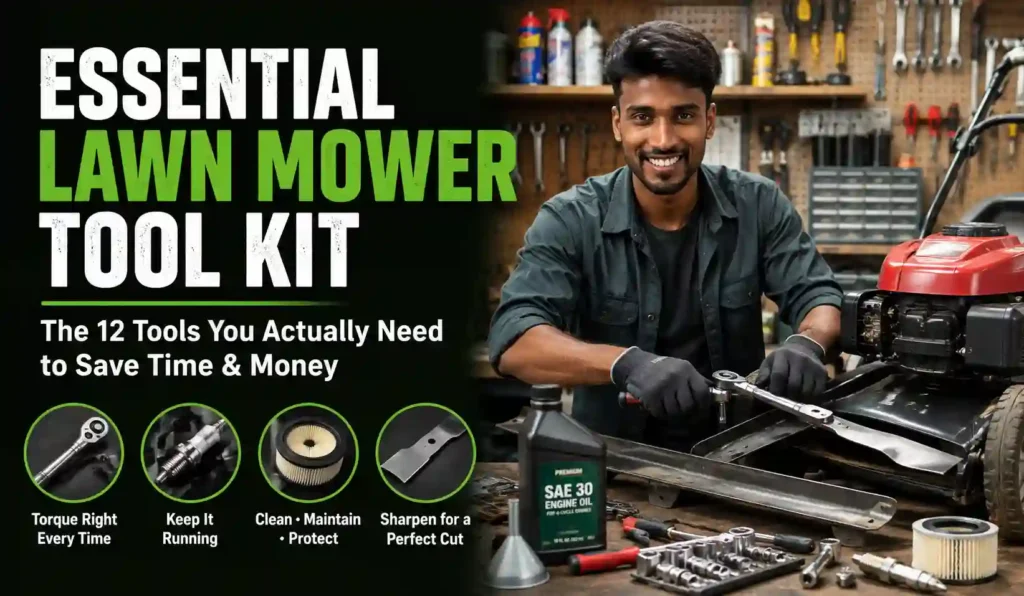
A gas mower needs twelve tools. They cover blade work, oil changes, plug swaps, and quick fixes. Here’s what earns a spot in the kit. Each one gets pulled off the shop shelf week after week.
1. Torque Wrench (for the Blade Bolt)
Most home kits skip this tool. It matters the most. Blade bolts need a set torque, often 45-60 ft-lbs on gas mowers (Briggs & Stratton, 2025). Guess with a bar tool and the bolt can back out or snap the shaft.
A basic torque wrench that covers 10-150 ft-lbs costs about $35 to $45 (Amazon, 2026). Buy this one first.
This type gives a clear click when you hit the set torque. You don’t need to watch a gauge. Set it to spec. Tighten until it clicks once. Stop there. A second pull past the click means you went too far.
2. Impact-Rated Socket Set (1/2-Inch Drive)
The blade bolt is often 15/16″ or 3/4″. It’s on tight. A cheap socket can crack under that much force. A 6-piece impact-rated socket set with a bar tool costs $20 to $30.
These sockets use tougher steel than plain chrome ones. They flex a bit under shock instead of breaking. This matters most on the first hard pull, before the torque wrench comes into play. A bolt that hasn’t moved in a year or two can take real force to break free.
Expert tip: Wedge a short piece of wood against the blade so it can’t spin. Do this before you break the bolt loose. It’s faster and safer than holding the blade by hand.
3. Spark Plug Wrench (13/16″ and 5/8″)
Two sizes fit most gas engines. A 13/16″ socket fits the common plug type. A 5/8″ socket fits older or smaller engines. A wrench with both sizes built in costs $5 to $10 (Briggs & Stratton Online Store, 2026).
Guess the size wrong and you round off the plug’s edges. A quick job turns into a stuck-plug mess. Check your engine’s manual once. Then buy the matching wrench.
4. Oil Pump
Most mowers have no drain plug. Oil comes out through the fill hole with a hand pump. A basic pump that holds 1.5 to 2 quarts costs $15 to $20.
5. Funnel with Flexible Spout
A $5 funnel with a bendy tip stops the spill that almost always happens when you pour fresh oil straight from the bottle into a small, angled hole.
6. Blade Sharpening File or Bench Grinder Attachment
A dull blade tears grass instead of a clean cut. Torn grass turns brown at the tip within two days (Penn State Extension, 2024). A 10-inch metal file with a handle costs $10 to $15. It works for two or three sharpen jobs each season. A grinder wheel ($15-$20) is faster if you own a grinder.
A file takes more time but removes less metal each pass. That means more sharpens before the blade wears out. Keep the same edge angle each time. Count your strokes so both sides get the same amount of care.
7. Blade Balancer
An uneven blade shakes the whole deck. That wears down the bearing that holds the blade shaft. This is the second most common cause of a repair visit, right after loose bolts. A small magnet-cone balancer costs $8 to $12. It takes thirty seconds to check a blade after each sharpen.
Set the blade on the balancer’s point. A good blade stays flat and level. If one side dips, file a bit off that side’s edge and check again. Skip this step, and a freshly sharpened mower can shake worse than it did with a dull blade.
8. Wire Brush
A stiff wire brush ($5-$8) clears caked grass and dirt off the deck and blade. Packed grass under the deck blocks airflow. That makes the engine run hot.
9. Deck-Cleaning Scraper
A flat plastic scraper ($8-$12) pulls packed grass off the bottom of the deck. It won’t scratch the paint the way a metal tool would. [PHOTO NOTE: Underside of mower deck with a scraper removing caked grass buildup]
10. Air Filter Cleaning Kit / New Filters
You can wash a foam pre-filter in warm water and soap and reuse it. A paper filter must be replaced. Paper filters cost $6 to $10 for a two-pack. Plan for both, since most mowers use a paper filter behind a foam layer.
11. Small Parts Tray or Magnetic Dish
A $6 magnetic dish keeps bolts and washers from rolling off into the grass while you pull the blade. It’s a small item that saves real hassle.
12. Nitrile Gloves and Safety Glasses
This one isn’t optional. A mower blade stays sharp enough to cut you even with the engine off. A $10 box of gloves plus $8 safety glasses is cheap cover against a trip to urgent care.
At-a-Glance: Gas Mower Tool Kit
| Tool | Typical Price | Used For |
|---|---|---|
| Torque wrench | $35-$45 | Blade bolt to spec |
| Impact socket set | $20-$30 | Removing blade bolt |
| Spark plug wrench (13/16″ + 5/8″) | $5-$10 | Spark plug service |
| Oil pump pump | $15-$20 | Oil changes |
| Flexible funnel | $5 | Adding fresh oil |
| Sharpen file or grinder wheel | $10-$20 | Blade sharpen |
| Blade balancer | $8-$12 | Checking blade balance |
| Wire brush | $5-$8 | Deck and blade cleaning |
| Deck scraper | $8-$12 | Clearing packed clippings |
| Air filter (paper, 2-pack) | $6-$10 | Replacement |
| Magnetic parts tray | $6 | Holds small parts |
| Gloves and safety glasses | $18 | Blade-handling safety |
| Total | $141-$186 | Full 12-piece kit |
These prices come from Amazon and maker sites, checked in January 2026. Check them again close to publish, since sale prices shift a lot.
Battery-Electric Mower Tool Kit: What’s Different
Battery mowers drop about a third of the gas kit. No plug wrench. No oil pump. No funnel. No paper filter. What takes their place is small but easy to forget.
Torque driver instead of a torque wrench. Battery mower blade bolts use a lighter spec, often 15-25 ft-lbs, and a smaller bolt size than gas mowers. A compact torque driver ($25-$35) is the right tool here, not a full-size wrench.
Battery contact contact cleaner. Rust or grime on the battery contacts is the top reason a battery mower won’t turn on. This shows up most in damp climates or after winter storage. A can of contact cleaner costs $8-$10 and takes thirty seconds to use.
Everything else carries over. The balancer, wire brush, scraper, and safety gear from the gas kit work the same way on a battery mower. The deck still packs with grass. The blade still needs the same care.
At-a-Glance: Battery Mower Kit Differences
| Gas Mower Tool | Battery Mower Equivalent | Why It Changes |
|---|---|---|
| 1/2″ torque wrench | 1/4″ torque driver | Lower bolt torque spec |
| Spark plug wrench | Not needed | No spark plug |
| Oil pump + funnel | Not needed | No engine oil |
| Paper air filter | Not needed | No combustion air intake |
| N/A | Contact cleaner | Battery contact corrosion |
Who this is NOT for: if you own a robot mower, skip both kits above. A robot mower rarely needs home tool work past a blade disc swap, and that job comes with its own small tool. Check the MowerInsights robot mower hub for care tips by model.
Top Picks by Use Case
Best small kit for renters or small yards: a plug wrench (or torque driver for a battery mower), wire brush, scraper, and gloves. About $25-$35 total. It fits in a shoebox.
Best mid-size kit for most owners: the full 12-piece gas kit, or the battery version, at $130-$190. It covers oil changes, blade work, and filter swaps for years.
Best kit if you skip engine work: drop the oil pump and plug wrench. Keep the torque wrench, socket set, file, balancer, and cleaning tools. About $90-$110. This is the set Siddik hands to most owners who want to stay hands-on but skip the engine.
Best low-care choice: a battery mower with a sealed, tool-free blade release cuts your kit down to just cleaning tools and gloves. This is worth thinking about when you buy the mower, not just the tools.
When This Kit Isn’t Enough
A 12-piece kit handles routine care. A few jobs still call for a shop, even for a hands-on owner.
Carburetor rebuilds need a cleaning kit, exact parts, and a good ear for how a fine-tuned idle sounds. A home fix, done once a year, is more likely to cause a new fault than fix the old one.
Flywheel or ignition coil work needs a puller tool and an exact gap check with a feeler gauge. The puller runs $65-$140. That’s a big cost for a job you may do just once, so a $30-$50 shop visit is often the smarter choice.
Drive or self-propel faults on walk-behind mowers often mean opening a sealed gearbox. That part isn’t meant for home fixes. If self-propel stops working, that’s a shop job, not a tool-kit fix.
Battery mowers draw the line in a different spot. Packs, motors, and control boards are sealed shut on most models. Past blade and deck care, a real electric fault means a warranty claim or a shop visit, not a home fix.
Buying Mistakes to Avoid
- Buying a big car tool chest instead of a small, focused kit. A 200-piece set has maybe 12 tools you’ll ever touch, and it costs three times as much as a kit built for mowers.
- Skipping the torque wrench to save $40. This is the costliest shortcut on this list. A bolt that’s too tight can crack the shaft. That fix costs far more than the wrench.
- Buying plain chrome sockets instead of impact-rated ones. A plain socket can crack under the force needed to break a stuck bolt loose.
- Guessing the plug wrench size instead of checking the manual. A rounded plug edge can mean a $20-$30 shop bill just to pull it out.
- Leaving parts out of the budget. Tools are a one-time cost. Oil, filters, and plugs run $15-$25 a year, and that adds up fast if you don’t plan for it.
Maintenance and Total Cost of Ownership
A full gas kit costs $141-$186, one time. Compare that to shop rates. A basic blade sharpen and check runs $25-$40. An oil change with a filter runs $30-$50, parts included (based on typical 2025-2026 small-shop rates). Do two sharpens and one oil change a year yourself, and the kit pays for itself in under two seasons.
The most common fix on shop mowers isn’t a broken part. It’s a blade bolt that came loose, or one torqued too hard with a bar tool that cracked the mount. Both come from a missing torque wrench. That’s why it tops this list, not the plug wrench most guides lead with.
Yearly parts for a gas mower run about $15-$25. That’s one plug ($3-$6), one paper filter ($6-$10), and a quart and a half of oil ($8-$12). A battery mower cuts this near zero, since there’s no engine to feed. The battery pack itself is a bigger cost every 3-5 years, based on how much you use it.
A tool kit also helps you catch small faults fast. A mower that only sees a shop once a year can run a whole season on a dull, uneven blade before anyone notices. The signs, like a ragged cut or a slight shake, build up slowly. Own a balancer and a file, and you fix that the same weekend it starts. Skip it, and the shaft bearing wears down over months. That’s the gap between a $10 sharpen habit and a $60-$90 bearing swap down the road.
Storage matters too. A simple wall board or a $15-$20 tool tray keeps the kit in order. That stops the top reason people quit doing their own care: not finding the right tool once the mower is already pulled out and the oil is already drained.
Frequently Asked Questions
What tools do I need to sharpen a lawn mower blade at home?
You need a socket set to pull the blade, a torque wrench to put it back to spec, a file or grinder to sharpen the edge, and a balancer to check the blade spins even. Wear gloves. The edge stays sharp even with the mower off.
Do I need different tools for a gas mower versus a battery mower?
Yes. A gas mower needs a plug wrench, an oil pump, a funnel, and filter care. A battery mower skips all of that. It needs a smaller torque driver for the blade bolt and a contact cleaner, since the bolt spec is lighter and rust on the battery contacts is the more common fault.
What size wrench fits most lawn mower spark plugs?
Most gas mower engines use a 13/16″ plug socket. Some older or smaller engines use 5/8″. Check your engine’s model first, since the wrong size rounds off the plug’s edges.
How much torque should a mower blade bolt be tightened to?
This shifts by engine and blade type. It’s often 45-60 ft-lbs on gas mowers and 15-25 ft-lbs on many battery mowers.
Is it worth buying a full tool kit instead of taking the mower to a shop?
Yes, if you do at least one oil change and one blade sharpen each season. The kit’s one-time cost tends to pay for itself within one or two seasons, compared to shop rates for those same two jobs.
Can I use a car spark plug wrench on my lawn mower?
Maybe, if the socket size matches. But most car plug wrenches are built for a deeper plug and don’t fit the tight, angled space on a mower engine well. A mower-exact wrench is worth the $5-$10.
How often should I sharpen my mower blade?
Most mowers need a sharpen two or three times a season, or about every 20-25 hours of use. Rocks, roots, or sandy soil dull the edge faster and may call for an extra touch-up between the usual sharpens.
What’s the most common mistake people make with a new tool kit?
Using a bar tool or driver to put the blade bolt back on, instead of the torque wrench. Force is fine to break a bolt loose. But putting it back needs the torque wrench every time. That’s the step that stops the bolt from working loose or cracking the mount.
Where should I store my lawn mower tool kit?
Keep it close to where you park the mower, not in a far corner of the garage. A small wall board or a tray near the mower means you’ll grab the right tool right away. Tools that sit in a far drawer tend to go unused, even after you own them.
Tools You Can Skip
A mower tool kit can grow fast if you let it. A few items get sold as “must-haves” but rarely earn their spot in a home kit.
A full compression tester. This checks engine health, but it’s a job for a shop, not a weekend fix. Skip it unless you plan to rebuild engines often.
A dedicated carb cleaning kit. Most home fixes for a rough-running mower come down to old fuel, not a dirty carb. Try fresh fuel and a new plug first. Save the carb kit for later, if you still have trouble.
A large socket set with 50-plus pieces. Mower work needs maybe six sizes. A big set costs more and takes up more space than the small, focused set in this guide.
A pressure washer just for the deck. A hose, a scraper, and a wire brush do the same job for a lot less money. A pressure washer is nice to have, but it’s not part of the core kit.
Skip these four, and your kit stays small, cheap, and useful. Add them later only if a real, repeat need shows up.
The First Three Jobs to Try With Your New Kit
A new kit can feel like a lot at once. Start small. These three jobs build skill fast, and each one takes under thirty minutes.
Job one: pull the blade and check its edge. Wedge a block against the blade. Break the bolt loose with your socket set. Look at the edge under good light. If it’s dull or nicked, that’s your first sharpen job. If it’s clean, put the bolt back on with your torque wrench, at the right spec, and stop there.
Job two: change the oil. Warm the engine for a minute or two first. Thin, warm oil drains faster than cold oil. Use your pump to pull the old oil out through the fill hole. Add fresh oil with your funnel. Check the level on the dipstick before you close it up.
Job three: clean the deck. Tip the mower on its side, spark plug wire off first for safety. Scrape off the packed grass with your deck tool. Brush the rest loose with your wire brush. A clean deck cuts better and runs cooler.
Do these three jobs once, and most of the kit stops feeling new. By the second season, they take less time than a coffee break.
Conclusion
A “drawer full of stuff” and a real working kit are two different things. The gap is about twelve items, and the one that matters most, a torque wrench for the blade bolt, is the one most home kits skip. Start with your mower type, gas or battery. Then plan for yearly parts, not just a one-time buy. A focused $90-$190 kit will cover nearly every repair your mower needs for years.
Pingback: Best Lawn Mower Lifts for Easy Maintenance in 2026
Pingback: How to Sharpen Lawn Mower Blades at Home