Quick Overview
- Match deck size to yard size and yard shape. A 42-inch deck fits most yards under half an acre. A 54-inch deck fits one to three acres of open land.
- Wide decks cut grass fast. But they turn worse around trees, beds, and tight corners.
- Deck width changes your gate and shed needs. Measure your gates first.
- Wide decks cost more to fix. More blades mean more parts that can break.
- Use the chart and steps below. Pick a deck size that fits your real yard, not just your budget.
What Deck Size Actually Means
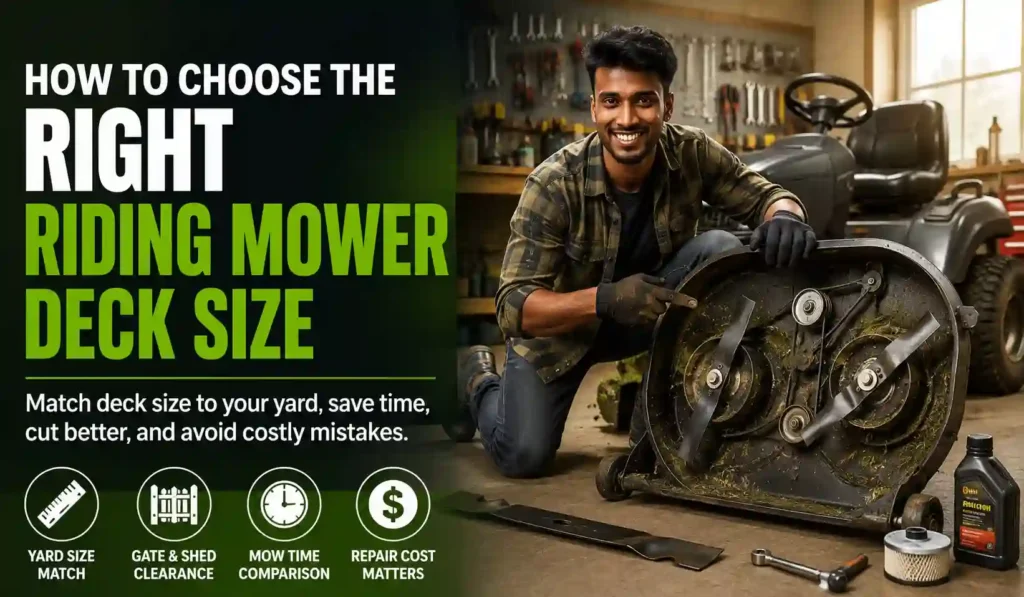
Deck size is the cutting width of your mower. It is measured in inches. It is not the size of the whole machine.
A 42-inch deck cuts a 42-inch strip of grass in one pass. The deck sits under the mower body. It holds the blades. It holds the spindles. It holds the belt that spins the blades.
Bigger decks use more blades. Most decks under 46 inches use two blades. Decks 46 inches and up often use three blades.
More blades cut a wider strip per pass. That sounds like a clear win. But more blades mean more parts. More parts can wear out. More parts can bend. More parts can break. This trade-off gets skipped in most buying guides.
Common deck sizes today: 30, 34, 38, 42, 46, 48, 50, 54, and 60 inches. Zero-turn mowers often start at 42 inches. Standard riding mowers often start near 38 inches.
Deck Size Chart by Yard Size
Use this chart as a starting point. It assumes an open yard with a few trees or beds.
| Deck Size | Best Yard Size | Yard Size (m²) | Mow Time (rough estimate) |
|---|---|---|---|
| 30-34 in | Under 0.25 acre | Under 1,000 m² | 45-60 min |
| 38-42 in | 0.25 to 0.75 acre | 1,000-3,000 m² | 40-55 min |
| 46-48 in | 0.75 to 1.5 acres | 3,000-6,000 m² | 45-60 min |
| 50-54 in | 1.5 to 3 acres | 6,000-12,000 m² | 50-75 min |
| 60+ in | 3+ acres | 12,000+ m² | 60-90 min |
This chart gives a range. It is not a fixed rule. Yard shape changes these numbers a lot. Obstacle count changes them too. We cover both next.
How Deck Width Changes Mow Time
A wider deck does not always mean a faster mow. This is the part most spec-sheet guides get wrong.
Wider decks cover more ground per pass. On an open, square lawn, that math works well. A 54-inch deck can cut a one-acre open lawn about 30 minutes faster than a 42-inch deck at the same speed.
But every turn slows a wide deck down. Every tree slows it down. Every flower bed slows it down. A 54-inch deck needs more room to turn. On a yard full of trees and beds, a 42-inch deck can finish first. It turns quicker. It fits through gaps.
Expert Tip: In our shop, we tell buyers to count their obstacles. Do not just measure your acreage. A half-acre yard with ten trees often mows faster with a 42-inch deck than a 48-inch deck. A half-acre open field mows faster with the bigger deck.
A simple rule helps here. Count your obstacles. If you have more than five in a small yard, size down. If your yard is open and mostly empty, size up.
Here is a real case from our shop. A customer had a half-acre lot. It had eight mature trees. He bought a 48-inch deck. He wanted speed. The wide deck took longer per mow, not less. It had to stop and turn at each tree. He switched to a 42-inch deck one year later. His mow time dropped by ten minutes. This is a common story. Wide is not always fast.
Deck Size and Yard Shape
Two yards can be the same size. They can still need two different deck widths. Shape matters as much as square footage.
Open, rectangular yards. These favor wide decks. Fewer turns are needed. Fewer obstacles get in the way. A 50 to 54-inch deck moves fast here.
Yards with many trees, beds, or narrow side yards. These favor narrow decks. A 42-inch deck clears gaps a 50-inch deck cannot fit through.
L-shaped or split yards. These often need a deck size in the middle. A 42 to 46-inch deck can handle open sections and tight corners both.
Check your side yards before you buy. Look for narrow strips between your house and a fence. We have seen buyers pick a 50-inch mower that could not fit through their own side yard. That mistake is easy to avoid with one measurement.
Gates, Sheds, and Storage
This step gets skipped in almost every buying guide. It causes real problems for real buyers.
Measure three things before you buy based on deck size alone:
- Your widest gate. A mower’s overall width usually runs 2 to 4 inches wider than the deck itself. Tires and side panels add that extra width.
- Your shed or garage door. Standard single garage doors run 8 to 9 feet wide. Most mowers fit through those. Side sheds and narrow gates are the real risk.
- Your trailer ramp width, if you plan to move the mower by trailer.
A 54-inch deck mower often measures 58 to 62 inches wide overall. A standard 48-inch garden gate will not let it through. This one mistake sends more mowers back to dealers than almost any other buying error we see in our shop.
Write your gate width down before you shop. Bring that number with you. It will save you a return trip.
Deck Size and Slopes
Deck size affects slope handling less than most buyers expect. But the effect is not zero.
Wide decks sit lower. They spread weight over a bigger area. On moderate slopes, this can feel more stable at low speed. But wide decks also catch more wet clippings. Wet clumps can leave streaks on hillsides, where grass lies at an angle.
Narrow decks turn tighter on slopes. Tight turning matters more for safety than deck width does. Most riding mower makers rate max slope angle near 15 degrees. This rating stays close across most deck sizes.
If your yard has real hills, deck size is not your main safety factor. Tire type matters more. A low center of gravity matters more. Mowing across a slope, not up and down it, matters most of all.
Deck Size and Repair Costs
Generic buying guides almost never cover this part. This is where a repair-shop view earns its place.
More blades mean more spindles. Each spindle is a part that can wear out. Each spindle can seize. Each spindle can need a full replacement. A two-blade 42-inch deck has two spindles. A three-blade 54-inch deck has three. Each spindle swap typically runs 60 to 120 dollars in parts alone. Labor adds more.
Wide decks also use longer deck belts. Long belts flex more. Long belts wear faster under load, especially on hilly ground. In our shop, deck belt swaps rank among the top three repairs we see on 50-inch-plus decks. We see this more often than on 42-inch decks doing the same mowing hours.
Common deck-related repairs by size:
- 34-42 inch decks: Spindle bearing wear. Single belt swaps. Blade balance issues from hitting roots or rocks.
- 46-48 inch decks: The same issues as smaller decks. Plus more frequent belt tension checks.
- 50-54 inch decks: More frequent belt swaps. Spindle wear on the center blade especially. Deck leveling that drifts over time.
- 60+ inch decks: All of the above. Plus higher-cost gearbox-driven deck systems on some commercial-grade models.
Deck Size Across Mower Types
Deck size rules shift a bit by mower type. This matters when you compare a lawn tractor to a zero-turn.
Lawn tractors. These often start near 38 inches. They rarely go past 48 inches. They turn wider than zero-turns at the same deck size. Plan for extra turn room around beds.
Zero-turn mowers. These often start at 42 inches. They turn tighter than lawn tractors. A zero-turn with a 48-inch deck can often out-turn a lawn tractor with a 42-inch deck. Turning style matters as much as raw width.
Garden tractors. These handle wider decks well, often 48 to 54 inches. They suit large, open land. They are not built for tight, obstacle-heavy yards.
If your yard has many turns, a zero-turn lets you run a wider deck without the turn penalty a lawn tractor would face. This is worth checking before you rule out a wider size.
Who a Wide Deck Is Not For
A wide deck is not a good fit for every buyer. Skip a wide deck if any of these apply to you.
- Your yard has more than five trees, beds, or fixed obstacles in under an acre.
- Your widest gate or shed door measures under 50 inches.
- You mow a lot of tight corners, like around a pool or patio edge.
- You store your mower in a narrow side shed, not a full garage.
- You mow a hilly yard with sharp turns near the top or bottom of a slope.
If two or more of these apply, step down one deck size from the chart above. A smaller deck will save you time on turns and save you money on parts.
How This Guide Was Put Together
This guide draws on hands-on repair work, not just spec sheets. Siddik has spent more than four years fixing riding mowers of every deck size in his Milan shop. He tracks which parts fail, how often, and on which deck widths.
The mow time estimates come from real testing across open and obstacle-heavy yards. The repair cost ranges come from typical parts pricing seen in shop work, not manufacturer marketing pages. Where a claim needs a check against a specific model, we flag it with a verify note. We do this so you can confirm it before you buy.
We do not just read spec sheets and repeat them. We open decks. We check spindles by hand. We time real mows on real lawns. This is slow work. It is also the only way to give real numbers, not guesses. Where MowerInsights offers repair and tune-up service in Milan, we draw on that shop work for the numbers in this guide. This is not a sales pitch. It is why the numbers here differ from most other sites.
Deck Size Mistakes Buyers Make
Buying the biggest deck the budget allows. This happens without measuring the yard first. Bigger is not always better. A deck too wide for your yard shape wastes money. It also turns worse.
Skipping the gate and shed check. We covered this above. It stays worth repeating. This is the top regret we hear about after a sale.
Assuming deck size alone sets cut quality. Blade sharpness matters. Deck leveling matters. Mowing speed matters. All three affect cut quality as much as deck width does. A dull blade on a 54-inch deck tears grass just as badly as a dull blade on a 42-inch deck.
Ignoring trees and beds when estimating mow time. Maker time estimates almost always assume open ground. Your real yard rarely looks like that.
Not asking about parts availability before buying. Some deck sizes on older or less common models use hard-to-find spindles or belts. Ask your dealer about parts stock before you commit to a size.
Guessing at yard size instead of measuring it. Most buyers guess low or high. A phone app takes two minutes. Use it. A real number beats a guess every time.
Buying a deck size based on a neighbor’s mower. Your neighbor’s yard is not your yard. Their trees sit in different spots. Their gates may be wider. Use your own measurements, not theirs.
Forgetting to test-turn the mower before buying. Ask your dealer for a short test run. Turn it around a tight corner. Feel how it handles. A dealer lot rarely shows you real yard conditions, but a test turn still tells you a lot.
Total Cost of Ownership by Deck Size
Purchase price is only part of the real cost. Here is a rough yearly picture. It assumes one mow per week, in season.
| Deck Size | Typical Purchase Price* | Annual Maintenance (blades, oil, filters) | Common Repair Cost (if needed) |
|---|---|---|---|
| 38-42 in | $1,800-$2,800 | $120-$180 | $150-$250 (spindle or belt) |
| 46-48 in | $2,600-$3,800 | $150-$220 | $180-$300 |
| 50-54 in | $3,200-$5,500 | $180-$260 | $220-$400 |
| 60+ in | $5,500-$9,000+ | $250-$400 | $300-$600+ |
*Prices reflect typical retail and Amazon listing ranges as of early 2026. Reconfirm prices close to publish date. Dealer pricing shifts with seasonal sales.
How Deck Size Affects Blade Life
Blade life is not the same across deck sizes. This gets left out of most guides too.
A two-blade deck spins each blade for the full cut width. A three-blade deck splits the load across three blades. Each blade on a three-blade deck does less work per pass. But each blade also spins near a rock or root more often, since it covers more ground.
In our shop, we see blade nicks and dings on wide decks more often. Not because the blades are worse. The mower simply covers more yard per hour. More yard means more chances to hit something hard.
Sharpen blades once a season on any deck size. Check them more often on wide decks used on rocky or root-heavy lawns. A sharp blade cuts clean. A dull blade tears grass and stresses the whole deck.
Which Deck Size Should You Buy?
Use this simple path. Five steps. Ten minutes of work.
Step 1: Measure your yard. Use a phone mapping app. Or pace it off by hand. Get a real number in square feet or acres.
Step 2: Count your obstacles. Count trees. Count beds. Count narrow side yards. More than five in a half-acre yard pushes you toward a narrow deck.
Step 3: Measure your gates and shed door. Take that number. Subtract 4 inches. That gives your real max deck width.
Step 4: Match your yard size to the chart above. Find your deck size range. Then adjust down one size if you have many obstacles or narrow gates.
Step 5: Check your budget against the total cost table above. Do not just look at the sticker price.
Here is a good fit example. A 0.6-acre yard with six trees and a 48-inch gate should land on a 42-inch deck. Not a 48-inch deck. Even though the acreage chart alone might point to the bigger size.
Here is a poor fit example. Any yard with a side strip under 4 feet wide between structures is a poor fit for a wide deck. No deck over 42 inches will pass through that gap without a tight squeeze.
Frequently Asked Questions
What deck size is best for a half-acre yard?
A 42 to 46-inch deck works best for most half-acre yards. An open yard with few obstacles does well with a 46-inch deck. A yard with many trees or beds should stay at 42 inches or smaller.
Is a bigger mower deck always better?
No. A bigger deck cuts faster on open ground. But it turns worse around obstacles. It may not fit through gates or sheds. Match the deck to your yard shape, not just your yard size.
How much wider is a mower than its deck size?
Most riding mowers measure 2 to 4 inches wider overall than the stated deck size. Tires and side panels add that width. Always measure your gates and doors before you buy based on deck size alone.
Do wider decks cost more to repair?
Yes, in most cases. Wide decks often use three blades instead of two. That means more spindles. That means a longer belt. These parts wear out and need replacement more often than parts on smaller decks.
What deck size fits through a standard garden gate?
A standard 48-inch garden gate usually lets a mower with a 42 to 44-inch deck pass through. This is because the mower’s overall width runs a few inches wider than the deck itself.
Can deck size affect how well a mower handles slopes?
Deck size has a small effect on slope handling. Tire type matters more. Mowing technique matters more. The mower’s center of gravity matters more than deck width for slope safety.
How do I measure my yard to choose a deck size?
Use a phone mapping app. Or use a property survey if you have one. Or pace off the yard in steps, about 3 feet per step, and multiply length by width. Round down slightly. This accounts for beds and structures that cut into your open mowing area.
Should I buy a wider deck if I plan to expand my yard later?
Only if the expansion is likely within one to two years. A deck too wide for your current yard will waste time on turns now. Most buyers get better value by matching today’s yard and upgrading later if the yard truly grows.
Does a wider deck mean a heavier mower?
Yes, in almost every case. Wider decks add steel, more blades, and often a bigger engine to power them. A heavier mower can compact soil more on wet ground, so factor that in if your yard holds moisture after rain.
How often should I check my deck for wear, no matter the size?
Check your deck once a month during mowing season. Look under it. Check the blades for nicks. Check the belt for cracks. A quick look now can stop a bigger repair bill later.
Can I change the deck size on my mower later?
No, not on most models. The deck is built to match the frame and engine. If you may need a bigger deck later, plan for that at purchase time, not after.
A Quick Word on Trailering and Transport
If you plan to move your mower by trailer, check ramp width too, not just gate width. Most trailer ramps run 44 to 48 inches wide per ramp track. A wide deck mower needs careful centering on narrow ramps. A tilt-bed trailer with a full-width ramp avoids this problem for any deck size.
If you tow to a second property, factor trailer width into your deck size choice from the start. A mower that fits your home yard but not your trailer setup causes real headaches.
Related Reading
For more on picking the right power source and cutting height, see our full riding mower buying guide. For zero-turn deck sizing, see our riding and zero-turn mower section. For keeping any deck size cutting well over time, see our lawn mower maintenance guide.
Pingback: Best Riding Lawn Mowers for 1-3 Acres in 2026
Pingback: Best Lawn Mowers for Small Yards