Quick Answer
Pick a reel mower if your lawn is flat and small. Small means under 5,000 square feet. It works best on thin grass, like fescue or bluegrass. It cuts clean. It needs no gas or battery. It rarely needs a repair shop.
Pick a rotary mower for bigger lawns. Pick it for slopes too. Pick it for thick grass, like St. Augustine or Bermuda. The spinning blade can cut through more grass. It also handles bumpy ground better than a reel mower can.
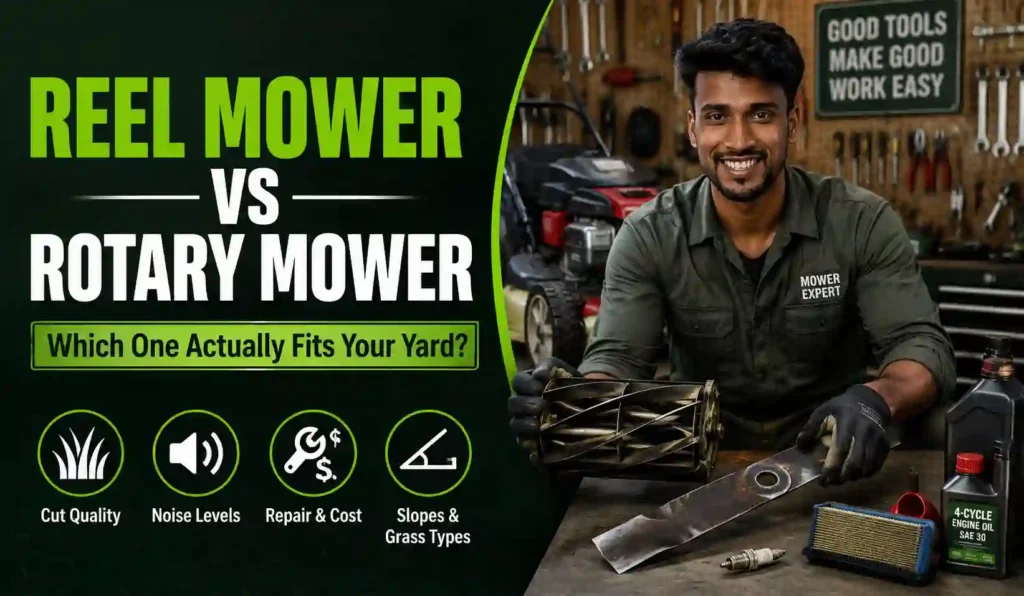
Reel Mower vs Rotary Mower at a Glance
| Spec | Reel Mower | Rotary Mower (Gas) | Rotary Mower (Battery) |
|---|---|---|---|
| How it cuts | Scissor cut, spinning drum | One fast spinning blade | One fast spinning blade |
| Best lawn size | Under 5,000 sq ft | 5,000 sq ft to 1 acre | Up to half an acre |
| Cut height range | 0.5″ to 3″ | 1″ to 4″ | 1″ to 4″ |
| Weight | 20-35 lbs | 55-75 lbs | 45-65 lbs |
| Noise level | 60-65 dB | 85-95 dB | 70-75 dB |
| Works on slopes over 15° | Not well | Yes | Yes |
| Works on wet grass | Not well | Fair | Fair |
| Price (2026) | $150-$350 | $350-$600 | $300-$700 |
| Yearly upkeep cost | $10-$25 | $60-$120 | $20-$50 |
| Average life span | 15-20 years | 8-12 years | 6-10 years |
How Each Mower Actually Cuts Grass
A reel mower cuts like a pair of scissors. A spinning drum has curved blades on it. Each blade meets a fixed bar. Grass gets sliced clean between them, just like paper meets scissors.
A rotary mower cuts with raw force. One flat blade spins fast under the deck. It spins at about 3,000 turns a minute. It hits the grass hard and breaks it off.
That one difference explains most of what follows. The scissor cut is gentle. It leaves a clean edge. The impact cut is tougher. It can chew through uneven grass and small twigs. But it also bruises the tip of each grass blade as it cuts.
In the shop, I can spot which mower cut a lawn just by looking at the grass tips. I use a hand lens. Reel-cut grass has a sharp, clean edge. Rotary-cut grass has a torn edge. This shows up even with a freshly sharpened blade.
Cut Quality: Which One Leaves a Better Lawn
A reel mower gives a clean, even cut on the right lawn. This is why golf courses still use reel mowers on greens and fairways. The scissor cut is that precise.
But that precision has limits. Grass must stay short and even. Once grass grows past about 3 inches, or grows unevenly, the reel mower starts to struggle. The drum can only cut what fits between the blade and the bar.
A rotary mower gives you more room to work with. It handles tall, uneven, or patchy grass with ease. The trade-off is a slightly rougher edge on each cut blade of grass. You won’t see it from a few feet away. But under close view, you’ll notice mild browning at the tip within a day or two. This shows up most in hot, dry weather (Turfgrass Producers International, 2023).
So if you want a lawn that looks like a putting green up close, go with a reel mower on a well-kept lawn. If you want a mower that handles whatever your grass throws at it, go with rotary.
The gap in cut quality grows if you skip a mow. A reel mower that misses one week on fast-growing grass starts to leave stems and rough streaks. The drum simply can’t gather grass once it grows past its limit. A rotary mower barely notices a missed week. It just kicks out more clippings. If your mowing schedule is not steady – due to travel, weather, or a lawn crew that skips a visit – that alone can push you toward rotary, no matter your yard size.
Power Source and Physical Effort
Most reel mowers run on push power alone. A few electric reel models exist too. Pushing one takes real effort, close to pushing an unpowered rotary mower. The cutting path is also narrower, often 14 to 20 inches wide. That means more passes to cover the same lawn.
Rotary mowers come in three types: gas, corded electric, and battery. The motor does the work for you. Gas models need fuel, oil changes, and a pull-start cord. Battery models start at the push of a button. They need only a charge. This is why battery rotary mowers are now the fastest-growing type in the market (Freedonia Group, 2024).
If you have knee, back, or shoulder pain, a reel mower is a tough pick. Its push-only design and narrow path make it hard work past a small yard. A self-propelled or battery rotary mower removes most of that strain.
There is a middle path. Some brands sell battery-assisted reel mowers. These keep the scissor cut but add power to the wheels. They cost more, often $300 to $450. But they close most of the effort gap. You still get the clean cut and quiet ride of a reel mower. This is a solid pick if you want reel-mower precision on a slightly bigger lawn than the usual 5,000-square-foot limit.
Noise Level Compared
A reel mower is the quietest mower you can buy, short of a robot mower. It runs at about 60 to 65 decibels. That’s close to normal talking volume. You could mow at 7 a.m. and no neighbor would notice.
A gas rotary mower runs loud: 85 to 95 decibels at the operator’s ear. OSHA recommends ear protection above 85 decibels for long use (Occupational Safety and Health Administration, 2023). A battery rotary mower sits in the middle, at about 70 to 75 decibels. It loses the engine noise but keeps some motor and blade hum.
How Each One Handles Slopes and Wet Grass
A reel mower has thin wheels. It also needs steady push speed to cut well. This makes it hard to control on any slope past about 10 to 15 degrees. The drum can skip on the high side of a hill. It can also miss grass on the low side. Wet grass makes this worse. Clippings clump inside the drum. Soon the mower pushes grass down instead of cutting it.
A rotary mower has a wider stance and its blade spins on its own power. This helps it grip better on moderate slopes. Most gas and battery rotary mowers also handle wet grass fairly well. Some clumping still happens on any mower in truly soaked grass. Neither mower type is safe on steep slopes where you could lose your footing. That job calls for a self-propelled mower with strong grip, or a pro crew.
In the shop, the top slope-related repair I see on rotary mowers is a bent blade shaft. This often happens when someone mows a hill the wrong way and hits a hidden rock or sprinkler head. On reel mowers, the same kind of slope damage bends the drum. That repair often costs more than the mower is worth.
How Each Mower Handles Different Grass Types
Most comparison guides skip this part. But it matters more than almost anything else here. Grass type changes which mower will actually work for you.
- Cool-season grass (Kentucky bluegrass, fine fescue, ryegrass): These grass types have thin, upright blades. They hold a low, even height well. A reel mower shines here. It’s the classic pick for these lawns.
- Warm-season grass (St. Augustine, Bermuda, zoysia): These grow thick and dense. They often spread with runners, which makes the ground uneven. A reel mower bogs down fast on St. Augustine. Its wide, tough blades resist the scissor cut. A rotary mower handles all three grass types with ease.
- Mixed or patchy lawns: Any lawn with weeds, clover, or uneven growth needs the give of a rotary mower. A reel mower’s fixed gap can only handle grass with a fairly steady height and shape.
Maintenance and Repair: The Shop-Floor View
A reel mower is simple by design. It has a drum, a bar, wheels, and a drive chain on push models. That simple build is why it can last 15 to 20 years with basic care. The most common fix I see is a bar out of line. This usually happens after hitting a hidden rock. It throws off the scissor gap and leaves streaks of uncut grass. Fixing this takes about 15 minutes in the shop. It rarely costs more than $20 to $30 in labor.
Gas rotary mowers come in far more often. The top three fixes, in order: a dull or bent blade from hitting debris, a fouled spark plug from old ethanol fuel left over winter, and a torn pull-start cord from rough yanking. A full spring tune-up – oil change, blade sharpening, spark plug, air filter – often runs $60 to $100 at a local shop.
Battery rotary mowers are the easiest to own over time. There’s no fuel system to gum up. The most common issue I see is a worn battery after 3 to 5 years of use. That’s a $60 to $150 swap, not a true repair. Blade sharpening is the only regular upkeep most owners need.
Expert Tip: If you own a reel mower, sharpen it every other season, not every season. The scissor cut dulls much slower than a rotary blade. Sharpening too often actually shortens drum life, since it removes more metal than needed.
One repair pattern shows up with both mower types, and it traces back to storage. A reel mower left outside through a wet winter grows rust on the drum blades. This throws off the tight scissor gap. It forces a full spring reset, which costs more than a year of normal upkeep. Rotary mowers fare a bit better outside, but exposed metal decks rust through faster than most owners expect. A rusted-out deck is one of the few rotary problems not worth fixing. A dry shed or garage spot adds years of life to either mower, and it costs nothing.
Total Cost of Ownership Over Five Years
| Cost Category | Reel Mower | Gas Rotary | Battery Rotary |
|---|---|---|---|
| Purchase price | $150-$350 | $350-$600 | $300-$700 |
| Yearly fuel or power cost | $0 | $40-$70 | $10-$20 |
| Yearly upkeep cost | $10-$25 | $60-$120 | $20-$50 |
| 5-year upkeep total | $50-$125 | $500-$950 | $150-$350 |
| Likely big repair by year 5 | Rare | Blade shaft or fuel part, $80-$150 | Battery swap, $60-$150 |
| Est. 5-year total cost | $200-$475 | $930-$1,700 | $530-$1,200 |
A reel mower is the cheapest mower to own over five years by a wide gap. But that math only works if your lawn suits it in the first place. A reel mower that can’t cut your grass is not a bargain. It’s a mower you’ll toss within a season.
Resale value follows a similar path. A well-kept reel mower holds its value well on the used market. Buyers know it’s a simple, tough machine with few things to go wrong. Gas rotary mowers lose value faster, partly since used buyers worry about fuel-system wear they can’t see. Battery rotary mowers lose value the fastest of the three. A used battery’s health is hard to check, so buyers price that risk in. This matters if resale value is part of your plan.
Best For X: Matching the Mower to Your Yard
- Best for small, flat, fine-grass lawns: Reel mower. Under 5,000 square feet, with cool-season grass, is the sweet spot.
- Best for large lawns (over half an acre): A gas rotary mower with self-propel drive. Cutting width and power matter most at this size.
- Best for slopes: A battery or gas rotary mower with a wide stance and good grip.
- Best for low upkeep: A reel mower first. A battery rotary mower second.
- Best for thick, warm-season grass (St. Augustine, Bermuda): A rotary mower, gas or battery.
- Best for quiet neighborhoods or HOA quiet hours: A reel mower first. A battery rotary mower second.
Head-to-Head Decision Framework
If your lawn is under 5,000 square feet, flat, and grown from cool-season grass like fescue or bluegrass, pick a reel mower. You’ll get a cleaner cut, quiet runs, and a mower that rarely needs a repair shop.
If your lawn is bigger than that, has any real slope, or grows a thick warm-season grass like St. Augustine or Bermuda, pick a rotary mower. Go gas for top power, if you don’t mind fuel upkeep. Go battery for less noise and no fuel system to fuss with.
If you’re not sure what grass you have, a rotary mower is the safer buy. It handles a wider range of grass without failing outright.
Buying Mistakes to Avoid
Buyers tend to go wrong in a few clear ways. I see the results of each one come through the shop.
The top mistake: buying a reel mower for a yard over 5,000 square feet. It works fine at first. Then the extra push effort wears the owner down. Most stop using it within a season. Measure your real lawn size before you buy. Don’t just guess.
The second mistake: buying a gas rotary mower with no plan for fuel upkeep. Old ethanol gas left in the tank over winter is the top cause of spring no-start calls I get each year. It’s easy to prevent. Use a fuel stabilizer, or run the tank dry before storage.
The third mistake: buying on price alone, without checking cut height against your grass type. A rotary mower that can’t cut low enough for Bermuda grass, or a reel mower that can’t handle thick St. Augustine blades, will leave you needing a second mower within a year.
A fourth mistake shows up more with rotary mowers: picking a deck size that doesn’t fit your yard’s tight spots. A wide 21-inch deck moves fast on an open lawn. But it becomes a pain in a yard full of corners, garden beds, and narrow paths. I’ve fixed bent decks and cracked wheel housings from mowers forced through gaps too tight for them. Measure your tightest gap – a gate, a side path, a space by a fence – before you pick deck width. Don’t just measure total lawn size.
Who This Comparison Doesn’t Apply To
Neither mower type fits every yard. If you manage more than an acre, or deal with heavy brush or small trees mixed into your grass, or run a commercial site, look at a riding mower or zero-turn instead. Both push mower types get slow and hard on the body at that scale. In the same way, if you want zero weekly mowing effort, not just less effort, a robot mower is a better fit. It solves the work part fully, not just in part.
Frequently Asked Questions
Is a reel mower or rotary mower better for a small yard?
A reel mower is better for a small, flat yard under about 5,000 square feet. This is true most of all with fine grass, like fescue or bluegrass. It cuts cleaner, costs less to run, and needs almost no upkeep at that size.
Can a reel mower cut thick grass like St. Augustine?
Not well. St. Augustine’s thick, wide blades resist the scissor cut of a reel mower. They tend to bend, not cut clean. A rotary mower handles St. Augustine and other warm-season grass much better.
Are reel mowers actually better for the environment?
A push reel mower makes zero emissions and burns no fuel. That’s a real edge over a gas rotary mower. A battery rotary mower closes most of that gap too, since it also runs clean once charged.
How often do reel mowers need sharpening compared to rotary mowers?
A reel mower often needs a sharpening every 1 to 2 seasons. A rotary blade often needs it every season, or after about 20 to 25 hours of use. The impact cut dulls the edge faster than a scissor cut does.
Do rotary mowers really need more repairs than reel mowers?
Yes, based on what comes through a repair shop. Gas rotary mowers bring in the most repair work, mostly due to fuel-system issues. Reel mowers are simple enough that their top fix is a bar adjustment, not a swapped part.
Which mower type is safer to use?
Both are safe with normal care. But a rotary mower’s spinning blade carries more risk of throwing a rock or stick at high speed. A reel mower’s closed drum design makes that risk much lower.
Is a battery rotary mower a good middle ground between reel and gas?
Yes, for most mid-size lawns. A battery rotary mower keeps the grass-type range of a rotary mower. It cuts noise and upkeep closer to reel-mower levels. You pay a bit more for that mix.
How low can each mower type cut, and does that matter?
A reel mower can often cut as low as 0.5 inches. This suits lawns kept short all year, like many low-cut Bermuda lawns in the South. A rotary mower often starts near 1 inch. That’s too high for true low-cut Bermuda, but it’s fine for most cool-season grass, which does better at 2.5 to 3.5 inches.
Will a reel mower work if I have kids or pets who use the yard?
Yes, and it’s often the safer pick. A reel mower’s closed cutting drum is far less likely to throw debris or cause harm than a rotary mower’s open spinning blade. That matters if kids or pets are often in the yard while you mow.
Conclusion
The choice comes down to two things: how big your lawn is, and what grass grows on it. A reel mower rewards a small, flat, fine-grass yard with a clean cut, quiet runs, and the lowest total cost of the mowers covered here. A rotary mower earns its higher price and louder run by handling almost any lawn size, slope, or grass type with ease. Match the mower to your real yard, not to the one that looks best on a store shelf. Do that, and it should last a decade or more with just routine care.
Pingback: Best Lawn Mowers for Small Yards
Pingback: Best Budget Lawn Mowers Under $200 in 2026