Quick Answer
A robot mower wins on ease. It is a good pick if your yard is under 1,500 m². That is about 16,000 sq ft. It should be flat. Pick this if you want to stop mowing by hand. A push or riding mower wins on price. It cuts thick grass better. It is easy to fix. It costs less per year to run. If your yard has slopes over 20%, pick a normal mower. If you cut less than 1,000 m² and don’t mind an hour outside, skip the robot too.
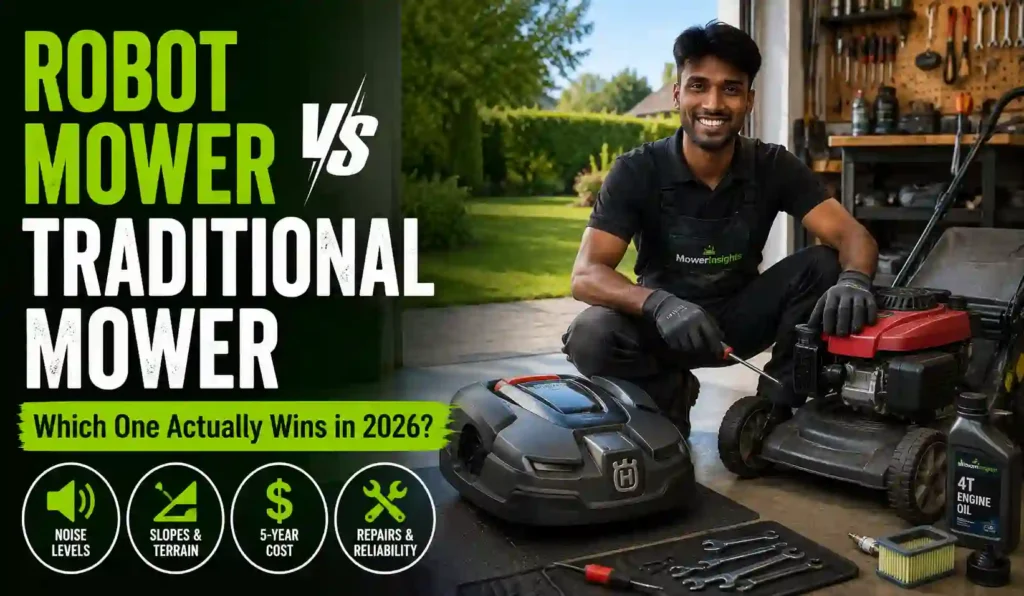
What You’re Actually Comparing
A robot mower drives itself. It cuts small bits of grass each day or two. It stays inside a wire, or a GPS zone. A normal mower cuts the whole lawn in one go. You push it, ride it, or run it on a set day.
This is not a fight over which mower is “best.” It is a fit test. Which routine works for your yard? Which fits your patience? A robot mower costs more up front. It takes some setup. Then it needs almost no work each week. A normal mower costs less. It gives you full say over when and how you cut.
Comparison Table: Specs Side-by-Side
| Spec | Robot Mower | Traditional Mower (Push/Self-Propelled) | Traditional Mower (Riding) |
|---|---|---|---|
| Typical price (2026) | €600 – €2,500 | €150 – €600 | €1,500 – €5,000 |
| Cutting width | 18 – 26 cm | 40 – 56 cm | 76 – 122 cm |
| Power source | Battery (Li-ion) | Gas or battery | Gas or battery |
| Max yard size (practical) | ~3,000 m² (top models) | Up to ~1,000 m² with ease | Up to 10,000+ m² |
| Max slope handled | 20 – 45% by model | Set by user’s grip and strength | 15 – 20% (safe limit) |
| Noise level | 55 – 65 dB | 75 – 95 dB (gas), 60 – 70 dB (battery) | 80 – 95 dB |
| Weekly time needed | 0 (after setup) | 30 – 90 min | 30 – 60 min |
| Setup work | High (wire or GPS map) | Low | Low |
| Average life span | 6 – 9 years | 8 – 12 years | 10 – 15 years |
Prices come from current brand and Amazon listings. Check them again close to your publish date. They shift with sales.
Robot Mowers: What They’re Good At
A robot mower’s main gift is time. It takes mowing off your list. It cuts small bits often. Most run every 1 to 3 days. The bits fall as fine mulch. You never bag grass. Your lawn stays at a fixed height. Most people can’t match that by hand.
Where robot mowers beat normal mowers:
- Even cuts. A robot mower cuts on a set plan. It does not care if you are busy or away. A normal mower waits for a person to show up.
- Better mulch. Small, frequent cuts break down fast. They feed the lawn. You use less feed.
- Quiet work. At 55-65 dB, it is quieter than a normal talk. This helps for early hours or shared yards.
- No fuel to deal with. No gas cans. No oil to change. No stale fuel in spring.
Where they fall short:
- Setup eats real time. Wire install for a mid-size yard takes 3 to 6 hours the first time.
- They struggle with grass over 10-12 cm. Thick leaves and tight paths give them trouble too.
- Most units can’t skip a patch for a party. You’d need the app for that.
In our shop, the top fix call is a torn or moved wire. The owner did not spot it. Next up: worn blades. This comes from small twigs and cones the unit can’t see.
Traditional Mowers: What They’re Good At
A push or riding mower gives you full say. You pick the height. You pick the path. You pick the day. On thick grass, or rough slopes, a strong engine cuts clean in one pass.
Where normal mowers beat robot mowers:
- More power on thick grass. A gas engine, or a strong battery motor, cuts dense grass in one pass. Most robots stall or need days to catch up.
- Better grip on rough ground. Riding mowers with good tires handle rough land well. Most robots use small wheels made for flat lawns.
- Cheap fixes. Blades, belts, plugs, and cables are cheap. You find them in any shop. Robot parts, like boards and sensors, often come from the maker alone. That costs more.
- No wire to keep up. Nothing to bury. No signal loss near trees or walls.
Where they fall short:
- They need your time each week in the grow months.
- Gas types need stored fuel, oil swaps, and winter prep.
- You must bag, mulch, or rake the cut grass. Unless you buy a mulch deck.
Best For X: Matching Mower to Yard
| Situation | Better Choice | Why |
|---|---|---|
| Yard under 1,500 m², flat, few things in the way | Robot mower | Setup pays off fast. Low work each week. |
| Yard over 20% slope on average | Traditional mower | Most robots stall or lose grip |
| Budget under €500 total | Traditional push mower | Good robots start near €600-800 |
| Renters or short stay | Traditional mower | No point burying wire in a yard you’ll leave |
| Owner who travels a lot | Robot mower | It keeps cutting while you’re away |
| Thick, fast grass (Bermuda, zoysia) | Traditional mower with a strong engine | One strong pass beats thin daily cuts |
| Large plot over 5,000 m² | Riding traditional mower | Robots at this size cost €2,500+ and still run slow |
| Loud-sensitive block or HOA | Robot mower | 55-65 dB vs 75-95 dB for gas mowers |
Head-to-Head Decision Logic
Want a fast call? Use this.
If your yard is under 1,500 m², mostly flat, with fewer than 5 things in the way, get a robot mower. The setup cost is worth the time it saves each week.
If your yard has slopes over 20%, thick grass, or tight paths under 60 cm wide, get a normal mower. Robots can’t fit tight gaps well. Most brands won’t cover slope harm past the rated limit.
If your budget is under €500 and you just need a reliable tool this year, get a push mower. Good robot mowers rarely dip below €600-700. The cheap ones tend to break within a year.
If you cut over 5,000 m², weigh a top robot mower against a riding mower. Look at time saved per month, not just the price tag. Past that size, robots may need to work in pairs. That shifts the math.
Noise, Slopes, and Wet Grass — The Numbers Nobody Gives You
Noise. Robot mowers run 55-65 dB. That is close to a quiet dishwasher. Gas push mowers run 75-95 dB. That is loud. Ear guards are a smart call for long use. Battery push mowers sit in between, at 60-70 dB.
Slopes. Most mid-price robots handle up to 20-25% grade. That is close to an 11-14 degree slope. Top models with strong wheel grip reach 40-45% grade. But that is a small slice of the market. It often costs €1,800 or more. Push mowers depend on your own footing more than the tool. Past 30% grade, it gets unsafe to walk. Riding mowers cap out near 15-20% grade for safe balance, no matter the engine.
Wet grass. Robot mowers tend to skip rainy days. Rain sensors block them from wet-grass runs. Cut bits clump and jam the disc on wet grass. Normal mowers can cut wet grass. But clumps still make the cut uneven. Wet grass can stall even a strong deck. Neither type does well on wet grass. That “myth” needs to die.
Thick or long grass. Robot mowers work best on grass under 10 cm. Past that height, most fail to cut clean. Some throw a jam error. Normal mowers, with a 150cc+ engine or the same in battery torque, cut grass up to 20-25 cm in one pass. For grass past 15 cm, a second pass at a lower height is a smart move. It avoids a scalped lawn.
Long-Term Ownership: Cost, Repairs, and What Breaks First
The price tag is not the whole cost. Here is a real 5-year cost view for a mid-range unit of each type. It comes from real parts prices and the fix trends we see in our shop.
| Cost Category | Robot Mower (mid-range) | Traditional Push Mower (gas) |
|---|---|---|
| Purchase price | €1,200 | €350 |
| Wire and install | €150 (DIY) – €400 (pro) | N/A |
| Yearly blade swap | €20-30 | €15-25 |
| Battery swap (year 3-4) | €150-250 | N/A |
| Yearly service | €60-100 | €40-70 (oil, filter, plug, blade sharpen) |
| Fuel (per year) | N/A | €60-100 |
| 5-year total (est.) | €1,850 – €2,400 | €900 – €1,300 |
A robot mower costs close to twice as much over 5 years. This counts new batteries and wire upkeep. That gap shrinks if you value your own time. A robot mower can save 25 to 75 hours a year, based on yard size.
What breaks first, by type:
On robot mowers, wire faults and dirty charge pins draw the most shop visits. A garden fork nicks buried wire. Rain leaves grime on charge pins. Those two cause most “my robot mower died” calls. The blade motor comes next. It jams on small bits it can’t dodge.
On gas mowers, the top fault is a fouled plug or a gummed-up fuel bowl. This comes from stale fuel left over winter. You can dodge this: drain the tank or add a fuel stabilizer before storage. Belt wear on self-drive types is the next most common fault, after 3-4 years of use.
Resale and repair ease. Normal mowers hold their worth better. Parts are the same across brands. Any local shop can fix them. Robot mowers lose worth fast. Resale is weak. Buyers worry about wire health and old batteries. Both are hard to check on a used unit.
Expert Tip: Buying a robot mower? Ask your installer, or do it your self: bury the wire at least 5 cm deep on any path where you’ll use a fork or edger. Shallow wire is the top cause of “my robot mower just stopped in the yard” calls we get.
Who This Is NOT For
Skip a robot mower if: your yard has a steep slope past the rated grade, your dog digs near buried wire, your grass often grows past 10-12 cm between cuts, or you can’t spare a weekend for first-time setup.
Skip a normal mower if: you have a health limit that makes weekly mowing hard, your plot is large and mowing eats half a day each week, or noise rules in your area block gas use in normal hours.
Frequently Asked Questions
Is a robot mower worth it for a small yard?
For a flat yard under 1,500 m², yes. The cost pays off in saved time. This often shows in one or two seasons. Frequent light cuts tend to make a lawn look healthier too.
Can a robot mower replace a normal mower for good?
For most home yards under 3,000 m² with mild slopes, yes. Very large plots, steep land, or tight paths still do best with a normal mower. Keep one on hand for edges and tight spots.
Do robot mowers work on hills?
Most mid-price robots handle up to 20-25% grade. Top models reach 40-45% grade but cost much more. Check the rated slope limit first. A slope past that limit can void your warranty.
How often do robot mowers need fixes vs normal mowers?
Robot mowers see more wire and part faults. Normal mowers see more wear items, like belts and plugs. Neither type is more solid than the other. The fault points just differ.
Is a robot mower cheaper than a normal mower over time?
No. In most cases, a robot mower costs more over 5 years. This counts new batteries and wire care. The trade is time, not cash. A robot mower saves real weekly work, at a higher total cost.
What yard size is too big for a robot mower?
Most home robot mowers cap out near 3,000 m². Past 5,000 m², a riding mower tends to work better. That is, unless you run two robot units at once.
Conclusion
Neither type wins flat out. A robot mower wins on ease, quiet, and steady lawn health for small to mid-size flat yards. A normal mower wins on price, raw power on thick grass, and cheap fixes over time. Match the tool to your yard size, your slope, and how much free time you’ll trade. The right pick will show fast.