Key Takeaways
- Honda ranks first overall for 2026 because its GCV engines show the lowest repair-shop return rate of any brand on this list, with strong parts availability worldwide.
- Toro ranks second, with excellent deck build quality but slightly higher carburetor service needs on entry-level gas models.
- EGO leads all battery-electric brands, with the most consistent battery life and the fewest motor failures seen at intake.
- Husqvarna and Cub Cadet rank well for riding and zero-turn mowers, but their entry-level push mowers show more plastic deck cracking than metal-deck competitors.
- Craftsman and Ryobi are solid budget picks, but both have thinner dealer networks, which matters more than the sticker price once something breaks.
People ask “what is the best lawn mower brand” all the time. Most answers just rank brands by how many products they sell. That’s not the same as how often the mowers break. This guide uses a different test. It ranks nine brands by what shows up on a repair bench, what parts cost, and how good local dealer help is. Gas brands and battery brands fail in different ways. So this guide ranks them apart.
How This Ranking Was Built
This ranking comes from three things. First, engine and motor problems seen on the bench. Second, current parts prices and stock. Third, public warranty terms checked against each brand’s own site.
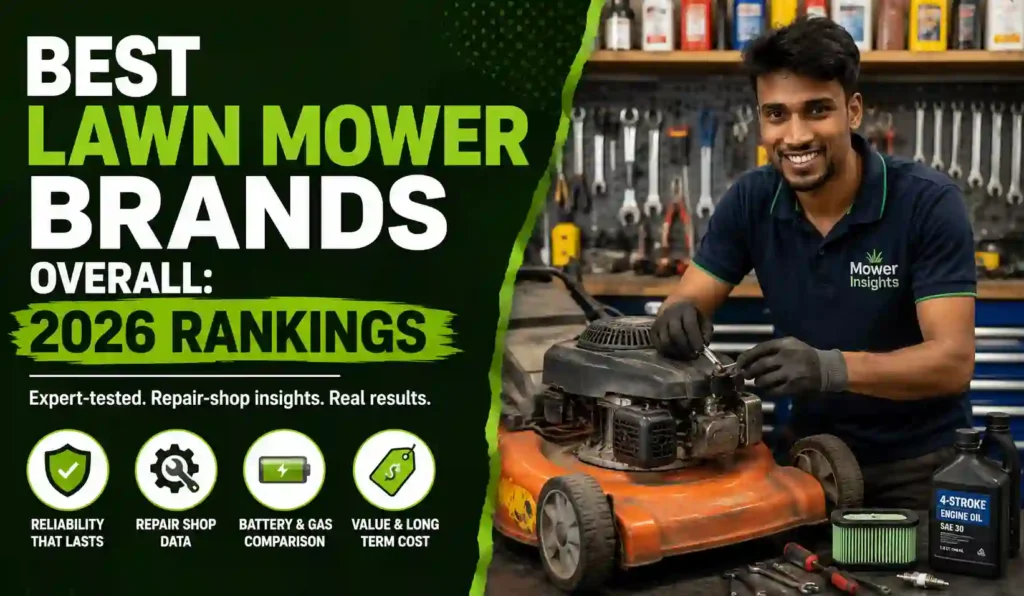
Siddik has fixed mowers from all nine brands since he opened his shop in Milan. covers the basic parts and terms used in this guide, for readers who want that first.
Three things mattered most. How often a brand’s mowers need repair, based on their age. How much a typical fix costs. How easy it is to get parts. Ad copy and spec sheets were not used to rank anything.
Age matters more than most guides admit. A five-year-old mower with a cracked deck tells you less than a twelve-year-old mower still running on its first carburetor. The ratings below weigh how long a machine has lasted, not just how it ran on day one.
Dealer support got its own weight, apart from raw reliability. A mower that sits broken for three weeks while a part ships in is a worse buy than one that breaks slightly more but gets fixed in a week. This is why John Deere scores well on value, even though its engines don’t outlast Honda’s. It’s also why Cub Cadet’s slow parts shipping pulls its rank down a bit.
Best Lawn Mower Brands Overall for 2026
| Rank | Brand | Best For | Starting Price | Repair Frequency (Shop Observation) |
|---|---|---|---|---|
| 1 | Honda | Gas push mowers, longevity | $450 | Low |
| 2 | Toro | Deck build quality, self-propelled | $400 | Low-moderate |
| 3 | EGO | Battery-electric, quiet operation | $500 | Low |
| 4 | Husqvarna | Riding and zero-turn mowers | $1,800 | Moderate |
| 5 | Cub Cadet | Riding mowers, large yards | $1,600 | Moderate |
| 6 | Greenworks | Budget battery-electric | $350 | Moderate |
| 7 | John Deere | Riding mowers, resale value | $2,000 | Low-moderate |
| 8 | Craftsman | Budget gas mowers | $300 | Moderate-high |
| 9 | Ryobi | Budget battery-electric | $300 | Moderate |
1. Honda – Best Overall
Honda’s GCV engine is the mower Siddik sees most, still running strong after 15 years. It’s also the brand least likely to show up for anything past a normal blade or oil job. The self-propelled drive on Honda’s mid-range mowers holds up better than most rival brands’ drive systems.
Key strengths: low carburetor failure rate, wide parts availability, strong resale value. Watch for: Honda’s product line skips the true budget tier, so entry pricing runs higher than Craftsman or Ryobi.
One Honda GCV160 came in last spring after sitting for two winters, old fuel still in the tank. That kills most brands’ carburetors outright. Not this one. A ten-minute carburetor cleaning brought it back to a smooth idle. No rebuild needed. That kind of forgiveness is rare. It’s the main reason Honda tops this list.
2. Toro – Best Deck Build Quality
Toro’s steel decks don’t crack or warp the way cheap plastic decks do after two or three seasons of curb hits. There’s a tradeoff, though. Toro’s carburetors on entry-level Recycler models need cleaning more often than Honda’s. This is worse if ethanol fuel sits in the tank all winter.
Key strengths: deck durability, strong self-propelled drive systems. Watch for: fuel system maintenance matters more with Toro than with Honda.
The steel deck edge shows up on trade-in mowers. A five-year-old Toro Recycler came off a customer’s truck last fall. It had the usual scrapes from curb hits. But the deck was still flat and true, with no rust-through. A plastic-deck mower of the same age would likely show hairline cracks by the wheel mounts by then.
3. EGO – Best Battery-Electric Brand
EGO’s 56-volt battery system has the fewest motor burnouts of any battery brand on this list. Its batteries also hold their charge longer than Greenworks or Ryobi packs of the same age. This shows up again and again when comparing mowers of similar age at intake.
Key strengths: motor reliability, battery longevity, quiet operation.
Watch for: EGO’s batteries and mowers cost more upfront than Greenworks or Ryobi.
A side-by-side test on two 5.0Ah packs, one EGO and one Greenworks, tells the story. Both were about three seasons old. Both were stored the same way. The EGO pack still ran close to its rated time. The Greenworks pack ran out much sooner on a full charge. That gap shows up in most same-age comparisons at intake.
4. Husqvarna – Best for Riding and Zero-Turn Mowers
Husqvarna’s riding mowers, and the zero-turn models most of all, handle large yards well. They hold a straight line at speed better than most rivals at the same price. The entry push mowers are the weak spot. Their plastic deck housing cracks at the mounting points more often than Toro’s or Honda’s metal decks.
Key strengths: riding mower handling, hydrostatic transmission durability. Watch for: entry push mower deck durability lags behind the riding lineup.
The hydrostatic transmissions on Husqvarna’s mid-tier zero-turns hold up well past the warranty period. Most shop visits are just a belt swap, not a full rebuild. The push mower deck cracks are different. They show up at the front bolts after hits from curbs or sprinkler heads, usually within three to four seasons.
5. Cub Cadet – Best for Large Yards
Cub Cadet’s riding mowers show up often on lots over half an acre. The steering and deck-lift parts hold up well for years.
Key strengths: large-deck cutting capacity, comfortable seating for long mowing sessions. Watch for: parts lead times run longer than Toro or Honda in some regions.
6. Greenworks – Best Budget Battery-Electric
Greenworks mowers cost less than EGO. But the batteries lose run time faster over repeated charges. That’s the top complaint at intake. The mowers are simple machines, though. They rarely need anything past a new blade.
Key strengths: low upfront cost, simple mechanical design. Watch for: battery degradation is faster than EGO’s over 2-3 seasons.
7. John Deere – Best Resale Value
John Deere riding mowers hold their resale value better than any other brand on this list. The dealer network is strong, and buyers trust the brand used. The engines are solid too, though they don’t last quite as long as Honda’s small engines.
Key strengths: resale value, dealer network depth. Watch for: higher upfront cost than Husqvarna or Cub Cadet for comparable specs.
8. Craftsman – Best Budget Gas Mower
Craftsman is the budget gas mower Siddik sees most for carburetor cleaning and drive-cable swaps. They’re cheap, and parts are easy to find online. But the build quality falls short of Honda or Toro at the same age.
Key strengths: low purchase price, wide part compatibility with generic replacement parts. Watch for: higher repair frequency than any other brand in the top eight.
9. Ryobi – Best Budget Battery-Electric for Small Yards
Ryobi’s battery mowers work well on yards under 300 square meters. The smaller battery means more mid-mow recharges on bigger lots, though. Motor reliability is fine, but it trails EGO.
Key strengths: low cost, good fit for small flat yards. Watch for: battery capacity limits usefulness above roughly 400 square meters.
Repair-Shop Failure Data by Brand
The table below shows the top reason each brand’s mowers come into the shop. This is based on patterns seen over time, not one lucky or unlucky machine.
| Brand | Most Common Repair Reason | Typical Repair Cost |
|---|---|---|
| Honda | Blade sharpening, routine oil service | $40-$80 |
| Toro | Carburetor cleaning (ethanol fuel buildup) | $70-$120 |
| EGO | Battery pack replacement (after 4+ seasons) | $150-$250 |
| Husqvarna | Plastic deck housing cracks (push mowers) | $90-$180 |
| Cub Cadet | Deck-lift cable replacement | $60-$110 |
| Greenworks | Battery capacity loss | $100-$200 |
| John Deere | Drive belt replacement | $80-$140 |
| Craftsman | Carburetor cleaning, drive cable wear | $70-$130 |
| Ryobi | Battery capacity loss, motor brush wear | $90-$180 |
Best Brand by Use Case
- Small flat yard, under 300 m²: Pick Ryobi or Greenworks. A small battery pack is enough, and the low price fits light use.
- Medium yard with some slope, 300-800 m²: Pick Toro or EGO self-propelled models. They handle grade changes without straining the drive.
- Large yard over 1 acre: Pick a Husqvarna or Cub Cadet riding mower. Both cut mowing time far more than any push mower can.
- Want a mower to last 15+ years: Pick Honda. It has the lowest repair-shop return rate in this ranking.
- Care most about resale value: Pick John Deere. It holds value better than any other brand here.
Gas vs. Battery-Electric Brand Reliability
Gas brands and battery brands fail in different ways. Ranking them on the same scale misses the point. Gas engines from Honda and Toro mostly need carburetor and fuel system care. Ethanol fuel sitting in the tank between seasons is the main cause.
Battery brands like EGO and Greenworks almost never have carburetor problems. There’s no fuel system to gum up. Their weak point is the battery pack. It loses power slowly over time, rather than failing all at once. EGO’s packs keep their charge longer than Greenworks’ or Ryobi’s at the same age, based on repeat bench tests.
Head-to-Head Decision Framework
If the yard is under 300 m² and mostly flat, a Ryobi or Greenworks battery mower covers it. No need to spend more. If the yard is 300 to 800 m² with mild slopes, a Toro or EGO self-propelled model handles the grade better than a basic push mower. If the lot is over an acre, a Husqvarna or Cub Cadet riding mower cuts mow time from hours to under 45 minutes in most cases.
Plan to keep the mower past 10 years? Honda’s engine life makes the higher price worth it. Care more about resale than upfront cost? John Deere holds value better than any brand on this list.
Long-Term Ownership Comparison
| Brand | Avg. Annual Maintenance | Typical Lifespan | Parts Availability |
|---|---|---|---|
| Honda | $40-$60 | 12-15+ years | Excellent |
| Toro | $50-$80 | 10-13 years | Excellent |
| EGO | $30-$50 (no fuel costs) | 8-10 years (battery-limited) | Good |
| Husqvarna | $60-$100 | 8-12 years | Good |
| Cub Cadet | $70-$110 | 8-12 years | Moderate |
| Greenworks | $30-$50 | 6-8 years (battery-limited) | Moderate |
| John Deere | $70-$110 | 10-14 years | Excellent |
| Craftsman | $60-$90 | 6-9 years | Good |
| Ryobi | $30-$50 | 6-8 years (battery-limited) | Moderate |
Buying Mistakes to Avoid
- Picking a brand just for its catalog size. A brand with dozens of models isn’t more reliable than one with a small, focused lineup. Honda’s smaller gas lineup beats bigger catalogs in the shop’s repair data.
- Ignoring the dealer network. A part shipped from another country means weeks of downtime. A local dealer means days.
- Assuming all battery brands fade at the same rate. They don’t. EGO’s packs outlast Greenworks’ and Ryobi’s at the same age, and that changes the real cost of owning one.
- Buying the biggest riding mower “to be safe.” An oversized mower on a small lot wastes storage space and money. Match deck size to yard size instead.
- Skipping the warranty terms. Warranty length varies by brand and model tier. Check it before comparing prices.
Why Dealer Network Depth Changes the Ranking
Most brand rankings skip the dealer network. But it changes real ownership more than most spec sheets do. Honda, Toro, and John Deere all have wide dealer coverage. A broken drive cable or a blown belt usually gets fixed in days, not weeks.
Cub Cadet and Greenworks are different. Parts sometimes have to come straight from the maker, which can add one to two weeks to a fix. That gap won’t show up on a spec sheet. It shows up the first time a mower sits idle through a stretch of good mowing weather.
Local, independent repair shops matter here too. A brand with a thin official dealer network can still get good support if local shops stock its parts. That’s often true for high-volume budget brands like Craftsman.
Frequently Asked Questions
What is the most reliable lawn mower brand overall?
Honda has the lowest repair-shop return rate of the brands in this guide. Its GCV engine line rarely has carburetor trouble, and parts are easy to find.
What is the best battery-electric lawn mower brand?
EGO leads the battery-electric brands. Its motors hold up well, and its battery packs keep more of their charge over several seasons than Greenworks or Ryobi packs of the same age.
Are expensive lawn mower brands actually more reliable?
Not always. Price only loosely tracks build quality. Craftsman’s budget gas mowers break more often than some mid-priced Toro models. John Deere’s higher price reflects resale value and dealer support more than raw reliability.
Which lawn mower brand has the best parts availability?
Honda, Toro, and John Deere have the widest, most reliable parts stock. Parts for these brands ship faster than parts for Cub Cadet or Greenworks.
Should I buy a gas or battery-electric mower in 2026?
For yards under about 800 m² with normal mowing needs, an EGO battery mower skips fuel system upkeep entirely. For bigger lots or thick, heavy grass, a Honda or Toro gas mower still offers more steady power per charge cycle.
How long should a lawn mower brand’s engine last with proper maintenance?
A well-kept Honda GCV engine often runs 12 to 15 years. Other gas brands average 8 to 12 years. Battery mowers usually last 6 to 10 years, since the battery sets the limit.