Quick Overview
- If you’re weighing Stihl 261 vs 271 Chainsaws, the short answer is: the MS 261 is a professional saw built for daily use, and the MS 271 Farm Boss is a homeowner saw built for occasional cutting.
- Both run the same 50.2 cc engine, but the MS 261 makes more power (3.8 hp vs 3.5 hp) and weighs less (10.8 lbs vs 12.3 lbs).
- The MS 261 costs roughly $200-$260 more, priced around $760 to $800 versus $520 to $540 for the MS 271.
- Buy the MS 261 if you cut firewood every week or run the saw professionally. Buy the MS 271 if you cut a few cords a year.
- Neither saw is the wrong choice – they’re built for different amounts of use, not different skill levels.
Stihl 261 vs 271 Chainsaws comes down to how often you’ll actually pull the starter cord. The MS 261 is STIHL’s professional mid-size saw: lighter, more powerful, and built with better internals for saws that run for hours at a time. The MS 271 Farm Boss is the homeowner version of the same size class – a solid, durable saw, but built to a lower price point and a lighter duty cycle. Occasional users save money with the 271. Frequent users get more saw, and lower long-term repair costs, from the 261.
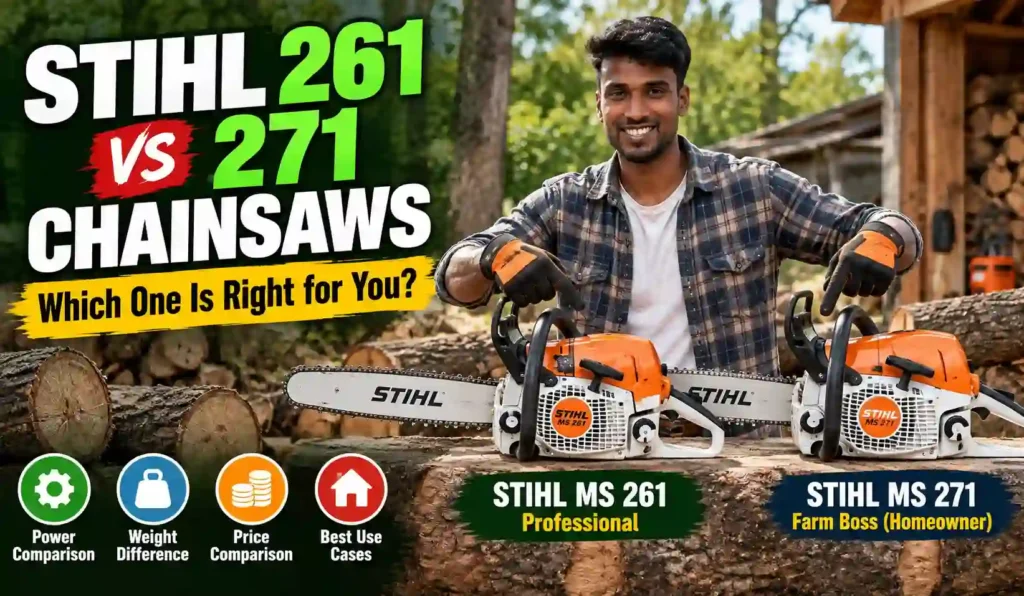
Stihl 261 vs 271 Chainsaws: Key Differences at a Glance
Both saws share the same 50.2 cc displacement, which confuses a lot of buyers into thinking they’re the same saw with a different sticker. They aren’t. The engine tuning, weight, and internal components all differ.
| Spec | STIHL MS 261 | STIHL MS 271 Farm Boss |
|---|---|---|
| Grade | Professional | Homeowner / farm |
| Displacement | 50.2 cc | 50.2 cc |
| Power output | 3.8 hp (2.8 kW) | 3.5 hp (2.6 kW) |
| Powerhead weight | 10.8 lbs (4.9 kg) | 12.3 lbs (5.6 kg) |
| Recommended bar length | 16-20 in | 16-20 in |
| Chain tensioning | Side-access; quick-adjust on the C-M model | Side-access |
| Air filtration | Long-life, pre-separation | Long-life, pre-separation |
| Typical US price | $760-$800 | $520-$540 |
The gap that surprises most buyers: the MS 261 is the lighter saw, even though it’s the more powerful one. STIHL builds the 261’s housing and internal parts to hold up under constant use, which usually means more weight, not less. Here it’s the opposite, because the pro-grade castings are lighter-duty aluminum and magnesium rather than the heavier material used in the homeowner-grade 271.
MS 261: What It’s Built For
The MS 261 is a professional saw meant to run all day, several days a week, without falling apart. Tree crews, landscapers, and firewood processors who cut for a living use this size class because it’s light enough to swing all day and strong enough to not need constant repairs.
What worked:
- Noticeably lighter in hand than the 271, which matters after an hour of limbing
- Power delivery feels stronger through the cut, not just on paper
- The C-M variant’s automatic engine tuning keeps the saw running right through altitude and temperature changes without carburetor adjustments
What didn’t:
- The extra cost only pays off if you’re actually running the saw often – light users won’t notice the difference
- Parts and service for the professional line cost more than the homeowner line
Rating: 8.5/10
Best for: anyone cutting firewood weekly, running a tree service, or putting more than 20-30 hours a year on the saw.
MS 271 Farm Boss: What It’s Built For
The MS 271 Farm Boss is STIHL’s answer for a homeowner who needs a real chainsaw, not a $150 big-box saw, but doesn’t need professional-grade internals. It’s built to the same 50.2 cc size as the 261, priced to compete with mid-tier homeowner saws from other brands.
What worked:
- Handles typical yard work – felling small trees, cutting firewood a few times a year, storm cleanup – without strain
- Same long-life air filter system as the 261, so maintenance intervals are similar
- Meaningfully cheaper, which matters if the saw sits in the garage most of the year
What didn’t:
- The extra 1.5 lbs is noticeable during longer cutting sessions
- Slightly less power at the same displacement means it works a bit harder in bigger wood
Rating: 8.0/10
Best for: homeowners cutting a few cords of firewood a year, occasional storm cleanup, or general property upkeep.
Power and Cutting Performance
The MS 261 makes 3.8 hp from its 50.2 cc engine. The MS 271 makes 3.5 hp from the same displacement. That 0.3 hp gap sounds small, but it shows up in bigger wood – the 261 pulls through an 18-inch oak round noticeably faster than the 271 at the same bar length.
Both saws handle 16 to 20-inch bars, so bar length isn’t the differentiator here. The engine tuning is. STIHL builds the 261’s internals – piston, cylinder porting, ignition timing – to sustain higher output over longer runtimes. The 271’s tuning favors fuel efficiency and a longer service life at lower duty cycles.
For occasional cutting, the difference in raw power is barely noticeable. For someone running the saw for hours, it adds up.
Weight and Ergonomics
At 10.8 lbs, the MS 261 is 1.5 lbs lighter than the 271’s 12.3 lbs. That doesn’t sound like much until you’ve held a chainsaw overhead or out at arm’s length for an hour straight – every pound matters to your shoulders and forearms by the end of a workday.
The 271’s extra weight comes from its housing and internal components, which use heavier materials to hit a lower price point. It’s not a flaw. It’s a trade-off that makes sense for a saw that runs a few hours a month instead of a few hours a day.
Build Quality and Durability
The MS 261 uses professional-grade bearings, a stronger clutch assembly, and tighter tolerances throughout the engine. That’s what “professional” means in STIHL’s lineup – not just more power, but parts built to survive thousands of hours of use.
The MS 271 is still a genuine STIHL saw, not a budget import. It uses the same 2-MIX engine technology and the same long-life air filtration system as the 261. The difference shows up over time: a 271 run hard, every day, for years will need more frequent repairs than a 261 in the same role. A 271 used a few dozen hours a year will likely outlast its owner’s need for it.
Maintenance and Long-Term Cost
Both saws use the same long-life, pre-separation air filter design, so air filter changes happen on a similar schedule for both. Chain tensioning is side-access on both, with the 261’s C-M variant adding a tool-free quick-adjust feature the base 271 doesn’t have.
Where the cost gap really shows up is parts and repair frequency. Professional-line parts (261) cost more individually, but the saw needs them less often under heavy use. Homeowner-line parts (271) cost less individually, but a saw pushed into professional-level use will need them more often. Match the saw to your actual duty cycle and the maintenance cost works out fine either way.
Price and Value
The MS 261 runs about $760 to $800 depending on bar length and variant. The MS 271 Farm Boss runs about $520 to $540. Prices may vary by retailer and change over time.
That $200-$260 gap buys you more power, less weight, and parts built for higher duty cycles. If you’re not going to use that extra capacity, you’re paying for headroom you won’t touch. If you are, the 261 pays for itself in fewer repairs and less fatigue over a season of real use.
Stihl 261 vs 271 Chainsaws: Which One Should You Buy?
- You cut firewood every week, or for a living: get the MS 261. The lighter weight and extra power matter over hundreds of hours a year.
- You cut a few cords a year, or handle occasional storm cleanup: the MS 271 Farm Boss does the job for meaningfully less money.
- You’re upgrading from a big-box homeowner saw: either one is a real step up, but the 271 gets you STIHL build quality at a homeowner price.
- You’re on a tight budget but want to cut often: buy the 261 anyway if you can – a homeowner saw run at professional duty cycles wears out faster and costs more in repairs over time.
Common Mistakes When Choosing Between Them
- Assuming the higher model number means more saw. The 271 has a higher number but is the homeowner-grade saw. STIHL’s naming isn’t purely sequential by capability.
- Buying the 271 for daily professional use to save money upfront. It’ll cost more in repairs and downtime than the 261 would have over a year of heavy use.
- Buying the 261 for occasional yard work. You’ll pay professional pricing for capability you won’t use.
- Ignoring bar length compatibility. Both saws handle 16-20 inch bars, so bar length shouldn’t be the deciding factor between them.
Frequently Asked Questions
What is the real difference in Stihl 261 vs 271 Chainsaws?
The MS 261 is a professional-grade saw with more power (3.8 hp) and less weight (10.8 lbs). The MS 271 Farm Boss is a homeowner-grade saw with slightly less power (3.5 hp) and more weight (12.3 lbs), at a lower price.
Is the MS 261 worth the extra money over the MS 271?
It depends on how much you’ll use it. For weekly or professional cutting, yes – the 261 costs less in repairs and fatigue over time. For occasional yard work, the 271 does the job for less money.
Can the MS 271 handle firewood cutting?
Yes. The MS 271 Farm Boss is built specifically for firewood cutting, storm cleanup, and general property work. It just isn’t built for daily, all-day use the way the 261 is.
Do the MS 261 and MS 271 use the same bar and chain?
Both accept 16 to 20-inch bars and use the same .325-inch pitch chain, so bars and chains are generally interchangeable between them.
Which saw is easier to maintain?
Both use the same long-life, pre-separation air filter system, so routine maintenance is similar. The 261’s C-M variant adds a tool-free chain tensioner that makes field adjustments faster.
Is there a big price difference between the two saws?
Yes. The MS 261 typically runs $760 to $800, while the MS 271 Farm Boss runs $520 to $540, a gap of roughly $200 to $260.
Final Verdict
Stihl 261 vs 271 Chainsaws isn’t a question of which saw is better – it’s a question of which saw matches how much you’ll actually use it. The MS 261 is the right call for anyone cutting firewood regularly or running the saw professionally: it’s lighter, stronger, and built to survive heavy use. The MS 271 Farm Boss is the right call for homeowners handling occasional cutting and storm cleanup, at a meaningfully lower price. Buy for your actual duty cycle, not for the biggest number on the spec sheet.
Why Trust This Guide
MowerInsights.com comes out of hands-on outdoor power equipment repair work, including gas-powered saws and mowers from major brands like STIHL. This comparison draws on manufacturer spec sheets, published retail pricing, and real-world repair patterns seen across professional and homeowner-grade two-stroke engines.