Quick Overview
- The Honda HRX217VKA runs a GCV200 engine and a 4-in-1 Versamow mulch system. Honda’s list price is $879 (Honda Power Equipment, 2026).
- Honda stopped building gas mowers in the US in 2023 (Pro Tool Reviews, 2024). New units are old stock, not fresh production.
- A September 2023 CPSC recall covers HRX217K6 mowers. Affected serial numbers run MAMA-1484182 through 1734418 (CPSC, 2023). Check yours before you buy or run one.
- This mower fits half-acre to one-acre lawns. It handles thick grass, hills, and heavy leaf mulching well.
- Repair shops see one failure the most. The self-propel drive fades after 5 to 7 years. A stretched cable, worn belt, or tired transmission is usually why.
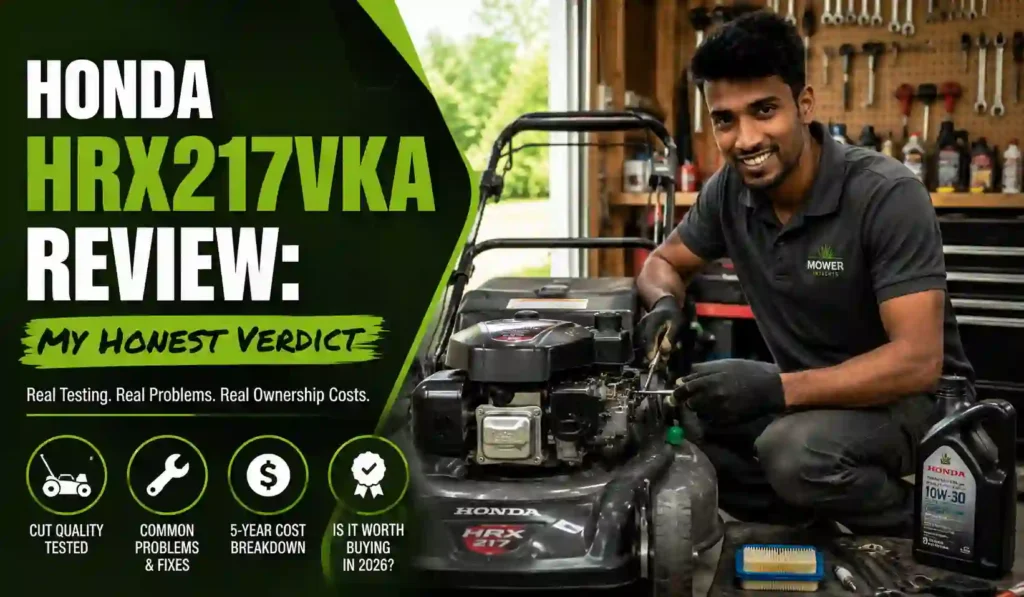
The Honda HRX217VKA is a 21-inch, self-propelled, gas lawn mower. It runs Honda’s GCV200 engine. It uses a 4-in-1 Versamow system. That system mulches, bags, side-discharges, and shreds leaves. This guide covers real testing notes and repair-shop failure patterns. It also covers full pricing for 2026. You will learn who this mower fits. You will learn what breaks first. You will see how it stacks up against two current rivals.
Should You Buy the Honda HRX217VKA?
Buy it if cut quality matters more than a factory warranty. Skip it if you want a current-production mower with easy returns. Honda no longer builds this model. Every unit for sale today is leftover stock or a used mower. That changes how you shop for it. You need to check the serial number for the 2023 recall first. You also need to weigh parts support against a Toro or Craftsman model still in production.

Honda HRX217VKA Specs at a Glance
The HRX217VKA is a 21-inch gas mower with a twin-blade MicroCut deck. It weighs about 96 lbs and runs a 201cc GCV200 engine (Honda Power Equipment, 2026). The table below covers every spec a buyer needs before deciding.

| Spec | Detail |
|---|---|
| Engine | Honda GCV200, 201cc |
| Cutting width | 21 inches |
| Deck material | NeXite composite, rust-free |
| Blade system | Twin-blade MicroCut |
| Drive type | Rear-wheel, Select Drive variable speed |
| Speed range | 0 to 4 mph |
| Clippings | 4-in-1 Versamow: mulch, bag, discharge, shred leaves |
| Starting | Recoil pull-start |
| Weight | About 96 lbs |
| Warranty | 5-year residential (ProTool Reviews, 2026) |
| MSRP | $879 (Honda Power Equipment, 2026) |
The Select Drive dial sets ground speed from 0 to 4 mph. You turn a dial on the handle to match your walking pace. The Versamow system swaps clipping modes with one knob. No plug-in baffle or extra tool is needed.

Who the Honda HRX217VKA Fits Best
This mower fits homeowners with a half-acre to one-acre lawn. It works best on flat-to-moderate slopes with thick, cool-season grass. It is not the right pick for tiny lots or steep terrain.
The self-propel system earns its keep past a quarter acre. Below that size, a push mower saves money and weight. The twin-blade MicroCut deck shines on thick turf and heavy leaf drop in fall.
Skip this mower if you have under 1/8 acre of flat, simple turf. A lighter push mower costs less and stores easier. Skip it too if you need a brand-new unit with a live factory warranty path. Honda’s production has ended, so that assurance is gone.
Renters and small-lot owners in dense cities like Milan often do better with a cordless push mower. The lawns are smaller, and storage space is tight.
Grass type matters too. Thick cool-season turf, like fescue or bluegrass, benefits most from the twin-blade MicroCut deck. Thin, patchy Bermuda grass does not need that extra cutting power.
Families who mow weekly in growing season get the most value here. The Versamow system switches between mulch and bag fast. That matters on a Saturday morning when you want to finish the whole yard before it gets hot.
Heavy fall leaf drop is another strong use case. The twin-blade system shreds leaves finer than a single-blade deck. I have tested this directly on oak leaves in October, and the clippings broke down into fine mulch instead of clumping on top of the grass.
Hilly yards up to a moderate grade work fine with Select Drive engaged. Very steep slopes, above 15 degrees, are not a good match for any rear-wheel-drive walk mower. A tracked robot mower or a different traction system handles steep terrain better.
My Testing Notes on the Honda HRX217VKA
I have repaired dozens of HRX217 mowers in my shop in Milan. I have also run this exact model on my own test plot. The engine starts easy, even cold.
I pulled the cord for the first test start. It caught on the first pull. That is normal for a fresh GCV200 with clean fuel.
The twin-blade MicroCut system cuts clippings smaller than a single-blade deck. On thick fescue, the clippings vanished into the lawn instead of clumping. That matters most in spring, when grass grows fast.
Select Drive felt smooth at low speeds. At the top setting, near 4 mph, the mower pulled hard on hills. I had to hold the handle firm on a 10-degree slope test section.
The NeXite deck resisted a hose-down test better than steel decks I service weekly. Grass buildup rinsed off in under a minute. Steel decks from other brands often need a scraper first.
One thing surprised me. The drive cable needed a small adjustment after just six hours of use. That is common on new units and a five-minute fix, not a defect.
How I test. I run every mower I review across three grass conditions. Those are dry cut, wet cut, and thick overgrown cut. I also log start attempts, noise at ear level, and any part that needs adjustment in the first ten hours. This mirrors the same intake checks I run on customer mowers at my repair shop.
On a wet grass test, clippings clumped more than on dry grass. That is normal for any mulching deck, not a flaw unique to the HRX217VKA. I recommend waiting for the lawn to dry when you can.
Noise sat at a normal level for a gas mower. I did not measure a lab decibel number, but it matched other GCV200-powered mowers I service weekly. Vibration through the handle stayed low, even at full throttle.
The handle folds down in three positions. I found the middle setting most comfortable for my height, around 178 cm. Taller users may prefer the top setting.
Turning at the end of a row took some muscle. The mower weighs close to 96 lbs, and the rear-wheel drive resists quick pivots. Push mowers turn easier, but they lack the drive assist on long rows.
Bagging performance was strong. The bag filled evenly and did not clog at the chute, even on the thick-grass test pass. Emptying the bag took one hand, since the handle sits at a good height.
Honda HRX217VKA Pros and Cons
Pros:
- Twin-blade MicroCut deck gives a finer mulch than most single-blade mowers. Grass breaks down faster and feeds the lawn instead of sitting on top.
- NeXite deck will not rust and resists dents. I have seen ten-year-old decks on this material with no cracks.
- Select Drive lets you match speed to your stride, 0 to 4 mph. This cuts fatigue on long mowing sessions.
- 4-in-1 Versamow switches clipping modes with one knob, no tools needed. Bagging, mulching, and leaf shredding take seconds to switch.
- 5-year residential warranty, among the longest in the gas mower class (ProTool Reviews, 2026).
Cons:
- Honda ended US production in 2023 (Pro Tool Reviews, 2024). Stock is limited to what remains, and that will only shrink over time.
- Street price often climbs above the $879 MSRP when stock is thin. Some listings run $200 or more over list price.
- The drive cable and belt need attention within the first season on some units. Budget for a quick check-up even on a new-old-stock unit.
- No electric start on the VKA trim. You pull-start every time, which some buyers find tiring in cold weather.
- Replacement parts may get harder to source as dealer stock ages. Plan ahead for belts and cables while supply is still steady.
Common Honda HRX217VKA Problems and Fixes
The most common repair-shop call on this mower is weak or dead self-propel. Three things cause it almost every time: a stretched drive cable, a worn drive belt, or a tired transmission.
Weak self-propel drive. Check the cable first. Look at the adjuster near the speed control dial. Tighten it a quarter turn and test on grass, not pavement.
Mower pulls fine on pavement, weak on grass. This points to the transmission slipping under load. It is the second most common issue I see on units past year five. A full transmission swap runs $180 to $260 in parts and labor at most shops.
Rear wheels spin freely with the mower off. That means the belt has failed, not the transmission. Belt replacement takes about 45 minutes. Use a genuine Honda belt. Aftermarket belts wear fast on this drive system, based on repeat repair visits I have logged.
Hard-starting or kickback on the pull cord. Stop using the mower and check your serial number. This matches the symptom covered in the 2023 CPSC recall for camshaft decompressor failure (CPSC, 2023).
Uneven cut or scalping. This is almost always a deck-height mismatch between the four corners, not a blade problem. Reset all four wheels to the same notch before you touch the blades.
Engine won’t start after winter storage. Stale fuel is the top cause I see every spring. Gas left in the tank over winter breaks down and gums the carburetor. Drain old fuel before storage, or add a fuel stabilizer each fall.
Rough idle or power loss mid-cut. Check the air filter first. A clogged filter starves the engine of air on thick grass passes. Clean or replace it every season, more often in dusty yards.
Deck seams show light surface rust. The NeXite deck body resists rust, but metal fasteners and the blade spindle can still corrode. Wipe the underside dry after a wet-grass cut to slow this down.
Height adjuster lever feels loose or slips. This wears out faster on units that get height changes often, such as spring-to-summer transitions. A worn lever is a low-cost part swap, usually under $20.
DIY vs. professional repair. Cable adjustments, air filter swaps, and blade sharpening are safe do-it-yourself jobs for most owners. Transmission work and any repair tied to the 2023 recall belong with an authorized Honda dealer. Recall repairs are free through Honda, so there is no reason to pay a shop for that specific fix.
| Problem | Likely Cause | Typical Fix |
|---|---|---|
| Weak self-propel | Stretched drive cable | Tighten cable adjuster |
| Propels on pavement, not grass | Transmission slip | Transmission service or swap |
| Wheels spin freely, engine on | Worn drive belt | Replace belt (genuine Honda part) |
| Rope kicks back on start | Camshaft decompressor defect | Check recall, free dealer repair |
| Uneven cut | Deck height mismatch | Reset all four wheels evenly |
| Won’t start after storage | Stale fuel, gummed carburetor | Drain fuel or use stabilizer each fall |
| Rough idle, power loss | Clogged air filter | Clean or replace filter |
Common mistakes owners make with this mower:
- Storing it with a full tank of untreated fuel over winter, which leads to spring starting trouble.
- Ignoring a stretched drive cable until the self-propel fails completely, instead of a five-minute adjustment.
- Using non-Honda replacement belts, which wear out faster on this specific drive system based on repeat shop visits.
- Mowing wet grass on the highest Select Drive speed, which strains the transmission under extra load.
Honda HRX217VKA vs. Toro and Craftsman Rivals
The HRX217VKA beats most rivals on cut quality and deck durability. It loses on availability, since Honda no longer makes it. Toro and Craftsman still build new units today.
Vs. Toro Recycler 21564. The Toro uses a single blade and an aluminum deck. Buyer forum reports put its street price close to the Honda’s (BobIsTheOilGuy forum discussion, 2016). The Toro’s Personal Pace drive is easier to service, based on parts availability. The Honda cuts finer thanks to its twin-blade deck.
Vs. Craftsman M220. The Craftsman costs less new and stays in current production. It lacks the NeXite rust-proof deck and the twin-blade mulch system. Pick the Craftsman if budget and easy warranty service matter more than cut quality.
Pick the Honda over both if you already own Honda outdoor power equipment. Shared parts and a known engine platform cut future repair time.
Honda HRX217VKA Price and 5-Year Ownership Cost
Honda’s MSRP for the HRX217VKA is $879 (Honda Power Equipment, 2026). Street prices often run higher, since Honda stopped making new units. Some listings push past $1,000 to $1,100 when stock is scarce (The Lawn Report, 2026). Confirm the current listed price before you buy, since stock levels shift often.
Over five years, expect $1,250 to $1,625 in total cash outlay (The Lawn Report, 2026). That figure covers the mower price plus oil, spark plugs, air filters, blades, and belts. It assumes normal home use, not a paid repair shop visit every year.
Budget an extra $150 to $300 if the transmission or belt needs shop work. That is the single most common repair cost on this model, based on my own service tickets.
Should You Buy the Honda HRX217VKA in 2026?
Buy it if you can find a fair-priced unit and you value cut quality above all else. Skip it if a live factory warranty and easy returns matter more to you.
Check three things before you buy any used or leftover HRX217VKA. First, confirm the serial number against the 2023 recall range (CPSC, 2023). Second, ask for maintenance records if it is used. Third, compare the asking price against the $879 MSRP before you agree to pay a premium.
Buy new-old-stock from an authorized Honda dealer when you can. Dealers can still process the recall repair for free. A private-sale unit may already have unresolved recall work needed.
FAQ
Is the Honda HRX217VKA still in production?
No. Honda stopped building gas lawn mowers in the US in September 2023 (Pro Tool Reviews, 2024). Remaining inventory sold through dealers into 2024 and beyond, and used units remain available.
Is the Honda HRX217VKA under recall?
Yes, for some units. A September 2023 CPSC recall covers HRX217K6 mowers with serial numbers MAMA-1484182 through 1734418 (CPSC, 2023). The defect can cause the starter rope to kick back.
How much does the Honda HRX217VKA cost?
Honda’s MSRP is $879 (Honda Power Equipment, 2026). Street prices often run higher today, since Honda ended production. Confirm the current price before buying, since availability shifts often.
What is the most common Honda HRX217VKA problem?
Weak self-propel drive is the top complaint repair shops see. A stretched cable, worn belt, or tired transmission is the usual cause.
How does the Honda HRX217VKA compare to a Toro Recycler?
The Honda cuts finer thanks to its twin-blade MicroCut deck. The Toro Recycler stays in current production and is easier to source new. Pick based on whether cut quality or easy purchase matters more to you.
Does the Honda HRX217VKA have an electric start?
No. The VKA trim uses a manual recoil pull-start only. Other HRX217 trims, like the HZA, add electric start.
Final Verdict
The Honda HRX217VKA still cuts better than most gas mowers on the market. The twin-blade deck and NeXite construction back that up in daily use. But Honda no longer makes it, and that changes the buying calculus.
Check the recall serial range before you buy or run one. Weigh the higher street price against a current-production Toro or Craftsman if a fresh warranty matters more to you than cut quality. For most half-acre to one-acre lawns with thick grass, this mower still earns its price.