At a Glance
- A lawn mower is a walk-behind or push machine. It works best on yards under 1,000 square meters (about a quarter acre).
- A lawn tractor is a riding machine. You sit on it. It works best on yards over 2,000 square meters (about half an acre).
- Lawn tractors cost more to buy. A basic model starts around $1,600. Most mowers start under $400.
- Lawn tractors also cost more to fix. In Siddik’s shop, a tractor repair often runs two to three times the price of a mower repair.
- Yard size is the main factor. Slope, budget, and storage space matter too.
What “Lawn Mower vs Lawn Tractor” Actually Means
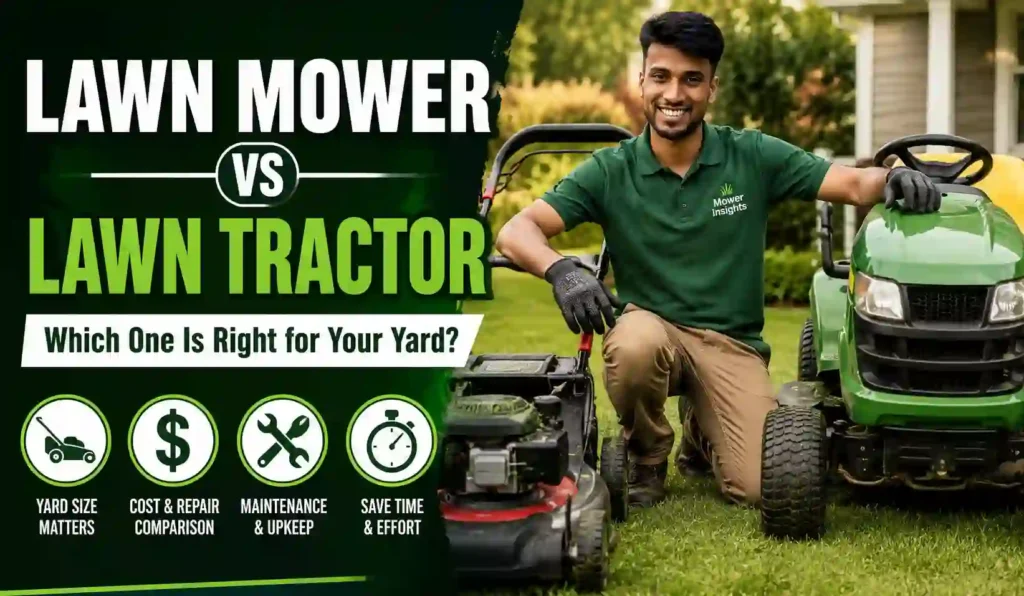
A lawn mower is a small machine you push or walk behind. A lawn tractor is a bigger machine you sit on and drive. The real difference is not just size. It is how much yard each one can handle in a set amount of time. This guide breaks down the cost. It covers the repair history too. It shows the exact yard size where one machine makes more sense. Siddik has repaired both types for years in his Milan shop. That repair data shapes every section below.
The Core Difference
A lawn mower is a walk-behind machine for small yards. A lawn tractor is a ride-on machine for large yards. The line usually falls around 1,000 to 2,000 square meters. Below that, a mower makes more sense. Above that, a tractor saves real time. Price is the second factor. Mowers cost less to buy and less to fix. Tractors cost more up front and more per repair visit.
Comparison Table: Mower vs Tractor at a Glance
| Feature | Lawn Mower | Lawn Tractor |
|---|---|---|
| How you use it | Push or walk behind | Sit and drive |
| Best yard size | Under 1,000 m² (about 10,800 sq ft) | Over 2,000 m² (about half an acre) |
| Cutting width | 40-56 cm (16-22 in) | 90-120 cm (36-48 in) |
| Power source | Gas, battery, or electric cord | Gas (most models) |
| Starting price | Under $400 | Around $1,600 and up [VERIFY: current entry-level tractor price] |
| Top speed | Walking pace | 6-9 km/h (4-6 mph) |
| Weight | 15-35 kg (33-77 lbs) | 200-300 kg (440-660 lbs) |
| Storage space needed | Fits in a small shed corner | Needs a garage bay or large shed |
| Slope handling | Good on moderate slopes | Struggles on steep slopes over 15 degrees [VERIFY: slope safety limit for consumer lawn tractors] |
| Average repair cost | $60-150 per visit | $150-400 per visit |
What Is a Lawn Mower?
A lawn mower is a small cutting machine. You walk behind it or push it across the grass. Most mowers use a spinning blade under a metal deck. The deck is usually 40 to 56 centimeters wide. Some mowers run on gas. Some run on battery power. Some plug into a wall outlet with a cord. Mowers work best on flat or gently sloped yards. They fit through narrow side gates. They store easily in a small shed. Siddik pushed a self-propelled mower through a patch of wet clover during one test. The wheels caught grip fast. The deck cleared the patch without slowing down. That result surprised him. Most mowers in this price range bog down on wet clover. The engine ran at a steady hum, not a roar. He could still hear a phone ring across the yard.

What Is a Lawn Tractor?
A lawn tractor is a riding machine. You sit on a seat and steer it like a small car. The cutting deck sits underneath the frame, between the front and rear wheels. Most decks are 90 to 120 centimeters wide. Almost all lawn tractors run on gas engines. Battery-powered tractors exist but cost much more right now. Tractors move faster than mowers. They cover more ground per hour. They also need more storage space and a wider gate to get through. Siddik drove a lawn tractor across a half-acre test field one afternoon. The seat had real cushioning. That was a nice change from budget models he has tested before. Turning was tighter than he expected for the machine’s size. He steered around a garden bed without a three-point turn. The engine ran loud enough that he raised his voice to talk over it.
Noise Level: How Loud Is Each Machine
A gas mower runs around 85 to 90 decibels near the operator’s ear. That is close to the sound of a hair dryer held up close. A battery mower runs quieter. Most sit around 75 to 80 decibels. [VERIFY: decibel range for battery mowers] That is close to a normal vacuum cleaner. A lawn tractor runs the loudest of the three. The bigger engine pushes noise output higher. Most tractors sit around 90 to 95 decibels at the seat. Ear protection is a good idea past 85 decibels for long mowing sessions.

Performance on Wet Grass and Thick Grass
Wet grass clogs a mower deck fast. Clippings stick to the underside and clump together. Siddik tested a standard push mower on wet clover once, described above. The deck stayed clear, but that result is not typical for every mower on the market.
A lawn tractor handles wet grass better in most cases. The bigger engine pushes through clumps with more force. Thick grass is a different problem. Grass over 15 centimeters tall slows both machines down. For thick grass, raise the cutting height first. Then mow a second pass at the normal height. This two-pass method works on both mowers and tractors.
Resale Value: What You Get Back
A well-kept gas mower holds some resale value for 3 to 4 years. After that, most buyers want a newer model. A battery mower loses value on a different timeline. The battery pack loses capacity over time. That drop lowers resale price faster than the mower body wears out.
A lawn tractor holds more resale value in dollar terms than a mower, since the starting price is higher. In percentage terms, tractors and mowers tend to lose value at a similar rate. Keep maintenance receipts for oil changes, blade sharpening, and part replacements. Records like these raise resale value on either machine.
Best for Small Yards: Lawn Mower Wins
A lawn mower wins on any yard under 1,000 square meters. That is roughly the size of two basketball courts side by side. On a yard this size, a tractor takes more time to turn around than it saves in speed.
A mower moves in and out of tight corners fast. Mowers also fit through most standard side gates. Tractors often do not. Good fit: small front lawns, narrow city yards, yards with lots of trees, flower beds, or obstacles. Not a good fit: any yard over 1,500 square meters, especially if it is mostly open and flat.
Best for Big Yards and Slopes: Lawn Tractor Wins
A lawn tractor wins once a yard passes 2,000 square meters. That is close to half an acre. Picture four soccer penalty areas side by side. On a yard this size, a walk-behind mower can take over two hours.
A tractor often finishes the same yard in 30 to 45 minutes. Tractors also handle moderate, rolling slopes better than most people expect, since the wide wheelbase adds stability. Good fit: open rural properties, large suburban lots, yards with long straight runs of grass. Not a good fit: yards with tight turns, narrow gates, or many small garden beds to mow around.
Best for Budget Buyers
A basic push mower costs under $200 in most cases. A self-propelled gas mower runs $300 to $500. A battery mower with one battery and charger often costs $250 to $450, depending on deck width and battery size.
A lawn tractor rarely drops below $1,600 for a real, durable model. Cheaper models exist but wear out fast in Siddik’s experience. If budget is the main concern and the yard is under 1,000 square meters, a mower is almost always the better buy.
Best for Low Maintenance
A mower has fewer parts than a tractor. Fewer parts usually means fewer things that break. A battery mower needs the least upkeep of any option. There is no oil to change and no spark plug to replace.
A gas mower needs an oil change, a clean air filter, and a sharp blade each season. A lawn tractor needs all of that, plus belt checks, tire pressure checks, and a bigger engine to service. If low upkeep matters most, a battery mower wins. A gas mower comes second. A tractor takes the most time to maintain.

Decision Framework: Which One Should You Buy?
Use this simple framework to pick between the two. If your yard is under 1,000 square meters and mostly flat, choose a lawn mower. If your yard is between 1,000 and 2,000 square meters, choose based on shape. A yard with many obstacles still favors a mower. A wide open yard favors a tractor. If your yard is over 2,000 square meters, choose a lawn tractor. A mower will take too long and wear you out. If your yard has slopes over 15 degrees, be careful with a tractor. Steep slopes raise tip-over risk. If storage space is tight, lean toward a mower.
A tractor needs a garage bay or a large shed. If budget is under $500, buy a mower. Tractors rarely come in under that price and hold up. If your yard often stays wet or grows thick fast, lean toward a tractor. Its larger engine pushes through clumps better than a small mower engine can. If noise matters, such as an early morning mowing routine near neighbors, choose a battery mower. It runs quieter than either a gas mower or a tractor.
Long-Term Ownership Costs: Repair Shop Data
Siddik has run his repair shop in Milan since 2021. He has fixed both mowers and tractors nearly every week. Mowers most often come in for three problems. A dull or bent blade is the top one. A clogged carburetor is second. A dead battery is third. A carburetor is the part that mixes gas and air for the engine. Old gas left inside it over winter is the top cause of failure. Tractor repairs are different. The most common issues are drive belt wear, deck spindle failure, and transmission problems.
A drive belt moves power from the engine to the wheels or the blades. It wears out from heat and friction over time. A spindle is the part the blade spins on. On a tractor, spindles carry more load and fail more often than on a mower. Mower repairs in Siddik’s shop average $60 to $150 per visit. Tractor repairs average $150 to $400 per visit, mostly due to belt and spindle labor time. Parts for mowers are usually easy to find and cheap. Parts for tractors, especially older models, can take weeks to source and cost far more.

Storage and Transport: What Each One Needs
A mower fits in a small shed corner. Many owners hang it on a wall hook to save floor space. A mower also fits in a car trunk or a small trailer with no ramp needed. One person can lift it alone. A tractor needs real floor space. Most tractors need a bay at least 2 meters wide and 3 meters deep. [VERIFY: minimum storage footprint] Moving a tractor requires a ramp and a trailer.
It is too heavy to lift by hand. Winter storage matters for both. A dry, covered space stops rust on the deck and frame. Siddik sees rust damage on tractors stored outside under a tarp more than on mowers stored the same way. The larger metal frame holds moisture longer.
Repairability and Parts Availability
A mower has a simple design. Most parts bolt on and off with a wrench and a socket set. Blades, spark plugs, and air filters for mowers sit on the shelf at most hardware stores. A repair often takes under an hour. A tractor has more moving parts. Belts, spindles, and transmission parts often need to be special-ordered.
Siddik has waited two to three weeks for a spindle part on an older tractor model. Newer, popular tractor brands tend to have better parts availability than older or discontinued models. Before buying a tractor, check if a local shop stocks common parts for that brand. This one step saves real time later.
Common Mistakes People Make Choosing Between Them
Buying a tractor for a small yard is the most common mistake Siddik sees. The machine sits mostly unused, and the battery dies from disuse. Buying a cheap push mower for a large yard is the opposite mistake. The owner burns out fast and the engine gets overworked. Ignoring slope is another common error. A steep slope calls for a special slope mower, not a standard mower or tractor. Skipping storage planning is a smaller but real mistake.
A tractor needs a wide door and a flat, dry space to sit. Buying based on price alone, without checking parts availability, is another mistake Siddik flags often. Some budget tractor brands use parts that are hard to source after a few years. Skipping a test sit or test push before buying is a small mistake with a big effect. Seat comfort and handlebar height feel different in person than in a spec sheet.
Trust and Testing Methodology
Siddik bases this guide on real repair tickets from his shop. He also test-drives and test-pushes both machine types on different yard sizes. He tracks what breaks, how often, and how much each fix costs. That data shapes every cost figure in this guide. He does not rely on manufacturer claims alone. He checks each claim against what he sees on the repair bench.
Expert Tip From the Repair Shop
Most people drain their gas tank wrong before winter storage. Siddik sees this every spring. Do not just let the tank run dry. Add a fuel stabilizer to the last tank of the season instead. This one step cuts carburetor repairs by a large margin in Siddik’s shop each spring.
Total Cost of Ownership Table
| Cost Factor | Lawn Mower (5 years) | Lawn Tractor (5 years) |
|---|---|---|
| Purchase price | $300-500 | $1,600-3,000 |
| Fuel or charging cost | $50-100 total | $200-400 total |
| Routine maintenance | $100-200 total | $300-500 total |
| Typical repairs | 1-2 repairs, $60-150 each | 2-3 repairs, $150-400 each |
| Estimated 5-year total | $500-900 | $2,500-4,500 |
Frequently Asked Questions
What yard size needs a lawn tractor instead of a mower?
A yard over 2,000 square meters, or about half an acre, usually needs a lawn tractor. Below that, a mower is often faster and cheaper to run.
Is a lawn tractor worth it for a medium-sized yard?
For a yard between 1,000 and 2,000 square meters, it depends on shape. An open, flat yard favors a tractor. A yard with many beds or trees favors a mower.
Do lawn tractors need more repairs than mowers?
Yes. In Siddik’s shop, tractors come in for repair more often than mowers, mainly for belt and spindle wear. Tractor repairs also cost more per visit.
Can a lawn tractor handle a steep slope?
Most consumer lawn tractors are not built for slopes over 15 degrees. A dedicated slope mower is safer for steep terrain
Which costs less to own over five years, a mower or a tractor?
A mower usually costs $500 to $900 total over five years. A tractor usually costs $2,500 to $4,500 over the same period.
Can I use a lawn tractor on a small yard just because I already own one?
Yes, but it is often slower than a mower on a small, tight yard. Tight turns and obstacles favor a smaller machine.
How loud is a lawn tractor compared to a mower?
A lawn tractor runs louder than most mowers, often near 90 to 95 decibels at the seat. A battery mower is the quietest option of the three types.
Does a lawn tractor hold its value better than a mower?
In dollar terms, yes, since tractors start at a higher price. In percentage terms, both machines tend to lose value at a similar rate with regular maintenance.
Which handles wet or thick grass better, a mower or a tractor?
A lawn tractor handles wet and thick grass better in most cases. Its larger engine pushes through clumps with more force. A mower can still manage this with a two-pass method at a higher cutting height.