Quick Overview
- The Husqvarna 580BTS hits harder: 1,000 CFM and 47 N of blow force, against 912 CFM and 35 N for the STIHL BR 700.
- The STIHL BR 700 is lighter (23.4 lb vs 26.8 lb dry) and has a lower sound rating (75 dB(A) vs 79 dB(A)).
- The 580BTS holds almost twice the fuel (87.9 fl oz vs 47.3 fl oz) and costs $80 less.
- Pick the BR 700 for comfort over long days. Pick the 580BTS for wet leaves, big piles, and fewer fuel stops.
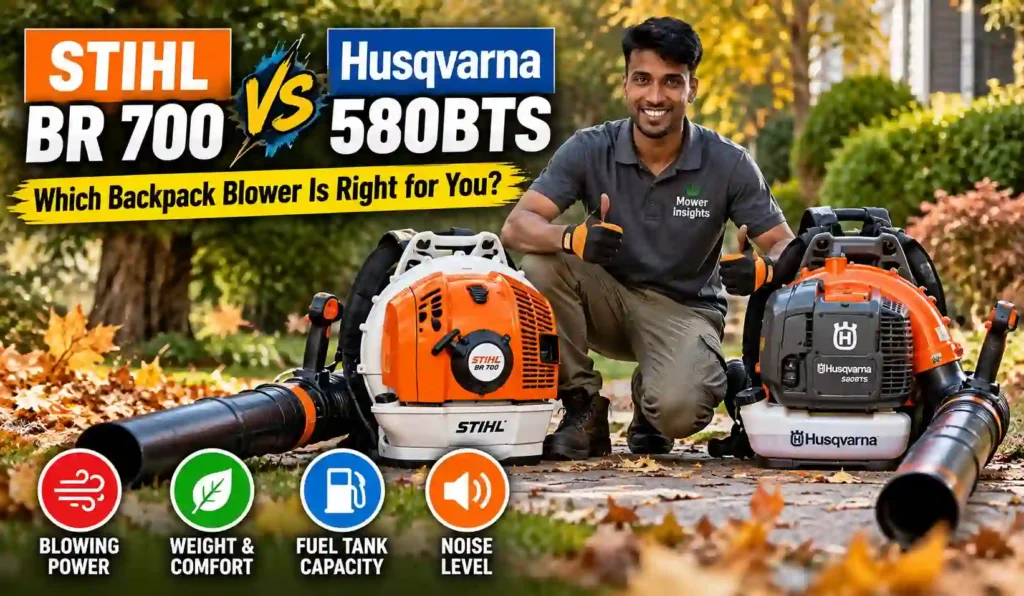
STIHL BR 700 vs Husqvarna 580BTS is the matchup many buyers land on when they want a pro-grade gas backpack blower for a big yard.
Both machines are built for long jobs and heavy debris. Each one makes a different trade. The Husqvarna pushes harder and holds more fuel. The STIHL weighs less and carries easier.
Every number below comes from manufacturer spec sheets. We also explain what each number means once the blower is on your back.
STIHL BR 700 vs Husqvarna 580BTS: Quick Verdict
The STIHL BR 700 wins on comfort, and the Husqvarna 580BTS wins on raw power and price. Neither is a bad pick. In our scoring, the BR 700 earns 8.4 out of 10 and the 580BTS earns 8.2 out of 10. Your debris type and carry time decide the winner.
| STIHL BR 700 | Husqvarna 580BTS | |
|---|---|---|
| MowerInsights Rating | 8.4/10 | 8.2/10 |
| Price | $729.99 | $649.99 |
| Best for | Long days, lower weight | Wet leaves, big piles |
| Top pro | Lighter by 3.4 lb | 47 N of blow force |
| Top con | Smaller fuel tank | Heavier, especially when full |
STIHL BR 700 vs Husqvarna 580BTS Specs Side by Side
The 580BTS leads on power, air speed, and fuel capacity. The BR 700 leads on weight and sound rating. Both run on a fuel and oil mix and both are sold as backpack blowers for professional use. Here is every main spec in one table.
| Spec | STIHL BR 700 | Husqvarna 580BTS |
|---|---|---|
| Engine | 64.8 cc, 4-MIX | 75.6 cc, X-Torq 2-stroke |
| Engine power | 3.8 hp | 4.59 hp |
| Air volume at nozzle | 912 CFM | 1,000 CFM |
| Max air speed | 197 mph | 220 mph |
| Blow force | 35 N | 47 N |
| Dry weight | 23.4 lb | 26.8 lb |
| Fuel tank | 47.3 fl oz | 87.9 fl oz |
| Sound rating | 75 dB(A) | 79 dB(A) at about 50 ft |
| Throttle | Multi-function control handle | Tube-mounted, with cruise control |
| Price | $729.99 | $649.99 |
Prices may vary by retailer and change over time.
How to Read Blower Specs Without Getting Fooled
Compare blowers at the nozzle, at max speed, and with the same sound method. Spec sheets mix measuring points, and that makes one blower look better or worse than it is. Four traps catch most buyers.
Trap 1: CFM at the nozzle vs in the housing. CFM means cubic feet per minute, the volume of air the blower moves. Husqvarna lists 1,200 CFM inside the housing and 1,000 CFM in the pipe. Only the nozzle number matters, so compare 1,000 against 912.
Trap 2: Average speed vs max speed. STIHL has listed the BR 700 at 165 mph average and 197 mph maximum. Husqvarna lists 220 mph at the round nozzle, which is a maximum. Compare max against max.
Trap 3: Old 580BTS versions. Earlier versions of the 580BTS were listed at 908 CFM and 941 CFM. The current model is listed at 1,000 CFM. Check the model tag on the machine before you trust a spec sheet.
Trap 4: Mixed noise numbers. Some online comparison sheets show noise numbers above 100 dB for both blowers. Those figures use a different measuring method than the manufacturer ratings in the table above. Do not mix the two.
A simple way to think about it: CFM is the width of a broom, and mph is how hard you push it. Blow force in newtons (N) combines both into one number.
Comfort and Build Quality: Which Blower Carries Better?
The STIHL BR 700 carries better, and the gap grows once you add fuel. It weighs 23.4 lb dry, against 26.8 lb for the Husqvarna 580BTS. A full tank adds about 2.3 lb to the BR 700 and about 4.2 lb to the 580BTS. That puts them near 25.7 lb and 31 lb loaded.
Those loaded weights are MowerInsights estimates. We used about 6 lb per gallon of gas and the listed tank sizes.
STIHL BR 700
- What worked: An anti-vibration system and an adjustable harness spread the load across your shoulders and back.
- What worked: The tube length and control handle adjust with a lever, with no tools.
- What worked: The rounded body is less likely to snag on branches in tight beds.
- What didn’t: The small tank means more refuel stops, which cuts into the weight advantage.
Husqvarna 580BTS
- What worked: A ventilated, load-reducing harness with a padded hip belt moves weight onto your hips.
- What worked: Cruise control lets you release the trigger on long, open runs.
- What didn’t: It is the heavier machine, and the full-tank weight is close to 31 lb.
Comfort and Build: STIHL BR 700 9.0/10, Husqvarna 580BTS 7.5/10
Best for: Anyone who wears a blower for two hours or more at a time should lean toward the BR 700.
Blowing Power: Which Blower Moves More Debris?
The Husqvarna 580BTS is the stronger blower. It moves 1,000 CFM at up to 220 mph for 47 N of force. The STIHL BR 700 moves 912 CFM at up to 197 mph for 35 N. That is about 34% more blow force, 10% more air, and 12% more speed for the 580BTS.
The force gap is the number to watch. Wet, matted leaves and stuck debris respond to force more than to air volume.
STIHL BR 700
- What worked: 912 CFM is enough to clear wet leaves and heavy debris, which STIHL names as the target job for this model.
- What worked: At 35 N, it is STIHL’s most powerful backpack blower in the line.
- What didn’t: Packed, wet leaf mats take more passes than they do with the 580BTS.
Husqvarna 580BTS
- What worked: 47 N of force lifts wet leaves, pine needles, and stuck debris in fewer passes.
- What worked: Variable speed lets you drop the power near flower beds.
- What didn’t: Full power burns more fuel, so the extra force comes with a cost.
Blowing Power: STIHL BR 700 8.0/10, Husqvarna 580BTS 9.0/10
Best for: Buyers who clear wet leaves, heavy fall drop, or storm debris should pick the 580BTS.
Engine and Fuel Tank: Which Blower Runs Longer?
The Husqvarna 580BTS runs longer between fills because its tank is 1.86 times larger. The tank holds 87.9 fl oz, against 47.3 fl oz for the STIHL BR 700. The BR 700 uses a smaller engine built to sip fuel. Both need a fuel and oil mix.
The STIHL has a 64.8 cc 4-MIX engine. STIHL says it was built for low fuel use and low emissions. At the listed 1.28 liters per hour, the 47.3 fl oz tank (about 1.4 liters) lasts roughly one hour of hard running.
The Husqvarna has a 75.6 cc X-Torq engine. Husqvarna says X-Torq cuts exhaust emissions by up to 60% and raises fuel efficiency by 20% compared with a standard 2-stroke. Husqvarna does not publish hours per tank for this model. A bigger engine burns more fuel, so do not assume the larger tank doubles your run time.
STIHL BR 700
- What worked: A fuel-efficient engine keeps the cost per hour down.
- What didn’t: One hour per tank at hard throttle means refueling several times on a big job.
Husqvarna 580BTS
- What worked: The large tank means fewer stops on all-day jobs.
- What didn’t: The bigger engine uses more fuel per hour.
Engine and Fuel: STIHL BR 700 8.5/10, Husqvarna 580BTS 8.0/10
Best for: Pick the BR 700 if fuel cost matters most. Pick the 580BTS if stopping to refuel slows you down.
Ease of Use: Which Blower Is Simpler to Run?
Both blowers are simple to run, and the BR 700 is a little simpler to start. STIHL adds a semi-automatic choke and a purge pump primer. The primer is built so you cannot flood the engine by pressing it too many times. Husqvarna offers an easy-starting engine and cruise control.
STIHL BR 700
- What worked: All controls sit on one multi-function handle, so your hand never leaves the grip.
- What worked: The start routine has fewer steps, with less risk of flooding.
- What didn’t: The handle has more settings to learn than a plain trigger.
Husqvarna 580BTS
- What worked: A tube-mounted throttle with cruise control is easy to learn.
- What didn’t: The heavier machine takes more effort to lift onto your back and to set down.
Ease of Use: STIHL BR 700 8.5/10, Husqvarna 580BTS 8.0/10
Best for: First-time pro-grade buyers will find the BR 700 start routine more forgiving.
Maintenance: Which Blower Is Easier to Keep Running?
The Husqvarna 580BTS asks for slightly less filter care, and the STIHL BR 700 is simple to maintain. The 580BTS has a two-stage air filter and an Air Injection system that spins larger dust out before it reaches the filter. Husqvarna says this means fewer filter cleanings in dusty yards.
Both blowers need the same basic care. Use fresh, correctly mixed fuel. Clean the air filter. Check the spark plug. Husqvarna lists a spark plug electrode gap of 0.03 in for the 580BTS.
In a repair shop, a gas blower that will not start usually comes back to old fuel or a clogged filter. Drain the tank before winter storage on either machine.
STIHL BR 700
- What worked: A short, plain service routine with common wear items.
- What didn’t: Dusty yards mean more frequent filter checks.
Husqvarna 580BTS
- What worked: Two-stage filtration and Air Injection extend the time between filter cleanings.
- What didn’t: A heavier, larger machine is bulkier to store and move around.
Maintenance: STIHL BR 700 8.0/10, Husqvarna 580BTS 8.5/10
Best for: Owners in dusty, dry climates, such as Texas or the Southwest, will value the 580BTS filter system.
Scorecard: STIHL BR 700 vs Husqvarna 580BTS Ratings
The BR 700 scores 8.4 out of 10 and the 580BTS scores 8.2 out of 10. Each overall score is the average of five category scores. The gap is small, so treat the result as a tie broken by comfort. These are MowerInsights editorial scores based on spec comparison and review of owner feedback.
| Category | STIHL BR 700 | Husqvarna 580BTS |
|---|---|---|
| Comfort and Build | 9.0 | 7.5 |
| Blowing Power | 8.0 | 9.0 |
| Engine and Fuel | 8.5 | 8.0 |
| Ease of Use | 8.5 | 8.0 |
| Maintenance | 8.0 | 8.5 |
| Overall | 8.4 | 8.2 |
Pros and Cons of Each Blower
Each blower has one pro and one con that can change your decision. For the BR 700, the pro is low weight and the con is the small tank. For the 580BTS, the pro is blow force and the con is weight.
| Pros | Cons | |
|---|---|---|
| STIHL BR 700 | Lighter at 23.4 lb. Lower 75 dB(A) rating. Simple start routine. Fuel-efficient engine. | Smaller 47.3 fl oz tank. Less blow force at 35 N. Costs $80 more. |
| Husqvarna 580BTS | 47 N of blow force. 87.9 fl oz tank. Costs $80 less. Strong filter system. | Heavier at 26.8 lb dry. About 31 lb when full. Higher 79 dB(A) rating. |
Who Should Buy the STIHL BR 700?
Buy the BR 700 if you carry the blower for hours and your debris is mostly dry or lightly wet. It rewards comfort and lower weight. These situations fit it best:
- You blow for two hours or more at a time and feel shoulder or back fatigue.
- Your yard is one acre or more, but the debris is mostly dry leaves and grass clippings.
- Neighbors are close, and a lower sound rating matters to you.
- You want a simple start routine and lower fuel use.
Who Should Buy the Husqvarna 580BTS?
Buy the 580BTS if your yard drops heavy, wet, or packed debris and you want fewer fuel stops. It rewards raw power. These situations fit it best:
- Your property has heavy tree cover, pine needles, or wet fall leaves that stick to the ground.
- You want the biggest tank so you refuel less during a long job.
- You want the lower price and the extra force.
- You run a crew and want a machine built for the longest working hours.
Neither blower suits a small lot. For a yard under half an acre, a handheld or cordless blower is lighter and costs less.
STIHL BR 700 vs Husqvarna 580BTS Price and Value
The Husqvarna 580BTS is the better value on paper. It costs $649.99, against $729.99 for the STIHL BR 700. That is $80, or about 11%, less for a machine with more blow force. The BR 700 earns its higher price with lower weight and a simpler start routine.
| Value measure | STIHL BR 700 | Husqvarna 580BTS |
|---|---|---|
| Price | $729.99 | $649.99 |
| Price per newton of blow force | About $20.86 | About $13.83 |
The price per newton is a MowerInsights calculation. It divides the price by the listed blow force. By that measure, each newton of force costs about $7 less on the 580BTS.
Prices may vary by retailer and change over time.
FAQs
Which is better, the STIHL BR 700 or the Husqvarna 580BTS?
The Husqvarna 580BTS is better for power and price, and the STIHL BR 700 is better for comfort. The 580BTS gives 47 N of force against 35 N. The BR 700 weighs 3.4 lb less. Choose by the debris you clear and the time you carry the blower.
Is the Husqvarna 580BTS louder than the STIHL BR 700?
Yes, by the manufacturer ratings. Husqvarna lists 79 dB(A) at about 50 feet. STIHL lists 75 dB(A). A gap of 4 dB is noticeable but small. Wear hearing protection with either machine.
How much does each blower weigh?
The STIHL BR 700 weighs 23.4 lb dry. The Husqvarna 580BTS weighs 26.8 lb dry. With a full tank, we estimate about 25.7 lb and 31 lb. Gas adds weight, and the 580BTS tank holds almost twice as much.
What does 4-MIX mean on the STIHL BR 700?
4-MIX is STIHL’s name for its engine design. It is built to cut fuel use and emissions. It still runs on a fuel and oil mix, like the 580BTS, so you mix fuel for both machines.
How long does a tank last on each blower?
The STIHL BR 700 lasts roughly one hour at hard running, based on its listed fuel use of 1.28 liters per hour and a tank of about 1.4 liters. Husqvarna does not publish run time for the 580BTS. Expect longer than the BR 700, but not double.
Are these blowers good for homeowners?
Yes, for large properties. Both are professional-grade blowers, and both are heavy and loud for a small lot. They fit homeowners with an acre or more, or with heavy leaf and debris loads.
What is a cheaper Husqvarna option close to the BR 700?
The Husqvarna 570BTS is worth a look. Husqvarna lists it at 65.6 cc, 972 CFM, and 37 N of blow force. That is close to the 912 CFM and 35 N of the BR 700. Check the current price, since it can change.
Final Verdict
Choose the STIHL BR 700 if you carry the blower for long stretches and want lower weight, a lower sound rating, and an easy start. Choose the Husqvarna 580BTS if you clear wet, heavy debris and want 47 N of force, a large tank, and an $80 lower price. For most large-yard homeowners, the BR 700 is the easier machine to live with. For storm cleanup and heavy fall drop, the 580BTS is the stronger tool.
Why Trust This Guide
MowerInsights is run by Siddik Kazi, who also repairs and services lawn equipment in a workshop in Italy. That repair work is where the maintenance advice in this guide comes from.
For this comparison, we used the manufacturers’ own spec sheets and published product pages for every number. We then checked those numbers against each other and flagged where measuring methods differ. Scores are MowerInsights editorial judgments, and fuel weights and value figures are our own calculations.
Pingback: Best Lawn Mowers for Wet or Humid Climates (2026)