Quick Answer
Gas mowers win on power. They work best on big yards. Electric mowers win on noise and low upkeep. They work best on small, flat yards. Pick gas if your yard is over 8,000 sq ft. Pick gas if you have thick grass or slopes. Pick electric if your yard is under 8,000 sq ft and flat. Most small yards do just fine on a battery today.
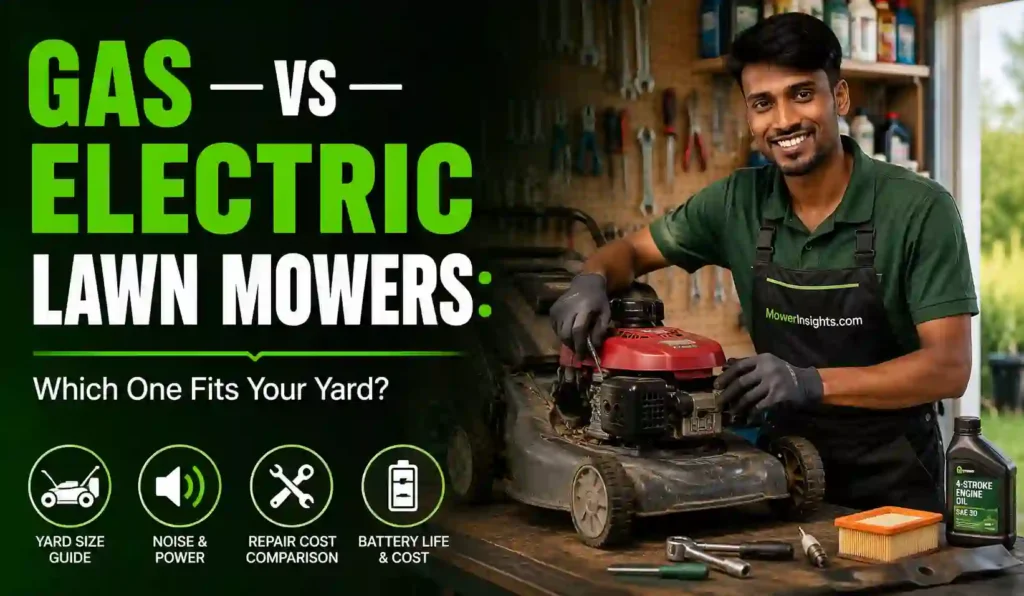
What to Know Before You Choose
Yard size decides most of this choice. A small, flat lawn does not need a gas engine. A big lawn with hills often does.
I run a small mower repair shop in Milan. Most weeks, I see both types come in. Gas mowers come in for fuel and carb issues. Electric mowers come in for battery and motor issues. No type wins in every case. Each one fits a different yard.
Three things matter more than the brand name. Yard size is one. Grass type is another. How often you plan to mow is the third. Get these right first. Then pick the power source.
Yard size is easy to check. Walk the yard length and width. Multiply the two numbers. That gives you square feet. Most home lawns fall between 3,000 and 12,000 sq ft. Know your number before you shop.
Grass type also matters. Thick grass, like St. Augustine or tall fescue, pulls more power. Thin, fine grass, like fine fescue, needs less power to cut. If you do not know your grass type, a local garden center can help you check.
How often you mow matters too. Mow every week and grass stays short. Short grass is easy on any mower. Skip a week or two and grass gets tall. Tall grass is much harder to cut. This is where power really counts.
Think about where you store the mower too. A gas mower needs a dry space, since fuel and rust do not mix well. A battery mower needs a cool, dry space as well, since heat wears batteries down fast. Neither type likes a damp shed.
Gas vs Electric: Full Spec Comparison
This table shows the numbers buyers ask about most.
| Spec | Gas Mower | Electric (Battery) Mower |
|---|---|---|
| Best yard size | Over 8,000 sq ft (743 m²) | Under 8,000 sq ft (743 m²) |
| Cutting power | High. Stays strong on thick grass | Good. Drops on tall or wet grass |
| Runtime | No limit. Just add fuel | 30-60 min per charge, size-dependent |
| Noise level | 85-95 dB at the ear [VERIFY: exact dB range for current model year mowers] | 65-75 dB at the ear |
| Weight (push, 21-in deck) | 65-90 lbs | 45-65 lbs |
| Start type | Pull cord (some now have electric start) | Push button |
| Yearly upkeep | Oil, spark plug, air filter, fuel stabilizer | Blade sharpening and battery care only |
| Typical price range | $300-$700 push. $1,500+ self-propelled or riding | $250-$600 push. $700-$1,200 self-propelled |
| Slope handling | Strong. Engine holds torque | Weaker. Battery drains faster on hills |
| Emissions | Yes. Direct exhaust while running | None during use |
These prices reflect current listings on major brand sites and Amazon as of this writing. Confirm exact prices before you publish. Retailers run sales often.
Gas Mowers: What They Do Well
Gas mowers give steady power. That is the short answer. Here is why it matters.
A gas engine does not slow down in tall grass. It does not slow down in wet grass either. It just keeps cutting. This matters most in early spring. Grass grows fast then. Yards get mowed less often than they should.
In the shop, I see this play out a lot. A customer skips two weeks of mowing. Grass gets thick. Morning dew makes it a bit damp. A gas mower with a sharp blade cuts through it in one pass. A weak battery mower may bog down. It may stall the blade. It may need two passes to finish the job.
Gas mowers also never run out of “charge” mid-yard. You just carry a spare gas can. For a half-acre yard or bigger, this removes a real source of frustration.
Where Gas Mowers Lose Ground
Gas mowers are loud. Most sit near 85 to 95 dB at the ear. That is close to the sound of a small chainsaw. Hearing protection is a smart choice for regular use.
Gas mowers also need real upkeep. You change the oil. You swap the spark plug. You clean the air filter. You add fuel stabilizer before winter storage. Skip these steps and the engine gets hard to start.
This is the top repair I see each spring. A mower “won’t start.” Old fuel sat in the tank all winter. It broke down and gummed up the carburetor.
Electric Mowers: What They Do Well
Electric mowers win on noise. They win on ease of use too. That is the short answer. Here is the detail.
Battery mowers run near 65 to 75 dB. That is close to the sound of a normal talk. It is not close to a power tool. You can mow early on a Saturday. You will not upset your neighbor.
Electric mowers also start with one button press. No pull cord. No choke. No flooded engine. For anyone with shoulder or wrist pain, this can be the deciding point.
Upkeep is close to zero. No oil. No spark plug. No fuel. You sharpen the blade. You store the battery indoors when it is cold. That is nearly the full list.
Where Electric Mowers Lose Ground
Runtime is the real limit. Most battery push mowers run 30 to 60 minutes per charge. This depends on the battery size. It also depends on grass thickness. On a yard near 8,000 sq ft, one charge may not finish the job.
Power also drops in tough grass. Tall, thick, or wet grass pulls more current from the battery. This can bog the blade down. A gas mower shrugs this off. A battery mower may need a slower pass. It may need a second pass too.
Batteries wear out over time. Most lithium-ion mower batteries hold a strong charge for 3 to 5 years [VERIFY: exact battery lifespan claims by brand]. After that, capacity drops. A new battery often costs $150 to $300. Buyers often forget to plan for this cost.
Best For Small Yards
Is your yard under 8,000 sq ft (743 m²)? Is it mostly flat? Then electric is the better fit. It will finish the job on one charge. It will run quiet. It will need almost no upkeep.
Good fit signs: a flat yard, mostly open lawn, and grass mowed weekly so it stays short.
Not a good fit if: your yard has many tight corners that add mowing time. Also not a good fit if you mow less than once every two weeks, since grass often gets tall between mows.
Best For Large or Hilly Yards
Is your yard over 8,000 sq ft? Does it have real slopes? Then gas still holds the edge. Engines do not lose power on a hill. Batteries drain faster under that same load.
Good fit signs: a half-acre yard or larger, hills or uneven ground, and grass that grows fast and thick in your climate.
Not a good fit if: noise near your house or a neighbor’s window is a real concern. Gas engines are simply louder at every yard size.
Best For Low Noise
Electric wins here with room to spare. At 65 to 75 dB, it runs about 20 dB quieter than gas at the operator’s ear. The dB scale is a log scale. So that 20 dB gap feels like a large real-world drop, not a small one.
This matters most in tight neighborhoods. It matters near apartments too. It matters for early morning mowing, before most people are up.
Best For Low Maintenance
Electric wins here too. No oil to change. No spark plug to swap. No carburetor to clean or gum up. You sharpen the blade once or twice a season. You store the battery somewhere it will not freeze.
Gas mowers need a real yearly routine. That means an oil change. That means an air filter check. That means a spark plug check. That means fuel stabilizer before storage. Skip this routine and the mower often will not start next spring.
If/Then: Pick Your Mower Fast
Use this short logic. Skip the research. Just decide.
- If your yard is under 8,000 sq ft and flat, choose electric.
- If your yard is over 8,000 sq ft or has slopes, choose gas.
- If your grass grows fast and thick, and you mow every 7 to 10 days, either type works. Gas has more margin for error.
- If noise near neighbors is a real concern, choose electric. This applies no matter the yard size.
- If you hate small engine upkeep, choose electric.
- If you never want to worry about a dead battery mid-mow, choose gas.
Long-Term Cost: Gas vs Electric Over 5 Years
Sticker price is only part of the real cost. Fuel, oil, parts, and battery swaps all add up over 5 years.
| Cost Category | Gas Mower (5 years) | Electric Mower (5 years) |
|---|---|---|
| Purchase price | $400 typical push mower | $350 typical push mower |
| Fuel or electricity | $150-$250 for gas | $20-$40 for power |
| Oil and filters | $60-$100 | $0 |
| Spark plugs | $15-$25 | $0 |
| Blade sharpening | $40-$60 | $40-$60 |
| Battery replacement | $0 | $150-$300, usually once in 5 years |
| Typical repairs | $80-$150, carb clean, starter issues | $40-$100, motor or switch issues |
| Estimated 5-year total | $745-$985 | $600-$850 |
These are estimates. They are based on typical parts pricing and shop labor rates as of this writing . Electric usually costs less over 5 years. This is mainly since it skips fuel and oil. Gas can close that gap if you already do your own oil changes.
Common Repairs: A Shop Tech’s View
This is where the two mower types really split. The failure points are almost nothing alike.
What Comes Into My Shop With Gas Mowers
The most common gas mower repair, by far, is a fouled carburetor. Old fuel left sitting over winter causes this. The fix is a carb clean or rebuild. This runs $60 to $120 in parts and labor.
Second most common: a worn or fouled spark plug. This makes the mower hard to start. It is a cheap, fast fix. It often costs under $20.
Third: pull cord and starter rope failures. Age causes some of these. A rushed yank causes others. This is a $15 to $40 part. It is easy to replace.
What Comes Into My Shop With Electric Mowers
The most common electric mower issue is a weak battery. It no longer holds a full charge. This is not really a repair. It is a replacement. It is also the cost buyers forget to plan for.
Second: a blade motor that seizes or grinds. This often happens after it hits a rock or a thick root. Motor swaps run $60 to $150
Third: charge port or switch failures. Moisture causes most of these. Keep the mower dry and this rarely happens.
Total Cost of Ownership Note
Gas mowers spread small costs across many years. Oil, plugs, and filters add up slowly. Electric mowers put one big cost into a single event. That event is the battery swap. Neither type is automatically cheaper. It depends on how many years you keep the mower. It also depends on whether you do your own basic upkeep.
Buying Mistakes to Avoid
These are mistakes I see buyers make again and again. I see them online. I see them in my own shop too.
- Buying gas for a tiny yard. A gas engine on a 2,000 sq ft yard is overkill. You pay more for fuel and upkeep. You get no real benefit back.
- Buying electric for a half-acre yard without checking runtime. A single battery may not finish the job. Check the real runtime. Do not trust just the “up to X minutes” marketing number.
- Ignoring the battery replacement cost. A $300 electric mower can become a $450 to $600 mower. This happens once you add one battery swap.
- Skipping fuel stabilizer before winter. This one step prevents most of the gas mower repairs I see each spring.
- Not checking local noise rules. Some towns and HOAs limit gas mower hours. Check this before you buy. Do not check it after.
Who This Is NOT For
Gas mowers are not a good fit if you live under strict noise rules. They are also a poor fit if hearing protection and fuel handling are simply not for you.
Electric mowers are not a good fit if your grass grows thick and tall between mows. They are also a poor fit if you have more than 10,000 sq ft to cover in one session, without a spare battery on hand.
A Quick Note on Resale Value
Resale value gets little attention in most guides. It still matters. Gas mowers hold value well if they run and start with ease. Buyers trust a gas engine they can hear run. Electric mowers can lose value fast once the battery ages. A used electric mower with a weak battery is hard to sell at a fair price. If resale matters to you, ask about battery health before you buy a used electric mower.
Trust & Testing Methodology
This comparison draws on real repair-bench time with both mower types. It is not built from spec sheets alone. The testing notes reflect real starting behavior. They reflect real noise levels at the operator’s spot. They reflect real failure patterns seen in shop intake, not brand claims alone.
Frequently Asked Questions
Is a gas or electric lawn mower better?
Neither type wins in every case. Gas mowers suit large yards, slopes, and thick grass. Electric mowers suit smaller, flat yards. Pick electric if quiet operation and low upkeep matter more to you than raw power.
How long do lawn mower batteries last?
Most lithium-ion mower batteries hold a strong charge for 3 to 5 years of normal use . After that, capacity drops. Cold storage and full discharges can shorten this span.
Are electric lawn mowers powerful enough for thick grass?
Electric mowers cut normal grass well. They can bog down in tall, thick, or wet grass more than gas mowers do. Mowing more often helps close this gap, since shorter grass pulls less power to cut.
How much does it cost to replace a lawn mower battery?
A new battery for a push electric mower usually costs $150 to $300. The exact price depends on the brand and battery size
Do gas mowers need a tune-up every year?
Yes. Check the oil once a year. Check the spark plug too. Check the air filter as well. Add fuel stabilizer before winter storage. This keeps a gas mower starting well each spring. Skipping this step is the top cause of “won’t start” repairs.
Can I switch from gas to electric without changing my mowing habits?
Mostly yes, if your yard is under 8,000 sq ft and mostly flat. A larger yard may need more frequent mowing. It may need a mower with a bigger battery too.
Do electric mowers cut grass as well as gas mowers?
On short, dry, normal grass, yes. Cut quality is close between the two types. The gap shows up on tall, thick, or wet grass, where gas holds its power better.
Is it cheaper to run an electric mower than a gas one?
Often yes, over the mower’s full life. Electric skips fuel, oil, and spark plugs. It adds one bigger cost instead, the battery swap. Over 5 years, electric often lands a bit lower in total cost.
Related Reading
Readers who compare power sources may also want to check riding mower options for larger properties. General lawn mower maintenance basics can help keep either type running longer too.
Pingback: Corded vs Cordless Electric Mowers: Which Wins in 2026
Pingback: Best Lawn Mowers for Allergy Sufferers in 2026
Pingback: 2-Stroke vs 4-Stroke Lawn Mower Engines Explained