Quick Answer
Pick a riding mower if your yard has hills, tight spots, or you are new to power gear. Pick a zero-turn if your yard is flat and one acre or more. A flat yard that size saves real time with a zero-turn. A yard with hills is safer and easier with a riding mower.
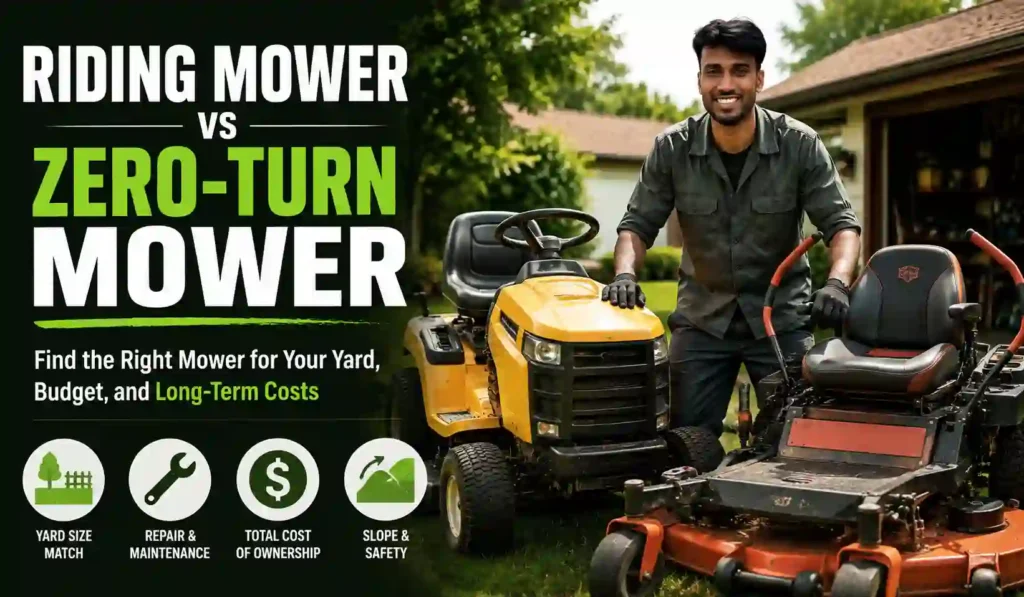
What’s the Real Difference Between These Two Mowers
A riding mower has a wheel. You turn it like a car. A zero-turn has two levers. One lever runs each rear wheel. Each wheel can spin on its own. This lets it turn in place.
This one fact sets up most of the trade-offs. Split-wheel steering is quick. It moves fast around trees and beds. But it is also less stable on a hill. A small move of the lever can send it sideways fast.
Riding mowers use a simple drive train. It is much like a car’s. Fewer parts mean fewer costly fixes. This is true in Siddik’s shop too. Zero-turns use two pumps, one per wheel. This adds cost. It also adds more ways to break.
Riding Mower vs Zero-Turn: Spec Comparison Table
| Spec | Riding Mower | Zero-Turn Mower |
|---|---|---|
| Steering | Wheel, wide turns | Two levers, turns in place |
| Cutting width | 38-46 inches | 42-60 inches |
| Top speed | 4-6 mph | 6-10 mph |
| Best yard size | Up to 1 acre | 1 acre and up |
| Price (new) | $1,800-$3,500 | $3,000-$7,500 |
| Slope handling | Better on 10-15 degree slopes | Not safe past 10 degrees |
| Drive type | Manual, hydro, or auto | Dual hydro pumps |
| Learning curve | Low, like driving a car | Fair, takes 1-2 tries |
| Repair level | Simple parts | More parts, more cost |
| Yearly upkeep cost | $80-$150 | $150-$300 |
These prices come from Cub Cadet, Craftsman, and Husqvarna sites and Amazon, checked in August 2026. Prices move with sales. Check them again before you publish.
Riding Mower: A Closer Look
Pick a riding mower if your yard has hills. Pick it for tight side yards too. Pick it if you are new to power gear. It is the safe first choice.
In the shop, most riding mowers come in for one thing. Worn belts. Worn bearings. Old carb issues. These are cheap fixes. A belt costs $15 to $40. It takes under an hour to swap. Most owners can do it with basic tools.
Expert Tip: The belt often wears out first. This is true on mowers with a hand clutch. Blades still look sharp. But the belt is worn. If you sharpen blades each year, also check belt tension. You may be fixing the wrong part.
Riding mowers hold a straight line on hills. Both rear wheels move at the same speed in a turn. A zero-turn’s wheels can spin at different speeds. This gives it quick turns. But it can also make the back end slide on wet grass.
Fuel and power: most riding mowers run on gas. Battery models are growing too. Ryobi and EGO both make them. A gas mower holds 2 to 3 gallons. It runs 1 to 2 hours per tank. This depends on grass thickness. Battery models cover half an acre to a full acre per charge. This depends on pack size.
Zero-Turn Mower: A Closer Look
Pick a zero-turn if your yard is large and mostly flat. Pick it if you must steer around many trees or beds.
A zero-turn saves time for one main reason. It does not slow down to swing wide. It just turns in place at each tree. On a one-acre yard with a dozen trees, this adds up fast. Week after week.
In the shop, most zero-turns come in for one of three things. Pump failures. Belt wear from high speed. Worn spindles from fast runs on rough ground. These fixes cost more. One wheel motor swap can run $250 to $500 in parts alone. Labor is extra.
Expert Tip: Does a zero-turn pull to one side on a straight pass? Check the fluid level first. Low fluid is the top cause we see. It is a five-minute fix. Not a $400 one.
Most top-end zero-turns run on gas. Battery zero-turns now exist too. Greenworks and EGO both make them. They run 1 to 2 acres per charge. But they cost more than gas models.
Best For X: Match the Mower to Your Yard
- Best for yards under half an acre: A riding mower. A zero-turn’s speed edge barely matters at this size.
- Best for one acre or more, few obstacles: A zero-turn. This is where it saves real time, often cutting mow time by 30-40%.
- Best for slopes over 10 degrees: A riding mower. Most makers cap safe zero-turn use at 10-15 degrees.
- Best for a first-time owner: A riding mower. It drives more like a car. A zero-turn can take a try or two to learn.
- Best for low upkeep: A riding mower. Fewer hydraulic parts means fewer costly failures.
- Best budget pick: A riding mower. It costs less to buy and less to keep up.
Head-to-Head Decision Steps
Is your yard under one acre and mostly flat?
Either mower works. A riding mower costs less to buy. It also costs less to keep up.
Is your yard over one acre and mostly flat?
A zero-turn will save real time each week. It is worth the higher price.
Does your yard have any slope past 10 degrees?
Pick a riding mower. This is a safety point. Not just a taste.
Is your yard small but full of beds and trees, and flat?
A zero-turn can still save time. Just plan for a longer learning curve.
Do you plan to fix your own mower?
A riding mower’s simple drive is easier to work on. Basic tools will do the job.
Slopes and Safety: The Part Most Sites Skip
Most sites say zero-turns “are not great for hills.” They do not say why. They do not say at what angle risk starts. Here is the real cause. A zero-turn’s wheels can spin at different speeds in a turn. This gives it less grip than a mower with locked-speed rear wheels. On wet grass, or a slope past 10 to 15 degrees, this can lead to real roll risk. It is not just a theory.
Riding mowers are not risk-free on hills either. But their turn style gives you more warning before a slide starts. Not sure about your yard’s slope? Check it with a slope tool. A phone level app works too. Do this before you buy. A slope past 15 degrees is often a job for a push mower or a lawn crew. Not a rider of either kind.
Long-Term Cost: What You’ll Really Pay
Price at the store is just part of the cost. Here is what five years of use tends to run, based on the fixes we see most.
| Cost Type | Riding Mower (5-yr est.) | Zero-Turn (5-yr est.) |
|---|---|---|
| Store price | $1,800-$3,500 | $3,000-$7,500 |
| Routine care (oil, filters, blades) | $400-$750 | $750-$1,500 |
| Belt or spindle swaps | $75-$200 | $150-$400 |
| Big repair (pump, drive) | $150-$400 (rare) | $250-$600 (more common) |
| 5-year total (est.) | $2,425-$4,850 | $4,150-$10,000 |
These numbers come from shop prices near Milan in 2026. They will shift by area, brand, and how well you care for the mower. Regular oil changes cut down on big repairs. Sharp blades help too. This is true for both types.
Resale value often runs higher in raw dollars for zero-turns. They start at a higher price, so this makes sense. But as a share of store price, a well-kept riding mower can hold its value just as well. Demand for used riding mowers stays steady at the low end of the market.
Common Buyer Mistakes
- Picking by deck width alone. A wide deck cuts fast in open space. But it is harder to steer around things. This is true on either mower. Match deck width to how open your yard really is.
- Skipping the slope check. Buyers measure yard size. They skip slope angle. Angle matters more for safety on a zero-turn than size does.
- Not planning for the learning curve. New zero-turn owners think they will mow well on day one. Give it one or two tries in open space first. Then trust it near trees or beds.
- Ignoring part access. Some off-brand models use parts that are hard to find. In the shop, this is the top cause of long repair waits.
Who This Guide Is NOT For
If your yard is under a quarter acre, skip both mower types. A good push mower or self-propelled mower will do the job just as fast, for far less money and far less upkeep.
If quick, split hand control is hard for you, a zero-turn asks more of your hands than a riding mower does. A riding mower or a robot mower may work better for you.
Frequently Asked Questions
Is a zero-turn mower faster than a riding mower?
Yes, in open space. Zero-turns run 6-10 mph. Riding mowers run 4-6 mph. The zero-turn’s tight turns also cut down on slow-downs near trees or beds.
Can a zero-turn mower handle a slope?
Most makers say no past 10-15 degrees, due to slide risk. A riding mower tends to hold its line better on a mild slope.
Which costs less to keep up, a riding mower or a zero-turn?
A riding mower, in most cases. It has fewer hydraulic parts. Expect $400-$750 in care costs over five years, versus $750-$1,500 for a zero-turn.
How big should my yard be to make a zero-turn worth it?
About one acre. That is the point where a zero-turn’s speed edge starts to beat its higher price for most owners.
Is a zero-turn hard to learn?
A bit, yes. Most new owners need one or two tries in open space to get used to the dual levers before they mow near trees or beds.
Do riding mowers or zero-turns hold value better?
Zero-turns often hold more in raw dollars, since they cost more up front. Riding mowers often hold a similar share of their store price at resale.
Pingback: Best Zero-Turn Mowers for Beginners in 2026
Pingback: Best Riding Lawn Mowers for 1-3 Acres in 2026